
Business Loan Terms Explained: APR vs Flat Rate vs Comparison Rate for Australian Borrowers
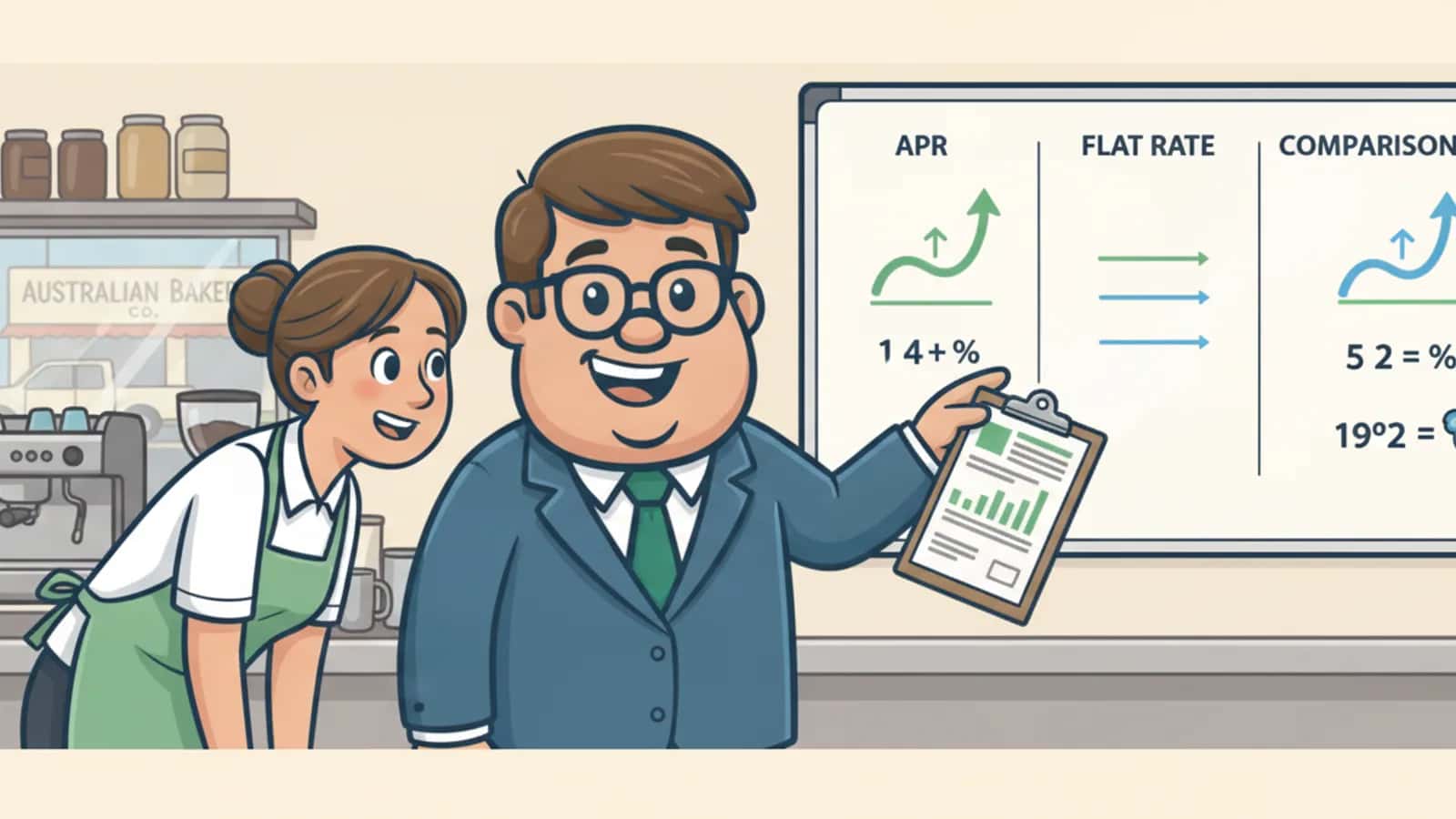
APR (Annual Percentage Rate), flat rate, and comparison rate are three different ways lenders express the cost of a business loan — and they don't mean the same thing. The advertised rate is almost never the full picture.
Quick answer
APR (Annual Percentage Rate), flat rate, and comparison rate are three different ways lenders express the cost of a business loan — and they don't mean the same thing. The advertised rate is almost never the full picture. Understanding how each rate works is the fastest way to avoid overpaying and compare offers on a level playing field.
Key takeaways
- Flat rates look lower but cost more. A 10% flat rate on a $100,000 loan is not the same as a 10% APR — the flat rate applies to the original balance, not the reducing balance, so you pay more interest overall.
- Comparison rates include fees. They're the closest thing to a true cost figure, but they still have limits — especially for business loans, where fee structures vary widely.
- APR reflects the reducing balance. It's a more accurate measure of annual cost than a flat rate, but it still won't capture every fee.
- Unsecured business loans in Australia currently range from 8.5% to 24% per annum as of June 2026, while secured loans range from 6.5% to 14% per annum.
- Small businesses pay more than larger ones. The RBA reported that in April 2026, the average rate for small businesses was 7.26% p.a. versus 5.95% for medium businesses.
- 88.2% of outstanding business finance in Australia is on variable rates as of January 2026.
- Hidden fees — establishment, monthly, early repayment — can add thousands to the real cost of a loan.
- Bad credit doesn't automatically disqualify you. Specialist lenders assess trading history and revenue, not just credit scores.
- A 2-minute eligibility check with a platform like Funding Fred can compare multiple lenders without a hard credit search.
What Exactly Is APR and How Is It Different From Flat Rate
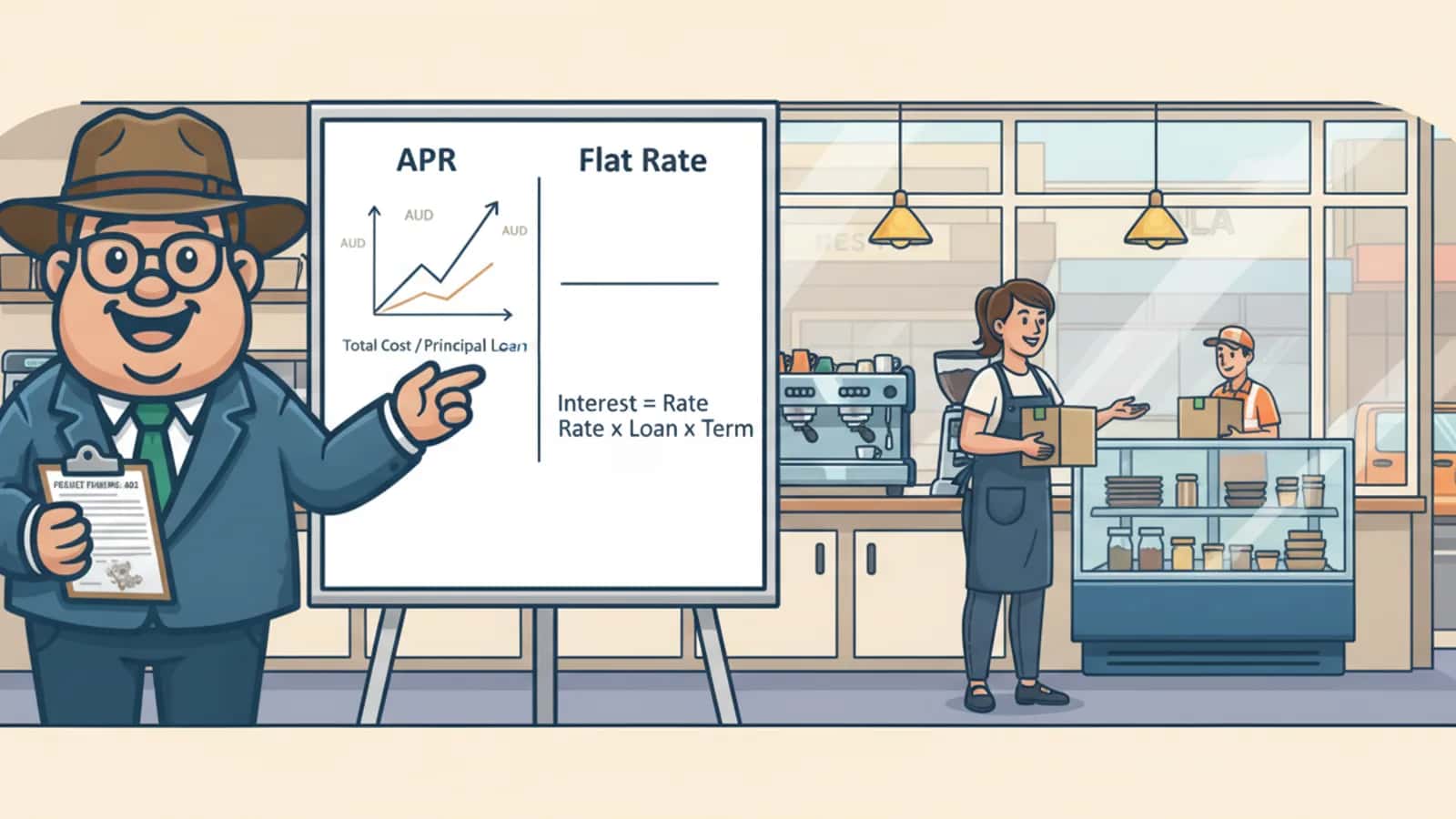
APR (Annual Percentage Rate) measures interest against the outstanding (reducing) loan balance each year. A flat rate applies interest to the original loan amount for the entire term — even as you pay it down. That distinction matters enormously in practice.
Here's a worked example:
$50,000 loan over 2 years
Flat Rate
- Stated Rate
- 10%
- Actual Interest Paid
- $10,000
- Effective APR
- ~18–19%
APR
- Stated Rate
- 10%
- Actual Interest Paid
- ~$5,500
- Effective APR
- 10%
With a flat rate, you're charged 10% on $50,000 every year — even in month 23 when you've already repaid most of the principal. With APR, interest is calculated on what you actually owe at any given point.
Choose APR-based loans if you want a clear, like-for-like comparison across lenders. Choose flat rate products cautiously — they're common in short-term and invoice finance, but get the full cost in dollar terms before signing.
How Do Comparison Rates Work for Small Business Loans in Australia

A comparison rate bundles the interest rate and most standard fees into a single annual percentage figure. It was designed to stop lenders from advertising a low headline rate while burying fees in the fine print.
For consumer loans, comparison rates are legally required under the National Credit Code. For business loans, the rules are less strict — lenders may include a comparison rate voluntarily, but the methodology can vary.
What a comparison rate typically includes
- The base interest rate
- Establishment/application fees
- Monthly or annual account-keeping fees
What it often excludes
- Early repayment fees
- Redraw fees
- Valuation or legal fees (on secured loans)
- Merchant cash advance factor rates (a completely different structure)
Practical rule: If a lender shows a comparison rate significantly higher than their advertised rate, that gap represents fees. A 9% advertised rate with a 14% comparison rate means roughly 5% of the loan value is going to fees annually. That's worth investigating before you proceed.
For a broader breakdown of what business borrowing actually costs, see this guide to business loans, costs, and eligibility.
Which Type of Loan Rate Will Save the Most Money
The rate structure that saves the most money depends on your loan term, repayment schedule, and how fees are structured. For longer terms (2+ years), APR-based loans almost always cost less than flat rate equivalents. For very short terms (under 6 months), the difference narrows.
Quick decision guide
- Short-term cash flow gap (under 6 months): Factor rate or flat rate products may be fine — get the total repayment figure in dollars and compare directly.
- Medium-term investment (1–3 years): APR-based loans with a low comparison rate are usually the better deal.
- Long-term asset purchase (3+ years): Secured loans with fixed APR and minimal fees will typically offer the lowest total cost.
As of June 2026, secured business term loans from major banks range between 7.5% and 9.5% per annum, while unsecured loans from specialist lenders can run from 8.5% to 24% per annum. The gap between secured and unsecured reflects lender risk — not necessarily product quality.
Don't chase the lowest rate in isolation. A 7.5% secured loan that takes 8 weeks to approve and requires a property guarantee may cost a hospitality business more in lost opportunity than a 15% unsecured loan funded in 48 hours.
What Hidden Fees Should You Watch Out For in Business Loan Terms
The advertised rate is rarely the full cost. These are the fees most likely to inflate what you actually pay:
- Establishment fee:
- Charged upfront, typically 1–3% of the loan amount. On a $200,000 loan, that's $2,000–$6,000 before you've made a single repayment.
- Monthly account-keeping fee:
- Can be $10–$50/month — small individually, but $600/year on a 3-year loan adds up.
- Early repayment fee:
- Some lenders charge a penalty if you pay off early. This can wipe out any interest savings from refinancing.
- Missed payment fee:
- Usually $25–$75 per occurrence, but some lenders also trigger a rate increase.
- Valuation and legal fees:
- Common on secured loans. Budget $500–$2,000 for a property valuation alone.
- Broker or origination fee:
- Some brokers charge a separate fee on top of the lender's establishment fee.
Edge case to watch: Some lenders advertise "no establishment fee" but build the equivalent cost into a higher interest rate or a mandatory insurance product. Always ask for the total cost of the loan in dollar terms over the full term.
Am I Eligible for a Business Loan If I'm a Startup
Most traditional lenders require at least 2 years of trading history, which excludes the majority of startups. Specialist and non-bank lenders often work with businesses that have been trading for as little as 6 months, provided revenue is consistent.
Typical eligibility thresholds across lender types:
Major banks
- Min. Trading Age
- 2–3 years
- Min. Monthly Revenue
- Varies
- Credit Check
- Hard check required
Non-bank lenders
- Min. Trading Age
- 6–12 months
- Min. Monthly Revenue
- ~$5,000–$10,000/month
- Credit Check
- Soft or hard
Merchant cash advance
- Min. Trading Age
- 3–6 months
- Min. Monthly Revenue
- Based on card turnover
- Credit Check
- Often flexible
Platforms like Funding Fred connect businesses with selected Australian finance partners who consider actual trading performance — not just years in operation. The 2-minute eligibility check doesn't trigger a hard credit search, so there's no risk to your credit file just for checking.
Startups under 6 months will find options limited. In that case, look at equipment finance (asset-secured), invoice finance, or government-backed startup grants before taking on high-rate debt.
How Much Can You Typically Borrow, and Does the Rate Structure Change
Loan size directly affects which rate structures are available to you. Smaller loans (under $50,000) are more likely to come with flat rates or factor rates. Larger loans ($250,000+) are more likely to be APR-based with a formal comparison rate disclosed.
The average small business loan amount requested in Australia is approximately $167,272. Most specialist lenders offer unsecured loans from $5,000 to $500,000, while secured facilities can extend to $7.5 million or more.
How loan size affects rate
- Under $50,000: Rates tend to be higher (more admin cost per dollar lent), often 15–24% p.a. unsecured
- $50,000–$250,000: Mid-range, 10–18% p.a. unsecured depending on trading history and sector
- $250,000+: Lower rates available, especially with security or strong revenue history
The RBA's March 2026 cash rate increase to 4.10% has pushed secured bank rates to 7.5–9.5% p.a. Variable rate products — which make up 88.2% of outstanding business finance — will continue to move with the Bank Bill Swap Rate (BBSW), which rose from 3.5475% in January 2026 to 4.30% by June 2026.
What Are the Most Common Mistakes When Comparing Business Loan Rates
The biggest mistake is comparing rates without accounting for structure. A flat rate and an APR are not the same number, and treating them as equivalent can lead to a decision that costs tens of thousands more than expected.
Other common errors:
- Ignoring the comparison rate. The headline rate looks great; the comparison rate tells the real story.
- Not asking for the total repayment figure. Always ask: "What is the total amount I will repay over the full term, including all fees?"
- Choosing the longest term to lower repayments. A longer term reduces monthly payments but increases total interest paid significantly.
- Assuming variable is always cheaper. Variable rates are lower today but carry rate-rise risk. With the BBSW up sharply in 2026, that risk is real.
- Not comparing at least 3 lenders. One offer is not a market. Get multiple quotes before committing.
- Overlooking early repayment penalties. If your cash flow improves and you want to pay off early, a penalty clause can make that expensive.
For more guidance on navigating your options, the Australian Business Loan Guides cover specific scenarios across industries and loan types.
Can I Get a Business Loan With Bad Credit
Yes — but the rate will be higher, and the lender pool is smaller. Major banks typically require a clean credit history. Specialist and non-bank lenders assess the full picture: revenue, trading age, industry, and cash flow consistency.
What "bad credit" actually means to a lender
- Defaults or judgements on your credit file: significant but not always disqualifying
- Low personal credit score: weighted less heavily by non-bank lenders
- Previous business insolvency: harder to work around, but not impossible after 2+ years of clean trading
Platforms that work with All Credit Types — like Funding Fred — match businesses to specialist partners based on the full business profile, not just the credit score. The key is demonstrating consistent revenue and a viable business model.
Practical tip: Before applying anywhere, check your credit file via a free service (Equifax, Illion, or Experian). Errors are common and can be disputed. A corrected file can improve your rate offer.
What Documents Do You Need to Qualify for a Business Loan
The documentation required depends heavily on the lender and loan size. Non-bank lenders have streamlined this significantly compared to major banks.
Typical requirements by lender type:
| Document | Major Bank | Non-Bank Lender |
|---|---|---|
| 2 years financial statements | ✅ Required | Often not required |
| 6 months bank statements | ✅ Required | ✅ Usually required |
| Tax returns (2 years) | ✅ Required | Sometimes |
| Business activity statements | ✅ Required | Sometimes |
| Director ID / ABN verification | ✅ Required | ✅ Required |
| Property details (secured loans) | ✅ Required | N/A (unsecured) |
For unsecured loans under $150,000, many specialist lenders only need 3–6 months of bank statements and ABN/ACN verification. The process is faster and the paperwork is lighter.
How Quickly Can You Get Approved for a Business Loan
With a specialist non-bank lender, approval can happen within 24–48 hours of submitting documents. Major banks typically take 2–6 weeks for a business loan decision.
Speed matters. A Melbourne café that needs a cool room replaced before summer can't wait 6 weeks. A Brisbane tradie who lands a large contract and needs to buy equipment this week can't afford a bank's timeline.
Typical approval timelines:
- 1
Major banks
2–6 weeks (often longer for secured loans)
- 2
Non-bank lenders (via platforms)
24–48 hours
- 3
Merchant cash advances
Same day to 24 hours
The Funding Fred eligibility check takes 2 minutes. No hard credit search. No obligation to proceed. If you qualify, you'll be matched with selected Australian finance partners and can have a decision fast — sometimes funded by the next business day.
How Do Interest Rates Differ by Business Size and Industry
Smaller businesses consistently pay higher rates than larger ones. The RBA reported that in April 2026, small businesses paid an average of 7.26% p.a. versus 5.95% for medium businesses. This gap reflects perceived risk, not a deliberate penalty.
Industry also affects rate offers
- Low-risk sectors (professional services, established retail, healthcare): tend to attract better rates
- Higher-risk sectors (hospitality, construction, early-stage e-commerce): lenders price in sector volatility
- Seasonal businesses (tourism, agriculture): may face tighter terms due to uneven cash flow
Non-bank lenders often have more nuanced sector assessments than major banks, which apply blanket criteria. A Gold Coast hospitality business with strong summer revenue but quiet winters may be declined by a bank but approved by a specialist partner who understands the trading pattern.
Your Apples-to-Apples Checklist for Comparing Business Loan Offers
Before signing anything, run every offer through this checklist:
- [ ] What is the total repayment amount in dollars over the full term?
- [ ] Is the rate quoted as APR, flat rate, or factor rate? Convert to APR if needed.
- [ ] What is the comparison rate (if disclosed)?
- [ ] What fees apply: establishment, monthly, early repayment, missed payment?
- [ ] Is the rate fixed or variable? If variable, what index does it track?
- [ ] What is the repayment frequency (daily, weekly, monthly)?
- [ ] Are there any security requirements (property, equipment, personal guarantee)?
- [ ] What happens if you want to repay early?
- [ ] How long until funds are in your account?
A lender who can't answer all of these questions clearly is a lender worth avoiding.
Next steps
Advertised rates are a starting point, not a final answer. The difference between a flat rate and an APR can mean paying nearly double the interest on the same loan. A comparison rate closes some of that gap, but fees outside the formula still matter. The only reliable comparison is total cost in dollars, across the full term, with all fees included.
For Australian small business owners in 2026, the good news is that the market has genuinely expanded. Specialist non-bank lenders now offer fast, flexible funding that major banks simply can't match on speed or criteria. The RBA's current rate environment means borrowing costs are higher across the board — but the right lender, matched to your actual business profile, can still deliver a workable deal.
Next steps:
- Use the checklist above to strip every offer back to total dollar cost.
- Get at least three quotes before committing.
- Check your eligibility in 2 minutes — no hard credit search, no obligation, and access to selected Australian finance partners across the full market.
Business Funding. Made Simple.
Further reading
Frequently asked questions
What Exactly Is APR and How Is It Different From Flat Rate?
APR (Annual Percentage Rate) measures interest against the outstanding (reducing) loan balance each year. A flat rate applies interest to the original loan amount for the entire term — even as you pay it down. That distinction matters enormously in practice.
How Do Comparison Rates Work for Small Business Loans in Australia?
A comparison rate bundles the interest rate and most standard fees into a single annual percentage figure. It was designed to stop lenders from advertising a low headline rate while burying fees in the fine print.
Which Type of Loan Rate Will Save the Most Money?
The rate structure that saves the most money depends on your loan term, repayment schedule, and how fees are structured. For longer terms (2+ years), APR-based loans almost always cost less than flat rate equivalents. For very short terms (under 6 months), the difference narrows.
What Hidden Fees Should You Watch Out For in Business Loan Terms?
The advertised rate is rarely the full cost. These are the fees most likely to inflate what you actually pay:
How Much Can You Typically Borrow, and Does the Rate Structure Change?
Loan size directly affects which rate structures are available to you. Smaller loans (under $50,000) are more likely to come with flat rates or factor rates. Larger loans ($250,000+) are more likely to be APR-based with a formal comparison rate disclosed.
What Are the Most Common Mistakes When Comparing Business Loan Rates?
The biggest mistake is comparing rates without accounting for structure. A flat rate and an APR are not the same number, and treating them as equivalent can lead to a decision that costs tens of thousands more than expected.
Written by
The Funding Fred Editorial Team creates plain-English guides to help business owners understand funding options, eligibility, and application readiness before they compare finance options.