
How to Compare Business Loan Rates and Fees: A Step-by-Step Guide for Australian SMEs
Comparing business loan rates and fees in Australia means looking beyond the headline interest rate. You need to weigh the comparison rate, all upfront and ongoing fees, and the total cost of credit over the loan term.

Quick answer
Comparing business loan rates and fees in Australia means looking beyond the headline interest rate. You need to weigh the comparison rate, all upfront and ongoing fees, and the total cost of credit over the loan term. This step-by-step guide for Australian SMEs walks through exactly how to do that — across banks, fintechs, and non-bank lenders — so you can make a genuinely informed decision, not just pick the lowest number on a rate sheet.
Key takeaways
- Headline rates mislead. Always calculate the total cost of credit, including origination fees, monthly admin fees, and early repayment charges.
- Comparison rates exist for a reason. They fold fees into the interest rate to give a more honest picture — use them as your baseline.
- Bank rates are lower on paper but harder to access. Online and non-bank lenders charge more but approve faster and accept a wider range of credit profiles.
- Unsecured loans cost more than secured loans because the lender takes on more risk — that trade-off is often worth it for speed and simplicity.
- Sole traders can qualify for business loans, though criteria vary by lender.
- Average credit is not a dealbreaker with non-bank lenders who assess actual business performance — revenue, trading history, and sector fit matter more.
- Typical approval times range from 24–48 hours with fintechs to 2–6 weeks with major banks.
- The biggest comparison mistake is focusing only on interest rate and ignoring fees that can add thousands to the total cost.
- A 2-minute eligibility check (no hard credit search) is the fastest way to see what you actually qualify for before committing to a full application.
What Are the Different Types of Business Loans in Australia?

Australian SMEs can access several distinct loan structures, each suited to different needs and cash flow profiles. The main types are term loans, lines of credit, equipment finance, invoice finance, and merchant cash advances.
- Term loans
- a lump sum repaid over a fixed period (6 months to 10 years). Best for one-off investments like a fit-out or expansion.
- Business line of credit
- draw funds as needed up to a set limit. Good for managing cash flow gaps.
- Equipment finance
- secured against the asset being purchased. Lower rates because the lender holds security.
- Invoice finance
- advances cash against outstanding invoices. Useful for B2B businesses with slow-paying clients.
- Merchant cash advance (MCA)
- repayments are taken as a percentage of daily card sales. Flexible for hospitality and retail with variable revenue. Funding Fred offers both unsecured loans and MCAs through its panel of specialist partners.
Choose based on purpose: If you need capital fast and don't want to pledge assets, an unsecured term loan or MCA is usually the right fit. If you're buying equipment, asset finance will almost always be cheaper.
How Do Interest Rates Vary Between Banks and Online Lenders?
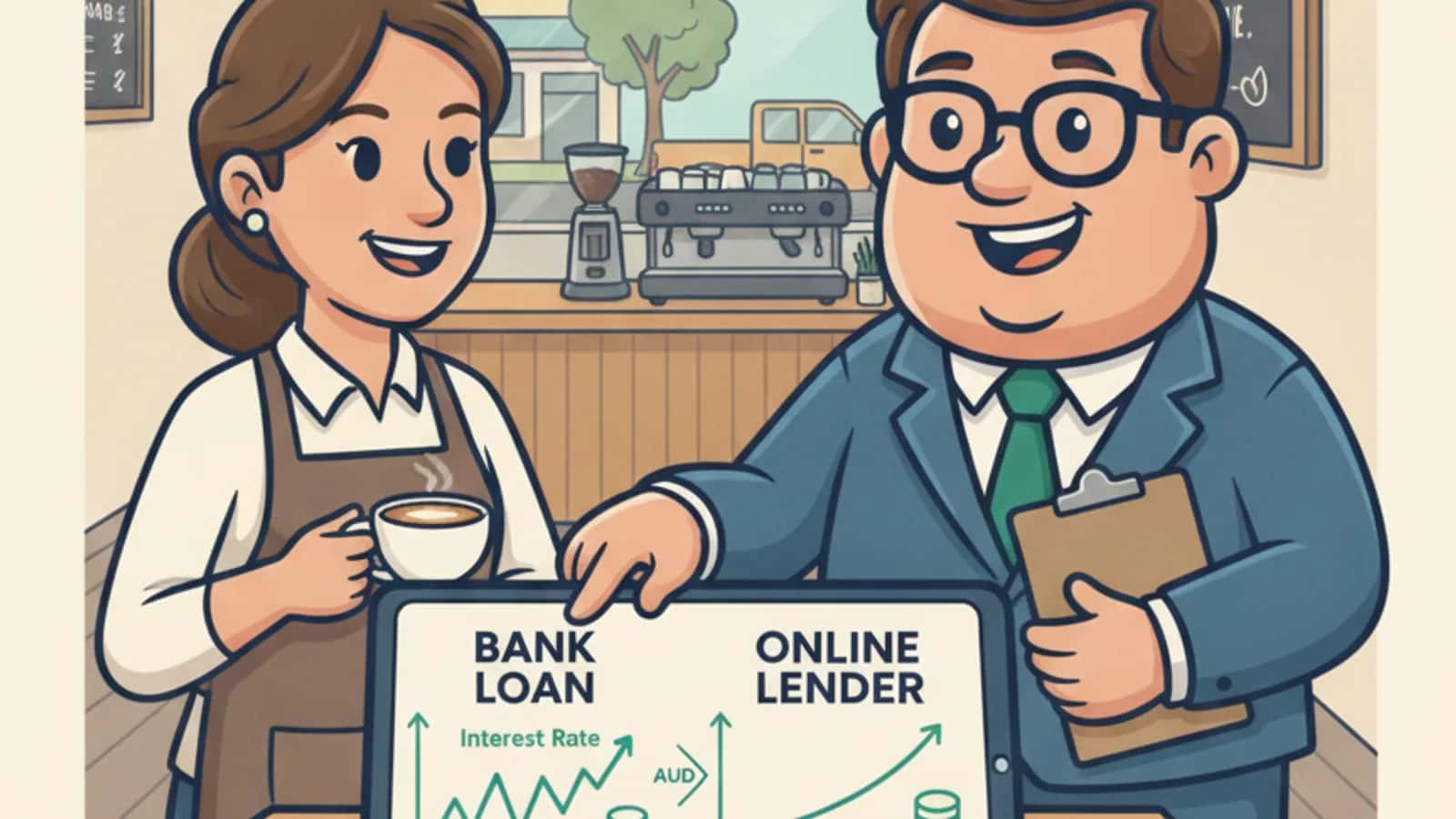
The gap between bank and non-bank rates is real, but so is the gap in accessibility. Major bank business loan rates in Australia currently sit in the range of approximately 7%–12% p.a. for secured products, while online and non-bank lenders typically charge 10%–30%+ p.a. depending on risk profile, loan size, and term.
The RBA's benchmark data shows the average small business variable rate from major banks has tracked between 7% and 9% through early 2026, but that rate is only available to businesses with strong financials, clean credit, and often property as security.
Online lenders price for speed and flexibility. A Brisbane café that's been trading 18 months with solid revenue but no property to offer will pay more than a long-established Sydney law firm — but the café can actually get funded.
Major banks (ANZ, NAB, CBA, Westpac)
- Typical Rate Range
- 7%–12% p.a.
- Approval Time
- 2–6 weeks
- Security Required
- Usually yes
Non-bank / fintech lenders
- Typical Rate Range
- 10%–30%+ p.a.
- Approval Time
- 24–72 hours
- Security Required
- Often no
Credit unions / mutuals
- Typical Rate Range
- 8%–14% p.a.
- Approval Time
- 1–3 weeks
- Security Required
- Varies
*Sources:*
Understanding how broader rate movements flow into your loan cost is worth reading about — this guide on how interest rate swings affect Australian business loans breaks it down clearly.
What Fees Should You Watch Out for When Getting a Business Loan?
Interest rate is only part of the cost. Fees can add hundreds or thousands of dollars to what you actually pay — and they're often buried in the fine print.
Fees to check before signing anything
- Origination / establishment fee — charged upfront to set up the loan. Typically 1%–3% of the loan amount, though some lenders charge a flat fee.
- Monthly administration fee — a recurring charge that compounds over the loan term. Even $30/month adds $360 over a year.
- Early repayment fee (break cost) — charged if you pay out the loan ahead of schedule. Can be significant on fixed-rate products.
- Late payment fee — usually a flat fee per missed payment, plus potential default interest.
- Annual fee — common on lines of credit.
- Valuation fee — applies to secured loans where the lender needs to value your property or assets.
- Broker or referral fee — sometimes charged by intermediaries rather than the lender directly. Understanding the difference between a broker and a direct lender helps you know who's charging what.
The comparison rate framework: In Australia, lenders are required to disclose a comparison rate that includes the interest rate plus most fees, expressed as a single annual percentage. Always compare comparison rates, not headline rates, when evaluating similar products.
How to Compare Business Loan Rates and Fees Step by Step
This is the core framework for making a like-for-like comparison across lenders. Use it as a checklist before committing to any product.
- 1
Define your borrowing need
Nail down the amount, purpose, and ideal repayment term before approaching any lender. Vague applications get generic offers.
- 2
Collect the comparison rate (not just the headline rate)
Ask every lender for their comparison rate on the specific product and term you're considering. This is your apples-to-apples number.
- 3
List all fees
Request a full fee schedule: establishment, monthly admin, early repayment, late payment, and any other charges. Add them up over your expected loan term.
- 4
Calculate total cost of credit
Total cost = (Monthly repayment × number of months) + all fees. This is the only number that tells you what you're actually paying.
- 5
Check the repayment structure
Daily, weekly, or monthly repayments affect your cash flow differently. A lower rate with daily repayments can squeeze a hospitality business harder than a slightly higher rate paid monthly.
- 6
Check for flexibility
Can you make extra repayments? What are the early exit costs? Flexibility has real value if your revenue is seasonal or unpredictable.
- 7
Run a 2-minute eligibility check
Before spending hours on full applications, use a platform like Funding Fred to see which lenders are likely to approve you — no hard credit search, no obligation. Check Eligibility Now.
How Do Secured vs Unsecured Business Loans Differ?
Secured loans require an asset (property, equipment, or inventory) as collateral. Unsecured loans don't. The trade-off is straightforward: secured loans are cheaper but slower and riskier for the borrower; unsecured loans are faster and simpler but cost more.
- Secured:
- Lower rates (often 7%–12% p.a.), larger amounts available, longer terms. Risk: the lender can seize the asset if you default.
- Unsecured:
- Higher rates (often 10%–30%+ p.a.), faster approval (sometimes same day), no asset at risk. Lenders assess revenue and trading history instead.
For most SMEs who need capital quickly — a Gold Coast restaurant needing a kitchen upgrade, a Perth tradie covering a payroll gap — unsecured is the practical choice. Speed and simplicity outweigh the rate difference when the alternative is waiting six weeks for a bank decision.
Am I Eligible for a Business Loan with Average Credit?
Yes — with the right lender. Major banks typically require a strong credit score and clean financial history. Non-bank and fintech lenders assess a broader picture: monthly revenue, time in business, industry, and cash flow patterns.
Most non-bank lenders in Australia will consider applications from businesses with:
- At least 6–12 months of trading history
- Monthly revenue above $5,000–$10,000 (varies by lender)
- An ABN registered in Australia
- A credit score that isn't perfect but shows no recent defaults or bankruptcies
For specific strategies to strengthen your application before you apply, see how to improve your business loan approval chances in Australia.
How Much Can a Small Business Owner Actually Borrow?
Borrowing capacity depends on revenue, trading history, existing debt, and the lender's risk appetite. As a general guide:
- Non-bank lenders:
- typically offer 1–1.5× monthly revenue for unsecured loans, up to $500,000 for well-established businesses.
- Banks:
- may lend higher amounts but require security, detailed financials, and longer trading history.
- Funding Fred's panel:
- covers $5,000 to $7.5 million, matching businesses to the right lender based on actual performance — not just credit score.
Rule of thumb: If your business turns over $50,000/month, an unsecured lender will likely consider up to $50,000–$75,000. Secured products or invoice finance can unlock higher amounts.
What Documents Do You Need to Apply for a Business Loan?
The documentation required varies significantly between lender types. Banks want more; fintechs want less.
Typical requirements for non-bank / fintech lenders
- ABN and ACN
- 3–6 months of business bank statements
- Basic ID (driver's licence or passport)
- Recent BAS statements (sometimes)
Typical requirements for major banks
- 2 years of financial statements (P&L, balance sheet)
- 2 years of tax returns (business and personal)
- Detailed business plan (for larger amounts)
- Property details if applying for a secured loan
- ATO portal access or BAS history
The fintech advantage is real here. An Adelaide retail store owner applied on a Tuesday afternoon through Funding Fred's panel and had funds in the account by Thursday — because the lender only needed bank statements and an ABN, not two years of audited accounts.
Can I Get a Business Loan as a Sole Trader?
Yes. Sole traders are eligible for business loans in Australia, though some lenders treat sole trader applications more like personal loans and apply different criteria. The key is demonstrating consistent business revenue through bank statements and having an active ABN.
For a detailed breakdown of what's available and how to position your application, this guide to business loans for Australian sole traders and micro-businesses covers the specifics.
Which Business Loan Is Best for a Small Startup?
Startups face the hardest path because most lenders want 6–12 months of trading history. Options include:
- Government-backed loans and grants
- (check business.gov.au for current programs)
- Non-bank lenders
- with lower minimum trading requirements
- Merchant cash advances
- for businesses with card sales from day one
- Equipment finance
- where the asset itself is the security
For a full breakdown of startup-specific funding options, this guide on business loans for Australian startups with no track record is worth reading before you apply.
What Are the Biggest Mistakes Entrepreneurs Make When Comparing Loans?
Most comparison mistakes come down to looking at one number instead of the full picture.
- 1
Comparing headline rates instead of comparison rates
a 1% difference in headline rate can be wiped out by fees.
- 2
Ignoring repayment frequency
daily repayments hurt cash flow more than monthly, even at the same rate.
- 3
Not reading the early repayment clause
if you plan to pay off early, a high break cost makes a "cheap" loan expensive.
- 4
Applying to multiple lenders simultaneously
multiple hard credit checks in a short window can lower your score. Use a no-hard-check eligibility tool first.
- 5
Borrowing more than needed
larger loans mean more interest paid, even if the rate is the same.
- 6
Choosing on speed alone
fast approval is valuable, but not if the total cost is twice what a slightly slower option would charge.
For a deeper look at loan terminology that trips up most borrowers, this plain-English guide to APR, comparison rates, LVR, and amortisation is a practical reference.
What Are the Typical Approval Times for Business Loans?
Approval times vary widely and are one of the most important practical factors for SMEs with urgent capital needs.
| Lender Type | Typical Decision Time | Funding Time After Approval |
|---|---|---|
| Major banks | 2–6 weeks | 1–5 business days |
| Non-bank lenders | 24–48 hours | Same day to 2 days |
| Fintech / online platforms | 2–24 hours | Same day to 48 hours |
For businesses that need capital now — not in six weeks — the non-bank and fintech pathway is the only realistic option. Funding Fred's panel of selected Australian finance partners can deliver a fast decision with smart matching to the right lender, without a hard credit check to start.
What Happens If I Can't Repay My Business Loan?
Missing repayments has real consequences, and knowing them upfront is part of responsible borrowing.
- Late fees
- apply immediately on most loans.
- Default interest
- (a higher rate) may kick in after a defined period.
- Credit file impact
- defaults are recorded and affect future borrowing capacity.
- Secured loans:
- the lender can enforce their security and seize the pledged asset.
- Unsecured loans:
- the lender may pursue recovery through debt collection or legal action, but cannot automatically seize assets without a court order.
- Personal guarantees
- many business loans require a personal guarantee, meaning the business owner is personally liable if the business can't repay.
If you're facing repayment difficulty, contact the lender early. Most have hardship provisions and would rather restructure than default. The Australian Financial Complaints Authority (AFCA) is also available if you have a dispute with a lender.
How Do Business Loan Rates Compare to Personal Loan Rates?
Business loan rates from specialist lenders can be competitive with — or lower than — personal loan rates, especially for established businesses with strong revenue. Personal loans in Australia typically range from 6%–20%+ p.a. depending on credit profile.
The key difference is that business loans are assessed on business performance, not just personal credit. A business with strong monthly revenue can often access more capital at a better rate through a business loan than through a personal loan — and the interest may be tax-deductible as a business expense (check with your accountant).
Traditional Banks vs Funding Fred's Specialist Panel
| Factor | Traditional Banks | Funding Fred |
|---|---|---|
| Application time | Hours of paperwork | 2-minute eligibility check |
| Credit check to start | Hard check | No hard check to start |
| Approval time | 2–6 weeks | Fast Decision (24–72 hrs) |
| Criteria | Strict, asset-heavy | Flexible Criteria, all credit types |
| Loan range | Varies | $5k–$7.5m |
| Matching | You apply to one lender | Smart Matching across specialist partners |
| Obligation | Full application required | No obligation to proceed |
Application time
- Traditional Banks
- Hours of paperwork
- Funding Fred
- 2-minute eligibility check
Credit check to start
- Traditional Banks
- Hard check
- Funding Fred
- No hard check to start
Approval time
- Traditional Banks
- 2–6 weeks
- Funding Fred
- Fast Decision (24–72 hrs)
Criteria
- Traditional Banks
- Strict, asset-heavy
- Funding Fred
- Flexible Criteria, all credit types
Loan range
- Traditional Banks
- Varies
- Funding Fred
- $5k–$7.5m
Matching
- Traditional Banks
- You apply to one lender
- Funding Fred
- Smart Matching across specialist partners
Obligation
- Traditional Banks
- Full application required
- Funding Fred
- No obligation to proceed
Business Funding. Made Simple.
Next steps
Comparing business loan rates and fees isn't complicated once you know what to look for. The headline rate is just the starting point. Comparison rates, fee schedules, repayment frequency, and early exit costs all affect what you actually pay — and ignoring any of them is how businesses end up paying far more than they expected.
Actionable next steps:
- Define your need — amount, purpose, and term — before approaching any lender.
- Use comparison rates, not headline rates, as your benchmark across lenders.
- List all fees and calculate total cost of credit for each option.
- Check your eligibility without a hard credit search before committing to a full application.
- Run a 2-minute check through Funding Fred — no paperwork, no hard check, no obligation. See which of the selected Australian finance partners are likely to say yes, and what it'll actually cost.
Check Eligibility Now — it takes two minutes and won't affect your credit score.
Further reading
Frequently asked questions
What Are the Different Types of Business Loans in Australia?
Australian SMEs can access several distinct loan structures, each suited to different needs and cash flow profiles. The main types are term loans, lines of credit, equipment finance, invoice finance, and merchant cash advances.
How Do Interest Rates Vary Between Banks and Online Lenders?
The gap between bank and non-bank rates is real, but so is the gap in accessibility. Major bank business loan rates in Australia currently sit in the range of approximately 7%–12% p.a. for secured products, while online and non-bank lenders typically charge 10%–30%+ p.a. depending on risk profile, loan size, and term.
What Fees Should You Watch Out for When Getting a Business Loan?
Interest rate is only part of the cost. Fees can add hundreds or thousands of dollars to what you actually pay — and they're often buried in the fine print.
How to Compare Business Loan Rates and Fees Step by Step?
This is the core framework for making a like-for-like comparison across lenders. Use it as a checklist before committing to any product.
How Do Secured vs Unsecured Business Loans Differ?
Secured loans require an asset (property, equipment, or inventory) as collateral. Unsecured loans don't. The trade-off is straightforward: secured loans are cheaper but slower and riskier for the borrower; unsecured loans are faster and simpler but cost more.
Am I Eligible for a Business Loan with Average Credit?
Yes — with the right lender. Major banks typically require a strong credit score and clean financial history. Non-bank and fintech lenders assess a broader picture: monthly revenue, time in business, industry, and cash flow patterns.
Written by
The Funding Fred Editorial Team creates plain-English guides to help business owners understand funding options, eligibility, and application readiness before they compare finance options.
Sources
- Interest Rates - [2] Interest Rates - https://www.money.com.au/business-loans/interest-rates [3] Interest Rates Fees Charges - https://www.nab.com.au/important-information/business/interest-rates-fees-charges [4] Business Loan Rates Australia - https://comparisonaustralia.com.au/business-loan-rates-australia/ [6] Unsecured Business Loans - https://www.money.com.au/business-loans/unsecured-business-loans [7] Business Loans - https://www.finder.com.au/business-loans [8] Small Business Loans - https://www.lend.com.au/small-business-loans [9] Australia Sme Business Loans 2026 Guide - https://clarivian.io/blog/australia-sme-business-loans-2026-guide
- business.gov.au finance
- ASIC small business guidance