
Business Loans for Startups in Australia: How to Get Funded with No Track Record
Getting business loans for startups in Australia with no track record is genuinely possible in 2026, but the path rarely runs through a big-four bank. Non-bank lenders, government programs, and specialist finance platforms assess new businesses on revenue potential, business plan quality, and founder credit rather than years of trading history.

Quick answer
Getting business loans for startups in Australia with no track record is genuinely possible in 2026, but the path rarely runs through a big-four bank. Non-bank lenders, government programs, and specialist finance platforms assess new businesses on revenue potential, business plan quality, and founder credit rather than years of trading history. Startups with at least six months of operation and $6,000+ in monthly revenue have the strongest options, but even pre-revenue founders have government-backed routes worth exploring.
Key takeaways
- Non-bank lenders approve startups under 12 months of trading at roughly 31%, compared to 68% for established businesses
- Unsecured loans from $5,000 to $500,000 are available to startups with six months of trading and consistent monthly revenue
- Government programs like the Entrepreneurs' Programme and R&D Tax Incentive can fund early-stage businesses without requiring repayment
- Bank of Melbourne offers a dedicated startup loan of $10,000–$50,000 for ABNs registered under two years, no asset security required
- A solid business plan significantly improves approval odds, especially with bank lenders
- Personal credit history matters more for startups than for established businesses — lenders use it as a proxy for financial responsibility
- Platforms like Funding Fred run a 2-minute eligibility check with no hard credit search, connecting founders with specialist partners across Australia
- Merchant cash advances are a strong fit for startups with card-based revenue but limited trading history
- Grants and co-investment programs (especially for female founders and tech startups) can reduce how much debt a founder needs to take on
What Are the Different Types of Startup Loans in Australia
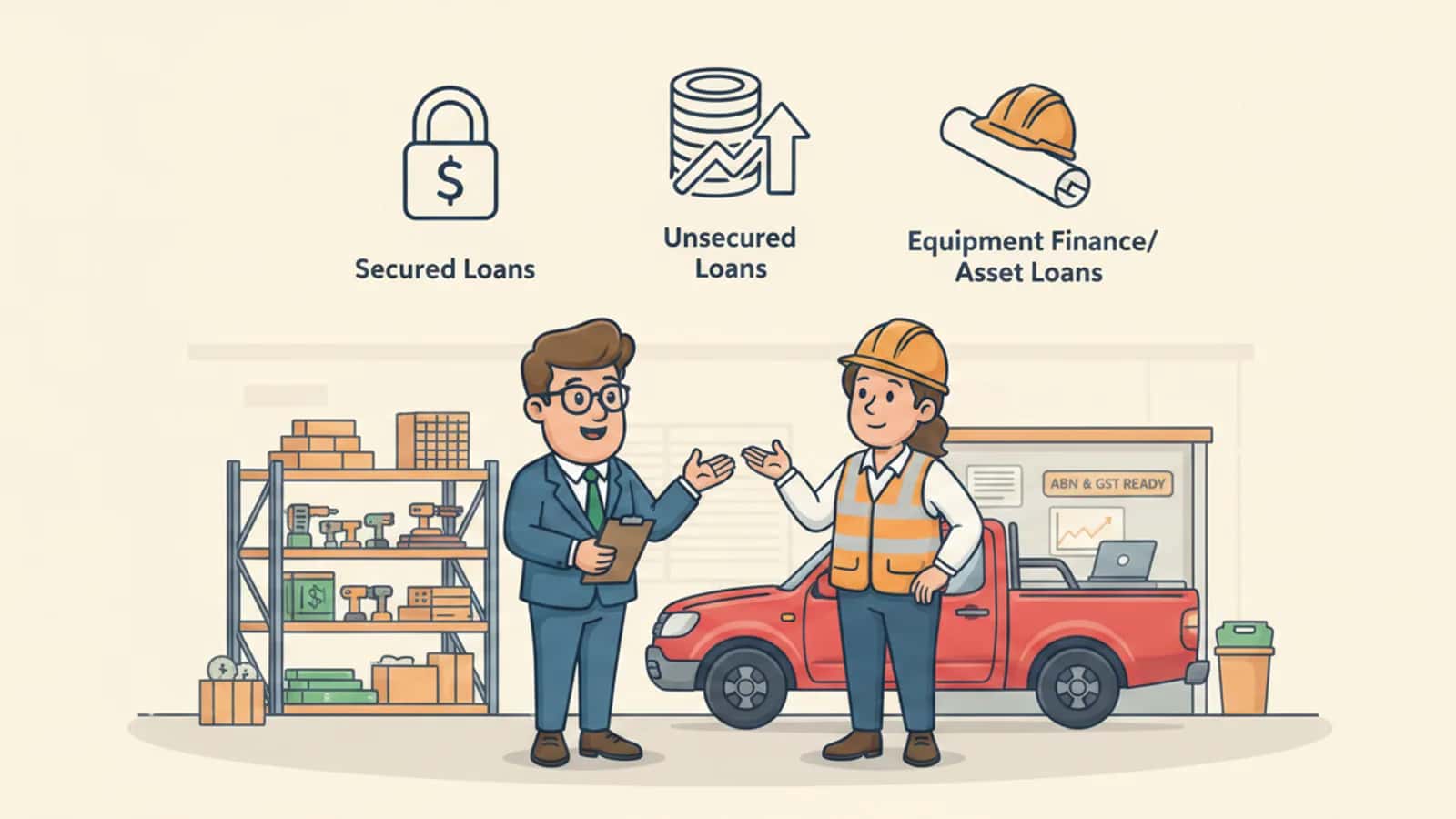
Australian startups can access several distinct funding structures, and the right one depends on trading age, revenue, and how the capital will be used.
Here's a breakdown of the main options:
Unsecured Business Loan
- Best For
- Startups 6–24 months old with revenue
- Typical Range
- $5K–$500K
- Key Requirement
- Monthly revenue of $6K+
Startup-Specific Bank Loan
- Best For
- ABN under 2 years, business plan ready
- Typical Range
- $10K–$50K
- Key Requirement
- Business plan, bank account
Merchant Cash Advance
- Best For
- Hospitality, retail, e-commerce with card sales
- Typical Range
- $5K–$500K
- Key Requirement
- Consistent card turnover
No-Doc Commercial Loan
- Best For
- Property-backed capital needs
- Typical Range
- Up to $10M
- Key Requirement
- Property equity/exit strategy
Government Grant/Program
- Best For
- Pre-revenue or early commercialisation
- Typical Range
- $5K–$500K+
- Key Requirement
- Eligibility criteria vary
R&D Tax Incentive
- Best For
- Tech, biotech, innovative product startups
- Typical Range
- 43.5% tax offset
- Key Requirement
- Eligible R&D expenditure
Unsecured loans are the most common route for early-stage businesses. Non-bank lenders assess revenue consistency and business model rather than years of trading. Merchant cash advances work differently — the lender advances a lump sum and recoups it as a percentage of daily card sales, which suits businesses with variable income. Government grants don't require repayment at all, making them worth pursuing before taking on debt. Match the structure to your revenue profile when comparing Australian business loan options.
How Hard Is It to Get a Business Loan With No Business History

Harder than for an established business, but not impossible. The honest reality is that approval rates drop significantly for startups — approximately 31% for businesses under 12 months of trading, versus 68% for established operators. That gap exists because lenders are pricing risk, and no trading history means less data to work with.
What lenders look at instead:
- Personal credit score
- your financial behaviour before the business started
- Business plan quality
- does the revenue model make sense?
- Industry sector
- some sectors (hospitality, construction, professional services) are better understood by specialist lenders
- Founder's assets
- even for unsecured loans, some lenders want to know what's behind you
- ABN registration age
- six months is often the minimum threshold for non-bank lenders
The good news: specialist non-bank lenders are built for exactly this situation. They use different criteria than the majors. A café in Brisbane that's been open seven months with $12,000 in monthly card sales has real options — a big-four bank might say no, but a specialist partner working through a platform like Funding Fred might say yes by Thursday.
"Applied Tuesday arvo, funded by Thursday" — that's the kind of timeline specialist lenders work to, not the six-week bank queue.
Can I Get a Startup Loan With Bad Personal Credit
Bad personal credit makes startup funding harder, but it doesn't automatically disqualify a founder. Some lenders specifically work with all credit types, including defaults and impaired credit files.
Key points:
- Non-bank lenders weigh multiple factors — revenue, business model, and sector — not just a credit score
- A strong business plan and healthy monthly revenue can offset a bruised credit history
- Secured options (using property or equipment as collateral) are more accessible with poor credit
- No-doc commercial loans from lenders like Marway Capital focus on property value and exit strategy rather than income or credit verification
- Starting with a platform that runs a no hard check to start eligibility assessment protects your credit score while you shop around
Choose this path if: Your credit is impaired but your business has real revenue and a clear repayment plan. Avoid applying to multiple lenders simultaneously — each hard inquiry can lower your score further.
What Government Programs Help New Australian Businesses Get Funding
Several Australian government programs are specifically designed for startups and early-stage businesses, and many don't require repayment.
Federal programs
- Entrepreneurs' Programme — provides business advisors, cash grants up to $20,000, and commercialisation funding for growth-focused businesses
- Industry Growth Program — advisory services and funding from $5M to $100M for innovative SMEs working within National Reconstruction Fund priority areas
- R&D Tax Incentive — a 43.5% refundable tax offset on eligible R&D spending. A startup spending $200,000 on qualifying R&D could receive an $87,000 cash refund
State-based programs
- Research Commercialisation and Startup Fund (SA) — matched funding between $50,000 and $500,000 for South Australian startups commercialising innovative products
- Female Founders Co-Investment Fund (QLD) — co-investment grants for female-led startups raising early-stage capital, matching funds at a 1:3 ratio
These programs are competitive and have eligibility criteria, but they're worth pursuing before taking on debt. Grants don't need to be repaid, which changes the economics of early-stage funding significantly.
How Much Money Can a First-Time Startup Typically Borrow
For most first-time startups in Australia, realistic borrowing ranges sit between $5,000 and $150,000 from non-bank lenders, depending on trading age and monthly revenue. Bank-specific startup products like the Bank of Melbourne Startup Loan cap at $50,000.
Factors that push the number up:
- Longer trading history (12+ months)
- Higher and consistent monthly revenue
- Strong personal credit
- Clear use of funds with a repayment plan
- Collateral or property equity
Factors that pull it down:
- Under six months of trading
- Irregular or seasonal revenue
- Impaired personal credit
- No business plan
Non-bank lenders on platforms like Funding Fred can fund from $5,000 to $7.5 million — but for a brand-new startup, the realistic starting range is $10,000–$100,000. As the business builds a track record, borrowing capacity grows quickly.
What Documents Do I Need to Apply for a Startup Business Loan
The documentation required varies by lender type, but here's what to have ready.
For non-bank/specialist lenders (minimum)
- ABN and ACN
- 3–6 months of business bank statements
- Proof of identity (driver's licence or passport)
- Basic revenue summary
For bank startup loans (more thorough)
- Business plan with financial projections
- Personal tax returns (1–2 years)
- Business bank account statements
- Details of any existing debts or liabilities
- Evidence of industry experience or qualifications
For government grants
- Business plan and commercialisation roadmap
- Financial statements or projections
- Evidence of innovation or R&D activity
- Co-funding evidence (for matched-funding programs)
The lighter the documentation requirement, the faster the decision. Platforms running a 2-minute eligibility check — like Funding Fred — ask for the basics upfront and only go deeper once a match is found. No obligation to proceed at that stage.
For a deeper look at what lenders assess, the business loans guide on Funding Fred covers costs, eligibility, and lender criteria in detail.
Are There Alternative Funding Sources Besides Traditional Bank Loans
Yes — and for startups, alternatives often work better than banks. The traditional bank process is built for businesses with two-plus years of financials, strong assets, and a clean credit file. Most startups don't tick all three boxes.
Practical alternatives
- Non-bank specialist lenders — faster decisions, flexible criteria, assess revenue over history
- Merchant cash advances — ideal for hospitality, retail, and e-commerce with card-based revenue
- Government grants and programs — non-repayable funding for eligible startups
- Angel investors and venture capital — equity-based, suited to high-growth tech startups
- Crowdfunding — works well for consumer products with a built-in audience
- Invoice financing — converts outstanding invoices to immediate cash (better for B2B startups)
- Equipment finance — asset-backed lending specifically for machinery, vehicles, or tech
Platforms that compare offers from selected Australian finance partners — without impacting your credit score — are the fastest way to see what's actually available. Funding Fred's business funding platform connects startups with the right lender type based on their actual situation, not a generic product menu.
What Are the Typical Interest Rates for New Business Loans in Australia
Interest rates for startup business loans in Australia vary significantly based on lender type, loan structure, and risk profile. Providing a single number would be misleading — but here are realistic ranges.
| Lender Type | Approximate Rate Range | Notes |
|---|---|---|
| Big-four banks | 7%–12% p.a. | Hard to access without trading history |
| Non-bank lenders | 12%–35%+ p.a. | Higher for newer businesses, lower with revenue |
| Merchant cash advance | Factor rate 1.1–1.5x | Not an interest rate — a flat fee on advance |
| Government loans/grants | 0% (grants) or concessional | Program-dependent |
Rates are higher for startups because lenders are pricing in risk. A business with six months of trading will pay more than one with three years. That gap narrows fast as the business builds a track record and revenue consistency.
Watch for: Comparison rates, establishment fees, and early repayment penalties. Always check the total cost of the loan, not just the headline rate. The Australian business loan guides on Funding Fred break down how to compare loan costs properly.
What Mistakes Do Most First-Time Entrepreneurs Make When Seeking Startup Funding
Most first-time founders make the same handful of mistakes. Knowing them upfront saves time and protects your credit score.
- 1
Going to the bank first
major banks have the strictest criteria. Non-bank lenders and specialist platforms are a better starting point for most startups.
- 2
Applying to multiple lenders simultaneously
each hard credit inquiry lowers your score. Use a platform that does a soft check first.
- 3
No business plan
even for non-bank lenders, a clear use-of-funds statement improves approval odds significantly.
- 4
Borrowing too much too soon
start with what you need to hit the next revenue milestone, not the maximum available.
- 5
Ignoring government programs
grants and advisory programs are underused by first-time founders who assume they won't qualify.
- 6
Mixing personal and business finances
lenders want to see clean business bank statements. Commingled accounts make this impossible to assess.
- 7
Not knowing their numbers
founders who can't articulate monthly revenue, average transaction value, and gross margin struggle in any lender conversation.
Which Australian Banks Are Most Startup-Friendly
Most big-four banks (ANZ, CBA, NAB, Westpac) are not well-suited to pre-revenue or early-stage startups. Their credit models are built around established trading history.
The more startup-friendly bank option in 2026 is Bank of Melbourne, which offers a dedicated startup loan product:
- Loan amounts: $10,000–$50,000
- No asset security required
- Targets businesses with an ABN registered for less than two years
- Requires a business plan and a Bank of Melbourne Freedom Business Account
Beyond that, regional banks and credit unions sometimes have more flexible criteria than the majors. But for most startups — especially those under 12 months old — non-bank lenders accessed through specialist platforms will move faster and approve more readily.
Do I Need a Business Plan to Get a Startup Loan
For bank loans, yes — a business plan is almost always required. For non-bank lenders, it depends. Many specialist lenders focus on current revenue data over projections, so a formal plan is less critical. But having one never hurts.
A useful startup business plan for lending purposes includes:
- What the business does and who it sells to
- Current monthly revenue and growth trajectory
- How the loan funds will be used
- How repayments will be serviced
- Key risks and how they're managed
It doesn't need to be 40 pages. A clear, honest two-page summary often works better than a glossy document full of optimistic projections lenders don't believe anyway.
What Collateral Do Startup Loans Usually Require
Many startup loan options in Australia are unsecured — meaning no collateral is required. This is one of the biggest differences between non-bank lenders and traditional banks.
- Unsecured loans
- from non-bank lenders: no asset security, assessed on revenue and creditworthiness
- Bank startup loans
- (e.g., Bank of Melbourne): no asset security up to $50,000
- No-doc commercial loans
- secured against property — lenders focus on property value and exit strategy rather than income
- Equipment finance
- the equipment itself serves as security
- Merchant cash advances
- no collateral — repaid through future card sales
For startups without property or significant assets, unsecured options are the practical path. The trade-off is typically a higher interest rate to reflect the lender's increased risk.
Are There Startup Loan Options Specifically for Tech or Digital Businesses
Tech and digital startups have access to some funding options that other sectors don't. The R&D Tax Incentive is the most significant — a 43.5% refundable tax offset on eligible R&D expenditure makes it highly relevant for software, biotech, and hardware startups.
The Industry Growth Program also specifically targets innovative SMEs in priority sectors, with funding from $5M to $100M for commercialisation projects. This is a serious program for tech startups with a genuine innovation angle.
Beyond grants, tech startups with recurring revenue (SaaS, subscription models) can access revenue-based financing — a structure where repayments scale with monthly revenue. This suits digital businesses with predictable but growing income.
For pre-revenue tech startups: Government grants, angel investment, and accelerator programs are more realistic than debt financing. Lenders need something to lend against — if there's no revenue yet, equity or grant funding is the more appropriate tool.
Next steps
Getting business loans for startups in Australia with no track record comes down to knowing which doors to knock on — and in what order. Major banks are built for established businesses. Non-bank specialist lenders, government programs, and platforms that match founders with the right funding partner are where most startups will find real traction.
Actionable next steps:
- 1
Run a 2-minute eligibility check
no hard credit search, no obligation. See what's actually available for your business right now at Funding Fred.
- 2
Prepare your basics
six months of bank statements, ABN details, and a clear use-of-funds summary.
- 3
Check government programs
before taking on debt, see if your business qualifies for the Entrepreneurs' Programme, R&D Tax Incentive, or a state-based grant.
- 4
Know your numbers
monthly revenue, average transaction size, and gross margin. Lenders ask, and founders who answer confidently get better outcomes.
- 5
Start with the right loan size
borrow what you need to hit the next milestone, not the maximum available. Build the track record, then borrow more.
Business Funding. Made Simple. That's what specialist finance partners and smart matching are built for. The traditional bank queue isn't the only path — and for most startups, it's not the right one.
For more on what lenders actually assess, read the complete business loans guide or browse the full Australian business loan resource hub.
Further reading
- indigenous business funding in australia grants loans and commercial options
- guide to business loan approval checklist
- guide to business loans for tradies and contractors in australia utes
- business loans for healthcare and allied health practices in australia options
- how low doc business loans in australia how to get approved with minimal works
Frequently asked questions
What Are the Different Types of Startup Loans in Australia?
Australian startups can access several distinct funding structures, and the right one depends on trading age, revenue, and how the capital will be used.
How Hard Is It to Get a Business Loan With No Business History?
Harder than for an established business, but not impossible. The honest reality is that approval rates drop significantly for startups — approximately 31% for businesses under 12 months of trading, versus 68% for established operators. That gap exists because lenders are pricing risk, and no trading history means less data to work with.
Can I Get a Startup Loan With Bad Personal Credit?
Bad personal credit makes startup funding harder, but it doesn't automatically disqualify a founder. Some lenders specifically work with all credit types, including defaults and impaired credit files.
What Government Programs Help New Australian Businesses Get Funding?
Several Australian government programs are specifically designed for startups and early-stage businesses, and many don't require repayment.
How Much Money Can a First-Time Startup Typically Borrow?
For most first-time startups in Australia, realistic borrowing ranges sit between $5,000 and $150,000 from non-bank lenders, depending on trading age and monthly revenue. Bank-specific startup products like the Bank of Melbourne Startup Loan cap at $50,000.
What Documents Do I Need to Apply for a Startup Business Loan?
The documentation required varies by lender type, but here's what to have ready.
Written by
The Funding Fred Editorial Team creates plain-English guides to help business owners understand funding options, eligibility, and application readiness before they compare finance options.