SBA 504 vs 7(a) Loans: Which Works Better for Real Estate
SBA 504 loans focus on eligible fixed assets such as owner-occupied real estate and major equipment, while 7(a) loans can cover a broader mix of eligible costs. Compare occupancy, use of funds, borrower injection, rate structure, fees and processing requirements.

Quick answer
SBA 504 loans focus on eligible fixed assets such as owner-occupied real estate and major equipment, while 7(a) loans can cover a broader mix of eligible costs. Compare occupancy, use of funds, borrower injection, rate structure, fees and processing requirements.
Key takeaways
- 504 financing combines a bank loan, a CDC/SBA-backed portion and borrower injection
- 7(a) loans can cover working capital and acquisitions as well as eligible fixed assets
- The 504 SBA-backed portion can reach $5.5 million for qualifying projects; 7(a) loans are capped at $5 million
- Required injection can increase for startups or special-purpose properties
- Timelines vary by lender, CDC, valuation, documentation and SBA processing
What Exactly Is an SBA 504 Loan and How Does It Work
An SBA 504 loan is a three-party financing structure designed specifically for owner-occupied commercial real estate and equipment purchases. The borrower provides 10% down, a bank finances 50% with a conventional loan, and a Certified Development Company (CDC) provides 40% through an SBA debenture.
This structure creates lower monthly payments because the SBA portion carries a fixed interest rate for 10 or 20 years. The bank portion typically uses a variable rate for the first five to seven years. Unlike traditional commercial loans, the 504 program requires the business to occupy at least 51% of the property for existing buildings or 60% for new construction.
The job creation requirement sets 504 loans apart from other financing options. Businesses must create or retain one job per $65,000 of SBA funding, though small manufacturers get a higher threshold of $100,000 per job. This requirement makes 504 loans particularly attractive for growing businesses that plan to expand their workforce.
Choose a 504 loan if: You need owner-occupied commercial real estate, can meet job creation requirements, and want the lowest possible down payment with long-term fixed rates.
How Much Down Payment Do You Need for 504 vs 7(a) Loans
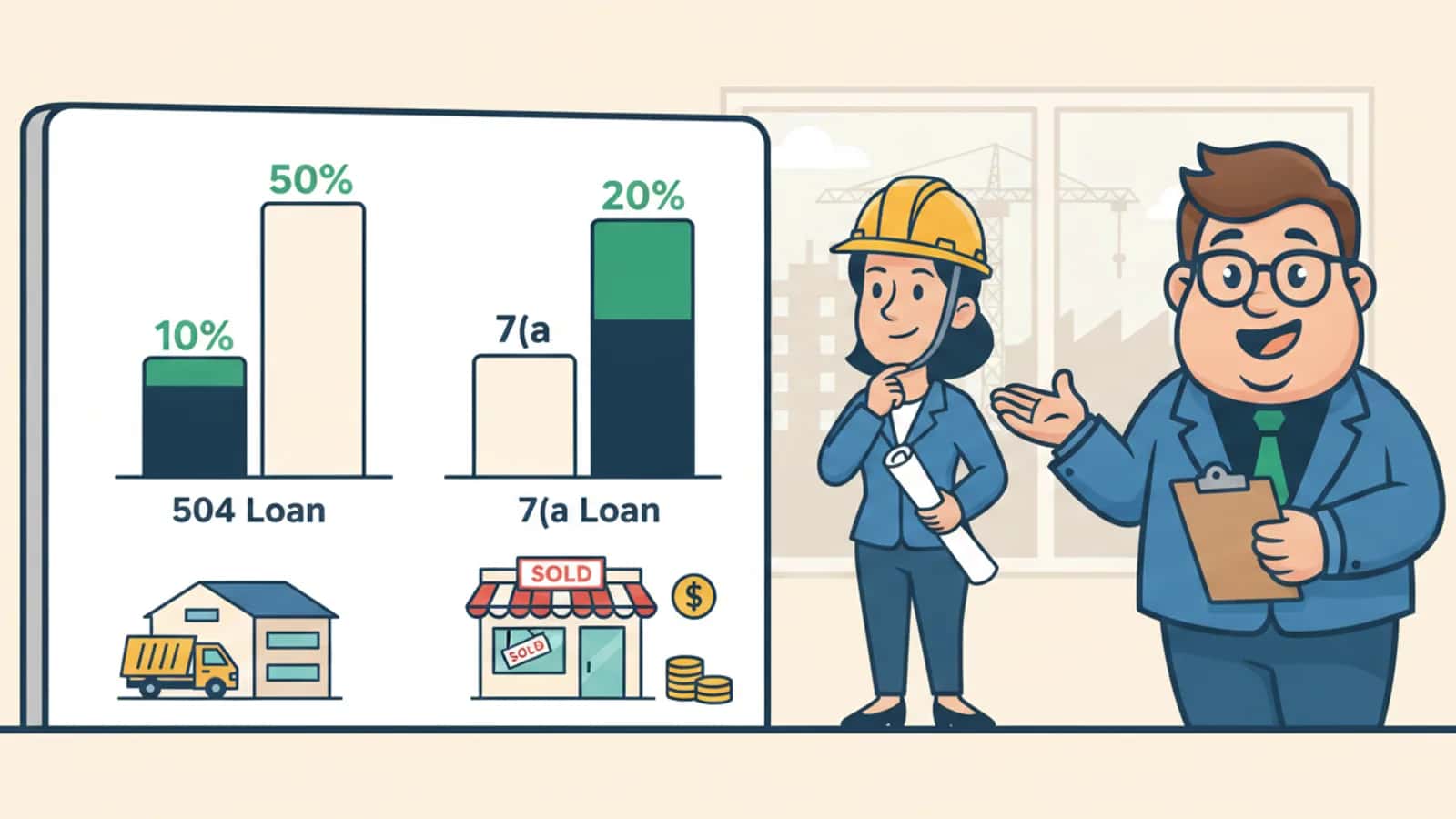
SBA 504 loans require a 10% down payment for most owner-occupied commercial real estate purchases, making them significantly more accessible than 7(a) loans. The 7(a) program typically requires 15% down for owner-occupied properties and up to 25% for investment properties.
For a $1 million property purchase, this difference means $100,000 down with a 504 loan versus $150,000-$250,000 with a 7(a) loan. The 504 structure achieves this lower down payment through the three-party financing arrangement where the CDC provides 40% of the purchase price.
However, 504 loans increase the down payment to 15% for special purpose properties like gas stations or hotels due to higher risk factors. Businesses with a net worth over $15 million or average net income over $5 million in the past two years also face a 15% down payment requirement.
Which Loan Has Lower Interest Rates for Commercial Property
SBA 504 loans typically offer lower overall borrowing costs due to the fixed-rate SBA debenture portion. The SBA portion carries a fixed rate for the full term, while the bank portion uses market rates that reset every five to seven years.
Current 504 rates in 2026 show the SBA debenture portion at approximately 5.5% to 6.0% fixed for 20 years, while the bank portion ranges from 6.0% to 7.5% depending on the lender and borrower qualifications. The blended rate often falls below comparable 7(a) loan rates.
SBA 7(a) pricing may be fixed or variable and is negotiated subject to SBA maximums tied to a permitted base rate. Compare the actual rate, fees, reset frequency and total repayment in the lender's proposal.
A 504 structure and a 7(a) loan price risk differently, so a worked comparison should use current lender quotes for the same project rather than a generic rate assumption.
Can You Use 7(a) Loans for Real Estate or Only 504
You can use 7(a) loans for real estate purchases, but with more restrictions than 504 loans. The 7(a) program allows owner-occupied commercial real estate financing up to $5 million, making it a viable alternative when 504 loans don't fit your situation.
The key advantage of 7(a) loans for real estate is flexibility in property types and usage requirements. While 504 loans require strict owner-occupancy of 51-60%, 7(a) loans allow some mixed-use properties and have more lenient occupancy requirements. You can also use 7(a) loans for business acquisitions that include real estate.
However, 7(a) loans come with higher down payments and typically shorter amortization periods for real estate. Most 7(a) real estate loans amortize over 20-25 years compared to the 20-year fixed terms available with 504 loans. The SBA also limits 7(a) real estate loans to properties where the business will occupy the space.
Choose 7(a) for real estate when: You need faster closing, have mixed-use property requirements, or the property doesn't meet 504 occupancy standards.
Maximum Loan Amounts for 504 and 7(a) Programs
The maximum 7(a) loan is $5 million. For 504 financing, the SBA-backed debenture portion can generally reach $5 million and up to $5.5 million for certain projects; total project finance also includes the bank and borrower portions.
A business may use different SBA programs only when each transaction independently meets eligibility, use-of-funds and underwriting rules. The programme maximums should not be presented as an automatic combined borrowing entitlement.
Small manufacturers receive even higher limits, with 504 loans allowing up to $5.5 million for the SBA portion on projects that create significant manufacturing jobs. Energy efficiency and renewable energy projects also qualify for higher 504 limits in certain circumstances.
Practical impact: These higher limits make SBA financing viable for larger commercial real estate transactions that previously required conventional commercial loans with shorter terms and higher rates.
What Types of Commercial Real Estate Qualify
Both 504 and 7(a) loans work for standard commercial real estate like office buildings, warehouses, retail spaces, and manufacturing facilities. However, each program has specific property type restrictions that affect eligibility.
SBA 504 loans exclude passive real estate investments, properties primarily for rental income, and speculative development projects. The program focuses on properties that support business operations, including owner-occupied office buildings, manufacturing facilities, retail locations, and mixed-use buildings where the business occupies the majority of space.
SBA 7(a) loans have similar restrictions but offer more flexibility for properties with mixed commercial and investment components. Hotels and motels qualify under both programs, but 504 loans often provide better terms due to the lower down payment and fixed-rate structure.
Special purpose properties like gas stations, car washes, and restaurants face additional scrutiny under both programs. These properties typically require higher down payments and may have industry-specific requirements for approval.
Which SBA Loan Is Easier to Get Approved
SBA 7(a) loans generally have a faster and simpler approval process due to fewer parties and requirements. The single-lender structure means working with one bank instead of coordinating between a bank, CDC, and the SBA as required for 504 loans.
Credit score requirements are similar for both programs, typically requiring a minimum 680 FICO score for the best terms. However, 504 loans add the job creation requirement and stricter owner-occupancy standards that can complicate approval for some businesses.
The documentation requirements favor 7(a) loans for speed and simplicity. While both programs require standard financial statements, tax returns, and business plans, 504 loans need additional job creation projections and detailed occupancy plans that extend the underwriting timeline.
Approval timeline comparison: 7(a) loans often receive approval decisions within 2-3 weeks, while 504 loans typically take 4-6 weeks due to the multi-party review process and additional SBA requirements.
For businesses that need working capital alongside real estate financing, exploring multiple funding options through a platform that offers Fast eligibility checks can help identify the most realistic path forward.
Biggest Mistakes Choosing Between 504 and 7(a)
The most common mistake is choosing 7(a) loans when 504 financing could save significant money on down payments and interest costs. Many borrowers select 7(a) loans for speed without calculating the long-term financial impact of higher down payments and variable rates.
Another frequent error involves misunderstanding the job creation requirements for 504 loans. Businesses often assume they can't meet these requirements when they actually qualify through job retention or have natural growth plans that satisfy the thresholds.
Property occupancy miscalculations also derail 504 applications. Some businesses apply for 504 financing on properties where they'll occupy less than 51%, only to discover this disqualifies them after spending time and money on the application process.
Timing mistakes include not accounting for the longer 504 closing process when facing purchase deadlines. Sellers may reject offers contingent on 504 financing due to the extended timeline, even when buyers qualify for better terms.
The biggest strategic error is not considering future needs. Businesses that choose 7(a) loans for immediate flexibility sometimes regret not securing the long-term fixed rates available through 504 financing when interest rates rise.
How Long Each Loan Takes to Close
Processing time varies by lender, CDC, appraisal, environmental review, legal work and SBA processing. Ask for a transaction-specific schedule and distinguish initial approval from closing and funding.
SBA Express can provide a faster SBA response for eligible smaller 7(a) applications, but that response is not the same as final lender approval or funding.
504 loan timelines extend due to coordination between the bank, CDC, and SBA. The CDC must approve the project, the bank must commit to the first mortgage, and the SBA must authorize the debenture. Each party has separate underwriting requirements and approval processes.
Factors that slow closing
- Environmental assessments for certain property types
- Appraisal delays in competitive markets
- Title issues or survey problems
- Multiple revision rounds for loan documents
Fast-track options: Some CDCs offer expedited 504 processing for straightforward transactions, potentially reducing the timeline to 45-60 days for well-prepared applications.
Industries That Work Better with 504 Loans
Manufacturing businesses benefit most from 504 loans due to higher loan limits, favorable job creation ratios, and the program's focus on productive business assets. Small manufacturers can justify jobs at $100,000 per position instead of the standard $65,000, making it easier to meet requirements.
Healthcare practices, including dental offices, veterinary clinics, and medical facilities, work well with 504 financing because they typically occupy their entire facility and have stable cash flows to support long-term fixed payments.
Retail businesses with significant inventory and equipment needs often prefer 504 loans because the program allows financing for both real estate and equipment in a single transaction. This works particularly well for restaurants, auto dealers, and specialty retailers.
Service businesses like accounting firms, law offices, and consulting companies may find 7(a) loans more suitable due to lower equipment needs and potential difficulty meeting job creation requirements with high-wage positions.
Transportation and logistics companies often benefit from 504 financing when purchasing facilities with significant equipment components like loading docks, specialized flooring, or climate control systems.
Fees and Closing Costs for Each Loan Type
SBA 504 loans typically have lower total fees despite the multi-party structure. The SBA guaranty fee ranges from 0.5% to 1.0% of the debenture amount, while CDC processing fees usually run 1.5% to 2.5% of the SBA portion.
SBA 7(a) loans carry guaranty fees from 2% to 3.75% of the guaranteed portion, depending on loan size and term. These fees are generally higher than 504 fees but apply to a single loan instead of multiple financing pieces.
Typical fee comparison for a $2 million property
- 504 loan: $15,000-$25,000 in SBA and CDC fees
- 7(a) loan: $25,000-$40,000 in SBA guaranty fees
Both programs allow fee financing, meaning you can roll most fees into the loan amount rather than paying them upfront. However, some lenders require certain fees paid at closing, particularly third-party costs like appraisals and environmental reports.
Additional closing costs include standard real estate expenses like title insurance, surveys, and legal fees. These costs are similar for both loan types but 504 loans may have slightly higher legal costs due to the more complex documentation.
Refinancing Options for Existing Properties
SBA 504 refinancing became available in recent years for businesses that want to access equity in properties purchased with conventional financing. The 504 refinance program allows up to 90% loan-to-value on existing owner-occupied properties.
SBA 7(a) loans offer more flexible refinancing options, including debt refinancing where the new loan amount exceeds the existing debt to provide working capital. This makes 7(a) loans attractive for businesses that need both real estate refinancing and additional capital.
The key restriction for both programs is the owner-occupancy requirement – you cannot refinance investment properties or buildings where your business occupies less than the required percentage. The refinanced property must meet the same occupancy standards as new purchases.
Refinancing benefits vary by program
- 504 refinancing: Lower rates, longer terms, potential equity access
- 7(a) refinancing: Faster processing, working capital options, more flexible terms
Businesses considering refinancing should evaluate current market rates against their existing loans and factor in SBA fees and closing costs to determine net savings.
Which Loan Works Best with Less Than Perfect Credit
SBA 7(a) loans generally accommodate lower credit scores better than 504 loans due to more flexible underwriting and fewer approval parties. While both programs prefer credit scores above 680, 7(a) lenders may approve borrowers with scores in the 620-680 range with compensating factors.
The single-lender structure of 7(a) loans allows for more nuanced credit decisions based on the complete borrower profile. Banks can weigh strong cash flow, industry experience, and collateral against credit weaknesses more easily than in the multi-party 504 process.
504 loans require approval from both the CDC and bank, creating multiple credit reviews that can be challenging for borderline credit situations. However, the lower down payment requirement may help businesses with limited cash but acceptable credit profiles.
Compensating factors that help with lower credit
- Strong business cash flow and debt service coverage
- Significant industry experience and management depth
- Additional collateral or personal guarantees
- Large down payments above minimum requirements
For businesses with credit challenges, working with lenders experienced in SBA programs and exploring business loan options that match their specific situation can improve approval odds.
Comparison Table: 504 vs 7(a) for Real Estate
| Feature | SBA 504 Loans | SBA 7(a) Loans |
|---|---|---|
| Typical borrower injection | Often 10%; can be higher | Varies by lender and transaction |
| Maximum amount | $5.5M SBA portion for qualifying projects | $5M total loan |
| Interest rate | Fixed on SBA portion; bank portion varies | Fixed or variable subject to SBA caps |
| Processing | Bank, CDC and SBA steps | Lender and, where required, SBA steps |
| Use of funds | Eligible fixed assets | Broader eligible business purposes |
| Job/public-policy requirements | Applies unless another public-policy goal is met | No 504-style job test |
| Maturity | Based on eligible asset and programme terms | Based on use of funds |
| Prepayment | May apply on SBA portion | Depends on maturity and loan terms |
Next steps
When comparing SBA 504 vs 7(a) loans for real estate, the 504 program typically delivers better financial terms through lower down payments and fixed interest rates, while 7(a) loans offer faster processing and more flexibility. The right choice depends on your specific property type, timeline, and business situation.
Choose 504 financing when you need owner-occupied commercial real estate, can meet job creation requirements, and want to minimize upfront costs with long-term rate stability. Select 7(a) loans when you need faster closing, have mixed-use property requirements, or want more flexibility in loan terms.
The 2026 program changes significantly expanded access to SBA financing by increasing loan limits and decoupling the programs. This means businesses can potentially access more capital at better terms than ever before for commercial real estate investments.
Before committing to either program, evaluate your complete financing needs including working capital requirements. Many businesses benefit from exploring multiple funding options to understand what they might qualify for across different programs and lenders.
Ready to explore your SBA loan options? Check Eligibility Now with No hard check to start and discover which US funding partners might work best for your commercial real estate needs through our Fast eligibility assessment process.
Further reading
Frequently asked questions
What Exactly Is an SBA 504 Loan and How Does It Work?
An SBA 504 loan is a three-party financing structure designed specifically for owner-occupied commercial real estate and equipment purchases. The borrower provides 10% down, a bank finances 50% with a conventional loan, and a Certified Development Company (CDC) provides 40% through an SBA debenture.
How Much Down Payment Do You Need for 504 vs 7(a) Loans?
SBA 504 loans require a 10% down payment for most owner-occupied commercial real estate purchases, making them significantly more accessible than 7(a) loans. The 7(a) program typically requires 15% down for owner-occupied properties and up to 25% for investment properties.
Which Loan Has Lower Interest Rates for Commercial Property?
SBA 504 loans typically offer lower overall borrowing costs due to the fixed-rate SBA debenture portion. The SBA portion carries a fixed rate for the full term, while the bank portion uses market rates that reset every five to seven years.
Can You Use 7(a) Loans for Real Estate or Only 504?
You can use 7(a) loans for real estate purchases, but with more restrictions than 504 loans. The 7(a) program allows owner-occupied commercial real estate financing up to $5 million, making it a viable alternative when 504 loans don't fit your situation.
What Types of Commercial Real Estate Qualify?
Both 504 and 7(a) loans work for standard commercial real estate like office buildings, warehouses, retail spaces, and manufacturing facilities. However, each program has specific property type restrictions that affect eligibility.
Which SBA Loan Is Easier to Get Approved?
SBA 7(a) loans generally have a faster and simpler approval process due to fewer parties and requirements. The single-lender structure means working with one bank instead of coordinating between a bank, CDC, and the SBA as required for 504 loans.
Written by
The Funding Fred Editorial Team creates plain-English guides to help business owners understand funding options, eligibility, and application readiness before they compare finance options.
Sources
- Sba 7a Vs 504 - [2] Sba Loans 7a 504 How To Apply Guide - https://www.rrova.com/blog/sba-loans-7a-504-how-to-apply-guide [3] Sba Just Decoupled 7(a) And 504. Here's What That Means For Your Deal - https://smblaw.group/blog/sba-just-decoupled-7(a)-and-504.-here%E2%80%99s-what-that-means-for-your-deal [4] Sba 7a Vs 504 Loan Comparison - https://commerciallendingbroker.com/blog/sba-7a-vs-504-loan-comparison [5] Sba 7a Vs Sba 504 Loans - https://smallbizfundingguide.org/sba-7a-vs-sba-504-loans/ [6] Sba Loans How To Apply - https://www.unitedcapitalsource.com/blog/sba-loans-how-to-apply/ [7] What To Know Before Applying For An Sba 7a Or 504 Loan - https://www.bannerbank.com/financial-resources/blog/what-to-know-before-applying-for-an-sba-7a-or-504-loan [8] 504 Vs 7a - https://cdcloans.com/504-vs-7a/ [9] Sba Doubles Cumulative 7a 504 Loan Limit 10 Million - https://www.sba.gov/article/2026/05/18/sba-doubles-cumulative-7a-504-loan-limit-10-million [10] Sba Loan 504 Vs Sba Loan 7a Explained - https://www.risingbank.com/sba-loan-504-vs-sba-loan-7a-explained/
- U.S. Small Business Administration loans
- U.S. Treasury small business programs
- SBA 504 loans