
Development Finance or Term Loan: Which Funding Solution Fits Your UK Property Project?
Development finance offers short-term, flexible funding (12-24 months) for property construction and renovation projects, while term loans provide longer-term capital (3-25 years) for established businesses and completed assets.

Quick answer
Development finance offers short-term, flexible funding (12-24 months) for property construction and renovation projects, while term loans provide longer-term capital (3-25 years) for established businesses and completed assets. Development finance suits time-sensitive opportunities with staged drawdowns, whereas term loans work better for predictable cash flows and lower-cost financing needs.
Key takeaways
- Development finance typically ranges from £250,000 to £25 million with 12-24 month terms at rates from 0.49% monthly
- Term loans offer 3-25 year repayment periods with lower rates but stricter eligibility criteria
- Development finance releases funds in stages as construction progresses, term loans provide lump sum funding
- Property developers and investors often need development finance for new builds, conversions, and refurbishments
- Term loans suit established businesses buying completed properties or refinancing existing assets
- Credit requirements vary significantly - development finance focuses on project viability, term loans emphasise business trading history
- Both options require detailed financial documentation but have different approval timescales
- Exit strategies differ - development finance expects sale or refinancing, term loans assume ongoing repayment capacity
What Exactly Is Development Finance?

Development finance is short-term, project-specific lending designed for property construction, conversion, and major refurbishment projects. Unlike traditional mortgages, these facilities release funds in stages as work progresses, matching cash flow to construction milestones.
The typical structure includes a day-one tranche covering land purchase and initial costs, followed by monthly construction draws based on surveyor valuations. Development finance facilities usually run for 12-24 months, with loan amounts from £250,000 to £150 million depending on project scale.
Key characteristics of development finance
- Staged funding: Money releases as work completes, not as a lump sum
- Interest-only payments: Capital repayment deferred until project completion
- Exit strategy required: Lenders expect refinancing or sale within the term
- Project-focused underwriting: Emphasis on development viability over business trading history
Recent market activity shows strong demand for specialist products. In March 2026, Paragon Development Finance launched a new facility targeting light industrial developments under 5,000 square feet, offering up to £10 million for 24-month terms. This reflects growing appetite for smaller-scale commercial projects across the UK.
Choose development finance if you're acquiring sites for construction, converting existing buildings, or undertaking major refurbishments where traditional mortgages won't cover the risk profile.
How Is a Term Loan Different from Traditional Bank Lending?
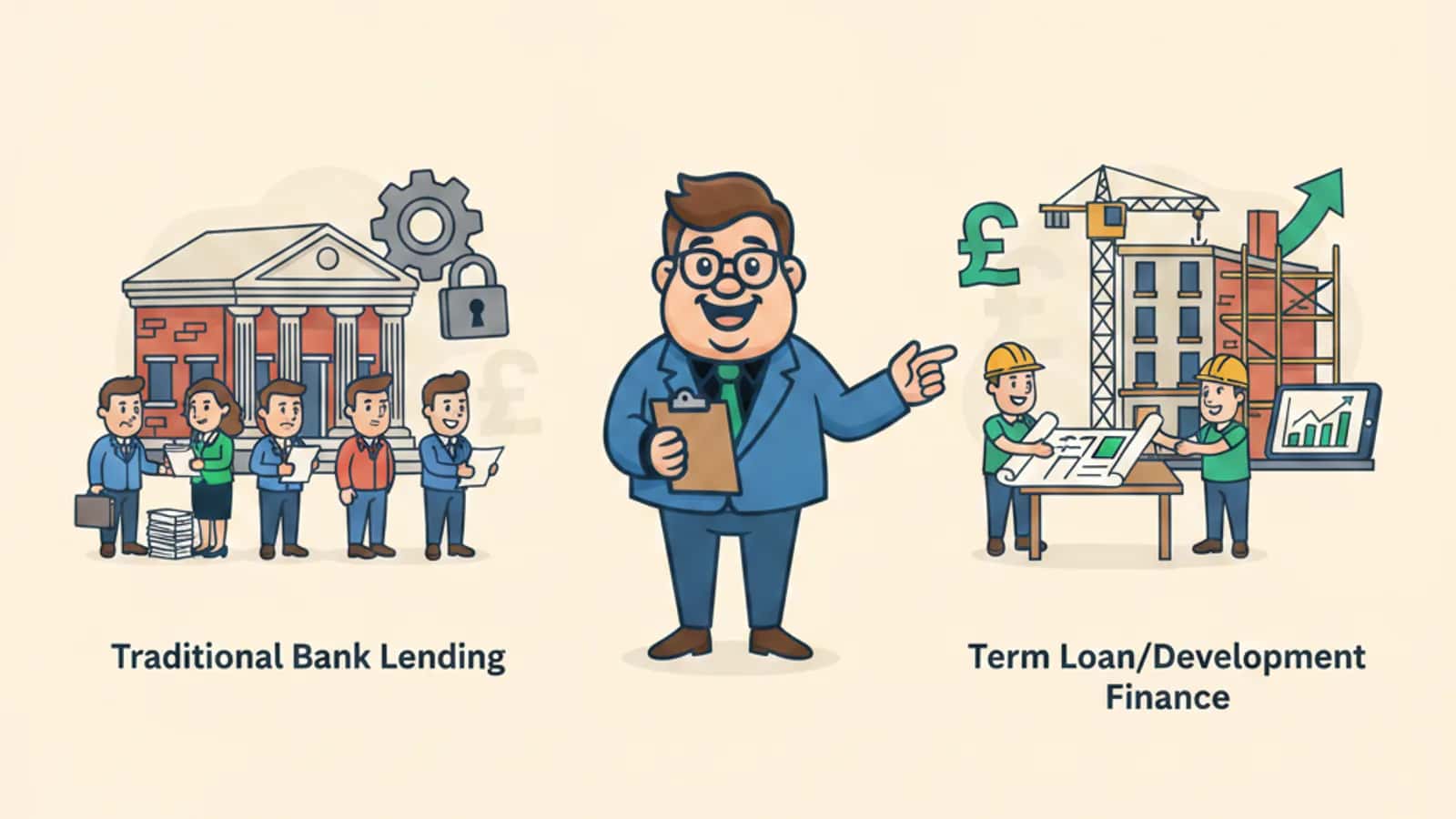
Term loans provide fixed amounts of capital repaid over predetermined periods, typically 3-25 years, with regular monthly or quarterly payments covering both interest and principal. Unlike revolving credit facilities, term loans offer certainty of funding and repayment schedule from day one.
Traditional bank lending often involves lengthy approval processes, extensive documentation requirements, and conservative lending criteria focused on established trading history. Term loans from specialist lenders can offer more flexible underwriting and faster decisions, particularly for property-backed transactions.
Term loan advantages over bank lending
- Faster approval: Specialist lenders often decide within 2-4 weeks vs 8-12 weeks for banks
- Flexible criteria: Focus on asset security rather than just covenant strength
- Relationship-based: Direct lender contact rather than branch-level bureaucracy
- Tailored structures: Seasonal payments, capital holidays, or bullet repayments available
For major infrastructure projects, term loans provide substantial funding capacity. New Era Energy & Digital secured a $290 million term loan facility with Macquarie Group in April 2026 for data centre development, demonstrating the scale available for suitable projects.
Common term loan uses
- Property acquisition for established businesses
- Equipment and machinery purchases
- Business expansion and acquisition funding
- Refinancing existing debt at better terms
Choose term loans when you need predictable funding costs, longer repayment periods, and have sufficient cash flow to service regular payments throughout the term.
Development Finance or Term Loan: Cost Comparison
Development finance typically costs more than term loans but offers greater flexibility for construction projects. Monthly rates start from 0.49% (approximately 6% annually) plus arrangement fees of 1-2% of the facility amount.
Term loans generally offer lower rates, starting from 3-8% annually depending on security, loan size, and borrower profile. However, the total cost depends on your specific requirements and risk profile.
| Factor | Development Finance | Term Loan |
|---|---|---|
| Interest Rate | 0.49%+ monthly (6%+ annually) | 3-8% annually |
| Arrangement Fee | 1-2% of facility | 0.5-1.5% of loan |
| Valuation Costs | £2,000-£5,000+ | £1,000-£3,000 |
| Legal Fees | £3,000-£8,000 | £2,000-£5,000 |
| Monitoring Fee | £500-£1,500 monthly | Not applicable |
| Exit Fee | 0.5-1% if early repayment | Variable |
Development finance cost factors
- Project complexity: More complex builds attract higher rates
- Loan-to-cost ratio: Higher leverage increases pricing
- Developer experience: Established track record reduces rates
- Location and end value: Prime locations often secure better terms
Term loan pricing considerations
- Security quality: Property-backed loans typically cheaper than unsecured
- Loan size: Larger facilities often benefit from economies of scale
- Term length: Longer terms may carry rate premiums
- Borrower strength: Strong financials and trading history improve pricing
For time-sensitive opportunities, development finance's speed often justifies the higher cost. A Manchester developer recently secured £2.66 million bridging finance at 65% loan-to-value for a 12-month redevelopment project, prioritising speed over cost.
Calculate total project costs including all fees when comparing options. Development finance may cost more monthly but could generate higher returns through faster project completion.
What Kind of Projects Qualify for Development Finance?
Development finance suits new-build construction, property conversions, major refurbishments, and mixed-use developments where traditional mortgages won't provide adequate funding flexibility. Lenders typically require projects with clear planning permission and viable exit strategies.
Qualifying project types
- Residential developments: Houses, flats, and apartment blocks for sale or rent
- Commercial construction: Offices, retail units, warehouses, and industrial buildings
- Mixed-use schemes: Combined residential and commercial developments
- Conversions: Office-to-residential, barn conversions, change-of-use projects
- Refurbishments: Substantial renovations adding significant value
- Infrastructure projects: Roads, utilities, and supporting development works
Recent transactions demonstrate the breadth of eligible projects. Kennedy Funding provided $2.7 million for a 34.61-acre mixed-use development in Medford, Oregon, combining commercial and residential elements. Meanwhile, specialist lenders increasingly support niche sectors like light industrial developments under 5,000 square feet.
Project requirements
- Planning permission: Full or detailed consent usually required
- Viable exit strategy: Clear route to sale or refinancing within the term
- Experienced team: Proven developer, contractor, and professional team
- Market demand: Evidence of end-user or buyer interest
- Appropriate location: Areas with established property markets
Projects that typically don't qualify
- Speculative land purchases without planning consent
- Owner-occupied residential properties (use residential mortgages instead)
- Projects without clear construction timelines
- Developments in areas with limited market demand
- Schemes requiring planning permission extensions beyond the loan term
Lenders increasingly favour projects with pre-sales, forward funding agreements, or guaranteed rental income. This reduces exit risk and can improve both approval chances and pricing terms.
Credit Score Requirements: Development Finance vs Term Loans
Development finance lenders focus primarily on project viability and developer experience rather than personal credit scores, though they still conduct credit checks as part of their due diligence process. A poor credit history won't automatically disqualify you if the project fundamentals are strong.
Term loan providers typically require stronger personal and business credit profiles, with minimum credit scores often around 650-700 for competitive rates. However, property security can compensate for weaker credit in some cases.
Development finance credit considerations
- Project strength matters most: Viable developments with good exit strategies can overcome credit issues
- Developer track record: Previous successful projects carry more weight than credit scores
- Explanation required: Lenders want to understand any adverse credit history
- Security focus: Strong project security can offset personal credit concerns
- Guarantor options: Additional guarantors can strengthen weaker applications
Term loan credit requirements
- Minimum scores: Most lenders prefer 650+ personal credit scores
- Business credit history: Trading accounts and payment records reviewed
- Debt-to-income ratios: Existing commitments assessed against income
- County Court Judgments: Recent CCJs may cause declines or higher pricing
- Bankruptcy history: Usually requires 6+ years since discharge
Improving your credit profile
- Check credit reports: Correct any errors with credit reference agencies
- Reduce existing debt: Lower utilisation ratios improve scores
- Maintain payments: Consistent payment history demonstrates reliability
- Build business credit: Establish trade references and maintain good supplier relationships
For bridging loans and development finance, asset security often outweighs credit concerns. Lenders may accept lower credit scores if the property provides adequate security and the exit strategy is robust.
Common credit mistakes
- Applying for multiple facilities simultaneously (creates hard searches)
- Failing to disclose adverse credit history upfront
- Not providing context for past financial difficulties
- Assuming poor credit automatically disqualifies applications
Who Should Use Development Finance and Who Shouldn't
Development finance suits property developers, investors, and businesses undertaking construction or major refurbishment projects where traditional mortgages can't provide the required flexibility. It's designed for professionals who understand construction risks and have clear exit strategies.
Ideal candidates for development finance
- Experienced developers: Track record of completing similar projects successfully
- Property investors: Building portfolios through new construction or conversion
- Commercial developers: Creating office, retail, or industrial properties
- Contractors with development arms: Builders expanding into property development
- Established businesses: Companies developing premises for own use then refinancing
Development finance works best when
- You need staged funding releases matching construction progress
- Traditional mortgages won't cover the project risk profile
- Speed of approval is crucial for securing opportunities
- You have a clear exit strategy (sale or refinancing) within 12-24 months
- The project will generate sufficient profit to justify higher interest costs
Who shouldn't use development finance
- First-time developers without experience: High risk of cost overruns and delays
- Owner-occupiers building homes: Residential self-build mortgages are cheaper
- Businesses needing long-term funding: Term loans offer better value for established operations
- Projects without planning permission: Too much uncertainty for most lenders
- Speculative developments: Without pre-sales or guaranteed demand
An Aldershot developer recently used £220,000 development exit finance to extract equity from a completed new-build property, enabling them to purchase land at auction. This demonstrates how experienced developers use these facilities strategically.
Red flags for development finance
- Unrealistic project timelines or budgets
- Insufficient contingency funds (less than 10-15% of build costs)
- Weak professional team (architect, contractor, quantity surveyor)
- Poor market research or unrealistic end values
- Inadequate personal financial resources for cost overruns
Better alternatives for inappropriate cases
- Self-build mortgages: For owner-occupied residential construction
- Commercial mortgages: For purchasing completed investment properties
- Business loans: For equipment, stock, or working capital needs
- Bridging loans: For short-term property purchases without construction
Choose development finance only if you understand construction risks, have relevant experience, and need the specific benefits of staged funding and flexible terms.
Common Mistakes When Applying for Development Finance
The most frequent mistake is underestimating total project costs and timelines, leading to funding shortfalls and delays that can derail developments. Lenders see this regularly and it's often the difference between approval and rejection.
Critical application mistakes
- Inadequate contingency planning: Budgeting less than 10-15% for unexpected costs
- Unrealistic timelines: Underestimating construction duration by 20-30%
- Poor professional team selection: Using inexperienced contractors or consultants
- Insufficient market research: Overestimating end values or rental demand
- Weak exit strategy: No clear plan for refinancing or sale within the term
Documentation and presentation errors
- Incomplete applications: Missing key documents delays decisions
- Unclear project descriptions: Lenders need detailed construction and design information
- Weak financial projections: Unrealistic profit margins or cost assumptions
- No comparable evidence: Failing to provide market evidence for end values
- Poor quality plans: Inadequate drawings or specifications
Financial planning mistakes
- Insufficient personal contribution: Most lenders require 25-35% equity input
- Overleveraging: Taking maximum loan-to-cost ratios without adequate reserves
- Ignoring holding costs: Forgetting insurance, security, and interest during construction
- No backup funding: What happens if the project needs additional capital?
Timing and process errors
- Late applications: Waiting until you need funds immediately reduces options
- Multiple simultaneous applications: Creates confusion and potential conflicts
- Poor communication: Not responding promptly to lender queries
- Changing project scope: Major alterations during the application process
How to avoid these mistakes
- Build realistic budgets: Include 15-20% contingencies for cost overruns
- Use experienced professionals: Invest in quality architects, contractors, and quantity surveyors
- Research thoroughly: Understand local market conditions and comparable sales
- Plan exit strategies early: Identify refinancing options or marketing strategies before you need them
- Maintain reserves: Keep additional funds available for unexpected requirements
Learning from successful applications: Solar Landscape's recent $600 million debt facility demonstrates the importance of comprehensive planning and professional presentation. The facility included both construction and term loan elements, showing how proper structuring can secure substantial funding.
Start applications early, present complete information, and work with experienced advisers who understand development finance requirements. The extra preparation time often results in better terms and smoother approval processes.
What Happens If Your Development Project Goes Over Budget?
Budget overruns are common in development projects, and lenders typically plan for this possibility through contingency requirements and additional funding mechanisms. However, significant cost increases can strain relationships and require careful management.
Immediate steps when facing cost overruns
- Contact your lender immediately: Early communication prevents surprises and maintains trust
- Provide detailed explanations: Document why costs have increased and provide revised budgets
- Present solutions: Show how you'll fund the additional requirements
- Update project timelines: Realistic completion dates help lenders assess exposure
- Demonstrate continued viability: Prove the project remains profitable despite higher costs
Lender responses to budget increases
- Additional funding: Some lenders offer top-up facilities for viable projects
- Higher interest rates: Increased risk may result in pricing adjustments
- Additional security: Lenders might require extra guarantees or collateral
- Closer monitoring: More frequent site inspections and progress reports
- Accelerated repayment: Lenders may reduce the loan term or require faster completion
Funding additional costs
- Personal resources: Use savings or other assets to bridge funding gaps
- Additional borrowing: Secure supplementary facilities from other lenders
- Partner investment: Bring in joint venture partners or investors
- Scope reduction: Modify the project to reduce total costs
- Phased completion: Complete the development in stages to generate early returns
Preventing budget overruns
- Detailed quantity surveying: Professional cost estimates reduce surprises
- Fixed-price contracts: Where possible, agree fixed construction costs
- Regular monitoring: Monthly cost reviews identify problems early
- Adequate contingencies: Budget 15-20% extra for unexpected costs
- Professional project management: Experienced oversight prevents costly mistakes
When projects become unviable: If cost overruns make projects unprofitable, lenders may consider various options including project sales, alternative exit strategies, or in extreme cases, enforcement action. Early communication and professional advice are crucial in these situations.
Mag Mile Capital's recent $24 million construction financing at 80% loan-to-cost demonstrates how proper structuring can accommodate cost variations while protecting both borrower and lender interests.
Legal and contractual considerations
- Review loan agreements for provisions covering cost increases
- Understand when lenders can withhold further advances
- Know your obligations for additional security or guarantees
- Consider insurance options for construction cost overruns
- Maintain detailed records of all cost variations and approvals
The key is maintaining open communication with lenders and having realistic contingency plans before problems arise.
Can Startups or Small Businesses Get Development Finance?
Startups and small businesses can access development finance, but they face additional challenges compared to established developers with proven track records. Lenders typically require stronger security, more detailed planning, and often personal guarantees to compensate for limited trading history.
Requirements for startup developers
- Experienced management team: Key personnel with relevant construction or property experience
- Substantial personal investment: Higher equity contributions (often 35-40% vs 25-30% for established developers)
- Professional advisers: Proven architects, contractors, and quantity surveyors
- Detailed business plans: Comprehensive project documentation and financial projections
- Strong guarantees: Personal guarantees and potentially additional security
Advantages startups can leverage
- Flexibility: Smaller operations can adapt quickly to lender requirements
- Focus: Single-project focus often appeals to lenders
- Innovation: Fresh approaches to development challenges
- Local knowledge: Understanding of specific market niches
- Competitive pricing: Lower overhead costs can improve project margins
Common startup challenges
- Limited track record: No previous developments to demonstrate competence
- Restricted funding options: Fewer lenders willing to consider startup developers
- Higher costs: Premium pricing to reflect increased risk
- Stricter monitoring: More frequent inspections and progress reports
- Personal exposure: Directors often required to provide personal guarantees
Strategies for startup success
- Partner with experienced developers: Joint ventures can provide credibility and expertise
- Start with smaller projects: Build track record gradually rather than attempting major developments
- Use specialist lenders: Some focus specifically on supporting new developers
- Provide comprehensive documentation: Over-prepare applications to demonstrate professionalism
- Consider alternative structures: Development management or contracting arrangements
Alternative funding sources for startups
- Asset finance: For construction equipment and machinery
- Invoice finance: For contractors with established client bases
- Peer-to-peer lending: Alternative platforms sometimes support property projects
- Crowdfunding: Retail investor platforms for smaller developments
- Government schemes: Various support programs for small business development
Recent market activity shows opportunities for well-prepared startups. Lightshift Energy secured $75 million in project finance facilities, demonstrating how newer companies can access substantial funding with the right project fundamentals and professional presentation.
Building credibility as a startup developer
- Complete smaller projects successfully to build a portfolio
- Maintain detailed records of all project outcomes
- Develop relationships with reliable contractors and consultants
- Understand local planning and regulatory requirements thoroughly
- Build financial reserves for unexpected challenges
When to wait before applying
- If you lack relevant construction or property experience
- When personal finances couldn't support cost overruns
- If the proposed project is too large for your experience level
- When market conditions are particularly challenging
- If you haven't secured appropriate professional advisers
Success as a startup developer requires careful preparation, realistic expectations, and often starting with smaller projects to build credibility with lenders.
How Long Does It Take to Get Approved for a Term Loan?
Term loan approval typically takes 2-6 weeks depending on the lender, loan complexity, and quality of application documentation. Specialist lenders often move faster than traditional banks, particularly for property-backed transactions with clear security.
Typical timeline breakdown:
- 1
Initial assessment
1-3 days for basic eligibility review
- 2
Formal application
3-7 days to complete detailed documentation
- 3
Underwriting review
1-2 weeks for credit assessment and property valuation
- 4
Legal documentation
1-2 weeks for solicitor review and completion
- 5
Funds release
1-3 days after legal completion
Factors affecting approval speed
- Application completeness: Full documentation packages process faster
- Property type and location: Standard properties in good areas speed approval
- Borrower complexity: Multiple entities or complex structures take longer
- Lender workload: Busy periods may extend timelines
- Legal complications: Title issues or complex security arrangements cause delays
Fast-track options
- Specialist lenders: Focus on speed for competitive advantage
- Existing relationships: Previous borrowers often receive priority treatment
- Standard products: Simple loan structures process more quickly
- Professional packaging: Applications prepared by experienced brokers move faster
Comparison with other funding types:
- 1
Bank loans
6-12 weeks typical approval time
- 2
Development finance
2-4 weeks for experienced developers
- 3
Bridging loans
1-2 weeks for urgent transactions
- 4
Commercial mortgages
4-8 weeks for standard properties
Preparing for faster approval
- Complete applications: Provide all required documents upfront
- Professional valuations: Arrange RICS surveys early in the process
- Legal readiness: Instruct solicitors and prepare title documentation
- Financial transparency: Clear, audited accounts and cash flow projections
- Responsive communication: Reply promptly to lender queries
Recent major transactions show how proper preparation can accelerate complex deals. KKR Real Estate Finance Trust closed a $550 million Term Loan B in March 2025, demonstrating that even substantial facilities can complete efficiently with professional structuring.
Common delays and how to avoid them
- Incomplete applications: Use comprehensive checklists to ensure nothing is missing
- Valuation issues: Brief surveyors thoroughly on property characteristics
- Legal complications: Resolve title issues before formal applications
- Credit problems: Address any adverse history proactively with explanations
- Security perfection: Ensure all charges can be registered without complications
When speed is critical: For time-sensitive opportunities, consider bridging loans which can complete in days rather than weeks. These provide temporary funding while arranging longer-term facilities, though at higher cost.
Managing expectations
- Complex transactions naturally take longer than standard cases
- Lender due diligence cannot be rushed without compromising quality
- Legal processes have minimum timeframes that cannot be shortened
- Christmas and summer periods often extend normal timelines
- Multiple lenders may be needed if the first application fails
Plan funding requirements well in advance to avoid pressure on approval timelines and ensure the best possible terms.
Risks of Development Finance Lending
Development finance carries inherent risks for both borrowers and lenders, including construction delays, cost overruns, market changes, and potential project failure. Understanding these risks helps borrowers prepare appropriate mitigation strategies and contingency plans.
Primary borrower risks
- Cost overruns: Construction costs exceeding budgets by 20-30% are common
- Time delays: Planning issues, weather, or contractor problems extending timelines
- Market changes: Property values or rental demand shifting during development
- Interest rate increases: Variable rates can significantly impact project costs
- Contractor failure: Builder insolvency or performance issues disrupting progress
Financial exposure risks
- Personal guarantees: Directors often personally liable for loan repayment
- Cross-default provisions: Problems with one project affecting other borrowing
- Security enforcement: Lenders can take control of projects if defaults occur
- Additional funding requirements: Needing extra capital when other sources unavailable
- Exit strategy failure: Unable to sell or refinance within the loan term
Market and regulatory risks
- Planning changes: New regulations affecting project viability or costs
- Economic downturns: Reduced demand for completed properties
- Interest rate volatility: Base rate changes affecting both costs and end values
- Brexit or political uncertainty: Market confidence and currency fluctuations
- Environmental regulations: New requirements increasing compliance costs
Operational risks
- Key person dependency: Reliance on specific individuals for project success
- Contractor quality: Poor workmanship requiring expensive remediation
- Health and safety incidents: Accidents causing delays and potential liability
- Theft and vandalism: Security costs and insurance claims
- Weather and natural disasters: Force majeure events disrupting construction
Mitigation strategies
- Comprehensive insurance: Professional indemnity, construction, and completion cover
- Fixed-price contracts: Where possible, agree guaranteed construction costs
- Experienced teams: Use proven professionals with strong track records
- Adequate contingencies: Budget 15-20% extra for unexpected costs and delays
- Regular monitoring: Monthly progress reviews and cost control procedures
Due diligence essentials
- Market research: Thorough analysis of local property demand and pricing
- Professional surveys: Detailed site investigations before purchase
- Planning validation: Confirm all consents are in place and implementable
- Financial modeling: Stress-test projections against adverse scenarios
- Legal review: Understand all contractual obligations and potential liabilities
Flatiron Energy's $540 million battery storage project financing demonstrates how major developments can manage complex risks through professional structuring and comprehensive planning.
Warning signs of excessive risk
- Unrealistic profit margins (over 25-30% in normal markets)
- Insufficient personal financial resources for contingencies
- Dependence on single buyers or tenants for project success
- Aggressive timelines without adequate buffer periods
- Lack of relevant experience in the development team
Risk management best practices
- Diversification: Don't commit all resources to single projects
- Professional advice: Use experienced lawyers, accountants, and consultants
- Regular reviews: Monthly assessment of progress against plans
- Flexible strategies: Maintain options for scope changes or alternative exits
- Relationship management: Keep lenders informed of progress and any issues
When to walk away: If risks exceed your capacity to manage them, consider alternative strategies or smaller projects that match your experience and resources. Development finance should enhance opportunities, not create unsustainable exposure.
Alternatives If You Don't Qualify for Development Finance or Term Loans
Several alternative funding options exist for borrowers who don't meet traditional development finance or term loan criteria, ranging from specialist lenders with flexible criteria to alternative structures that reduce risk exposure.
Bridging finance alternatives
- Bridging loans: Short-term funding for property purchases while arranging development finance
- Auction finance: Specialist facilities for property auction purchases
- Refurbishment loans: Smaller facilities for renovation rather than new construction
- Commercial mortgages: For purchasing completed investment properties
- Mezzanine finance: Higher-cost funding filling gaps in capital structures
Alternative business funding
- Asset finance: For construction equipment and machinery purchases
- Invoice finance: Converting unpaid invoices to immediate cash flow
- Trade finance: For businesses with international supply chains
- Merchant cash advances: Fast funding against future card receipts
- Peer-to-peer lending: Online platforms connecting borrowers with individual investors
Equity and partnership options
- Joint ventures: Partner with established developers or investors
- Crowdfunding: Raise capital from multiple small investors
- Family offices: High-net-worth individuals seeking property investments
- Property funds: Institutional investors in development projects
- Government grants: Various schemes supporting business development
Creative financing structures
- Forward funding: Sell developments to investors before completion
- Development management: Manage projects for fees rather than owning them
- Option agreements: Control sites without immediate purchase
- Lease-purchase arrangements: Gradual acquisition of development sites
- Revenue sharing: Share project profits rather than borrowing capital
Specialist lender options
- Near-prime lenders: Accept lower credit scores with higher pricing
- Non-bank lenders: Alternative institutions with flexible criteria
- Private lenders: Individuals or family offices providing development funding
- Overseas lenders: International institutions active in UK property
- Sector specialists: Lenders focusing on specific property types or regions
Improving qualification chances
- Build trading history: Establish business credit through smaller projects
- Improve credit scores: Address adverse credit and reduce existing debt
- Increase equity contribution: Higher deposits improve approval odds
- Use guarantors: Additional security from family or business partners
- Professional packaging: Work with experienced brokers who know suitable lenders
Short-term strategies
- Smaller projects: Build track record with lower-risk developments
- Renovation focus: Refurbishment projects often easier to fund than new builds
- Commercial property: Offices and industrial units sometimes have more flexible lending
- Regional opportunities: Areas with lower property values may offer easier entry
- Partnership roles: Work with established developers to gain experience
Government support schemes
- Help to Build: Support for custom and self-build housing
- Regional development grants: Local authority funding for regeneration projects
- Enterprise zones: Tax advantages and funding support in designated areas
- Brownfield remediation: Grants for contaminated land cleanup
- Energy efficiency schemes: Funding for sustainable development features
When traditional funding isn't suitable
- Owner-occupied developments: Use self-build mortgages instead
- Very small projects: Consider personal loans or remortgaging existing properties
- Speculative purchases: Wait until planning permission is secured
- Distressed situations: Specialist turnaround funding may be more appropriate
Building towards qualification
- Complete smaller projects successfully to demonstrate competence
- Maintain detailed records of all development activities
- Build relationships with professional advisers and contractors
- Understand local market conditions thoroughly
- Develop financial reserves for future opportunities
The key is matching funding sources to your specific situation and building credibility over time. Many successful developers started with alternative funding before accessing mainstream development finance.
Documentation Requirements for Development Loan Applications
Development finance applications require comprehensive documentation covering personal finances, project details, professional team credentials, and detailed construction plans. Lenders need sufficient information to assess both borrower capability and project viability.
Personal and business documentation
- Three years' audited accounts: For established businesses or trading entities
- Personal financial statements: Assets, liabilities, and income sources
- Credit reports: Recent reports from all major credit reference agencies
- Bank statements: Six months' personal and business banking history
- Tax returns and SA302s: Evidence of declared income and tax compliance
- Proof of identity: Passport or driving licence plus utility bills
Project-specific requirements
- Planning permission: Full or detailed consent with all conditions
- Architectural drawings: Detailed plans, elevations, and specifications
- Structural calculations: Engineer reports for significant construction work
- Build cost estimates: Quantity surveyor reports or detailed contractor quotes
- Project timeline: Month-by-month construction and cash flow schedules
- Market appraisal: RICS valuation of completed development value
Professional team documentation
- Contractor credentials: Company accounts, insurance certificates, and references
- Architect qualifications: RIBA membership and relevant project experience
- Quantity surveyor reports: RICS qualified professional cost assessments
- Project manager CV: Experience with similar scale and type of developments
- Legal team details: Solicitor credentials and property law experience
Financial projections and analysis
- Development appraisal: Detailed profit and loss projections
- Cash flow forecasts: Monthly funding requirements throughout the project
- Sensitivity analysis: Impact of cost increases or value reductions
- Exit strategy details: Sale or refinancing plans with supporting evidence
- Contingency planning: How additional costs or delays will be managed
Property and legal documentation
- Title deeds: Proof of ownership or purchase agreements
- Site surveys: Topographical, environmental, and ground condition reports
- Planning history: Previous applications and any enforcement issues
- Legal searches: Local authority, environmental, and mining searches
- Insurance proposals: Construction and professional indemnity cover
Common documentation mistakes
- Incomplete applications: Missing key documents delays decisions significantly
- Outdated information: Using old valuations or expired planning permissions
- Poor quality presentations: Unclear drawings or unprofessional formatting
- Inconsistent figures: Conflicting numbers between different documents
- Missing professional input: Attempting to prepare technical documents without qualified help
Streamlining the application process
- Use checklists: Ensure all required documents are included
- Professional preparation: Work with experienced brokers or advisers
- Early engagement: Start gathering documents before formal applications
- Digital organisation: Maintain electronic files for quick access
- Regular updates: Keep key documents current and readily available
Lender-specific requirements: Different lenders may have additional requirements such as:
- Environmental assessments:
- For sites with potential contamination
- Specialist reports:
- For listed buildings or conservation areas
- Insurance arrangements:
- Specific cover requirements or approved insurers
- Monitoring procedures:
- Progress reporting and inspection protocols
- Legal documentation:
- Particular security or guarantee structures
Timeline for document preparation
- Initial assessment: Basic documents for preliminary discussions (1-2 weeks)
- Formal application: Complete documentation package (2-4 weeks)
- Due diligence period: Responding to lender queries (1-2 weeks)
- Legal completion: Final documentation and fund release (1-2 weeks)
Professional support options
- Development finance brokers: Specialists who understand lender requirements
- Commercial finance advisers: Independent professionals with market knowledge
- Accountants and solicitors: Professional services for financial and legal documentation
- Project managers: Coordination of all professional inputs
- Quantity surveyors: Cost planning and budget preparation
Maintaining documentation: Keep all project documentation updated throughout the development process. Lenders may request progress reports, updated valuations, or revised cash flows as construction proceeds.
Digital document management
- Cloud storage: Secure, accessible filing systems
- Version control: Clear dating and revision tracking
- Access permissions: Appropriate sharing with professional team members
- Backup procedures: Multiple copies of critical documents
- Security measures: Password protection for sensitive financial information
Proper documentation preparation significantly improves approval chances and can reduce both timelines and costs. Investment in professional advice at the application stage often pays dividends through better terms and smoother processes.
Next steps for development finance or term loan
Choosing between development finance or term loan depends on your specific project requirements, timeline, and risk profile. Development finance offers the flexibility and staged funding essential for construction projects, while term loans provide cost-effective long-term capital for established operations.
Development finance suits property developers, investors undertaking major refurbishments, and businesses creating new assets where traditional mortgages won't work. The higher costs are often justified by speed, flexibility, and the ability to fund projects that generate substantial returns.
Term loans work better for purchasing completed properties, funding established business operations, or refinancing existing debt where predictable repayment schedules and lower costs are priorities.
Key decision factors
- Project type: New construction needs development finance, completed assets suit term loans
- Timeline: Short-term projects favour development finance, longer-term needs suit term loans
- Cash flow: Irregular construction cash flows need development finance flexibility
- Cost sensitivity: Term loans offer lower rates for suitable projects
- Experience level: Established developers access better development finance terms
For time-sensitive property opportunities where traditional lenders move too slowly, specialist bridging and development finance providers offer the speed and certainty needed to secure deals.
Ready to explore your options? Check Eligibility Now with our 2 min check - no hard credit search required. Our specialist partners understand property finance and can provide Fast Decisions for development projects from £25k to £25m+.
Whether you need development finance for your next project or a term loan for business expansion, the right funding solution can accelerate your success. Start your application today and discover how specialist lenders can support your property ambitions.
Further reading
Frequently asked questions
What Exactly Is Development Finance?
Development finance is short-term, project-specific lending designed for property construction, conversion, and major refurbishment projects. Unlike traditional mortgages, these facilities release funds in stages as work progresses, matching cash flow to construction milestones.
How Is a Term Loan Different from Traditional Bank Lending?
Term loans provide fixed amounts of capital repaid over predetermined periods, typically 3-25 years, with regular monthly or quarterly payments covering both interest and principal. Unlike revolving credit facilities, term loans offer certainty of funding and repayment schedule from day one.
What Kind of Projects Qualify for Development Finance?
Development finance suits new-build construction, property conversions, major refurbishments, and mixed-use developments where traditional mortgages won't provide adequate funding flexibility. Lenders typically require projects with clear planning permission and viable exit strategies.
Who Should Use Development Finance and Who Shouldn't?
Development finance suits property developers, investors, and businesses undertaking construction or major refurbishment projects where traditional mortgages can't provide the required flexibility. It's designed for professionals who understand construction risks and have clear exit strategies.
What Happens If Your Development Project Goes Over Budget?
Budget overruns are common in development projects, and lenders typically plan for this possibility through contingency requirements and additional funding mechanisms. However, significant cost increases can strain relationships and require careful management.
Can Startups or Small Businesses Get Development Finance?
Startups and small businesses can access development finance, but they face additional challenges compared to established developers with proven track records. Lenders typically require stronger security, more detailed planning, and often personal guarantees to compensate for limited trading history.
Written by
The Funding Fred Editorial Team creates plain-English guides to help business owners understand funding options, eligibility, and application readiness before they compare finance options.
Reviewed by
UK business finance content reviewer
Robert reads our UK business finance guides before they go live, checking each one is accurate, easy to follow, and reflects how lending actually works today — not how a brochure says it should. He's listed on the FCA Register, approved as an SMF3 (AR) Executive Director at Switcha Limited, and connected to Lucky Growth Partners Ltd through its appointed representative relationship, so the regulated detail gets a properly qualified second read.
Sources
- Paragon Development Finance Launches Specialist Light Industrial Loan Product
- New Era Energy Digital Closes Multi Tranche 290 Million Senior Secured Term Loan Credit Facility With Macquarie Group To Finance Texas Critical Data Center Flagship Project
- Kennedy Funding Closes 2 7 Million Loan For Medford Mixed Use Development Site
- Manchester Developer Secures 2 66m Bridging Finance
- Aldershot Developer Secures 220k Exit Finance
- Solar Landscape Secures %24600 Million Debt Facility To Accelerate Distributed Energy Deployment At Scale
- Mag Mile Capital Mmcp Secures 24m Construction Financing For 87 Unit L9dhpa54lcsz
- Lightshift Energy Keybanc Capital Markets Announce 75 Million Project Finance Facility Support
- 03 05 2025 213008584
- Flatiron Reaches Financial Close On Largest Battery Energy Storage Project In Massachusetts