
Merchant Cash Advances in the US: Factor Rates, Holdbacks and Alternatives
Merchant cash advances in the US provide fast funding by purchasing future sales at a discount, using factor rates (not interest rates) and daily holdbacks from revenue. With factor rates typically ranging from 1.1 to 1.5, the effective annual cost often exceeds 50% APR.

Quick answer
Merchant cash advances in the US provide fast funding by purchasing future sales at a discount, using factor rates (not interest rates) and daily holdbacks from revenue. With factor rates typically ranging from 1.1 to 1.5, the effective annual cost often exceeds 50% APR. Business owners should compare alternatives like SBA loans, lines of credit, and revenue-based financing before committing to this expensive option.
Key takeaways
- Factor rates multiply your advance amount to determine total repayment, a 1.3 factor rate means paying back $130 for every $100 received
- Daily holdbacks typically range from 10-20% of credit card sales or bank deposits until the advance is repaid
- No hard credit check to start with many providers, but expect personal guarantees and UCC liens on business assets
- Approval can happen within 24-48 hours, but the high cost makes MCAs suitable mainly for emergency cash flow needs
- Traditional bank loans, SBA programs, and business lines of credit offer significantly lower costs for qualified businesses
- Stacking multiple MCAs creates dangerous cash flow strain and should be avoided
- Early payoff is possible but rarely offers meaningful savings due to how factor rates work
- State regulations vary widely, some states require licensing while others have minimal oversight
What Is a Merchant Cash Advance and How Does It Work

A merchant cash advance purchases a portion of your future sales at a discount, then collects repayment through daily holdbacks from your revenue. Unlike traditional loans, MCAs are structured as commercial transactions rather than lending products.
The process works in three steps:
- 1
Purchase Agreement
The MCA provider buys future receivables for a lump sum payment
- 2
Daily Collection
A fixed percentage of daily sales gets automatically deducted
- 3
Completion
Repayment finishes when the purchased amount is fully collected
Most providers focus on businesses with consistent credit card sales or daily bank deposits. They evaluate your average monthly revenue over the past 3-6 months to determine advance size and repayment terms. The advance amount typically ranges from $5,000 to $500,000, though some providers go higher for established businesses.
Key difference from loans: MCAs don't have fixed payment schedules or maturity dates. Repayment fluctuates with your daily sales volume. During slow periods, you pay less. During busy periods, you pay more.
Factor Rate vs Interest Rate: Understanding MCA Pricing
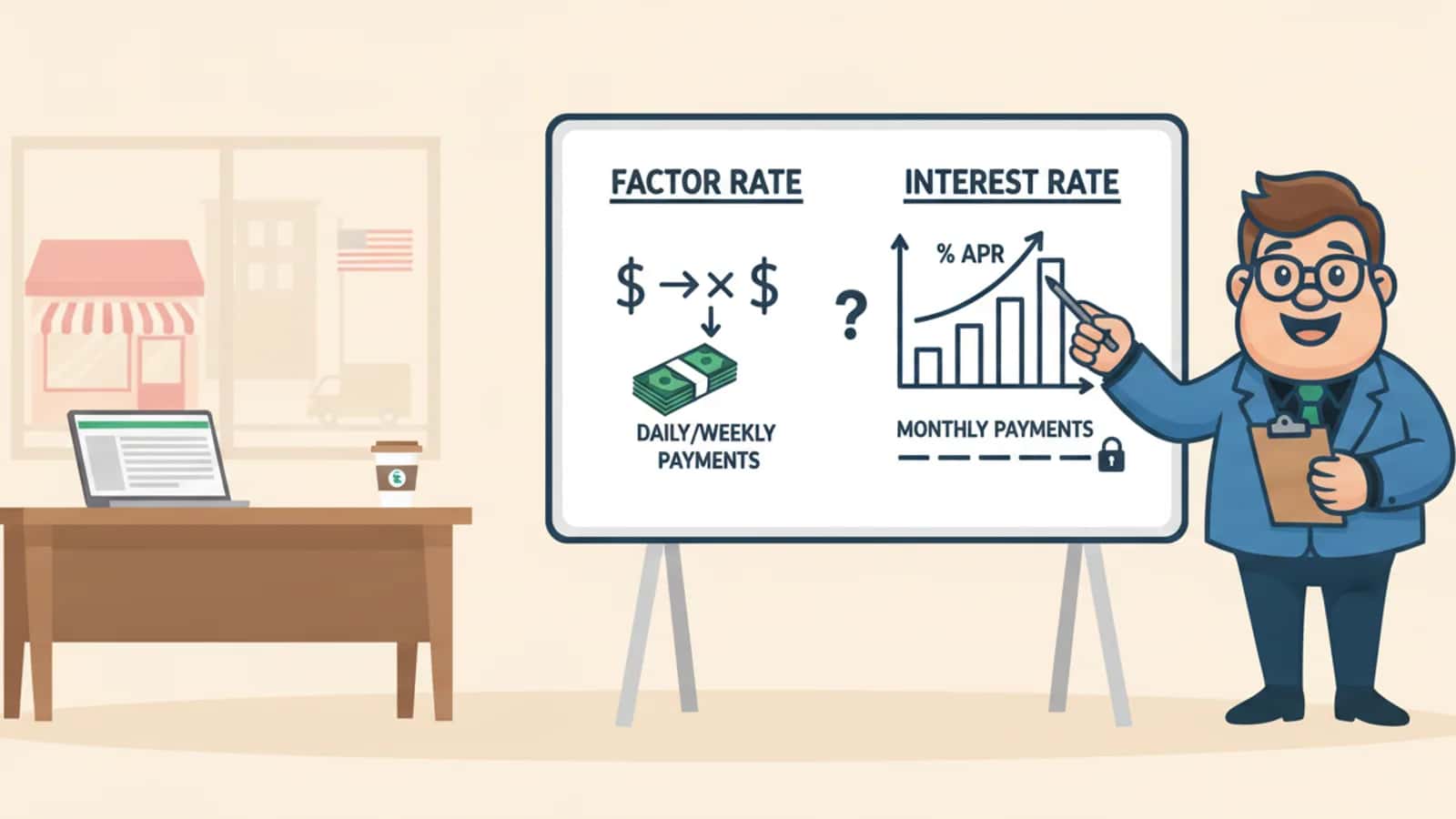
Factor rates determine your total repayment amount upfront, while interest rates calculate cost over time. This fundamental difference makes MCAs significantly more expensive than traditional financing.
A factor rate multiplies your advance to show total repayment. Common factor rates include:
- 1.1 to 1.2
- Lower-risk businesses with strong sales history
- 1.2 to 1.4
- Average risk profile, most common range
- 1.4 to 1.5
- Higher-risk businesses or those with credit issues
Example calculation: $50,000 advance with 1.3 factor rate = $65,000 total repayment ($15,000 fee).
Interest rates compound over time and depend on repayment speed. Factor rates remain fixed regardless of how quickly you repay. This structure means faster repayment doesn't reduce your total cost, only the time to completion.
The effective APR on MCAs typically ranges from 40% to 200% annually, depending on factor rate and repayment speed. A 1.3 factor rate repaid over six months equals roughly 60% APR. The same factor rate repaid over three months jumps to 120% APR.
How Much Do Merchant Cash Advances Actually Cost
MCAs rank among the most expensive business financing options available. The total cost depends on factor rate, advance amount, and repayment timeline. Before accepting that cost, compare the wider range of business funding options.
Typical cost breakdown
- Origination fees: Usually built into factor rate
- Processing fees: $0-500 for underwriting
- Early payoff penalties: Rare, but some providers charge 2-5% of remaining balance
Real-world examples:
*APR varies based on repayment speed
The high cost stems from several factors: no collateral requirements, fast approval, and higher default risk. Providers also argue they're purchasing future sales rather than lending money, which exempts them from traditional usury laws in many states.
Hidden costs to watch
- UCC lien filing fees
- Personal guarantee enforcement
- Collection agency fees if you default
- Stacking penalties from multiple providers
What Is a Holdback in a Merchant Cash Advance
A holdback represents the daily percentage of sales that goes toward MCA repayment. Most providers set holdbacks between 10-20% of gross receipts, though some go as high as 30% for higher-risk advances.
How holdbacks work
- Credit card sales: Direct integration with payment processor
- Bank deposits: ACH withdrawal from business checking account
- Split funding: Some providers use both methods simultaneously
Holdback calculation example: $10,000 daily sales with 15% holdback = $1,500 daily payment toward MCA balance.
The holdback percentage stays fixed throughout repayment. However, your actual daily payment fluctuates with sales volume. During busy periods, you pay more and finish faster. During slow periods, payments decrease but repayment extends longer.
Holdback impact on cash flow: Most businesses can handle 10-15% holdbacks without major disruption. Holdbacks above 20% often create cash flow strain, especially for businesses with thin profit margins. The key is ensuring sufficient daily cash remains for operating expenses, payroll, and inventory.
Some providers offer "seasonal adjustments" that reduce holdbacks during predictably slow periods. However, these adjustments typically extend repayment timelines and may increase total cost.
MCA Legal Status and State Regulations
MCAs operate legally in all 50 states, but regulatory oversight varies dramatically by location. Some states treat MCAs as commercial purchases with minimal regulation, while others impose lending-style requirements.
States with stricter MCA oversight
- New York: Requires disclosure of APR and payment amounts
- California: Mandates truth-in-lending disclosures for certain MCAs
- Virginia: Licensing requirements for some MCA providers
- Utah: Disclosure rules for commercial financing products
Federal regulatory context: The CFPB has increased scrutiny of commercial financing since 2024, focusing on disclosure requirements and fair dealing practices. However, MCAs remain largely exempt from federal lending regulations.
Legal structure protection: MCAs use purchase agreements rather than loan documents to avoid state usury laws. Courts generally uphold this distinction, though some states are reconsidering the classification.
What this means for borrowers: Always review your state's specific MCA regulations before signing. Some states provide cooling-off periods or mandatory disclosure protections that don't exist elsewhere.
Best Alternatives to Merchant Cash Advances
Several financing options offer better terms than MCAs for qualified businesses. The key is matching your situation with the right alternative.
Traditional bank loans
- Cost: 6-12% APR typical
- Timeline: 30-90 days approval
- Requirements: Strong credit, collateral, detailed financials
- Best for: Established businesses with good credit
SBA loans
- Cost: 11-17% APR current rates
- Timeline: 60-120 days typical
- Requirements: US business, owner investment, good credit
- Best for: Long-term financing needs
For more details, see our SBA 7(a) loans guide.
Business lines of credit
- Cost: 8-25% APR, pay only on usage
- Timeline: 2-4 weeks approval
- Requirements: Revenue history, moderate credit
- Best for: Working capital and cash flow management
Equipment financing
- Cost: 8-20% APR
- Timeline: 1-3 weeks approval
- Requirements: Equipment as collateral
- Best for: Purchasing business equipment
For equipment needs, check our equipment and cash flow options guide.
Revenue-based financing
- Cost: 15-35% APR equivalent
- Timeline: 1-2 weeks approval
- Requirements: Recurring revenue, growth trajectory
- Best for: SaaS and subscription businesses
Who Should Get an MCA vs Traditional Loan
MCAs make sense for specific situations, but traditional loans offer better value for most businesses. The decision depends on urgency, credit profile, and funding purpose.
Which is right for you?
Choose an MCA when
- You need funding within 48 hours
- Credit issues prevent bank approval
- Seasonal business with irregular income
- Emergency cash flow crisis
- Revenue-rich but asset-light business model
Choose traditional financing when
- You can wait 2-8 weeks for approval
- Credit score above 650
- Need funding for growth or equipment
- Want predictable monthly payments
- Seeking amounts above $100,000
Middle-ground options: If you need speed but want better terms, consider online lenders offering term loans with faster approval than traditional banks.
Red flag scenarios: Avoid MCAs for long-term needs, debt consolidation, or when you're already struggling with cash flow. The high cost will likely worsen financial stress rather than solve underlying problems.
What Happens If You Can't Repay an MCA
MCA defaults trigger aggressive collection efforts since providers typically secure personal guarantees and UCC liens on business assets. The consequences often exceed those of traditional loan defaults.
Immediate actions providers take
- Freeze or redirect business bank accounts
- Accelerate remaining balance to full amount
- File UCC foreclosure on business assets
- Pursue personal guarantee enforcement
Legal remedies available to providers
- Confession of judgment clauses (in some states)
- Asset seizure through UCC liens
- Personal asset claims via guarantees
- Wage garnishment of business owners
Your options during financial distress:
- 1
Negotiate workout agreement
Many providers prefer modified terms over default
- 2
Seek legal counsel
Review agreements for unfair practices
- 3
Consider bankruptcy protection
Chapter 11 can provide breathing room
- 4
Document harassment
Some collectors use illegal pressure tactics
Prevention strategies: Monitor cash flow closely and communicate early if problems arise. Most providers will work with businesses showing good faith efforts to resolve issues.
MCA Approval Speed and Requirements
MCAs offer the fastest approval process in commercial financing, often providing funds within 24-48 hours of application. However, speed comes with trade-offs in cost and terms.
Typical approval timeline:
- 1
Application
30 minutes online
- 2
Initial review
2-4 hours
- 3
Underwriting
4-24 hours
- 4
Funding
Same day to 48 hours
Standard requirements
- Minimum $10,000 monthly revenue
- 3-6 months in business
- Business bank account
- Credit card processing (for some providers)
- Personal guarantee from owners
Documentation needed
- 3-6 months bank statements
- Credit card processing statements
- Business license or registration
- ID and Social Security number
- Basic business information
No hard credit check to start: Most providers use soft credit pulls for initial qualification, preserving your credit score during the application process. Hard pulls typically occur only after preliminary approval.
Fast eligibility check: Platforms like Funding Fred offer quick pre-qualification across multiple MCA providers without impacting credit scores, helping you understand realistic options before committing to any single lender.
Common MCA Mistakes to Avoid
Business owners frequently make costly errors when using MCAs. Understanding these pitfalls helps you make better financing decisions and avoid financial distress.
Stacking multiple MCAs: Taking advances from multiple providers simultaneously creates dangerous cash flow strain. Combined holdbacks can consume 40-60% of daily revenue, leaving insufficient funds for operations.
Ignoring total cost: Many focus only on advance amount and factor rate while missing additional fees, UCC liens, and personal guarantee risks. Always calculate the total cost of capital.
Using MCAs for long-term needs: MCAs work best for short-term cash flow gaps. Using them for equipment purchases, expansion, or debt consolidation typically proves too expensive.
Failing to read agreements carefully: MCA contracts often contain confession of judgment clauses, automatic renewal terms, and broad personal guarantee language. Legal review is worth the cost.
Not exploring alternatives first: The speed of MCA approval tempts business owners to skip comparison shopping. Even an extra week of research can save thousands in financing costs.
Misunderstanding repayment mechanics: Some business owners expect fixed monthly payments like traditional loans. Daily holdbacks fluctuate with sales, making cash flow planning more complex.
Early Payoff Options and Credit Impact
Most MCAs allow early payoff, but the savings are often minimal due to how factor rates work. Understanding payoff mechanics helps you make informed decisions about refinancing or early repayment.
Early payoff calculation: Since factor rates set total repayment upfront, early payoff typically saves only a small discount (2-5% of remaining balance). Some providers offer no discount at all.
Example: $50,000 advance with 1.3 factor rate = $65,000 total owed. Early payoff after 50% completion might reduce remaining balance from $32,500 to $31,000, minimal savings for the effort.
Credit score impact: MCAs generally don't report to business credit bureaus during normal repayment. However, defaults, UCC liens, and legal actions will appear on credit reports and significantly damage scores.
Refinancing strategies: Some businesses use traditional loans or lines of credit to pay off MCAs early, capturing meaningful interest savings. This works best when credit has improved since the original MCA.
When early payoff makes sense
- You've secured lower-cost financing
- Cash windfall from large sale or contract
- Want to remove UCC liens before major transaction
- Planning to sell the business
Credit building alternatives: If you used an MCA due to credit issues, focus on establishing trade lines, business credit cards, and banking relationships that report positive payment history.
For more guidance on building business credit, see our business credit scores guide.
Next steps
Merchant cash advances in the US serve a specific niche for businesses needing fast funding despite credit challenges or unconventional revenue patterns. While the speed and accessibility are attractive, the high cost makes MCAs suitable mainly for emergency situations or short-term cash flow gaps. For more comparisons and application guidance, browse our business loan guides.
Before pursuing an MCA, explore alternatives like SBA loans, business lines of credit, or equipment financing that offer significantly better terms for qualified businesses. If you do choose an MCA, understand the total cost, avoid stacking multiple advances, and have a clear plan for managing the daily holdbacks without disrupting operations.
The key to smart business financing is matching your needs with the right funding source. For most situations, taking extra time to qualify for traditional financing saves substantial money compared to the convenience of merchant cash advances.
Ready to explore your options? Check eligibility now across multiple funding sources, no hard credit check to start. Compare terms, rates, and requirements to find the best fit for your business needs.
Further reading
Frequently asked questions
What Is a Merchant Cash Advance and How Does It Work?
A merchant cash advance purchases a portion of your future sales at a discount, then collects repayment through daily holdbacks from your revenue. Unlike traditional loans, MCAs are structured as commercial transactions rather than lending products.
How Much Do Merchant Cash Advances Actually Cost?
MCAs rank among the most expensive business financing options available. The total cost depends on factor rate, advance amount, and repayment timeline. Before accepting that cost, compare the wider range of business funding options.
What Is a Holdback in a Merchant Cash Advance?
A holdback represents the daily percentage of sales that goes toward MCA repayment. Most providers set holdbacks between 10-20% of gross receipts, though some go as high as 30% for higher-risk advances.
Who Should Get an MCA vs Traditional Loan?
MCAs make sense for specific situations, but traditional loans offer better value for most businesses. The decision depends on urgency, credit profile, and funding purpose.
What Happens If You Can't Repay an MCA?
MCA defaults trigger aggressive collection efforts since providers typically secure personal guarantees and UCC liens on business assets. The consequences often exceed those of traditional loan defaults.
Written by
The Funding Fred Editorial Team creates plain-English guides to help business owners understand funding options, eligibility, and application readiness before they compare finance options.
Sources
- Mca Market Report 2026 - [2] Us Mca Market Q2 2026 Merchant Cash Advance Trends And Data Analysis - https://www.ultimatebusinesscapital.com/post/us-mca-market-q2-2026-merchant-cash-advance-trends-and-data-analysis [3] What Is A Merchant Cash Advance 2026 - https://fundingexplained.com/what-is-a-merchant-cash-advance-2026/ [5] Best Merchant Cash Advance For Small Business 2026 - https://byzfunder.com/resources/best-merchant-cash-advance-for-small-business-2026 [7] Best Merchant Cash Advances - https://www.cnbc.com/select/best-merchant-cash-advances/ [9] Merchant Cash Advance Regulation By State - https://mca-track.com/merchant-cash-advance-regulation-by-state/
- U.S. Small Business Administration loans
- U.S. Treasury small business programs