
Development Finance vs Commercial Mortgage: When Permanent Debt Makes More Sense
Development finance is short-term funding for construction projects with higher rates (6.5-10%) and 12-24 month terms, while commercial mortgages are long-term loans for completed properties at lower rates (4-7%) over 5-25 years.

Quick answer
Development finance is short-term funding for construction projects with higher rates (6.5-10%) and 12-24 month terms, while commercial mortgages are long-term loans for completed properties at lower rates (4-7%) over 5-25 years. Permanent debt makes more sense when your property reaches stabilisation with predictable cash flow, allowing you to refinance at better terms and extend your hold strategy.
Key takeaways
- Development finance suits active construction phases with staged funding releases based on build progress
- Commercial mortgages work best for completed, income-producing properties with stable tenant occupancy
- Permanent debt becomes viable when properties achieve 75-85% occupancy and generate consistent rental income
- Interest rate savings of 2-4% annually justify refinancing from development finance to commercial mortgages
- Take-out loans provide the bridge from short-term development funding to long-term permanent financing
- LTV ratios differ significantly: development finance uses GDV (60-70%) while commercial mortgages use current value (60-75%)
- Monthly servicing changes from rolled-up interest during development to regular capital and interest payments
- Planning your exit strategy from development finance prevents costly extensions and protects project margins
What's the Difference Between Development Finance and Commercial Mortgages
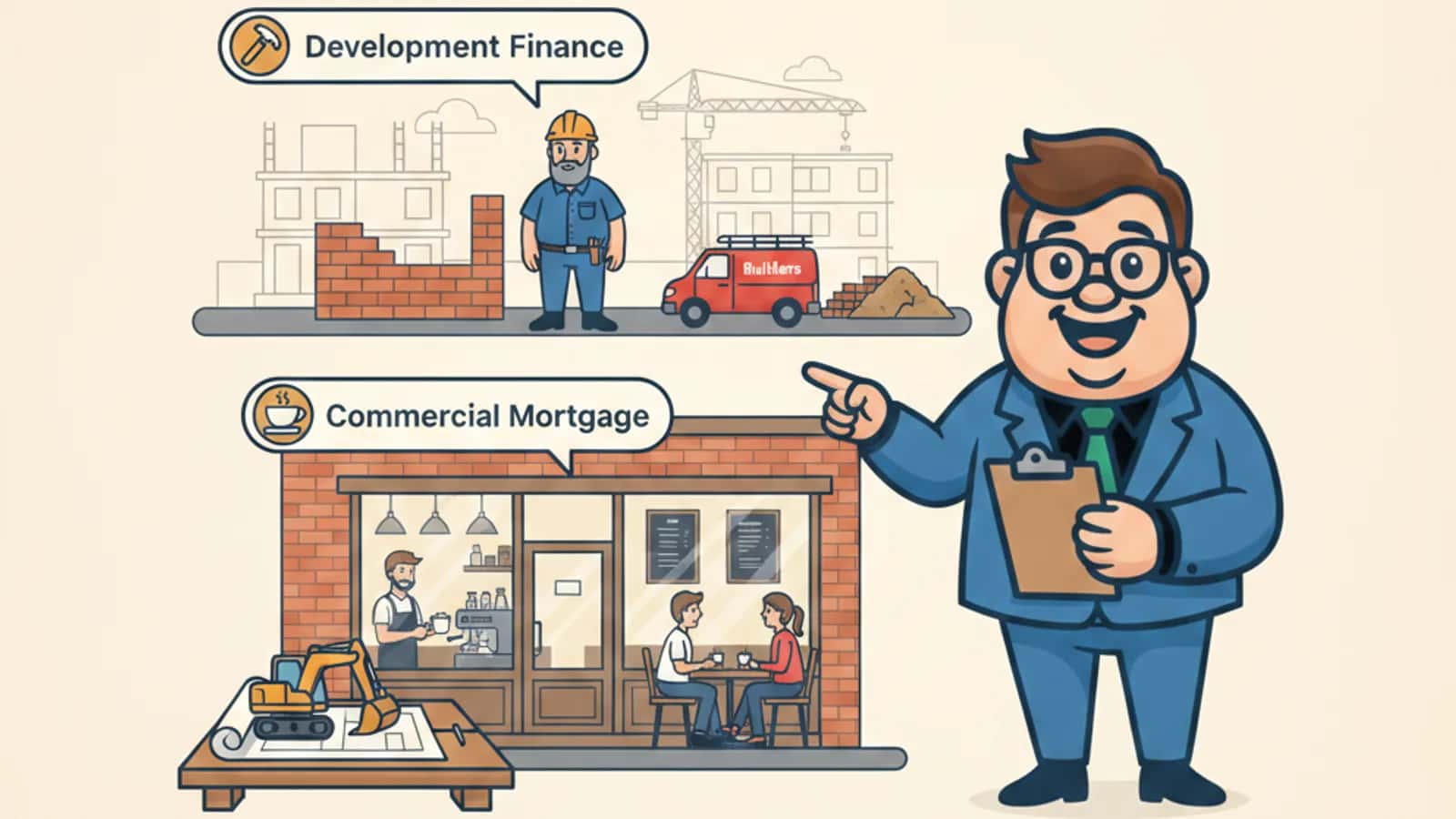
Development finance provides short-term funding for construction or major refurbishment projects, releasing funds in stages as work progresses. Commercial mortgages are long-term loans secured against completed, income-producing properties with regular monthly repayments over 5-25 years.
The fundamental difference lies in timing and purpose. Development finance bridges the gap between land acquisition and project completion, typically lasting 12-24 months. You draw funds against certified build progress, with interest often rolled up until completion or first sales.
Commercial mortgages assume you already own a stabilised property generating rental income. The lender evaluates existing cash flow rather than projected returns, making approval more straightforward but requiring completed assets.
Key structural differences
- Funding release: Staged drawdowns vs immediate full advance
- Interest payments: Rolled-up vs monthly servicing required
- Security basis: Future GDV vs current property value
- Approval focus: Build viability vs income sustainability
- Exit requirements: Sale or refinance vs ongoing rental income
Choose development finance if you're building, converting, or substantially refurbishing. Opt for commercial mortgages when acquiring completed investment properties or refinancing stabilised developments.
When Should You Use Development Finance Instead of a Commercial Mortgage

Use development finance when your project involves construction, major refurbishment, or conversion work that prevents immediate rental income generation. Commercial mortgages require existing cash flow that construction projects cannot provide during the build phase.
Development finance suits projects where:
- Ground-up construction:
- New-build residential, commercial, or mixed-use schemes
- Major conversions:
- Office-to-residential, barn conversions, change of use projects
- Substantial refurbishment:
- Properties requiring 6+ months of renovation work
- Land with planning:
- Sites ready for development but requiring construction funding
- Value-add strategies:
- Projects increasing property value through development work
Commercial mortgages work better for:
- Completed investment properties:
- Existing buy-to-let or commercial assets
- Stabilised developments:
- Recently completed projects with tenants in place
- Portfolio refinancing:
- Extracting equity from performing assets
- Long-term hold strategies:
- Properties intended for rental income generation
Decision rule: If your project requires more than 3 months of construction work preventing rental income, development finance provides the flexibility you need. For completed properties generating immediate cash flow, commercial mortgages offer better long-term rates.
Consider your development finance application checklist to ensure project readiness before applying.
How Does Permanent Debt Work in Real Estate Development
Permanent debt replaces short-term development finance once a property reaches stabilisation, typically when it achieves 75-85% occupancy and generates predictable cash flow. This transition allows developers to secure lower interest rates and longer repayment terms for completed projects.
The permanent financing process involves several key stages:
Stabilisation criteria
- Minimum 12-18 months of rental income history
- Occupancy levels above 75% for commercial properties
- Lease agreements with creditworthy tenants in place
- Property management systems operational
- All construction and letting defects resolved
Take-out loan structure: Permanent lenders provide take-out loans that repay the original development finance facility. These loans typically offer 20-25 year amortisation periods with 5-10 year fixed rate terms, requiring refinancing at maturity.
Cash flow requirements: Lenders assess Debt Service Coverage Ratio (DSCR), requiring net operating income to exceed annual loan payments by 20-35%. This ensures the property generates sufficient cash flow to service the debt comfortably.
Common permanent debt structures
- Interest-only periods: 2-5 years to establish cash flow stability
- Amortising loans: Capital and interest payments building equity over time
- Balloon structures: Lower payments with refinancing required at term end
Plan your permanent financing strategy during the development phase. Secure indicative terms from permanent lenders before starting construction to ensure smooth transition and protect project viability.
Interest Rates for Development Finance vs Commercial Mortgages
Development finance rates range from 6.5% to 10% per annum, while commercial mortgages typically cost 4% to 7% annually, representing potential savings of 2-4% when transitioning to permanent debt.
Development finance pricing factors
- Base rates: Usually Bank of England base rate plus 5-8% margin
- Risk premium: Higher rates reflect construction and market risks
- Arrangement fees: 1-2% of facility size plus legal costs
- Monitoring costs: Surveyor fees at each drawdown stage
- Exit fees: Early repayment charges if refinancing before term end
Commercial mortgage pricing structure
- Fixed rates: 4-7% for 2-10 year periods providing payment certainty
- Variable rates: Base rate plus 2-5% margin with monthly rate reviews
- Arrangement fees: 0.5-1.5% of loan amount plus valuation costs
- Legal fees: Typically £2,000-£5,000 depending on transaction complexity
The rate differential justifies refinancing once properties reach stabilisation. However, factor in refinancing costs including arrangement fees, legal expenses, and valuation charges when calculating net savings.
Market timing considerations: Interest rate cycles affect both products differently. Development finance rates move quickly with base rate changes, while commercial mortgages offer fixed-rate protection during volatile periods.
Can You Convert Development Finance to Permanent Debt
Most development finance facilities cannot convert directly to permanent debt, requiring separate commercial mortgage applications once projects reach completion and stabilisation. However, some specialist lenders offer seamless transition products combining both phases.
Standard refinancing process:
- Project completion: Practical completion certificate issued
- Letting phase: Secure tenant agreements for 75%+ of space
- Stabilisation period: 6-12 months of rental income history
- Commercial mortgage application: Full underwriting based on income performance
- Legal completion: New loan repays development finance facility
Seamless transition products: Some development finance lenders offer automatic conversion to permanent rates once stabilisation criteria are met. These products provide:
- Rate step-down:
- Automatic reduction to commercial mortgage rates
- Extended terms:
- Conversion from 18-month development terms to 5-25 year permanent financing
- No re-underwriting:
- Streamlined process based on original approval
- Cost savings:
- Reduced legal and arrangement fees compared to separate applications
Conversion criteria typically include
- Minimum 75% occupancy for commercial developments
- 85% pre-sales for residential schemes
- Debt service coverage ratio above 1.25x
- Property valuation meeting original GDV projections
- Clean construction completion with no outstanding defects
Planning your exit strategy: Secure backup refinancing options before starting development. Approach commercial mortgage lenders during construction to ensure competitive terms are available at completion.
Consider mezzanine finance and joint venture equity if permanent debt capacity falls short of development finance repayment requirements.
Who Qualifies for Development Finance vs Commercial Mortgages
Development finance requires proven construction experience and detailed project planning, while commercial mortgage qualification focuses on property income performance and borrower creditworthiness. Both assess affordability but use different criteria.
Development finance qualification:
Essential requirements
- Previous development experience or qualified project team
- Detailed planning permission and build cost estimates
- Minimum 20-30% deposit or equity contribution
- Clear exit strategy through sales or refinancing
- Professional team including architect, quantity surveyor, and contractor
Financial criteria
- Personal income to cover living expenses during development
- Liquid assets for cost overruns and contingencies
- Clean credit history with no recent defaults or CCJs
- Stress testing at higher interest rates for affordability
Commercial mortgage qualification:
Property requirements
- Completed property with current rental income
- Minimum 75% occupancy for multi-let buildings
- Lease agreements with creditworthy tenants
- Professional property management in place
- Current valuation supporting loan amount
Borrower criteria
- Debt service coverage ratio of 1.25x minimum
- Property experience for larger portfolios
- Personal guarantees often required
- Maximum 75% loan-to-value on property value
- Clean credit record and affordability assessment
Common qualification challenges
- Development finance: Proving construction competence and managing cash flow during build
- Commercial mortgages: Demonstrating sustainable rental income and tenant quality
Specialist scenarios: Some lenders offer development finance with adverse credit for experienced developers with past credit issues, focusing on project viability over credit scores.
Fees and Costs Associated with Development Finance
Development finance costs include arrangement fees of 1-2% of facility size, legal fees, monitoring surveyor charges, and potential exit fees, making total costs significantly higher than commercial mortgages.
Upfront costs breakdown:
Arrangement fees
- 1-2% of total facility (£20,000-£40,000 on £2m facility)
- Paid on completion, sometimes deducted from first drawdown
- Non-refundable even if facility unused
Legal and professional costs
- Lender's legal fees: £3,000-£8,000
- Borrower's legal fees: £2,000-£5,000
- Valuation and monitoring surveyor appointment: £2,000-£4,000
- Planning and technical due diligence: £1,000-£3,000
Ongoing costs during facility:
Interest charges
- Monthly interest on drawn amounts
- Commitment fees on undrawn facilities (0.5-1% per annum)
- Interest rolled up or serviced monthly depending on structure
Monitoring and drawdown costs
- Surveyor inspection fees: £500-£1,500 per drawdown
- Quantity surveyor certification: £300-£800 per stage
- Legal review of construction contracts: £500-£1,200
Exit and extension costs
- Early repayment charges: 1-3% if refinancing before maturity
- Extension fees: 0.5-1% for 3-6 month extensions
- Default interest: Additional 2-4% if payments missed
Compare these costs against project profit margins. Development finance should not exceed 15-20% of total development profit to maintain viable returns.
How Long Does It Take to Get Approved for Development Finance
Development finance approval typically takes 4-8 weeks from application to completion, depending on project complexity and documentation quality. Fast-track decisions are possible within 2-3 weeks for straightforward schemes with experienced developers.
Application timeline breakdown:
- 1
Week 1-2: Initial assessment
- Application submission and credit checks
- Preliminary project review and indicative terms
- Site visit and initial valuation instruction
- Legal instruction and title investigation
- 2
Week 3-4: Detailed underwriting
- Full project appraisal including GDV assessment
- Build cost verification by quantity surveyor
- Planning permission and technical due diligence review
- Financial stress testing and affordability analysis
- 3
Week 5-6: Final approval
- Credit committee decision and formal offer
- Legal documentation preparation
- Insurance arrangements and contractor vetting
- Monitoring surveyor appointment and drawdown schedule
- 4
Week 7-8: Legal completion
- Contract exchange and security perfection
- First drawdown for land purchase or initial costs
- Construction commencement and monitoring procedures
Factors affecting approval speed:
Accelerating factors
- Complete documentation package at application
- Experienced development team with track record
- Straightforward planning permission without conditions
- Standard residential or commercial schemes
- Established relationship with lender
Delaying factors
- Complex planning conditions or Section 106 agreements
- First-time developers requiring additional due diligence
- Unusual construction methods or specialist builds
- Title issues or restrictive covenants
- Incomplete cost estimates or professional team appointments
Fast-track options: Some specialist lenders offer 2-minute eligibility checks and fast decision processes for experienced developers with straightforward projects. Use our development finance platform to check eligibility now with no hard credit search.
Typical Loan to Value Ratios for Development vs Commercial Mortgages
Development finance LTV ratios reach 60-70% of Gross Development Value (GDV), while commercial mortgages offer 60-75% of current property value, creating different leverage opportunities depending on project stage.
Development finance LTV calculation:
GDV-based lending
- Gross Development Value: Total sales value of completed project
- Development costs: Land, construction, professional fees, finance costs
- Typical LTV: 60-70% of GDV depending on project risk
- Effective leverage: Often 80-90% of total development costs
Commercial mortgage LTV structure:
Current value assessment
- Based on existing rental income and market comparables
- Conservative valuations reflecting income sustainability
- Maximum 75% LTV for most commercial properties
- Lower ratios for specialist or secondary locations
Rental yield requirements
- Minimum 6-8% net initial yield for most commercial properties
- Higher yields required for secondary locations or shorter leases
- Stress testing at void periods and rent review assumptions
LTV comparison by property type:
| Property Type | Development Finance | Commercial Mortgage |
|---|---|---|
| Residential development | 65-70% GDV | 70-75% value |
| Commercial development | 60-65% GDV | 65-70% value |
| Mixed-use schemes | 60-65% GDV | 60-65% value |
| Specialist properties | 55-60% GDV | 55-65% value |
Leverage optimization strategies
- Use development finance for maximum project funding during construction
- Refinance to commercial mortgage for long-term hold strategies
- Consider bridge-to-development finance for site acquisition before planning consent
What Happens If Your Development Project Gets Delayed or Over Budget
Development finance lenders typically allow 3-6 month extensions at additional cost, but significant delays or cost overruns may require additional equity injection or alternative exit strategies to prevent default.
Common delay scenarios and solutions:
Planning delays
- Issue: Delayed planning consent or condition discharge
- Lender response: Extension possible if viable project remains
- Cost: Extension fees plus continued interest charges
- Developer action: Maintain regular lender communication and provide updated timelines
Construction delays
- Weather delays: Usually acceptable with contractor evidence
- Material shortages: Require updated build programmes and cost estimates
- Contractor issues: May need replacement contractor and revised completion dates
- Lender requirements: Updated quantity surveyor reports and revised cash flows
Cost overrun management:
Contingency planning
- Build 10-15% contingency into original facility
- Maintain liquid reserves for unexpected costs
- Regular cost monitoring and early warning systems
- Professional team oversight including quantity surveyor cost control
Additional funding options
- Facility increase: Additional borrowing if GDV supports higher LTV
- Equity injection: Developer contributes additional capital
- Mezzanine finance: Higher-cost secondary funding for shortfalls
- Joint venture partner: Bring in equity partner for additional capital
Default prevention strategies
- Early communication: Inform lenders immediately of potential issues
- Professional support: Engage project managers and cost consultants
- Alternative exits: Consider part-sales or pre-letting to generate cash flow
- Refinancing options: Secure backup facilities before current facility expires
Lender enforcement actions: If projects become unviable, lenders may appoint receivers or require immediate sale. Avoid this through proactive communication and realistic project management.
Is Development Finance Riskier Than a Standard Commercial Mortgage
Development finance carries higher risk due to construction uncertainties, market timing, and project completion challenges, while commercial mortgages benefit from existing income streams and completed assets.
Development finance risk factors:
Construction risks
- Build cost overruns from material price increases
- Contractor delays or insolvency during construction
- Technical issues requiring design changes or additional work
- Weather delays extending project timelines
- Planning condition compliance costs
Market timing risks
- Property values declining during development period
- Rental market weakening before letting completion
- Interest rate increases during construction phase
- Economic downturns affecting sales or letting prospects
Project-specific risks
- Planning permission challenges or condition variations
- Ground condition issues requiring additional foundation work
- Utility connection delays or capacity constraints
- Neighbour disputes or access right complications
Commercial mortgage risk profile:
Lower risk factors
- Existing rental income providing cash flow certainty
- Completed properties with known condition and performance
- Established tenant relationships and lease agreements
- Market value based on comparable evidence rather than projections
Remaining risks
- Tenant default or void periods affecting income
- Property obsolescence or market shifts
- Interest rate changes on variable rate loans
- Economic downturns reducing rental values
Risk mitigation strategies:
Development finance
- Comprehensive insurance including contract works and professional indemnity
- Fixed-price construction contracts with penalty clauses
- Pre-sales or pre-letting agreements where possible
- Conservative GDV assumptions and stress testing
- Experienced professional team with proven track records
Commercial mortgages
- Diversified tenant base reducing single-tenant risk
- Regular property maintenance and capital expenditure planning
- Fixed-rate periods protecting against rate increases
- Professional property management and letting expertise
The higher risk profile of development finance justifies the 2-4% rate premium over commercial mortgages, but experienced developers can manage these risks effectively through proper planning and professional support.
Common Mistakes Developers Make with Development Finance
The most common mistakes include inadequate contingency planning, poor cash flow management, and failing to secure exit financing before starting construction, leading to costly extensions or project failures.
Critical planning errors:
Insufficient contingency reserves
- Mistake: Borrowing maximum facility without cash reserves
- Impact: No buffer for cost overruns or delays
- Solution: Maintain 15-20% liquid contingency separate from facility
Unrealistic project timelines
- Mistake: Aggressive completion dates to minimise interest costs
- Impact: Extension fees and additional interest charges
- Solution: Add 20-30% time buffer to contractor programmes
Poor exit strategy planning
- Mistake: Assuming refinancing will be available at completion
- Impact: Forced sales at below-market values or expensive extensions
- Solution: Secure backup refinancing terms before starting construction
Financial management mistakes:
Cash flow mismanagement
- Mistake: Drawing funds faster than build progress justifies
- Impact: Running out of facility before completion
- Solution: Strict drawdown control aligned with surveyor certifications
Interest servicing problems
- Mistake: Insufficient personal income to cover rolled-up interest
- Impact: Facility default and potential receiver appointment
- Solution: Maintain adequate personal cash flow throughout development
Professional team errors
- Mistake: Appointing inexperienced contractors or consultants
- Impact: Build delays, cost overruns, and quality issues
- Solution: Use proven teams with relevant project experience and financial strength
Lender relationship management:
Poor communication
- Mistake: Failing to update lenders on project progress or issues
- Impact: Loss of lender confidence and reduced flexibility
- Solution: Regular progress reports and early problem notification
Facility breach risks
- Mistake: Ignoring facility conditions or covenant requirements
- Impact: Technical default and potential acceleration of loan
- Solution: Regular compliance monitoring and professional advice
Prevention strategies
- Use experienced professional advisers including solicitors and quantity surveyors
- Maintain conservative project assumptions and stress test scenarios
- Plan exit strategies before committing to development finance
- Keep detailed project records and maintain regular lender communication
How Lenders Assess Development Projects for Financing
Lenders evaluate development projects through comprehensive due diligence covering project viability, developer experience, market conditions, and exit strategy feasibility, with specialist teams assessing construction and commercial risks.
Project viability assessment:
Planning and technical review
- Planning permission validity and condition compliance requirements
- Technical feasibility including ground conditions and utility capacity
- Design quality and specification appropriateness for target market
- Construction programme realism and contractor capability
- Professional team qualifications and relevant experience
Financial viability analysis
- Build cost verification through quantity surveyor assessment
- GDV appraisal based on comparable evidence and market conditions
- Development profit margins and stress testing scenarios
- Cash flow projections including timing of sales or lettings
- Sensitivity analysis for cost increases and value variations
Developer assessment criteria:
Experience evaluation
- Previous development track record and project scale
- Financial strength and liquidity for contingencies
- Professional team relationships and contractor networks
- Local market knowledge and planning expertise
- Exit strategy execution capability
Financial strength analysis
- Personal wealth and liquid asset verification
- Income sustainability during development period
- Credit history and previous lender relationships
- Guarantor strength for corporate borrowers
- Stress testing for adverse scenarios
Market and location factors:
Demand assessment
- Local market conditions and absorption rates
- Competition analysis and differentiation factors
- Transport links and amenity provision
- Economic growth prospects and employment trends
- Planning policy support for development type
Security evaluation
- Land title investigation and legal due diligence
- Valuation methodology and comparable evidence
- Security ranking and other charge holders
- Insurance adequacy and professional indemnity cover
- Environmental and contamination risk assessment
Decision-making process: Most lenders use specialist development finance teams with construction and commercial property expertise. Credit committees review all aspects before approval, often requiring additional security or guarantees for marginal projects.
Approval enhancement strategies
- Present comprehensive project packages with professional cost estimates
- Demonstrate relevant experience through case studies and references
- Provide conservative assumptions with detailed stress testing
- Secure pre-sales or pre-letting agreements where possible
- Use established professional teams with lender relationships
Next steps
Understanding when permanent debt makes more sense than development finance requires careful analysis of your project timeline, cash flow requirements, and long-term investment strategy. Development finance provides essential flexibility during construction phases but comes at higher cost, making the transition to commercial mortgages crucial for optimising returns on completed projects.
The key decision point occurs when properties reach stabilisation with predictable rental income. At this stage, commercial mortgages offer significant cost savings of 2-4% annually while providing longer-term financing stability for hold strategies.
Take action on your development finance needs
- Check eligibility now for development finance with our 2-minute assessment
- Plan your exit strategy before starting construction to ensure smooth refinancing
- Maintain adequate contingency reserves for delays and cost overruns
- Consider specialist partners who understand development project requirements
For comprehensive guidance on your development finance application, review our complete development finance guide or explore development finance options tailored to your project requirements.
Ready to secure development funding? Our specialist partners offer facilities from £100k to £50m+ with fast decisions and flexible criteria. No obligation, no hard credit check to start.
Further reading
Frequently asked questions
What's the Difference Between Development Finance and Commercial Mortgages?
Development finance provides short-term funding for construction or major refurbishment projects, releasing funds in stages as work progresses. Commercial mortgages are long-term loans secured against completed, income-producing properties with regular monthly repayments over 5-25 years.
When Should You Use Development Finance Instead of a Commercial Mortgage?
Use development finance when your project involves construction, major refurbishment, or conversion work that prevents immediate rental income generation. Commercial mortgages require existing cash flow that construction projects cannot provide during the build phase.
How Does Permanent Debt Work in Real Estate Development?
Permanent debt replaces short-term development finance once a property reaches stabilisation, typically when it achieves 75-85% occupancy and generates predictable cash flow. This transition allows developers to secure lower interest rates and longer repayment terms for completed projects.
Can You Convert Development Finance to Permanent Debt?
Most development finance facilities cannot convert directly to permanent debt, requiring separate commercial mortgage applications once projects reach completion and stabilisation. However, some specialist lenders offer seamless transition products combining both phases.
Who Qualifies for Development Finance vs Commercial Mortgages?
Development finance requires proven construction experience and detailed project planning, while commercial mortgage qualification focuses on property income performance and borrower creditworthiness. Both assess affordability but use different criteria.
How Long Does It Take to Get Approved for Development Finance?
Development finance approval typically takes 4-8 weeks from application to completion, depending on project complexity and documentation quality. Fast-track decisions are possible within 2-3 weeks for straightforward schemes with experienced developers.
Written by
The Funding Fred Editorial Team creates plain-English guides to help business owners understand funding options, eligibility, and application readiness before they compare finance options.
Reviewed by
UK business finance content reviewer
Robert reads our UK business finance guides before they go live, checking each one is accurate, easy to follow, and reflects how lending actually works today — not how a brochure says it should. He's listed on the FCA Register, approved as an SMF3 (AR) Executive Director at Switcha Limited, and connected to Lucky Growth Partners Ltd through its appointed representative relationship, so the regulated detail gets a properly qualified second read.
Sources
- Development Finance Vs Commercial Mortgage [2] Bridge Loans Vs Permanent Financing - https://www.gspartners.com/resources/bridge-loans-vs-permanent-financing [3] How Do Commercial Mortgages Work Rates Terms Costs - https://legalclarity.org/how-do-commercial-mortgages-work-rates-terms-costs/ [4] How Do Commercial Real Estate Developers Make Money - https://legalclarity.org/how-do-commercial-real-estate-developers-make-money/ [5] What Is A Take Out Loan In Real Estate And How It Works - https://legalclarity.org/what-is-a-take-out-loan-in-real-estate-and-how-it-works/ [6] Commercial Mortgage Terms Explained - https://avanacapital.com/business-loans/commercial-mortgage-terms-explained/
- British Business Bank finance options
- GOV.UK business finance support