
Development Finance With or Without Planning Permission: What Changes?
Development finance with planning permission offers lower rates, higher leverage (up to 87.5% LTC), and faster drawdown. Without planning permission, expect 20-30% higher rates, reduced loan amounts, and specialist lenders only.

Quick answer
Development finance with planning permission offers lower rates, higher leverage (up to 87.5% LTC), and faster drawdown. Without planning permission, expect 20-30% higher rates, reduced loan amounts, and specialist lenders only. Planning status fundamentally changes lender appetite, project viability, and exit certainty.
Key takeaways
- Development finance with planning permission offers lower rates, higher leverage (up to 87.5% LTC), and faster drawdown. Without planning permission, expect 20-30% higher rates, reduced loan amounts, and specialist lenders only. Planning status fundamentally changes lender appetite, project viability, and exit certainty.
Key Takeaways
- Planning permission reduces development finance rates by 2-4% annually and increases available leverage
- Pre-planning finance typically caps at 60-70% loan-to-cost versus 87.5% with full consent
- Only specialist lenders fund pre-planning projects, limiting options and increasing costs
- Planning gain can now be recognized as equity contribution by progressive lenders like Assetz Capital
- Average planning approval takes 783 days for major residential applications, extending finance requirements
- Outline permission sits between full consent and no planning, with moderate rate premiums
- Permitted development rights with prior approval receive similar treatment to full planning permission
What Is Development Finance With or Without Planning Permission?

Development finance with planning permission provides funding for projects with full planning consent, offering the lowest rates and highest leverage. Without planning permission, development finance covers land acquisition and holding costs while pursuing consent, but at higher rates and reduced loan amounts.
The fundamental difference lies in risk assessment. Lenders view projects with planning permission as having established development viability and clear exit routes. Pre-planning finance carries planning risk - the possibility that consent may be refused, delayed, or granted with restrictive conditions that impact project economics.
Planning permission provides three key certainties for lenders
- Development viability - Confirmed ability to build the proposed scheme
- Exit clarity - Established end values based on consented development
- Timeline predictability - Removal of planning approval delays from project schedule
Choose pre-planning finance if you can secure land at significant discount to consented value, have strong planning expertise, or face competition for consented sites that erodes margins.
How Does Planning Permission Status Affect Development Finance Rates?
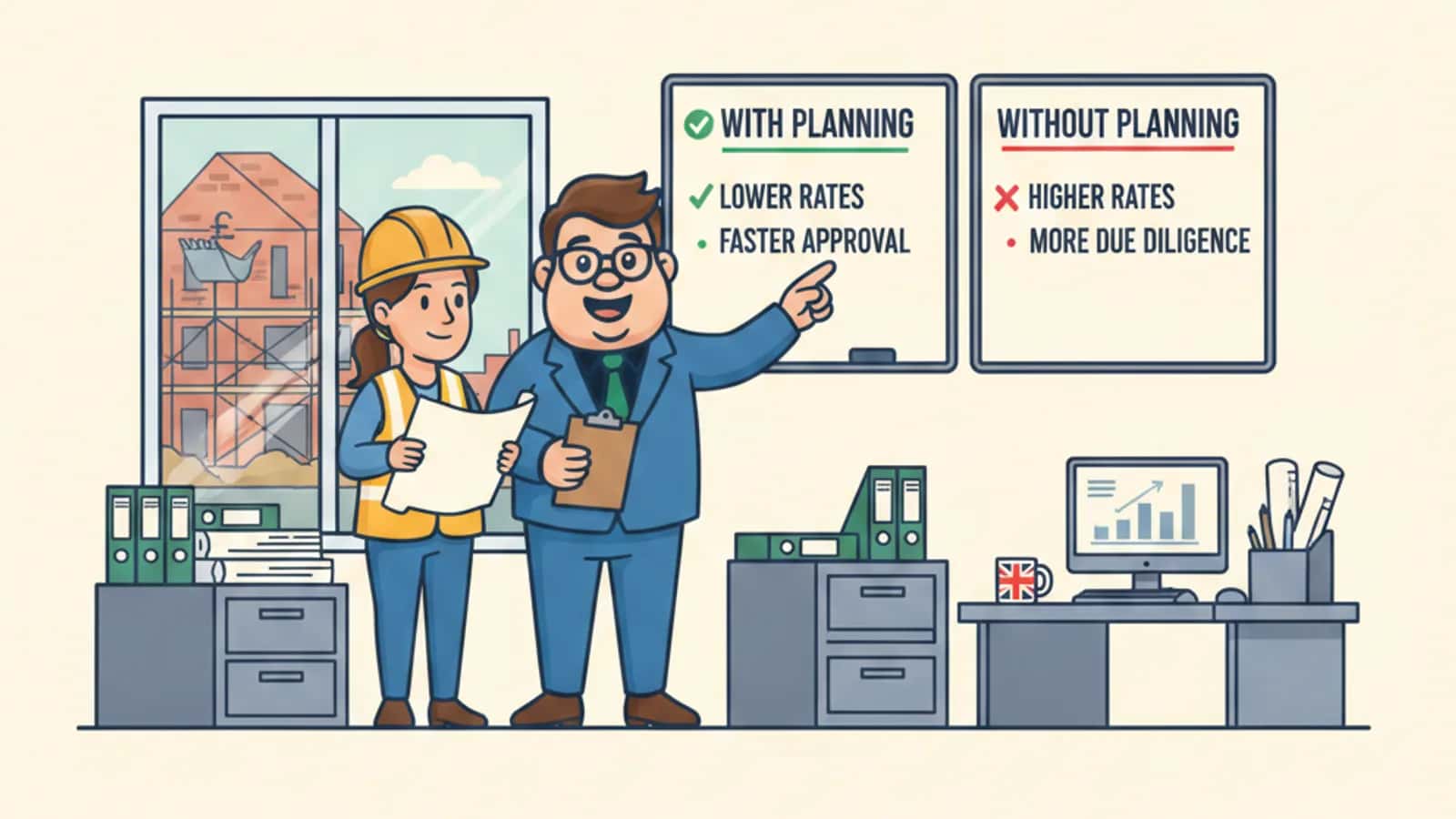
Planning permission status directly impacts development finance rates, with pre-planning projects paying 20-30% higher annual rates. Projects with full planning consent typically access rates from 8-12% annually, while pre-planning finance starts from 10-15% with specialist lenders only.
Recent market data shows planning delays averaging 783 days for major residential applications, forcing lenders to price extended holding periods and planning risk. This uncertainty translates to rate premiums that reflect both the probability of planning refusal and extended finance terms.
Rate structure by planning status
- Full planning permission: 8-12% annually, mainstream lender competition
- Outline permission: 9-13% annually, moderate rate premium
- Pre-planning: 10-15% annually, specialist lenders only
- Permitted development: 8-12% annually, similar to full planning
The rate differential reflects lender risk appetite. Most development finance providers require full planning consent before releasing construction funds, limiting pre-planning options to specialist lenders who understand planning processes and local authority dynamics.
For more information on development finance options, see our complete development finance guide.
What Loan-to-Value Ratios Apply With and Without Planning Permission?
Loan-to-value ratios vary significantly based on planning status, with full planning permission enabling leverage up to 87.5% loan-to-cost (LTC) and 72.5% loan-to-gross-development-value (LTGDV). Pre-planning finance typically caps at 60-70% LTC due to increased risk and uncertain end values.
Assetz Capital's 2026 policy update now recognizes planning gain and residual land value as equity contributions, reducing cash requirements for developers with strong planning prospects. This progressive approach acknowledges that planning permission adds substantial value that can substitute for cash equity.
Typical leverage by planning status:
The equity requirement difference means a £2 million project with full planning needs £250,000 cash versus £600,000 pre-planning - a significant capital efficiency difference that impacts project returns and pipeline capacity.
Choose higher leverage with planning permission if cash flow is constrained. Consider pre-planning finance if land discount exceeds the additional equity requirement and you have strong planning confidence.
Which Lenders Fund Development Projects Before Planning Approval?
Specialist development finance lenders fund pre-planning projects, but mainstream lenders typically require full planning consent. Key pre-planning lenders include Assetz Capital, MT Finance, and other alternative finance providers who understand planning processes and local market dynamics.
These specialist lenders assess planning probability through detailed feasibility studies, planning consultant reports, and local authority engagement records. They require experienced development teams with proven planning track records and often impose milestone-based funding releases tied to planning progress.
Pre-planning lender requirements
- Experienced development team with successful planning applications
- Professional planning consultant engaged from project outset
- Detailed feasibility study demonstrating planning policy compliance
- Local authority pre-application discussions documented
- Strong cash flow to cover extended planning periods
Most high street banks and traditional lenders avoid pre-planning risk entirely, preferring the certainty of consented schemes. This limited lender pool reduces competition and increases rates, but provides access to sites before planning premiums are applied.
For bridging finance during planning periods, explore our bridge to development finance options.
How Do Planning Delays Impact Development Finance Costs?
Planning delays significantly increase development finance costs through extended interest payments and holding costs. With major planning applications averaging 783 days for determination, developers face nearly two years of finance costs before construction begins.
Extended planning periods compound development finance costs in multiple ways. Interest continues accruing on land purchase loans, holding costs accumulate, and project cash flows extend beyond original projections. Lenders now factor realistic planning timelines into their assessments, requiring larger cost allowances and extended facility terms.
Cost impact of planning delays
- Extended interest periods - Additional 12-18 months of finance costs
- Increased holding costs - Site security, insurance, professional fees
- Facility extension fees - Lender charges for term extensions
- Opportunity cost - Delayed project completion and sales receipts
Smart developers structure finance arrangements around realistic planning timelines rather than statutory determination periods. This means securing longer initial terms, building delay contingencies into cash flow projections, and maintaining sufficient working capital for extended development periods.
Plan for 24-month planning periods on major residential schemes and 18 months for smaller projects to avoid facility extensions and associated fees.
What Are the Exit Strategy Differences With Planning Status?
Exit strategies differ fundamentally between projects with and without planning permission. Consented schemes offer multiple exit routes including construction completion, part-built sales, or consented land disposal. Pre-planning projects face limited exit options until consent is secured.
Projects with planning permission provide exit certainty that lenders value highly. Developers can sell consented land, complete construction for end-user sales, or dispose of part-built schemes to other developers. This flexibility reduces lender risk and improves finance terms.
Exit options by planning status:
With Planning Permission
- Complete construction and sell finished units
- Sell consented land to other developers
- Forward-sell off-plan to reduce construction risk
- Refinance to longer-term development finance
Without Planning Permission
- Secure planning consent then refinance or sell
- Sell land with planning application submitted
- Joint venture with planning-approved developer
- Limited exit options until consent achieved
The exit limitation for pre-planning projects explains why lenders demand higher equity contributions and charge premium rates. Developers must demonstrate strong planning confidence and have contingency plans for planning refusal scenarios.
Consider open versus closed bridging loans when planning exit strategies for development projects.
When Should Developers Consider Pre-Planning Finance?
Developers should consider pre-planning finance when land discounts exceed additional finance costs and equity requirements. This typically occurs when consented land commands significant premiums or when competition for approved sites erodes development margins.
Pre-planning acquisition makes financial sense when the land discount exceeds 30-40% of consented value, sufficient to cover higher finance rates, increased equity requirements, and planning risk. Experienced developers with strong planning track records can justify the additional risk through improved project economics.
Pre-planning finance suits developers who
- Have proven planning success in the target area
- Can secure land at significant discount to consented value
- Maintain sufficient cash flow for extended planning periods
- Understand local planning policy and authority preferences
- Can access specialist pre-planning lenders
Avoid pre-planning finance if
- Planning policy is uncertain or changing
- Local authority has high refusal rates
- Cash flow cannot support extended development periods
- Planning expertise is limited or unproven
Calculate the total cost difference including higher rates, increased equity, and extended timescales before committing to pre-planning acquisition. The land saving must exceed these additional costs to justify the approach.
How Does Outline Planning Permission Affect Development Finance?
Outline planning permission sits between full consent and no planning, establishing development principle while leaving detailed design for later approval. Lenders treat outline permission more favorably than pre-planning but apply moderate rate premiums versus full consent.
Outline permission provides certainty that development is acceptable in principle but requires reserved matters approval for detailed design, access, landscaping, and other specifics. This partial certainty reduces lender risk compared to pre-planning but maintains uncertainty around final development parameters.
Outline planning finance characteristics
- Rate premium of 1-2% annually versus full planning
- Moderate leverage reduction to 80% LTC typical
- Faster approval from development finance lenders
- Reserved matters risk still requires assessment
Lenders assess outline permission based on reserved matters complexity and local authority track record. Simple reserved matters on allocated sites receive favorable treatment, while complex schemes requiring significant design development face higher rates.
The Levelling-up and Regeneration Act 2023 introduced Section 73B variations to planning permissions, providing more flexibility for developers to modify approved plans without new applications. This change improves outline permission value by reducing variation risks.
Choose outline permission routes when full applications face extended timescales but development principle is clearly established through local plan allocation or policy support.
What Documentation Changes Based on Planning Status?
Documentation requirements vary significantly between projects with and without planning permission. Consented schemes require standard development finance documentation, while pre-planning projects need extensive planning risk assessment and professional reports.
Lenders require detailed planning probability assessment for pre-planning finance, including planning consultant reports, feasibility studies, and local authority engagement records. This additional documentation reflects the higher risk and specialized assessment required for pre-planning projects.
Documentation by planning status:
Full Planning Permission
- Planning consent and conditions schedule
- Building regulations approval or application
- Construction cost assessment and contractor quotes
- Development appraisal and sales projections
- Standard development finance application
Pre-Planning Projects
- Planning consultant feasibility report
- Local planning policy compliance assessment
- Pre-application advice from local authority
- Site constraints and technical studies
- Planning risk assessment and timeline projections
- Experienced team credentials and track record
Outline Permission
- Outline consent and reserved matters schedule
- Reserved matters submission timeline
- Detailed design development costs
- Consultant team appointments for reserved matters
The additional documentation for pre-planning projects extends application timescales and increases professional costs. Budget for enhanced due diligence periods and higher professional fees when pursuing pre-planning finance.
For guidance on business loan documentation requirements, see our complete documentation guide.
Next steps
Development finance with or without planning permission represents fundamentally different propositions for property developers. Planning consent provides rate advantages of 2-4% annually, higher leverage up to 87.5% LTC, and access to mainstream lender competition. Pre-planning finance demands specialist lenders, higher equity contributions, and premium rates but enables early site acquisition before planning premiums are applied.
The decision hinges on project economics and developer expertise. Choose pre-planning finance when land discounts exceed 30-40% of consented value and you have proven planning track records. Opt for consented site acquisition when cash flow is constrained or planning expertise is limited.
Progressive lenders like Assetz Capital now recognize planning gain as equity contribution, reducing cash requirements for developers with strong planning prospects. This evolution acknowledges planning permission's value creation and supports earlier project entry for experienced developers.
Ready to explore development finance options for your next project? Complete our 2 min eligibility check to access specialist development finance lenders offering facilities from £100k to £50m+. No hard credit check to start - just fast decisions from lenders who understand property development timelines and exit strategies.
Further reading
Frequently asked questions
What Is Development Finance With or Without Planning Permission?
Development finance with planning permission provides funding for projects with full planning consent, offering the lowest rates and highest leverage. Without planning permission, development finance covers land acquisition and holding costs while pursuing consent, but at higher rates and reduced loan amounts.
How Does Planning Permission Status Affect Development Finance Rates?
Planning permission status directly impacts development finance rates, with pre-planning projects paying 20-30% higher annual rates. Projects with full planning consent typically access rates from 8-12% annually, while pre-planning finance starts from 10-15% with specialist lenders only.
What Loan-to-Value Ratios Apply With and Without Planning Permission?
Loan-to-value ratios vary significantly based on planning status, with full planning permission enabling leverage up to 87.5% loan-to-cost (LTC) and 72.5% loan-to-gross-development-value (LTGDV). Pre-planning finance typically caps at 60-70% LTC due to increased risk and uncertain end values.
Which Lenders Fund Development Projects Before Planning Approval?
Specialist development finance lenders fund pre-planning projects, but mainstream lenders typically require full planning consent. Key pre-planning lenders include Assetz Capital, MT Finance, and other alternative finance providers who understand planning processes and local market dynamics.
How Do Planning Delays Impact Development Finance Costs?
Planning delays significantly increase development finance costs through extended interest payments and holding costs. With major planning applications averaging 783 days for determination, developers face nearly two years of finance costs before construction begins.
What Are the Exit Strategy Differences With Planning Status?
Exit strategies differ fundamentally between projects with and without planning permission. Consented schemes offer multiple exit routes including construction completion, part-built sales, or consented land disposal. Pre-planning projects face limited exit options until consent is secured.
Written by
The Funding Fred Editorial Team creates plain-English guides to help business owners understand funding options, eligibility, and application readiness before they compare finance options.
Reviewed by
UK business finance content reviewer
Robert reads our UK business finance guides before they go live, checking each one is accurate, easy to follow, and reflects how lending actually works today — not how a brochure says it should. He's listed on the FCA Register, approved as an SMF3 (AR) Executive Director at Switcha Limited, and connected to Lucky Growth Partners Ltd through its appointed representative relationship, so the regulated detail gets a properly qualified second read.