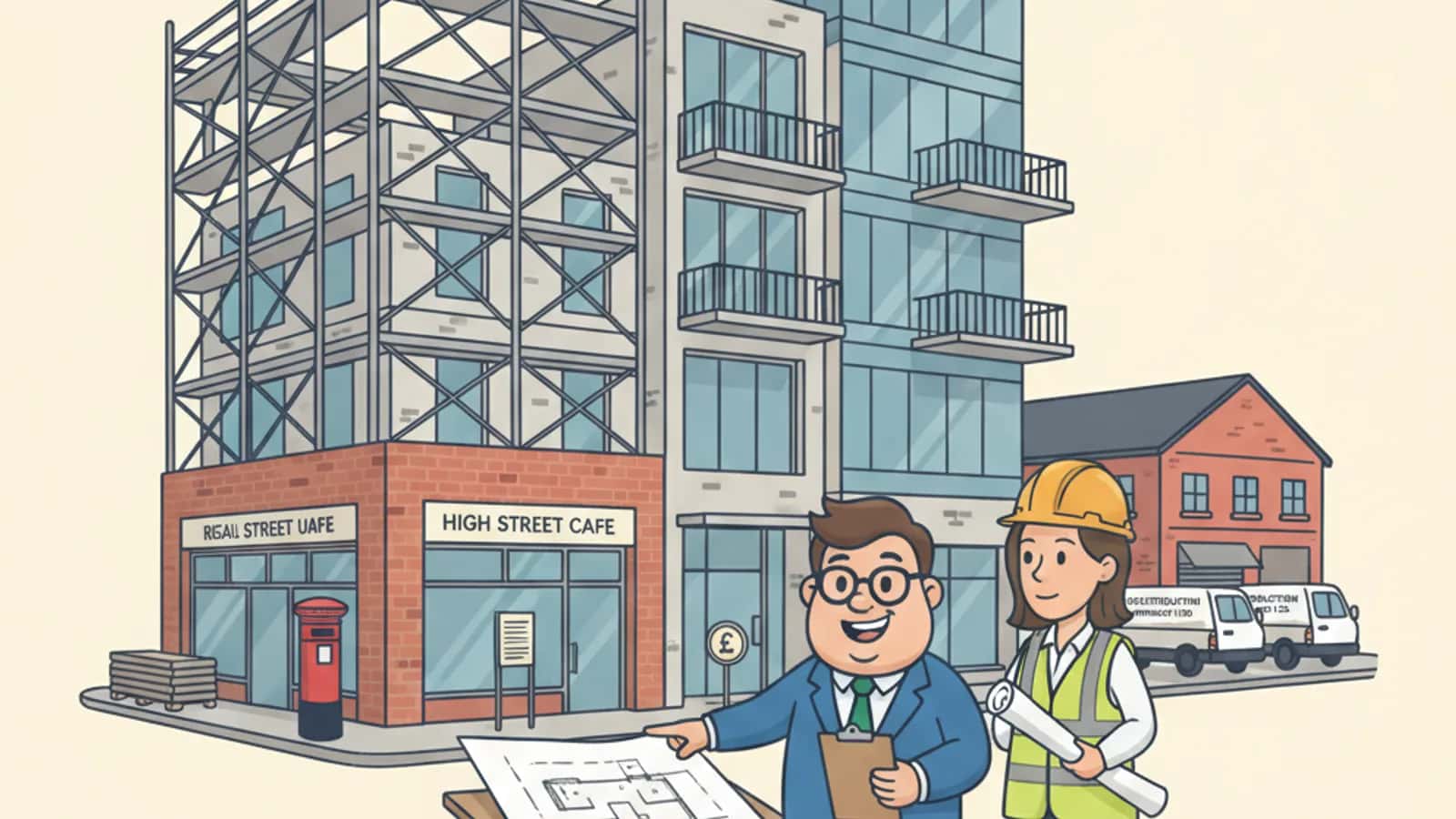
Office-to-Residential Conversion Finance: Funding Change-of-Use Projects
Office-to-residential conversion finance: funding change-of-use projects requires specialist development finance rather than traditional mortgages. Most conversions use construction loans covering 60-70% of project costs at SOFR plus 350-550 basis points, with 18-36 month terms and 30-40% equity requirements.
Quick answer
Office-to-residential conversion finance: funding change-of-use projects requires specialist development finance rather than traditional mortgages. Most conversions use construction loans covering 60-70% of project costs at SOFR plus 350-550 basis points, with 18-36 month terms and 30-40% equity requirements. Success depends on building suitability, local housing demand, and navigating zoning approvals.
Key takeaways
- Construction loans typically cover 60-70% of total project costs for office conversions
- Conversion costs range from £150-£350 per square foot in hard costs alone
- Buildings with smaller floor plates under 20,000 sq ft are most suitable for conversion
- Equity requirements are typically 30-40% of total project costs
- Planning permission and building regulations compliance add significant time and cost
- Government incentives like tax credits can improve project viability
- Exit strategies must account for local residential market demand
- Specialist development finance lenders understand conversion complexities better than high street banks
What Is Office-to-Residential Conversion and How Does Financing Work

Office-to-residential conversion transforms commercial office buildings into residential units through structural modifications, systems upgrades, and regulatory compliance. Financing works through specialist development finance rather than traditional property loans, as these projects require construction-level funding for extensive renovations.
The conversion process involves acquiring an existing office building, obtaining planning permission for change of use, then funding construction work to create residential units. This includes installing residential-grade plumbing, upgrading HVAC systems, adding kitchens and bathrooms, and ensuring compliance with building regulations for residential occupancy.
Development finance lenders structure these deals as construction loans because conversions involve significant building work rather than simple refurbishment. The financing covers both the property acquisition and construction costs, with funds released in stages as work progresses.
Key financing considerations include:
- Loan-to-cost ratios
- typically 60-70% of total project value
- Interest rates
- at base rate plus 3.5-5.5% margin
- Terms
- of 18-36 months to complete conversion work
- Exit strategy
- through refinancing or sale of completed units
In December 2025, Walker & Dunlop arranged a $778.6 million construction loan for converting 111 Wall Street in Lower Manhattan, marking the largest single-building office-to-residential conversion loan in history. This demonstrates the scale and complexity these projects can achieve with proper financing.
For UK developers, development finance specialists understand conversion projects better than high street lenders. They assess project viability based on construction costs, end values, and local housing demand rather than applying standard commercial property lending criteria.
How Much Does It Cost to Convert an Office Building to Apartments

Converting office buildings to apartments costs £150-£350 per square foot in hard construction costs, with total project costs including soft costs and financing reaching £250-£500+ per square foot. The wide cost range depends on building condition, structural requirements, and specification level.
Hard costs include the physical construction work:
- Structural modifications to create residential layouts
- New plumbing and drainage systems throughout
- Residential-grade electrical installations
- HVAC system upgrades for individual unit control
- Kitchen and bathroom installations
- Flooring, decoration, and finishing work
Soft costs add significant expense:
- Planning and building regulation fees
- Architect and structural engineer fees
- Project management and construction monitoring
- Legal costs for change of use applications
- Marketing and sales costs for exit strategy
Building suitability dramatically affects costs. Properties with smaller floor plates under 20,000 square feet, adequate natural light, and existing central services are more economical to convert. Buildings requiring major structural work, new lift installations, or extensive services upgrades can see costs exceed £500 per square foot.
Total project cost: £425-£925 per square foot
These costs explain why many conversions require office acquisition prices to fall significantly before projects become viable. A 2024 Goldman Sachs report indicated office prices would need to drop nearly 50% for most conversions to achieve acceptable returns.
Main Funding Sources for Office-to-Residential Conversion Projects
Development finance lenders are the primary funding source for office-to-residential conversion projects, offering construction loans specifically designed for change-of-use developments. These specialist lenders understand conversion complexities and structure facilities to match project cash flows.
Construction loans provide:
- 60-70% loan-to-cost ratios
- covering acquisition and build costs
- Staged drawdowns
- releasing funds as construction milestones complete
- Interest servicing
- during construction with capital repayment at exit
- 18-36 month terms
- allowing time for planning, construction, and sale/refinancing
Alternative funding sources
include:
Joint venture equity partners
who provide the 30-40% equity requirement in exchange for profit share. These partners often bring development expertise alongside capital, reducing project risk.
Mezzanine finance
bridges the gap between senior debt and equity, typically at higher interest rates but lower equity dilution. This works for larger conversions where additional leverage improves returns.
Government-backed schemes
in some regions offer preferential rates or guarantees for housing developments. These vary by location but can significantly improve project economics.
Private investors
seeking development returns may fund smaller conversion projects directly, particularly where developers have strong track records.
Institutional funding
from pension funds or real estate investment trusts targets larger conversion schemes, typically £10 million+ project values.
For UK developers, specialist development finance offers the most suitable funding structure. These lenders assess conversions based on development expertise rather than applying commercial property lending criteria that don't suit construction projects.
Funding Fred's 2-minute eligibility check connects developers with specialist partners who understand conversion projects. No hard credit search to start, matching projects from £100k to £50m+ with lenders experienced in change-of-use developments.
Can You Get a Traditional Mortgage for Office-to-Residential Conversion
No, traditional mortgages don't work for office-to-residential conversions because these projects involve extensive construction work rather than purchasing a completed residential property. High street mortgage lenders assess finished properties, not development projects requiring planning permission and major building work.
Why traditional mortgages don't fit
- Valuation challenges: Surveyors can't value incomplete conversions using residential comparables
- Construction risk: Mortgage lenders don't assess building work, project management, or construction costs
- Planning uncertainty: Mortgages require legal completion, but conversions need planning permission first
- Staged funding: Construction requires drawdowns as work progresses, not lump sum advances
Commercial mortgages also prove unsuitable because they're designed for investment properties generating immediate rental income. Conversions involve months of construction work with no income during the build period.
Development finance is specifically structured for these projects:
- Pre-planning funding
- available for suitable buildings before planning permission
- Construction expertise
- from lenders who understand building work and project timelines
- Staged releases
- matching construction progress and cash flow requirements
- Exit flexibility
- allowing refinancing to buy-to-let mortgages or sale on completion
After conversion completion, developers can refinance to traditional buy-to-let mortgages for rental properties or arrange residential mortgages for sales to owner-occupiers. The development finance provides the bridge from office building to completed residential units.
Some developers attempt bridging finance for the acquisition then separate construction loans for building work. However, this creates refinancing risk and higher costs compared to integrated development finance covering the entire project.
Bridging loans may suit the initial acquisition if planning permission is already secured, but development finance remains necessary for the construction phase.
Bridge Loans vs Construction Loans for Conversion Projects
Construction loans are better suited for office-to-residential conversions because they're designed for projects involving extensive building work, while bridge loans work best for short-term property transactions with minimal construction requirements.
Construction loans for conversions
- 18-36 month terms allowing time for planning, construction, and exit
- Staged drawdowns releasing funds as work completes, controlling project risk
- Construction monitoring with quantity surveyors assessing work progress
- Higher loan-to-cost ratios up to 70% because lenders understand development projects
- Interest servicing during construction with capital repayment at completion
Bridge loans for conversions
- 12-24 month terms often too short for complex conversion projects
- Lump sum advances providing all funds upfront, increasing carrying costs
- Limited construction expertise as bridging lenders focus on property transactions
- Lower loan-to-value ratios because bridges assess existing property value, not development potential
- Monthly interest payments throughout the loan term
When bridge loans work: If planning permission is already secured and construction work is straightforward, a bridge loan might fund the acquisition with a separate construction facility for building work. However, this creates refinancing risk and typically costs more than integrated development finance.
When construction loans work better: For most conversions involving planning applications, structural work, and extensive services upgrades, construction loans provide better terms and lower risk.
Hybrid approach: Some developers use bridge-to-development finance to secure properties before planning permission, then roll into construction loans for building work. This works where acquisition opportunities require quick completion.
Cost comparison
- Bridge loans: Typically 0.5-1% per month (6-12% annually) plus arrangement fees
- Construction loans: Base rate plus 3.5-5.5% annually plus arrangement fees
For most office-to-residential conversions, construction loans offer better value and more suitable terms than bridging finance.
Office-to-Residential Conversion Finance vs New Construction Financing
Conversion finance typically requires higher equity contributions and carries more risk than new construction financing because conversions involve unknown structural challenges and complex planning requirements that ground-up developments avoid.
Key differences:
Loan-to-cost ratios
- New construction: 70-80% LTC common for experienced developers
- Conversions: 60-70% LTC due to higher uncertainty and complexity
Interest rates
- New construction: Base rate + 3-5% for straightforward residential schemes
- Conversions: Base rate + 3.5-5.5% reflecting additional project risks
Planning complexity
- New construction: Standard residential planning applications with predictable requirements
- Conversions: Change-of-use applications involving building regulations, fire safety, and access compliance
Construction costs
- New construction: Predictable costs based on standard specifications and methods
- Conversions: Variable costs depending on existing building condition and structural requirements
Project timelines
- New construction: 12-24 months from start to completion
- Conversions: 18-36 months including planning, design, and complex construction work
Lender assessment
- New construction: Focus on market demand, build costs, and developer track record
- Conversions: Additional assessment of building suitability, conversion feasibility, and regulatory compliance
Exit strategies
- New construction: Clear residential market comparables for valuation and sales
- Conversions: May require education of valuers and buyers about converted properties
Risk factors unique to conversions
- Structural surprises during construction
- Asbestos or other hazardous materials requiring specialist removal
- Services upgrades proving more extensive than anticipated
- Planning conditions adding unexpected costs
Despite higher complexity, conversions can offer better returns where office acquisition prices are low and residential demand is strong. The key is working with development finance lenders who understand these projects and price risk appropriately.
Common Mistakes When Financing Conversion Projects
Underestimating total project costs is the most common mistake, with developers often focusing on obvious construction work while missing structural, services, and compliance costs that emerge during detailed design and construction phases.
Key financing mistakes:
Insufficient contingency funding: Conversions regularly encounter structural surprises, services complications, or planning conditions requiring additional work. Budget 10-15% contingency minimum, with 20% safer for complex buildings.
Wrong loan structure: Using bridging finance instead of construction loans, or attempting commercial mortgages for development projects. This creates refinancing risk and higher costs.
Inadequate equity provision: Assuming 70-80% leverage like new construction, when conversions typically require 30-40% equity due to higher risk and complexity.
Poor building assessment: Not conducting thorough structural surveys, services assessments, and planning feasibility studies before committing to acquisition and financing.
Ignoring exit strategy: Failing to research local residential market demand, pricing, and sales timelines. Some areas have oversupply of apartments despite office conversion opportunities.
Planning assumption errors: Assuming change-of-use permission will be straightforward, or underestimating building regulation compliance costs for residential conversion.
Construction cost surprises: Getting initial estimates without detailed surveys, then discovering structural work, fire safety upgrades, or accessibility requirements that double construction costs.
Financing timing mistakes: Applying for development finance before securing planning permission, or waiting too long and facing interest rate changes during application periods.
Lender selection errors: Choosing lenders based on headline rates rather than conversion experience, construction monitoring capabilities, and flexibility for project challenges.
Cash flow planning failures: Not accounting for extended development periods, planning delays, or construction complications that extend financing terms and increase costs.
How to avoid these mistakes
- Conduct thorough due diligence before acquisition
- Work with conversion-experienced professionals
- Use specialist development finance rather than inappropriate loan types
- Build realistic budgets with proper contingencies
- Research exit markets thoroughly before starting
How Long Does Financing Approval Take for Conversion Projects
Development finance approval for conversion projects typically takes 4-8 weeks from complete application submission, depending on project complexity, lender experience with conversions, and quality of documentation provided.
Approval timeline breakdown:
- 1
Week 1-2: Initial assessment
- Credit checks on borrowers and guarantors
- High-level project viability review
- Preliminary terms indication if suitable
- 2
Week 2-4: Detailed underwriting
- Full project cost analysis and feasibility assessment
- Planning permission review and compliance evaluation
- Market analysis for exit strategy validation
- Construction monitoring arrangements
- 3
Week 4-6: Valuation and surveys
- RICS valuation of existing building and conversion potential
- Structural survey identifying major works required
- Building services assessment for upgrade requirements
- Quantity surveyor cost verification
- 4
Week 6-8: Final approval and legal
- Credit committee approval for larger facilities
- Legal documentation and security arrangements
- Construction contract review and monitoring setup
- Funds release procedures and milestone definitions
Factors affecting approval speed:
Faster approval (4-6 weeks):
- Experienced developers with strong track records
- Buildings with planning permission already secured
- Complete applications with professional feasibility studies
- Lenders specializing in conversion projects
Slower approval (6-12 weeks):
- First-time conversion developers requiring additional assessment
- Complex buildings needing extensive structural evaluation
- Planning applications still pending or with conditions
- Lenders unfamiliar with conversion project risks
Pre-approval strategies
- Submit complete applications with all supporting documentation
- Use professional quantity surveyors for accurate cost estimates
- Provide detailed market analysis for exit strategy validation
- Work with development finance specialists experienced in conversions
Funding Fred's 2-minute eligibility check provides initial lender matching without hard credit searches, helping developers identify suitable lenders before formal applications. This can reduce overall approval timelines by ensuring applications go to appropriate specialist lenders.
Zoning and Regulatory Requirements for Office Conversions
Office-to-residential conversions require change-of-use planning permission from commercial (Class E) to residential (Class C3) use, plus building regulation approval to ensure the converted building meets residential safety and habitability standards.
Planning permission requirements:
Change of use application demonstrating:
- Suitable residential accommodation can be created
- Adequate natural light and ventilation for all units
- Appropriate access and egress arrangements
- Parking provision meeting local authority standards
- Impact on local infrastructure and services
Building regulation compliance covering:
- Fire safety
- Escape routes, fire doors, detection systems, and compartmentation
- Structural integrity
- Load calculations for new layouts and additional loads
- Insulation and ventilation
- Meeting residential thermal and air quality standards
- Accessibility
- Disabled access and facilities as required
- Sound insulation
- Between units and from external noise sources
Key regulatory challenges:
Residential space standards: Many office buildings have deep floor plates making it difficult to create units with adequate natural light and ventilation. Buildings over 20,000 sq ft floor plates often prove unsuitable.
Fire safety compliance: Offices and residential buildings have different fire safety requirements. Conversions may need additional escape routes, fire-resistant construction, and detection systems.
Accessibility requirements: Residential buildings need wheelchair accessibility, which may require lift installations or major access modifications in older office buildings.
Parking and amenity space: Local authorities often require residential parking provision and amenity space that office buildings may not provide.
Services capacity: Residential use requires different utility loads. Gas, electricity, water, and drainage systems may need significant upgrades.
Streamlined approval processes: Many UK local authorities are fast-tracking conversion applications to address housing shortages, but developers must still meet all safety and habitability requirements.
Professional advice essential: Use planning consultants experienced in conversions and building regulation specialists who understand residential compliance requirements. Poor advice can lead to expensive redesigns or project failure.
Who Qualifies for Office-to-Residential Conversion Financing
Experienced property developers with demonstrable construction project experience qualify most easily for conversion financing, as lenders assess both financial capacity and project delivery capability when evaluating these complex developments.
Primary qualification criteria:
Development experience
- Previous property development or major refurbishment projects
- Construction project management experience or professional team
- Understanding of planning processes and building regulations
- Track record of completing projects on time and budget
Financial strength
- 30-40% equity contribution for total project costs
- Adequate cash reserves for contingencies and cost overruns
- Strong credit history and financial statements
- Personal guarantees typically required for smaller developers
Project viability
- Suitable building with conversion potential
- Planning permission secured or strong prospects for approval
- Realistic cost estimates from qualified professionals
- Clear exit strategy with market evidence
Professional team
- Qualified architect experienced in conversions
- Structural engineer and building services consultants
- Planning consultant for change-of-use applications
- Quantity surveyor for accurate cost estimates
- Construction contractor with conversion experience
Who typically qualifies:
Established developers
with property development track records, even if new to conversions, provided they demonstrate understanding of the additional complexities involved.
Construction companies
expanding into development, particularly those with refurbishment experience, as conversions involve similar skills to major building renovations.
Property investors
with significant portfolios and construction project experience, especially those who've managed major refurbishments or extensions.
Joint venture partnerships
combining development experience with financial capacity, where individual partners may not qualify alone but together meet lender requirements.
Who struggles to qualify
- First-time developers without construction project experience
- Investors seeking 100% financing or minimal equity contributions
- Applicants without professional teams or realistic project planning
- Those with poor credit history or insufficient financial reserves
Funding Fred's development finance platform matches developers with specialist lenders based on project type and experience level. The 2-minute eligibility check identifies suitable lenders without hard credit searches, helping developers understand their options before formal applications.
What Happens if a Conversion Project Runs Over Budget
Budget overruns trigger additional funding requirements that must be met through increased equity contributions, additional borrowing, or project modifications, as most development finance facilities don't automatically increase loan amounts for cost escalations.
Common budget overrun scenarios:
Structural surprises: Hidden structural issues, asbestos removal, or foundation problems discovered during construction can add 20-50% to project costs.
Planning conditions: Additional requirements imposed during planning approval, such as enhanced fire safety systems or accessibility modifications.
Services upgrades: Electrical, plumbing, or HVAC systems requiring more extensive work than initially assessed, particularly in older buildings.
Market changes: Construction cost inflation or material price increases during extended project timelines.
Regulatory compliance: Building regulation requirements proving more extensive than anticipated, requiring additional safety or accessibility work.
Lender responses to overruns:
Additional funding assessment: Lenders may provide extra facilities up to their maximum loan-to-cost ratios, typically requiring updated valuations and cost assessments.
Increased equity requirements: Borrowers must inject additional equity to maintain loan-to-cost ratios and project viability.
Enhanced monitoring: More frequent site inspections and cost reporting to prevent further overruns and protect lender security.
Interest rate adjustments: Some lenders increase margins for projects experiencing significant cost overruns due to increased risk.
Strategies for managing overruns:
Contingency planning: Budget 15-20% contingencies for conversion projects and maintain cash reserves beyond initial equity requirements.
Professional cost management: Use quantity surveyors throughout the project to monitor costs and identify issues early.
Flexible financing: Work with lenders who understand conversion complexities and offer flexibility for genuine project needs.
Insurance protection: Professional indemnity and construction insurance can cover some cost overruns from design errors or unforeseen circumstances.
Communication with lenders: Early notification of potential overruns allows lenders to assess options before funding becomes critical.
Project modifications: Sometimes reducing specification or unit numbers can bring projects back within budget while maintaining viability.
The key is working with specialist development finance lenders who understand that conversions involve more uncertainty than new construction and price their facilities accordingly.
Government Grants and Tax Credits for Office-to-Residential Conversions
Government incentives for office-to-residential conversions vary by location and project type, with some regions offering significant tax benefits or grants to encourage housing development and urban regeneration through adaptive reuse of commercial buildings.
UK government support:
Permitted Development Rights: Streamlined planning processes allow conversion of certain office buildings to residential use without full planning applications, reducing time and costs.
Business rates relief: Some local authorities offer business rates reductions or exemptions during conversion periods to improve project viability.
Housing grants: Local authority housing grants may be available for conversions creating affordable housing units, particularly in areas with acute housing shortages.
Regional development funding: Some regions offer development grants or low-cost loans for projects contributing to local housing targets and urban regeneration.
Historic building incentives: Listed buildings or those in conservation areas may qualify for heritage grants or reduced VAT rates on approved restoration work.
International examples:
US Historic Tax Credits: Provide income tax credits for converting eligible historic office buildings, reducing overall project costs by up to 20% of qualified expenses.
New York City 467-m program: Offers 35-year property tax benefits for qualifying conversions that include affordable housing units, significantly improving project economics.
Canadian rehabilitation incentives: Various provinces offer tax credits or grants for converting commercial buildings to residential use in designated urban areas.
Accessing government support:
Early engagement: Contact local planning authorities and economic development teams before project planning to identify available incentives.
Professional advice: Use planning consultants familiar with local grant programs and application processes to maximize available support.
Affordable housing components: Including affordable units often unlocks additional grant funding and tax benefits.
Environmental benefits: Conversions demonstrating energy efficiency improvements or sustainability features may qualify for green building incentives.
Community benefits: Projects contributing to local regeneration goals or addressing specific housing needs often receive preferential treatment for grant applications.
While government support can significantly improve conversion project economics, developers shouldn't rely on uncertain grant funding for project viability. Use incentives to enhance returns rather than make marginal projects viable.
ROI on Office-to-Residential Conversion Investments
Office-to-residential conversion ROI typically ranges from 15-25% for successful projects, but returns vary significantly based on acquisition prices, conversion costs, and local residential market strength, with many conversions requiring office prices to fall 40-50% from peak values to achieve viable returns.
ROI calculation factors:
Total project costs
- Office building acquisition: £200-£400 per sq ft
- Hard construction costs: £150-£350 per sq ft
- Soft costs and fees: £50-£100 per sq ft
- Finance and contingency: £25-£75 per sq ft
- Total: £425-£925 per sq ft
Revenue potential
- Sale values: £400-£800+ per sq ft for completed units (location dependent)
- Rental yields: 4-8% gross yields on completed conversion value
- Development profit: 15-25% on total development cost for viable projects
Factors affecting returns:
Positive factors
- Low office acquisition prices in declining commercial areas
- Strong local residential demand and pricing
- Efficient building layouts minimizing conversion costs
- Government incentives reducing project costs
- Experienced teams controlling construction costs and timelines
Negative factors
- High office acquisition costs relative to residential values
- Complex buildings requiring extensive structural work
- Oversupplied residential markets limiting sale prices or rental demand
- Planning delays and additional requirements increasing costs
- Construction cost inflation during extended project timelines
Market reality: A 2024 Goldman Sachs analysis found office prices needed to fall nearly 50% for most conversions to achieve acceptable returns. This explains why conversion activity remains limited despite apparent opportunities.
Risk-adjusted returns: Conversions carry higher risk than new construction due to structural unknowns and regulatory complexity. Target returns should reflect this additional risk compared to ground-up development projects.
Successful conversion investors focus on acquiring suitable buildings at significant discounts to replacement cost, then controlling construction costs through experienced professional teams.
Best Cities and Programs for Converting Offices to Residential
Cities with declining office markets, strong residential demand, and supportive planning policies offer the best opportunities for office-to-residential conversions, with New York, London, and other major urban centers leading conversion activity through streamlined approval processes and financial incentives.
Leading conversion markets:
New York City
- 467-m tax abatement program providing 35-year property tax benefits
- Strong residential demand supporting conversion economics
- Streamlined approval processes for qualifying buildings
- Notable projects like 25 Water Street (1,300 apartments) and One Wall Street (500 units)
London and UK cities
- Permitted Development Rights allowing office-to-residential conversion without full planning applications
- Strong housing demand in central urban areas
- Local authority support for housing delivery targets
- Focus on smaller office buildings suitable for conversion
Other active markets
- Chicago: Abundant older office stock and supportive zoning policies
- Philadelphia: Lower acquisition costs and growing residential demand
- Toronto: Provincial incentives and urban intensification policies
- Berlin: Adaptive reuse programs and housing shortage driving conversions
Successful program characteristics:
Streamlined planning: Fast-track approval processes reducing time and uncertainty for conversion projects.
Financial incentives: Tax abatements, grants, or preferential financing improving project economics.
Zoning flexibility: Policies allowing mixed-use developments and varied unit sizes to optimize building layouts.
Infrastructure support: Investment in transportation and amenities supporting residential neighborhoods in former commercial areas.
Market conditions favoring conversions:
Office market weakness: Declining office values creating acquisition opportunities at conversion-viable prices.
Residential demand strength: Housing shortages or population growth supporting absorption of converted units.
Location advantages: Central urban locations with transportation access and amenities attractive to residential occupiers.
Building stock suitability: Inventory of smaller office buildings with characteristics suitable for residential conversion.
Challenges in some markets:
Washington D.C.: High construction costs, zoning restrictions, and market conditions make conversions rarely viable despite office market weakness.
Suburban office parks: Locations lacking residential amenities and transportation access struggle despite low acquisition costs.
For UK developers, focus on city centers with strong housing demand, supportive local authorities, and office buildings under 20,000 sq ft floor plates. Development finance specialists understand which markets and building types offer the best conversion potential.
Next steps
Office-to-residential conversion finance requires specialist development funding rather than traditional property loans, with most successful projects using construction loans covering 60-70% of costs at competitive rates from lenders who understand conversion complexities.
Success depends on acquiring suitable buildings at viable prices, securing appropriate development finance, and managing the planning and construction process professionally. With conversion costs of £150-£350 per square foot plus acquisition and soft costs, total project investments often reach £425-£925 per square foot.
The key is working with experienced professionals and specialist development finance lenders who understand that conversions involve different risks and opportunities than new construction or standard property investment.
Check Eligibility Now with Funding Fred's 2-minute assessment to connect with development finance specialists experienced in office-to-residential conversions. No hard credit check to start, matching projects from £100k to £50m+ with lenders who understand change-of-use developments and can structure facilities to match your project timeline and cash flow requirements.
Further reading
Frequently asked questions
What Is Office-to-Residential Conversion and How Does Financing Work?
Office-to-residential conversion transforms commercial office buildings into residential units through structural modifications, systems upgrades, and regulatory compliance. Financing works through specialist development finance rather than traditional property loans, as these projects require construction-level funding for extensive renovations.
How Much Does It Cost to Convert an Office Building to Apartments?
Converting office buildings to apartments costs £150-£350 per square foot in hard construction costs, with total project costs including soft costs and financing reaching £250-£500+ per square foot. The wide cost range depends on building condition, structural requirements, and specification level.
Can You Get a Traditional Mortgage for Office-to-Residential Conversion?
No, traditional mortgages don't work for office-to-residential conversions because these projects involve extensive construction work rather than purchasing a completed residential property. High street mortgage lenders assess finished properties, not development projects requiring planning permission and major building work.
How Long Does Financing Approval Take for Conversion Projects?
Development finance approval for conversion projects typically takes 4-8 weeks from complete application submission, depending on project complexity, lender experience with conversions, and quality of documentation provided.
Who Qualifies for Office-to-Residential Conversion Financing?
Experienced property developers with demonstrable construction project experience qualify most easily for conversion financing, as lenders assess both financial capacity and project delivery capability when evaluating these complex developments.
What Happens if a Conversion Project Runs Over Budget?
Budget overruns trigger additional funding requirements that must be met through increased equity contributions, additional borrowing, or project modifications, as most development finance facilities don't automatically increase loan amounts for cost escalations.
Written by
The Funding Fred Editorial Team creates plain-English guides to help business owners understand funding options, eligibility, and application readiness before they compare finance options.
Reviewed by
UK business finance content reviewer
Robert reads our UK business finance guides before they go live, checking each one is accurate, easy to follow, and reflects how lending actually works today — not how a brochure says it should. He's listed on the FCA Register, approved as an SMF3 (AR) Executive Director at Switcha Limited, and connected to Lucky Growth Partners Ltd through its appointed representative relationship, so the regulated detail gets a properly qualified second read.
Sources
- 867 Million Financing Office Residential Conversion [2] Office To Residential Conversion Nyc Guide - https://sky-nyc.com/blog/office-to-residential-conversion-nyc-guide [3] Office To Residential Conversion Financing - https://clscre.com/blog/office-to-residential-conversion-financing.html [4] Office To Residential Conversion What To Know - https://www.jpmorgan.com/insights/real-estate/community-development-banking/office-to-residential-conversion-what-to-know [5] Goldman Sachs Office Residential Conversions Price Cut - https://fortune.com/2024/02/28/goldman-sachs-office-residential-conversions-price-cut/ [6] Office To Residential Conversions - https://www.deloitte.com/us/en/insights/industry/financial-services/office-to-residential-conversions.html [7] Why Office To Residential Conversions Rarely Work In Dc - https://globalrealassets.georgetown.edu/insight/why-office-to-residential-conversions-rarely-work-in-dc/
- British Business Bank finance options
- GOV.UK business finance support