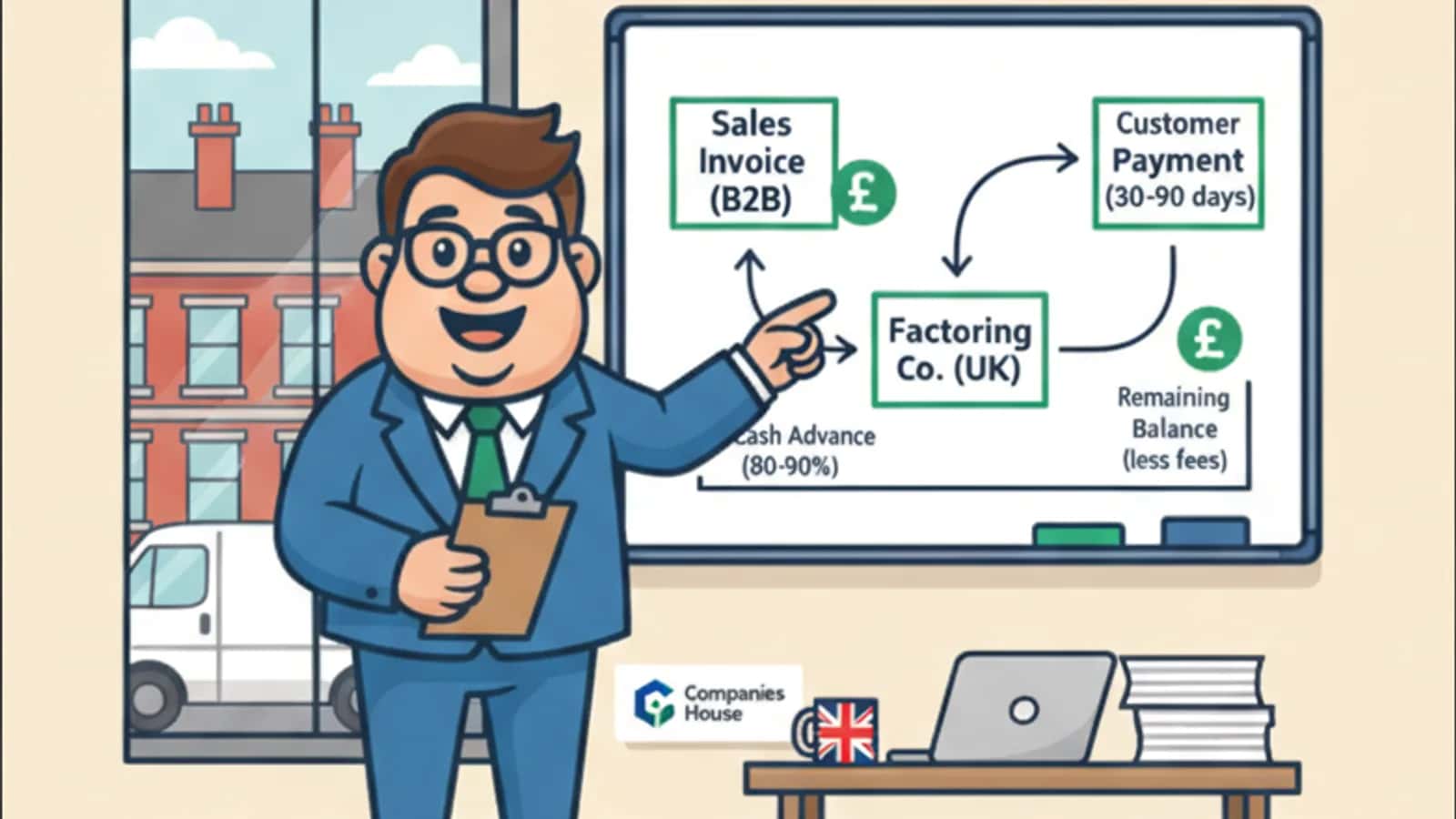
Recourse vs Non-Recourse Factoring: Who Carries the Bad-Debt Risk?
In recourse factoring, your business still carries the bad-debt risk if a customer never pays, the factor can buy the invoice back from you. In non recourse factoring, the factor absorbs the loss on approved, credit-checked debtors who become insolvent, within set limits.

Quick answer
In recourse factoring, your business still carries the bad-debt risk if a customer never pays, the factor can buy the invoice back from you. In non recourse factoring, the factor absorbs the loss on approved, credit-checked debtors who become insolvent, within set limits. Non-recourse protection usually costs more, excludes disputed invoices, and only applies within pre-agreed credit limits per customer.
Key takeaways
- Recourse factoring keeps bad-debt risk with your business. If an invoice goes unpaid, the factor reclaims the advance from you, often after a set recourse period.
- Non recourse factoring shifts insolvency risk to the factor, but only for invoices approved in advance and within an agreed credit limit per debtor.
- Non-recourse protection typically covers genuine customer insolvency, not late payment, disputes, or quality complaints.
- Non-recourse facilities generally carry a higher fee than recourse factoring because the factor is pricing in credit risk.
- Businesses with one dominant customer often lean toward non-recourse, because a single large default would otherwise hit cash flow hard.
- Smaller or newer businesses can access non-recourse factoring, but approval depends on the creditworthiness of their customers, not just their own.
- Market research shows rising demand for non-recourse and credit-protected invoice finance as businesses seek more certainty during uncertain trading conditions.
- Table of Contents
- What is non recourse factoring and how does it work
- Recourse vs non recourse factoring: what's the real difference
- Who pays if a customer doesn't pay in non recourse factoring
- What non-recourse bad debt protection covers
- What is a recourse period
- Non recourse factoring fees and costs
- Non recourse vs recourse factoring: which is better
- Non recourse factoring for small businesses and startups
- Non recourse factoring requirements and eligibility
- How factors assess credit risk
- Non recourse factoring risks and disadvantages
- Is non recourse factoring worth the higher fees
- FAQ
What is non recourse factoring and how does it work

Non recourse factoring is an invoice finance arrangement where the factor agrees to absorb the loss if an approved customer becomes insolvent and genuinely cannot pay, rather than passing that loss back to the business that raised the invoice.
Here's how it typically works in practice:
- The factor reviews each debtor (your customer) before agreeing a credit limit for that specific customer.
- You sell invoices within that limit, and the factor advances most of the invoice value upfront.
- If the customer pays normally, nothing changes, the facility works like standard invoice factoring.
- If the customer becomes insolvent within the approved limit and period, the factor writes off that debt rather than reclaiming the advance from you.
This structure means the factor is effectively pricing credit risk into the facility, similar to trade credit insurance bundled into the funding line. Businesses exposed to a concentrated customer base, or sectors with slower payment cycles like construction and wholesale, often explore this route for extra certainty.
Recourse vs non recourse factoring: what's the real difference
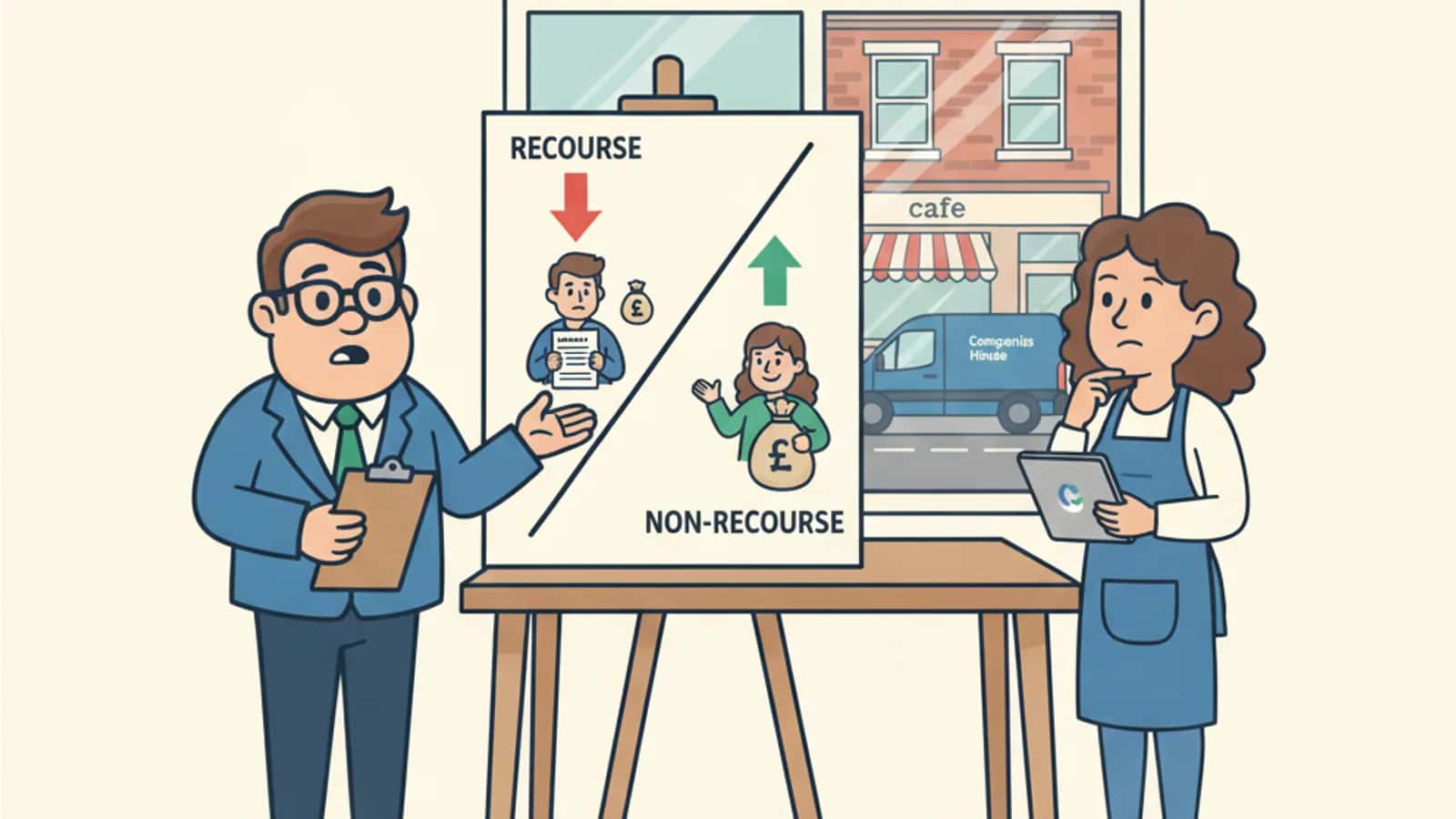
The core difference between recourse and non recourse factoring is who absorbs the loss when a customer never pays. Recourse factoring leaves that risk with your business; non recourse factoring transfers a defined portion of it to the factor.
| Feature | Recourse factoring | Non recourse factoring |
|---|---|---|
| Who carries bad-debt risk | Your business | The factor (within limits) |
| Typical cost | Lower fees | Higher fees, reflecting risk transfer |
| Covers customer insolvency | No, invoice bought back | Yes, within approved credit limits |
| Covers payment disputes | No | No, disputes are excluded either way |
| Credit checking on debtors | Lighter | More thorough, per-debtor underwriting |
| Best suited to | Diversified customer base, strong credit control | Concentrated customers or credit-sensitive sectors |
Recourse vs non recourse factoring isn't really about which is "better" in isolation, it's about which risk allocation fits your customer base and cash flow tolerance. A business with dozens of small, reliable customers may never need non-recourse cover. A business billing one large retailer for 70% of revenue has a very different risk profile.
For a side-by-side look at how factoring compares with invoice discounting more broadly, see this guide on factoring vs discounting.
Who pays if a customer doesn't pay in non recourse factoring
In non recourse factoring, the factor pays for the loss when a customer becomes genuinely insolvent within the agreed credit limit and timeframe, not your business. But this protection is narrower than many business owners assume.
What typically happens:
- The factor confirms the customer met the definition of insolvency (for example, administration, liquidation, or a formal insolvency process).
- The unpaid invoice must sit within the approved credit limit set for that debtor.
- The claim must be made within the policy's notification window.
- If all conditions are met, the factor absorbs the loss instead of debiting your account.
If the customer simply refuses to pay because of a quality dispute, short delivery, or contractual disagreement, that's a different scenario entirely, not bad-debt protection, but a commercial dispute. For a full breakdown of what actually happens operationally when a customer fails to pay, read what happens if a customer doesn't pay.
What non-recourse bad debt protection covers and what it doesn't
Non-recourse bad debt protection in invoice finance covers confirmed customer insolvency on approved invoices within agreed limits. It does not cover disputed invoices, late payment, or debts outside the approved credit limit.
What's typically included
- Formal insolvency of the debtor (administration, liquidation, bankruptcy-equivalent processes)
- Invoices that were pre-approved and within the agreed credit limit
- Claims made within the policy or contract notification period
What's typically excluded
- Invoice disputes over goods, services, pricing, or delivery
- Invoices issued above the approved credit limit for that customer
- Customers who simply pay late but remain solvent
- Invoices raised after a credit limit was withdrawn or reduced
- Contractual or performance disagreements between you and your customer
This is the point worth repeating: non-recourse protection is insolvency cover, not a guarantee against every unpaid invoice. If your business has a track record of disputes with customers over delivery quality or short-shipments, non-recourse factoring won't resolve that, it only addresses the risk of a customer going under.
What is a recourse period
A recourse period is the length of time a factor allows before it can require you to buy back an unpaid invoice under a recourse facility. It's a key contract term that determines how long you're "on the hook" before the factor reclaims funds advanced against that invoice.
How it tends to work:
- The factor sets a recourse period, commonly measured in weeks from the invoice due date (exact lengths vary by provider and contract).
- If the invoice remains unpaid at the end of that period, the factor debits your account or reduces future advances to recover the funds.
- In non-recourse deals, this mechanic is replaced (for approved, insolvent debtors) by the bad-debt protection terms instead.
Non recourse factoring fees and costs
Non recourse factoring usually costs more than recourse factoring because the factor is pricing in the cost of absorbing insolvency risk on your customers. The exact premium depends on your customer concentration, sector, and the credit quality of your debtor book, so it varies by provider and applicant.
Factors that influence the cost gap:
- Debtor credit quality
- , stronger, well-rated customers reduce the risk the factor is taking on, which can narrow the premium.
- Customer concentration
- , a book reliant on one or two large accounts usually pushes pricing up, since a single insolvency event is a bigger exposure for the factor.
- Sector risk
- , sectors with higher historical insolvency rates may see a wider gap between recourse and non-recourse pricing.
- Credit limit size
- , larger approved limits per debtor generally mean more risk transferred, which can affect fees.
Because pricing structures differ across providers (discount rate, service fee, minimum fees, and how bad-debt cover is charged), it's worth reviewing the full fee breakdown before comparing facilities. This guide on invoice finance costs walks through the typical components so you're comparing like-for-like quotes rather than headline rates alone.
Non recourse vs recourse factoring: which is better for your business
Neither option is universally better, the right choice depends on how concentrated your customer base is and how much bad-debt risk your business can absorb without disrupting cash flow. Non recourse factoring suits businesses that can't easily withstand a large customer default; recourse factoring suits businesses with a diversified, well-vetted customer base.
Which is right for you?
Choose recourse factoring if
- Your customer base is spread across many accounts, so no single default would be catastrophic.
- You already run solid credit checks and have low historical bad debt.
- You want the lowest possible funding cost.
Choose non recourse factoring if
- A handful of customers make up most of your invoice value.
- You operate in a sector with a higher rate of customer insolvency.
- Cash flow certainty matters more to you than shaving a few basis points off fees.
Which suits businesses with one large customer
Businesses billing one dominant customer for most of their revenue are often the strongest candidates for non recourse factoring, because a single insolvency event could otherwise wipe out a large share of outstanding invoices. In this scenario, the factor sets a credit limit specifically for that one debtor, and protection applies only up to that limit, so it's worth confirming the limit covers your typical invoice value, not just your average exposure.
If you're still deciding between structures generally, this overview of factoring vs discounting explains how recourse terms interact with each funding model.
Non recourse factoring for small businesses and startups
Small businesses and startups can access non recourse factoring, but approval depends heavily on the creditworthiness of their customers rather than the business's own trading history. Because the factor is underwriting the debtor, not just the applicant, a young business selling to large, well-rated companies may qualify more easily than one with a longer track record but weaker customers.
Practical considerations for smaller businesses:
- Early-stage businesses with concentrated customer risk (one or two buyers) are often exactly the profile non-recourse protection is designed for.
- Startups selling to small or newer companies may find credit limits lower, or non-recourse cover harder to secure, simply because the debtor's own credit file is thin.
- Many smaller businesses start with recourse factoring and move to non-recourse once customer relationships and invoice volumes are established.
For a broader look at how eligibility is assessed across invoice finance generally, see this guide to invoice finance eligibility criteria.
Non recourse factoring requirements and eligibility
Non recourse factoring eligibility depends mainly on the credit quality of your customers, your invoice volume, and how clean your sales ledger is, not solely on your own company's credit score. Lenders also look at your sector, average invoice size, and payment history with existing customers.
Typical requirements lenders assess:
- B2B invoices (not consumer sales) issued for completed goods or services
- A spread of customers, or at least customers the factor is willing to credit-check and approve
- Clean contracts with no onerous assignment or payment clauses
- Reasonable invoice volume to justify underwriting costs
Can you get non recourse factoring with bad credit
Your business having a weaker credit history doesn't automatically rule out non recourse factoring, because the factor is primarily underwriting your customers' ability to pay, not yours. That said, providers will still look at your business's financial stability, VAT and HMRC standing, and Companies House filings as part of overall risk assessment. If your own credit position is weak but your customers are strong, non-recourse factoring can sometimes be more accessible than a traditional loan, since repayment isn't tied to your personal or business credit score in the same way.
How factors assess credit risk and compare non recourse factoring companies
Factors assess credit risk in non-recourse deals by reviewing each debtor's financial strength individually, then setting a specific credit limit per customer rather than one blanket limit for your whole ledger. This is a different underwriting process from recourse factoring, where the focus sits more on your own trading history.
Typical assessment steps:
- Checking the debtor's filed accounts, payment history, and credit agency rating
- Reviewing trade references and existing credit relationships
- Setting an approved limit per debtor, which can be reduced or withdrawn if the customer's position deteriorates
- Monitoring ongoing exposure as invoice volumes change
When comparing non recourse factoring companies, look beyond the headline fee. Ask how credit limits are set and reviewed, how claims are triggered, what counts as "insolvency" under their terms, and how quickly limits can be reduced mid-contract. Providers differ meaningfully on these mechanics, and this is also where risk and approval differences between lenders tend to show up most clearly.
Non recourse factoring risks and disadvantages
The main disadvantages of non recourse factoring are higher cost, narrower cover than many businesses expect, and the possibility that credit limits can be reduced or withdrawn on a customer mid-facility.
Key risks to weigh up:
- Higher fees
- eat into margin on every invoice, even ones that would never have gone bad.
- Credit limits can shrink
- if a customer's financial position weakens, cutting your available funding on that account without warning.
- Disputes aren't covered
- , so a business with frequent quality or delivery disagreements gets little real protection.
- False sense of security
- , some businesses relax credit control because they assume everything is covered, then discover a specific invoice fell outside the approved limit.
Decision rule: if your bad-debt history is already low and your customers are financially stable, the extra cost of non-recourse factoring may not be justified. If one insolvency could seriously damage your cash position, the premium is often worth paying.
Is non recourse factoring worth the higher fees
Non recourse factoring is generally worth the higher fees for businesses with concentrated customer risk or operating in insolvency-prone sectors, and generally less worth it for businesses with a diversified, low-risk customer base. Market data shows growing uptake of non-recourse and credit-protected structures as businesses look for more certainty during uncertain economic conditions.
A simple way to weigh it up:
- Estimate your largest single customer's invoice exposure at any one time.
- Compare that figure against cash reserves you could absorb without disruption.
- If the exposure would seriously strain payroll, suppliers, or growth plans, the non-recourse premium is likely a reasonable insurance cost.
- If the exposure is small relative to your overall ledger, recourse factoring at a lower fee may be the more efficient choice.
Eligibility and application readiness checklist
- Sales ledger shows mainly B2B invoices, not consumer transactions
- Customer list identified, with largest debtors flagged for credit assessment
- Recent management accounts and bank statements ready to share
- Companies House filings and HMRC/VAT position up to date
- Existing contracts reviewed for assignment or payment clauses
- Clear answer on whether one customer represents a large share of revenue
- Realistic view of your own bad-debt history to compare against quoted fees
Next steps for non recourse factoring
Recourse and non-recourse factoring answer the same underlying question differently: who takes the hit if a customer can't pay? Recourse keeps that risk with you, at a lower cost. Non recourse factoring moves defined insolvency risk to the factor, at a higher price, with real limits on what's actually covered.
The right structure depends on your customer concentration, your sector's insolvency history, and how much cash flow disruption your business could absorb from a single bad debt. There's no universally "correct" answer, only the one that matches your risk tolerance and your ledger.
If you're ready to compare facilities, start with a straightforward invoice finance check. Funding Fred's 2 min check has no hard check to start, matches you with specialist partners, and gives you a fast decision with no obligation, so you can see real options for invoice factoring and invoice discounting before committing to either recourse or non-recourse terms. For more comparisons like this one, visit the invoice financing hub.
Frequently asked questions
What is non recourse factoring and how does it work?
Non recourse factoring is an invoice finance arrangement where the factor agrees to absorb the loss if an approved customer becomes insolvent and genuinely cannot pay, rather than passing that loss back to the business that raised the invoice.
Who pays if a customer doesn't pay in non recourse factoring?
In non recourse factoring, the factor pays for the loss when a customer becomes genuinely insolvent within the agreed credit limit and timeframe, not your business. But this protection is narrower than many business owners assume.
What non-recourse bad debt protection covers and what it doesn't?
Non-recourse bad debt protection in invoice finance covers confirmed customer insolvency on approved invoices within agreed limits. It does not cover disputed invoices, late payment, or debts outside the approved credit limit.
What is a recourse period?
A recourse period is the length of time a factor allows before it can require you to buy back an unpaid invoice under a recourse facility. It's a key contract term that determines how long you're "on the hook" before the factor reclaims funds advanced against that invoice.
How factors assess credit risk and compare non recourse factoring companies?
Factors assess credit risk in non-recourse deals by reviewing each debtor's financial strength individually, then setting a specific credit limit per customer rather than one blanket limit for your whole ledger. This is a different underwriting process from recourse factoring, where the focus sits more on your own trading history.
Is non recourse factoring worth the higher fees?
Non recourse factoring is generally worth the higher fees for businesses with concentrated customer risk or operating in insolvency-prone sectors, and generally less worth it for businesses with a diversified, low-risk customer base. Market data shows growing uptake of non-recourse and credit-protected structures as businesses look for more certainty during uncertain economic conditions.
Written by
The Funding Fred Editorial Team creates plain-English guides to help business owners understand funding options, eligibility, and application readiness before they compare finance options.
Reviewed by
UK business finance content reviewer
Robert reads our UK business finance guides before they go live, checking each one is accurate, easy to follow, and reflects how lending actually works today — not how a brochure says it should. He's listed on the FCA Register, approved as an SMF3 (AR) Executive Director at Switcha Limited, and connected to Lucky Growth Partners Ltd through its appointed representative relationship, so the regulated detail gets a properly qualified second read.
Sources
- Invoice Factoringplace Market
- Invoice Factoring Market
- Factoring Services Market 111547
- Invoice Factoring Market
- Us Factoring Services Market Report
- Factoring Services Market
- Recourse Vs Non Recourse Factoring
- Invoice Financing Market
- Recourse Factoring Vs Non Recourse Factoring
- 23102025131334 Recourse Vs Non Recourse Factoring