Debt Factoring UK: How Invoice Factoring Works and What It Costs
Debt factoring is a funding arrangement where a business sells its unpaid invoices to a factoring company in exchange for an upfront cash advance, usually a large percentage of the invoice value, paid within a day or two of approval.
Quick answer
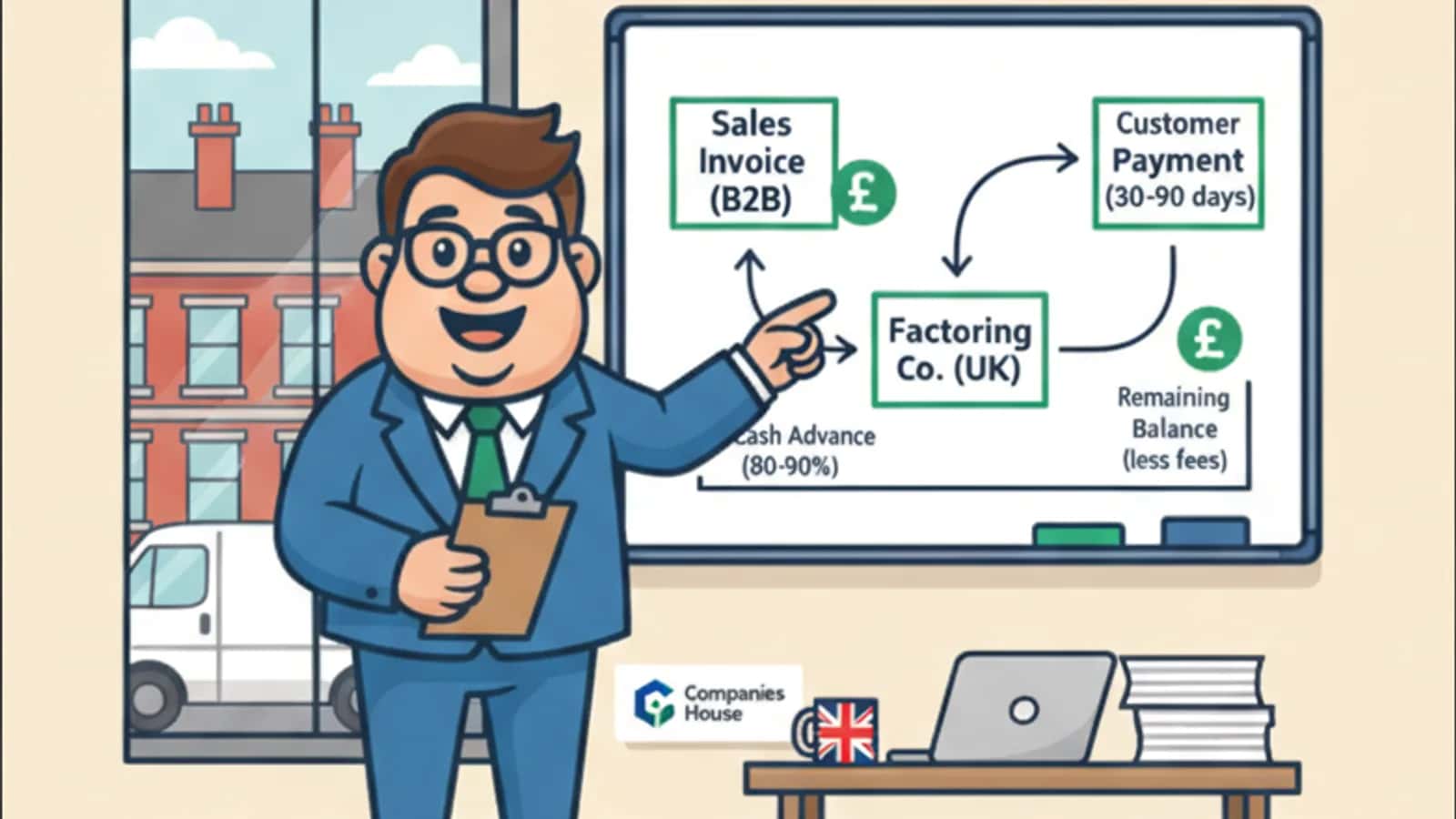
Debt factoring is a funding arrangement where a business sells its unpaid invoices to a factoring company in exchange for an upfront cash advance, usually a large percentage of the invoice value, paid within a day or two of approval. The factoring company then takes over collecting payment from your customers and releases the remaining balance, minus fees, once the invoice is settled. Costs typically combine a service fee and a discount charge, and pricing varies by lender, invoice volume, and customer credit quality.
Key takeaways
- Debt factoring converts unpaid invoices into cash, usually with most of the invoice value advanced upfront and the rest released on customer payment, minus fees.
- Factoring is disclosed: your customers usually know a factoring company is involved and pay them directly.
- Costs are typically made up of a service fee (for credit control and admin) plus a discount charge (similar to interest on the advance).
- Debt factoring suits businesses with a B2B sales ledger and slow-paying customers, including recruitment, construction, logistics, manufacturing, and wholesale firms.
- Non-recourse factoring includes bad debt protection; recourse factoring does not, so check which type you're being offered.
- Invoice discounting is the confidential alternative where you keep your own credit control and customers don't know a third party is funding the invoice.
- Startups can sometimes access factoring because approval often leans on customer creditworthiness rather than your own trading history, though eligibility still varies by lender.
- Pricing, advance rates, and funding speed vary by provider and applicant, so always check terms directly with a factoring company before signing.
What Is Debt Factoring and How Does It Work Step by Step?
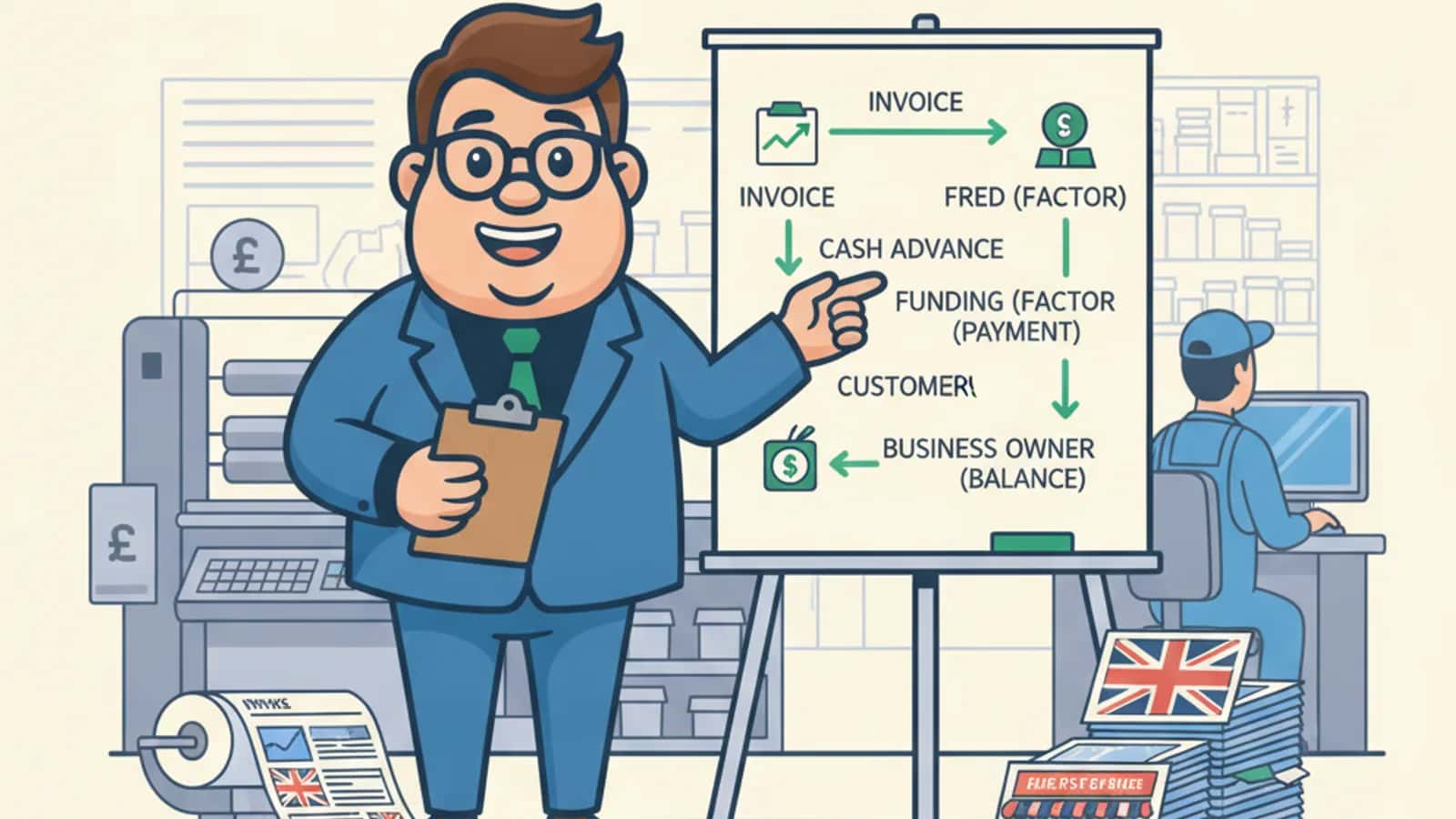
Debt factoring is a form of invoice finance where you sell unpaid invoices to a factoring company and receive a cash advance against their value. The factoring company then manages collection from your customer directly, and releases the remaining balance once the invoice is paid.
Here's how the process usually runs in practice:
- You raise an invoice. You deliver goods or services to a business customer and issue a normal invoice on your usual payment terms.
- You submit the invoice to the factoring company. This is often done through an online portal linked to your accounting software.
- The factoring company advances a percentage of the invoice value. This is typically paid into your account within one to two business days of approval, though timing varies by lender and applicant.
- The factoring company takes over credit control. They chase payment from your customer under their own name or a trading name, following agreed processes.
- Your customer pays the factoring company directly, usually into a dedicated collections account, rather than paying you.
- You receive the remaining balance, minus the agreed fees, once the invoice is settled in full.
This differs from a simple sales ledger loan because ownership of the debt (or the right to collect it) moves to the factoring company, not just the funding. For a fuller walkthrough of the mechanics and timing, see this step-by-step invoice finance process guide.
Invoice Factoring vs Traditional Business Loans
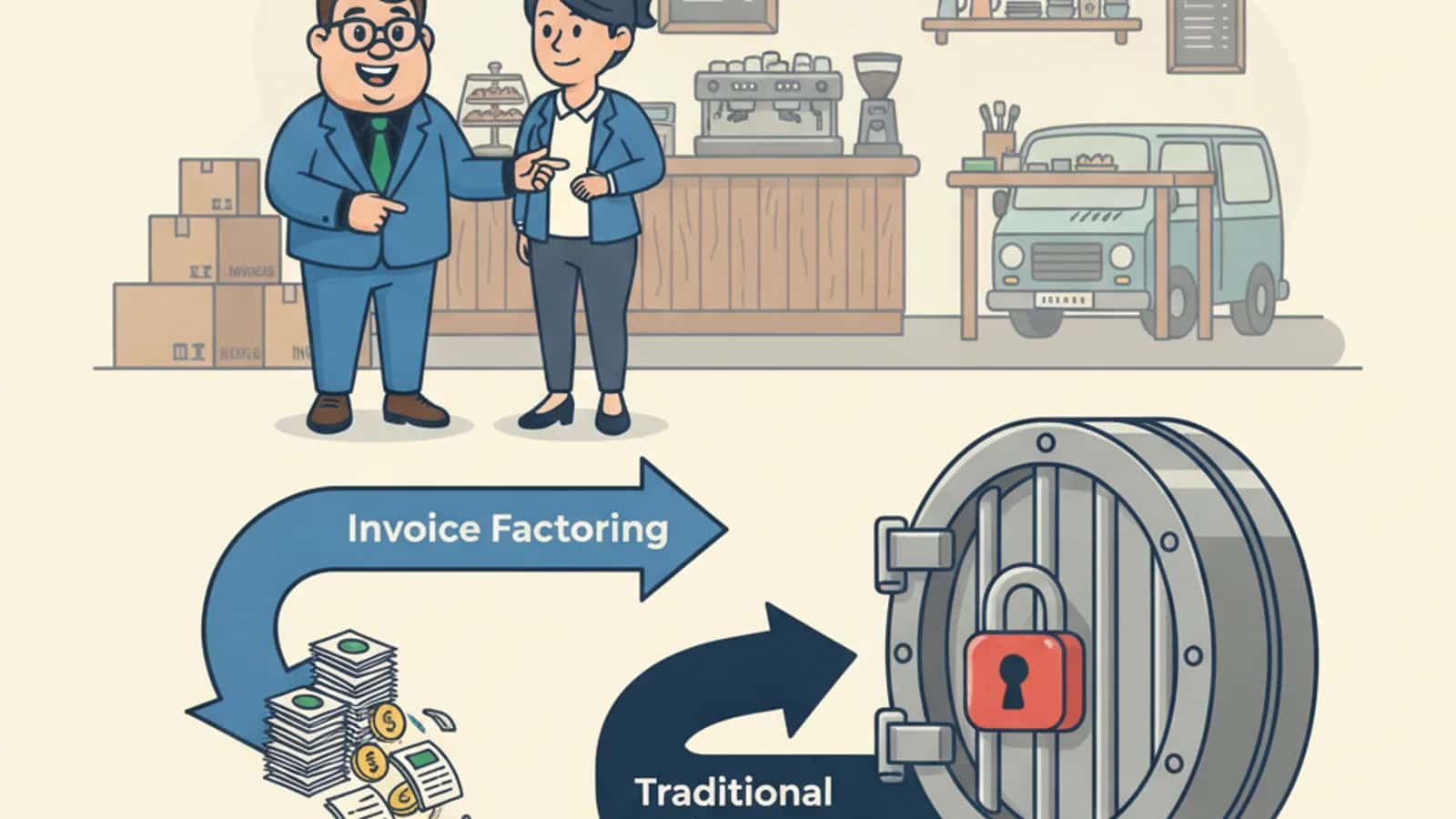
Debt factoring is not a loan. It's an advance against money your business has already earned, so it doesn't sit on your balance sheet the same way a term loan does.
The practical differences matter when you're comparing options:
| Feature | Debt Factoring | Traditional Business Loan |
|---|---|---|
| What's funded | Unpaid invoices you've already issued | A lump sum against general business assets or cash flow |
| Speed | Often same-week once a facility is set up | Can take longer, especially for larger sums |
| Repayment | Repaid as customers pay their invoices | Fixed monthly repayments regardless of customer payment |
| Credit control | Often handled by the factoring company | Stays with you |
| Growth link | Scales automatically as sales grow | Fixed limit set at approval |
| Customer visibility | Usually disclosed to customers | Not applicable |
Which is right for you?
Choose factoring if
your main cash flow problem is slow-paying customers on a healthy sales ledger, not a lack of underlying profitability.
Choose a traditional loan if
you need funding unrelated to your invoice book, such as equipment purchase or a one-off cost, and prefer fixed, predictable repayments.
For businesses weighing both routes side by side, this comparison of invoice finance against business loans goes into more detail on when each fits.
What Does Debt Factoring Cost in the UK?
Debt factoring costs are usually built from two parts: a service fee for credit control and administration, and a discount charge for the cash advanced, similar in function to interest. Exact rates depend on your turnover, invoice volume, customer credit quality, and the provider you use, so there is no single published UK-wide rate.
The typical fee structure looks like this:
- Service fee
- Covers invoice processing, credit control, and collections. Usually calculated as a percentage of each invoice value.
- Discount charge
- Applied to the amount advanced, calculated daily or monthly until the invoice is paid, in a similar way to an overdraft or loan interest charge.
- Additional charges
- Some facilities include setup fees, minimum monthly fees, or charges for same-day payments. These vary significantly between providers.
Because pricing structures differ by lender and are shaped by factors like sector risk, invoice volume, and customer spread, treat any quoted percentage as provider-specific rather than a market average. For a breakdown of what tends to drive pricing up or down, see this detailed look at invoice finance costs.
Decision rule: if your margins are thin on the invoices you'd be factoring, run the maths on total fees against the invoice value before committing, rather than just looking at the advance percentage.
Debt Factoring Fees and Hidden Charges to Watch For
The headline service fee and discount charge are not always the full cost. Some agreements include extra charges that only appear in the small print or kick in under specific conditions.
Things worth checking in any factoring agreement:
- Minimum fee clauses
- A guaranteed minimum monthly charge even if you factor fewer invoices than expected.
- Contract length and exit fees
- Some facilities lock you in for a minimum term, with charges for leaving early.
- CHAPS or same-day payment fees
- Faster access to funds can carry an extra charge per transaction.
- Credit check fees
- Charges for assessing the creditworthiness of new customers added to your ledger.
- Concentration limits
- If one customer makes up too much of your ledger, the factoring company may cap or reduce funding against that customer specifically.
Who Needs Invoice Factoring and Is It Right for Your Business?
Invoice factoring suits businesses that invoice other businesses on credit terms and have healthy, collectable invoices but struggle with the gap between doing the work and getting paid. It's less suitable for businesses that sell to consumers, have very few large customers, or already have strong in-house credit control they want to keep.
Typical sectors that use debt factoring include:
- Recruitment and staffing (covering weekly payroll while clients pay on 30 to 60 day terms)
- Construction and trades (bridging the gap between completed work and contractor payment runs)
- Logistics and haulage (funding fuel and driver costs while waiting on 60 to 90 day customer terms)
- Manufacturing and wholesale (financing stock and production costs against committed orders)
- Business services and consultancies (managing project-based invoicing with long client payment cycles)
Debt factoring for small businesses UK: smaller companies often turn to factoring because it can be more accessible than it appears, since approval tends to weigh more heavily on customer creditworthiness than on the applicant's own trading history or assets. That said, eligibility criteria, minimum turnover expectations, and acceptable sectors vary by provider, so check requirements directly with any factoring company before applying.
Is it right for your business? Ask yourself:
- Do you invoice other businesses, not consumers?
- Do your customers generally pay, just slowly?
- Would faster cash flow let you cover payroll, take new contracts, or avoid late payment penalties to your own suppliers?
If you answered yes to all three, factoring is worth investigating. The Invoice Finance for UK Businesses overview explains how a facility is structured and matched to your sales ledger.
How Quickly Can You Get Money From Invoice Factoring?
Once a factoring facility is set up, funds against new invoices are often released within one to two business days of submission and approval, though exact timing depends on the provider, the customer's credit check status, and how the invoice is submitted. Setting up the initial facility itself usually takes longer than funding a single invoice.
Speed depends on:
- Whether the customer has already been credit-checked and approved on your ledger
- How the invoice is submitted (automated portal integrations tend to be faster than manual submission)
- Whether you need same-day or standard payment, which can affect cost
Debt Factoring Advantages and Disadvantages
Debt factoring advantages and disadvantages both stem from the same core feature: you're handing over credit control in exchange for faster cash and support chasing payment. For some businesses, that's a clear win. For others, it's a trade-off worth thinking through.
Advantages
- Faster access to cash tied up in unpaid invoices
- Reduces reliance on traditional lending and personal guarantees
- Credit control and chasing is handled for you, saving admin time
- Funding scales with sales, not a fixed limit set months earlier
- Can include bad debt protection under non-recourse agreements
Disadvantages
- Customers usually know a third party is involved, which some businesses are sensitive about
- Fees reduce overall margin on factored invoices
- Recourse facilities mean you may still be liable if a customer doesn't pay
- Minimum contract terms and exit fees can reduce flexibility
- Not well suited to businesses with very few, very large customers (concentration risk)
Common Mistakes When Using Invoice Factoring
The most common mistakes come from underestimating total cost and overestimating control once customers are notified. Avoiding them starts with reading the agreement closely and testing the facility on a small scale first where possible.
Frequent errors to avoid:
- Factoring your entire ledger at once
- without testing how the provider handles customer communication
- Not clarifying recourse vs non-recourse terms
- , then being surprised when a bad debt lands back on the business
- Ignoring concentration limits
- , which can leave funding capped if one customer dominates the ledger
- Failing to tell customers in advance
- , creating confusion when the factoring company contacts them for the first time
- Comparing only headline discount rates
- between providers without checking service fees, minimums, and exit terms
Debt Factoring vs Invoice Discounting vs Supply Chain Financing
Debt factoring, invoice discounting, and supply chain financing all unlock cash from unpaid invoices or purchase orders, but they differ in who controls credit chasing and whether the customer knows a third party is involved.
- Debt factoring
- Disclosed. The factoring company manages credit control and your customer pays them directly.
- Invoice discounting
- Usually confidential. You keep managing credit control and collections yourself; the funder simply advances cash against the ledger. Customers typically aren't aware of the arrangement.
- Supply chain financing
- Usually initiated by a large buyer to help their suppliers get paid early, funded against the buyer's own credit strength rather than the supplier's ledger generally.
For most SMEs comparing their two realistic options, the choice comes down to factoring vs discounting. This detailed guide on invoice discounting vs factoring walks through how to decide based on your ledger size, credit control resources, and customer sensitivity.
Decision rule: choose discounting if you want to keep customer relationships fully in-house; choose factoring if you'd rather outsource collections and don't mind customers knowing.
Can Startups Use Debt Factoring?
Startups can sometimes access debt factoring because approval often depends more on the creditworthiness of your customers than on your own trading history. That said, many providers still want to see a minimum level of invoice volume or a certain number of months trading, so eligibility varies by lender.
What tends to help a new business qualify:
- A clear, collectable sales ledger with recognisable business customers
- Invoices for completed, undisputed work
- Reasonable invoice values relative to the facility size being requested
Startups should expect more scrutiny on individual customers, since the factoring company is effectively underwriting their ability to pay, not just the applicant's business plan.
Will My Customers Know About Debt Factoring?
Yes, in most standard debt factoring arrangements, your customers will know. The factoring company typically contacts them directly for payment, and invoices or remittance details may reference the factoring company's bank details.
This is one of the clearest differences from invoice discounting, where the arrangement is usually kept confidential and your business continues to look, to the customer, like it's managing its own collections. If customer perception is a concern, confidential structures exist, and it's worth understanding how confidentiality is maintained in invoice discounting arrangements before ruling factoring out entirely.
Practical tip: tell key customers proactively before the factoring company's first contact. Framing it as a standard part of how you manage growth tends to land better than customers hearing it for the first time from a collections call.
What Happens If My Customer Doesn't Pay After Factoring?
What happens depends on whether your agreement is recourse or non-recourse factoring. Under recourse factoring, you remain liable if the customer doesn't pay, and the factoring company can reclaim the advance from you. Under non-recourse factoring, bad debt protection means the factoring company absorbs the loss on approved invoices, within the terms of the agreement.
Key points to clarify before signing:
- Which invoices and customers are covered under non-recourse protection (often only pre-approved ones)
- The timeframe before an unpaid invoice is treated as a bad debt
- Whether disputed invoices (short payment, quality complaints) are treated differently from simple non-payment
This is one of the most misunderstood areas of factoring, and it's worth reading in full before assuming you're covered. This guide on what happens if a customer doesn't pay under invoice financing breaks down recourse terms in more depth.
How Do I Choose a Debt Factoring Provider?
Choosing a debt factoring provider comes down to matching facility type, pricing structure, and customer-handling approach to your sector and ledger, rather than picking the biggest name. Banks, bank-branded facilities, and independent specialist factoring companies all operate differently in the UK market.
Things to compare across providers:
- Advance rate and how it's calculated for your sector
- Full fee schedule, including minimums and exit terms
- Recourse vs non-recourse options available
- How credit control is handled and communicated to customers
- Contract length and notice period to exit
This isn't about ranking individual lenders, since terms and fit vary by applicant. For a structured look at weighing bank-branded facilities against specialist independents, see this guide on choosing a factoring company.
Application-Readiness Checklist
Before approaching a factoring company, gather:
- Last 3 to 6 months of sales ledger and aged debtor report
- Details of your top 5 to 10 customers by invoice value
- Recent management accounts or year-end accounts
- Confirmation invoices are for completed, undisputed work
- A clear view of your average customer payment terms (30, 60, 90 days)
- Companies House details and basic business information
More broadly, the invoice finance eligibility guide covers documentation and criteria that apply across most invoice finance facilities, not just factoring.
Next steps for debt factoring
Debt factoring solves a specific problem: you've done the work, issued the invoice, and now you're waiting while a customer sits on your money for 30, 60, or 90 days. Factoring turns that wait into same-week cash, with the factoring company taking on the job of chasing payment.
It isn't free, and it isn't right for every business. The fees matter, the disclosure to customers matters, and recourse terms matter more than most people realise until a payment goes wrong. But for recruitment firms covering payroll, hauliers funding fuel, or manufacturers financing stock against confirmed orders, it can close the exact gap that's holding growth back.
Next steps: pull together your aged debtor report, check your top customers' payment history, and compare recourse terms and fee schedules across a few providers before signing anything. For the full range of guides on structuring, costing, and comparing facilities, visit the invoice financing hub.
Check Eligibility Now with Funding Fred's 2 min check. No hard check to start, no obligation, and specialist partners matched to your sales ledger. Invoice Finance. Without the Fuss.
Frequently asked questions
What Is Debt Factoring and How Does It Work Step by Step?
Debt factoring is a form of invoice finance where you sell unpaid invoices to a factoring company and receive a cash advance against their value. The factoring company then manages collection from your customer directly, and releases the remaining balance once the invoice is paid.
What Does Debt Factoring Cost in the UK?
Debt factoring costs are usually built from two parts: a service fee for credit control and administration, and a discount charge for the cash advanced, similar in function to interest. Exact rates depend on your turnover, invoice volume, customer credit quality, and the provider you use, so there is no single published UK-wide rate.
Who Needs Invoice Factoring and Is It Right for Your Business?
Invoice factoring suits businesses that invoice other businesses on credit terms and have healthy, collectable invoices but struggle with the gap between doing the work and getting paid. It's less suitable for businesses that sell to consumers, have very few large customers, or already have strong in-house credit control they want to keep.
How Quickly Can You Get Money From Invoice Factoring?
Once a factoring facility is set up, funds against new invoices are often released within one to two business days of submission and approval, though exact timing depends on the provider, the customer's credit check status, and how the invoice is submitted. Setting up the initial facility itself usually takes longer than funding a single invoice.
Can Startups Use Debt Factoring?
Startups can sometimes access debt factoring because approval often depends more on the creditworthiness of your customers than on your own trading history. That said, many providers still want to see a minimum level of invoice volume or a certain number of months trading, so eligibility varies by lender.
Will My Customers Know About Debt Factoring?
Yes, in most standard debt factoring arrangements, your customers will know. The factoring company typically contacts them directly for payment, and invoices or remittance details may reference the factoring company's bank details.
Written by
The Funding Fred Editorial Team creates plain-English guides to help business owners understand funding options, eligibility, and application readiness before they compare finance options.
Reviewed by
UK business finance content reviewer
Robert reads our UK business finance guides before they go live, checking each one is accurate, easy to follow, and reflects how lending actually works today — not how a brochure says it should. He's listed on the FCA Register, approved as an SMF3 (AR) Executive Director at Switcha Limited, and connected to Lucky Growth Partners Ltd through its appointed representative relationship, so the regulated detail gets a properly qualified second read.