
Renewable Energy Asset Finance UK: Solar, Batteries and Energy-Efficient Equipment
UK businesses are securing renewable energy systems worth £25k to £3m through specialist asset finance, with terms from 5-15 years and deposit options starting from 0%. Solar panels, battery storage, and energy-efficient equipment can be acquired through hire purchase, finance lease, or Power Purchase Agreements without full upfront capital outlay.
Quick answer
UK businesses are securing renewable energy systems worth £25k to £3m through specialist asset finance, with terms from 5-15 years and deposit options starting from 0%. Solar panels, battery storage, and energy-efficient equipment can be acquired through hire purchase, finance lease, or Power Purchase Agreements without full upfront capital outlay.
Key takeaways
- Asset finance covers solar panels, battery storage, EV charging, and energy-efficient equipment from £1k to £5m
- Hire purchase and finance lease options available with flexible deposits from 0% upfront
- Power Purchase Agreements (PPAs) offer zero capital cost with long-term price certainty
- Tax benefits include Annual Investment Allowance and Enhanced Capital Allowances for qualifying equipment
- Specialist lenders fund 100% of capital costs for renewable energy projects
- Systems typically pay for themselves through energy savings within 7-12 years
- Finance terms range from 12 months to 15 years depending on equipment type and value
- Fast decision process matches project timelines for urgent installations
UK businesses are securing renewable energy systems worth £25k to £3m through specialist asset finance, with terms from 5-15 years and deposit options starting from 0%. Solar panels, battery storage, and energy-efficient equipment can be acquired through hire purchase, finance lease, or Power Purchase Agreements without full upfront capital outlay.
What is Renewable Energy Asset Finance and How Does it Work
Renewable energy asset finance allows UK businesses to acquire solar panels, battery storage, and energy-efficient equipment through structured payment plans rather than upfront purchase. Specialist lenders provide funding from £1k to £5m, with the equipment itself serving as security for the loan.
The process works like traditional asset finance but focuses specifically on green technology. Businesses choose between hire purchase (where they own the asset from day one), finance lease (where ownership transfers at the end), or operating lease arrangements. Monthly payments are structured to align with energy savings, making cash flow positive from installation.
Key financing structures include
- Hire Purchase: Own the equipment immediately, benefit from tax allowances, typical terms 3-7 years
- Finance Lease: Lower monthly payments, ownership transfers for nominal fee at term end
- Operating Lease: Off-balance sheet financing, maintenance often included
- Power Purchase Agreements: Zero upfront cost, pay for energy generated at fixed rate
Lenders assess the business's creditworthiness, the equipment's value, and projected energy savings. Many specialist providers fund 100% of capital costs, including installation and commissioning. The equipment's proven energy generation provides additional security, reducing lender risk.
Choose hire purchase if you want immediate ownership and tax benefits. Select finance lease for lower payments with eventual ownership. Consider PPAs if cash flow is tight but you want immediate energy savings.
Solar Panel Financing Options: Leasing vs Buying Outright
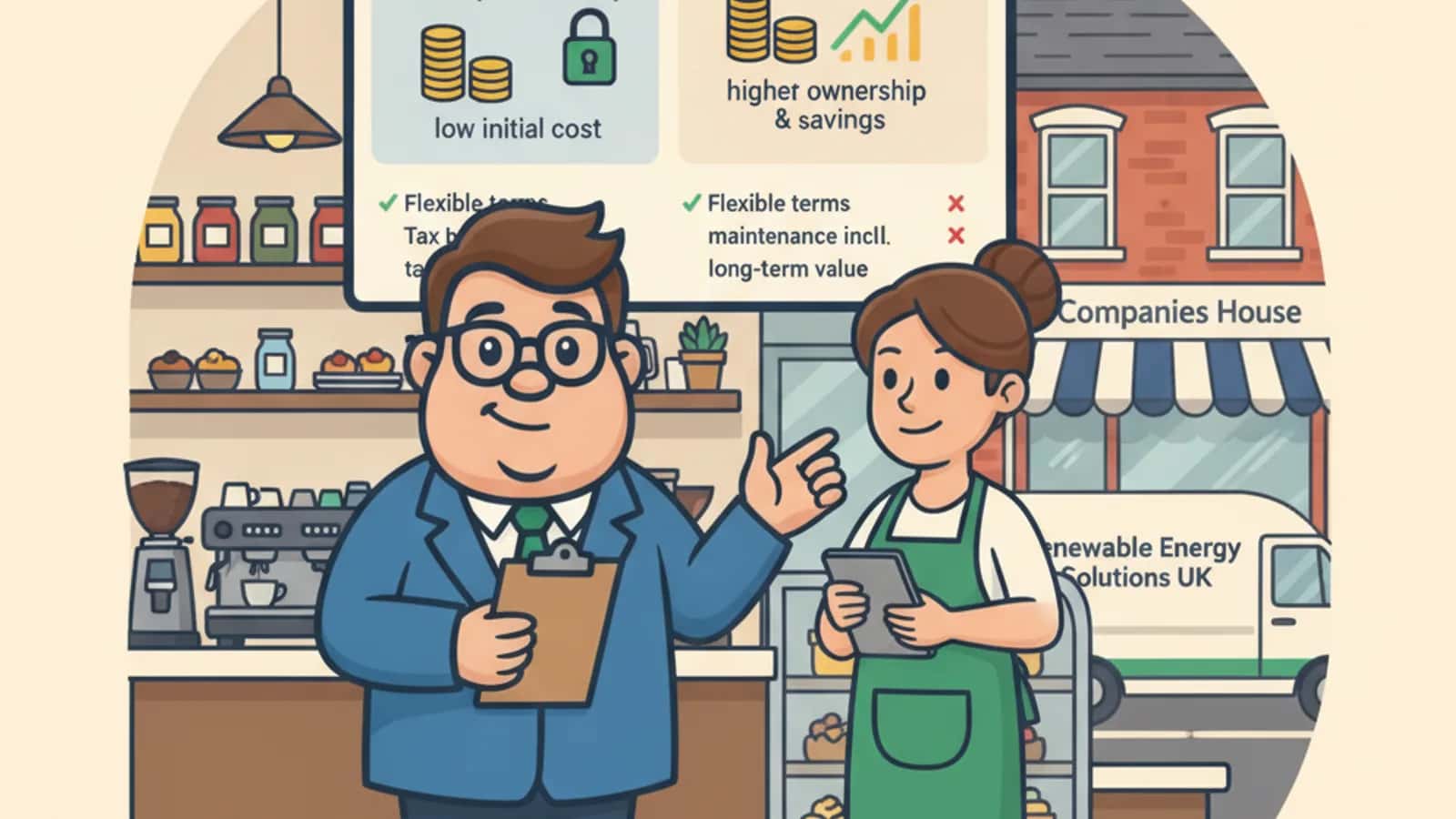
Solar leasing through asset finance spreads costs over 5-15 years with monthly payments from £200-£2,000 depending on system size, while buying outright requires £15k-£100k+ upfront for commercial installations. Leasing preserves working capital and provides immediate cash flow benefits through energy savings.
Leasing advantages
- Zero to low upfront costs (0-20% deposit options available)
- Predictable monthly payments aligned with energy savings
- Maintenance and insurance often included in operating leases
- Immediate tax relief on lease payments
- Preserves credit lines for core business activities
Buying outright benefits
- Full ownership from day one
- Maximum tax relief through Annual Investment Allowance
- No ongoing finance costs after purchase
- Complete control over system modifications
- Higher long-term returns once system is paid off
Financial comparison for 50kW commercial system:
| Factor | Leasing (7-year term) | Buying Outright |
|---|---|---|
| Upfront cost | £0-£8,000 | £40,000 |
| Monthly payment | £650 | £0 |
| Total cost | £54,600 | £40,000 |
| Tax relief | Lease payments deductible | 100% first-year allowance |
| Cash flow impact | Positive from month 1 | Break-even year 3-4 |
Most businesses choose leasing when they need to preserve cash for operations or lack the capital for outright purchase. The monthly savings on electricity bills typically exceed lease payments, creating positive cash flow from installation.
How Much Does Solar Panel Financing Cost in the UK
Solar panel financing costs in the UK range from 3.5% to 12% APR depending on the lender, loan term, and business credit profile, with typical monthly payments of £400-£1,500 for systems worth £25k-£100k. Specialist renewable energy lenders often offer better rates than traditional banks due to the equipment's proven performance and government support.
Cost factors affecting finance rates
- Business credit score: Excellent (750+) secures rates from 3.5-6%, fair (650-749) pays 6-10%
- Loan term: Shorter terms (3-5 years) get better rates than longer periods (10-15 years)
- Deposit amount: Higher deposits (20-30%) reduce monthly costs and interest rates
- System size: Larger installations (100kW+) often qualify for institutional rates
- Lender type: Specialist green finance providers vs traditional asset finance companies
Additional costs include arrangement fees (typically 1-2% of loan value), legal fees for larger facilities (£500-£2,000), and annual management charges for some lenders. Many specialist asset finance providers include these in the monthly payment to simplify budgeting.
Green finance incentives can reduce costs further. Some lenders offer discounted rates for qualifying renewable energy equipment, with reductions of 0.5-1.5% below standard asset finance rates.
Battery Storage System Loans and Financing
Yes, UK businesses can secure loans specifically for battery storage systems, with specialist lenders offering terms from 3-10 years and funding from £5k for small commercial batteries up to £500k+ for large-scale storage installations. Battery finance is often combined with solar panel funding as an integrated renewable energy package.
Battery storage financing works similarly to solar finance but considers the system's dual revenue streams: energy arbitrage (buying cheap, selling expensive) and grid services payments. Lenders assess projected savings from peak shaving, demand charge reduction, and potential income from grid balancing services.
Battery financing options include
- Standalone battery finance: For businesses adding storage to existing solar or grid connections
- Integrated solar-plus-storage: Combined funding for complete energy independence systems
- Retrofit financing: Adding batteries to existing solar installations with separate finance agreements
- Grid-scale storage: Specialist funding for MW-scale installations with revenue contracts
Typical battery system costs and finance:
Battery technology is advancing rapidly, so lenders prefer shorter terms (3-7 years) to align with technology refresh cycles. Some providers offer upgrade options within finance agreements to access improved battery chemistry as it becomes available.
Choose battery financing if your business has high peak demand charges, operates during expensive electricity periods, or wants backup power security. The combination of immediate savings and long-term energy independence often justifies the monthly finance costs.
Tax Benefits of Renewable Energy Asset Finance
Renewable energy equipment qualifies for significant UK tax benefits including 100% Annual Investment Allowance (AIA) for purchases up to £1m annually, Enhanced Capital Allowances for qualifying technologies, and full deductibility of lease payments against corporation tax. These incentives can reduce the effective cost of finance by 19-25% for corporation tax payers.
Key tax advantages
- Annual Investment Allowance: Claim 100% of equipment cost against profits in year of purchase (hire purchase and outright purchase)
- Enhanced Capital Allowances: Immediate 100% write-off for qualifying energy-saving equipment beyond AIA limits
- Lease payment deduction: Full monthly payments deductible against profits for operating leases
- Reduced VAT: Some renewable energy equipment qualifies for reduced 5% VAT rate
- Business rates relief: Renewable energy installations may qualify for business rates reductions
Tax relief comparison by finance type:
Hire Purchase
- Tax Relief
- 100% AIA
- Timing
- Year 1
- Cash Flow Impact
- Large upfront benefit
Finance Lease
- Tax Relief
- Capital allowances
- Timing
- Over lease term
- Cash Flow Impact
- Spread benefit
Operating Lease
- Tax Relief
- Lease payments
- Timing
- Monthly
- Cash Flow Impact
- Consistent relief
For a £100k solar installation, a business paying 25% corporation tax could save £25k in year one through AIA relief with hire purchase, or £5k annually over five years with an operating lease. The upfront relief often makes hire purchase attractive despite higher monthly payments.
Common tax planning mistake: Choosing operating lease purely for lower payments without considering the reduced total tax relief compared to hire purchase with AIA claims.
Work with your accountant to model the total cost of ownership including tax benefits. The optimal finance structure depends on your profit levels, tax position, and cash flow requirements.
Who Qualifies for Renewable Energy Asset Finance
UK businesses trading for 12+ months with annual turnover from £100k can typically qualify for renewable energy asset finance, though some specialist lenders consider startups with strong business plans and director guarantees. Credit scores above 650, stable cash flow, and clear energy savings projections strengthen applications significantly.
Standard eligibility criteria
- Trading history: Minimum 12-24 months for most lenders, some accept 6 months for strong applications
- Annual turnover: £100k+ for smaller systems, £500k+ for installations above £100k
- Credit score: Business and director scores above 650 preferred, some lenders accept 600+
- Sector restrictions: Most sectors accepted, some lenders avoid high-risk industries
- Financial stability: Profitable or break-even operations, positive cash flow trends
Enhanced qualification factors
- Existing relationship with renewable energy installer or consultant
- Clear energy audit showing projected savings exceeding finance costs
- Long-term property lease or freehold ownership for installation site
- Strong order book or contracted revenue streams
- Previous experience with asset finance or equipment loans
Specialist renewable energy lenders often have more flexible criteria than traditional asset finance providers. They understand the technology and can assess energy savings projections, making them more willing to lend to businesses that might not qualify elsewhere.
Qualification tips for stronger applications
- Provide detailed energy consumption data and savings projections
- Include quotes from certified installers with performance guarantees
- Demonstrate understanding of technology and maintenance requirements
- Show how energy savings improve overall business profitability
Startups and newer businesses may need director guarantees or higher deposits (20-30%) but can still access renewable energy finance with the right preparation and specialist lender selection.
Is Renewable Energy Financing Worth it for Small Businesses
Renewable energy financing is typically worth it for small businesses with annual electricity costs above £5k, as monthly finance payments are usually lower than energy savings, creating positive cash flow from installation. Businesses spending £10k+ annually on energy often see 15-25% immediate cost reductions that exceed finance costs.
Financial viability factors
- Energy spend threshold: Minimum £3k-5k annual electricity costs to justify finance costs
- Roof space availability: 200+ sqm for meaningful solar installation
- Usage patterns: Daytime energy consumption aligns with solar generation
- Electricity rates: Higher current rates (25p+ per kWh) improve payback
- Finance terms: Competitive rates (under 8%) ensure positive cash flow
When financing makes sense
- Immediate cash flow improvement needed
- Capital required for other business priorities
- Want to test renewable energy before larger investment
- Benefit from tax relief on lease payments
- Maintenance and insurance included in finance package
When to avoid financing
- Very low energy usage (under £3k annually)
- Uncertain property tenure (less than 10 years remaining)
- Poor credit history limiting access to competitive rates
- Sufficient cash reserves for outright purchase with better returns
Most small businesses find that asset finance for renewable energy provides the best balance of cash preservation and immediate energy savings, especially when combined with available tax reliefs.
What Happens to Solar Panels When You Sell Your Property
Solar panels financed through hire purchase or outright purchase transfer with the property sale and often increase property value, while leased systems require either lease transfer to the new owner or early settlement of the outstanding finance balance. The approach depends on your finance structure and buyer preferences.
Owned systems (hire purchase/cash purchase)
- Panels transfer automatically with property ownership
- Increase property value by 2-4% for commercial properties
- New owner benefits from ongoing energy savings
- No finance complications or early settlement required
- Energy performance certificates reflect improved ratings
Leased systems (finance lease/operating lease)
- Lease agreement must transfer to new owner or be settled early
- Buyer approval required by finance company for lease transfer
- Early settlement may include penalty charges (typically 1-3 months' payments)
- Some buyers prefer clean property purchase without ongoing finance obligations
Transfer process for leased systems:
- Notify finance company of intended sale (usually 30-90 days notice required)
- Obtain settlement figure including any early redemption penalties
- Present buyer with options: take over lease or require settlement at completion
- Complete finance company credit checks if buyer assumes lease
- Execute lease transfer documentation or settle balance at completion
Practical considerations
- Include solar system details and finance obligations in property marketing
- Provide energy generation data and savings evidence to buyers
- Factor settlement costs into sale price negotiations if early redemption required
- Ensure legal representatives understand renewable energy asset transfers
Most commercial property buyers view owned renewable energy systems as valuable assets that reduce operating costs. Leased systems require more negotiation but rarely prevent sales if handled properly during the marketing process.
Common Mistakes with Renewable Energy Financing
The most common mistake is choosing the cheapest monthly payment without considering total cost of ownership, tax benefits, and end-of-term options, often resulting in 20-40% higher lifetime costs compared to optimal finance structures. Many businesses also underestimate installation complexity and ongoing maintenance requirements.
Major financing mistakes to avoid:
- 1
Focusing only on monthly payments
- Operating leases appear cheaper but provide less tax relief
- Longer terms reduce payments but increase total interest costs
- Compare total cost including tax benefits, not just monthly amounts
- 2
Inadequate energy consumption analysis
- Overestimating daytime usage that aligns with solar generation
- Ignoring seasonal variations in energy production and consumption
- Failing to account for business growth affecting energy needs
- 3
Wrong finance structure for tax position
- Profitable businesses missing AIA benefits by choosing operating leases
- Loss-making businesses selecting hire purchase without immediate tax relief benefit
- Not coordinating renewable energy purchases with other capital investments
- 4
Insufficient due diligence on installers
- Choosing installers based on price without checking MCS certification
- Inadequate performance guarantees or warranty terms
- Poor integration between installer and finance provider
- 5
Ignoring maintenance and insurance costs
- Assuming systems are maintenance-free for entire finance term
- Inadequate insurance coverage for financed equipment
- Not budgeting for inverter replacements (typically 10-15 year lifespan)
- 6
Poor timing of finance applications
- Applying for finance before finalizing installation quotes and planning permissions
- Not allowing sufficient time for finance approval before installation deadlines
- Missing optimal installation windows due to delayed finance decisions
Avoiding these mistakes
- Get independent energy audits before selecting systems and finance
- Compare total cost scenarios including tax relief over full system lifespan
- Use specialist asset finance providers familiar with renewable energy projects
- Ensure installer and finance provider have established working relationships
Solar Panel and Battery System Lifespan
Solar panels typically last 25-30 years with performance warranties guaranteeing 80-90% output after 25 years, while battery systems have shorter lifespans of 10-15 years depending on technology and usage patterns. Finance terms are usually structured to align with equipment warranties and expected performance degradation.
Equipment lifespan expectations:
Solar Panels
- Performance warranty: 25 years (typically 80% output guaranteed)
- Physical lifespan: 30-35 years with proper maintenance
- Annual degradation: 0.3-0.8% per year for quality panels
- Inverter replacement: Required after 10-15 years (£2k-8k cost)
Battery Storage
- Lithium-ion batteries: 10-15 years or 6,000-10,000 cycles
- Lead-acid batteries: 5-8 years (less common in commercial installations)
- Performance degradation: 2-3% annually after initial years
- Warranty coverage: Typically 10 years or 70% capacity retention
Finance term alignment:
Most lenders structure renewable energy finance to conclude before major component replacements are required. Solar finance terms of 7-12 years ensure systems are owned outright well before inverter replacement. Battery finance uses shorter 3-7 year terms due to faster technology evolution.
Long-term financial planning
- Budget for inverter replacement in years 10-15 (often financed separately)
- Plan battery replacement or upgrade after initial finance term
- Factor degradation into long-term energy savings projections
- Consider technology upgrades when initial finance terms conclude
Maintenance requirements
- Annual system inspections and cleaning (£200-500 annually)
- Monitoring system maintenance and software updates
- Insurance coverage for weather damage and component failure
- Performance monitoring to identify issues early
The long lifespan of solar equipment makes it particularly suitable for asset finance, as systems continue generating value well beyond typical finance terms. Battery systems require more careful financial planning due to shorter lifespans and rapid technology advancement.
ESCO vs Traditional Solar Financing
Energy Service Company (ESCO) financing provides comprehensive energy solutions with performance guarantees and maintenance included, while traditional solar financing focuses purely on equipment acquisition with separate maintenance responsibilities. ESCOs typically charge 10-20% more but guarantee energy savings and system performance.
ESCO financing characteristics
- Performance guarantees: ESCO guarantees specific energy savings levels
- Comprehensive service: Design, installation, maintenance, monitoring, and insurance included
- Longer terms: Often 10-20 year agreements with full service provision
- Higher costs: Premium pricing for guaranteed performance and full service
- Risk transfer: ESCO bears technology and performance risk
Traditional asset finance benefits
- Lower costs: 15-25% cheaper than ESCO arrangements for equivalent systems
- Ownership control: Direct ownership and control over system modifications
- Flexible maintenance: Choose maintenance providers and service levels
- Shorter commitments: Typical 3-10 year finance terms
- Tax benefits: Direct access to capital allowances and AIA relief
Cost comparison for 100kW system:
| Factor | ESCO (15-year) | Traditional Finance (7-year) |
|---|---|---|
| Monthly cost | £1,200 | £980 |
| Maintenance included | Yes | No (£150/month estimated) |
| Performance guarantee | Yes | Equipment warranty only |
| Total 15-year cost | £216,000 | £147,000 |
| Ownership | ESCO retains | Business owns after 7 years |
Which is right for you?
Choose ESCO financing if
- You want guaranteed performance with no maintenance responsibilities
- Your business lacks technical expertise for system management
- Budget certainty is more important than lowest cost
- You prefer single-point accountability for all energy system aspects
Choose traditional financing if
- You want lowest total cost and direct ownership benefits
- Your business can manage maintenance relationships
- You want flexibility to modify or upgrade systems
- Tax benefits from ownership are valuable to your business
Most businesses with strong technical capabilities prefer traditional asset finance approaches for the cost savings and ownership benefits, while smaller businesses often value ESCO guarantees despite higher costs.
Renewable Energy Finance for Tenants and Renters
Business tenants can access renewable energy finance with landlord consent and lease agreements of 10+ years remaining, though options are more limited than for property owners and may require landlord guarantees or shared investment structures. Many lenders require written landlord approval and lease assignment rights for financed equipment.
Tenant financing options:
- 1
Landlord partnership arrangements
- Landlord purchases system, tenant pays through increased rent
- Shared investment with agreed energy savings split
- Landlord provides guarantee for tenant's finance application
- Green lease agreements with renewable energy clauses
- 2
Removable system financing
- Portable solar installations (car parks, temporary structures)
- Ground-mounted systems with removal rights
- Battery storage systems that can relocate with business
- Shorter finance terms aligned with lease periods
- 3
Power Purchase Agreements
- Third-party owns system, tenant buys electricity
- No upfront investment or equipment ownership required
- Landlord consent for roof/land use only
- Electricity supply agreement separate from property lease
Tenant eligibility requirements
- Minimum 7-10 years remaining on property lease
- Written landlord consent for installation and finance
- Strong business credit profile to offset property security limitations
- Clear lease assignment or removal rights for equipment
Landlord considerations
- System installation may improve property value and marketability
- Potential for increased rent reflecting energy cost savings
- Insurance and maintenance responsibilities clearly defined
- Reversion rights to system ownership at lease end
Practical solutions for tenants
- Negotiate renewable energy clauses during lease renewals
- Consider shared investment with landlord for mutual benefit
- Focus on systems with shorter payback periods (3-7 years)
- Explore portable or removable system options
While tenant financing is more complex than owner-occupier arrangements, growing numbers of specialist lenders understand commercial lease structures and can provide suitable finance options with proper documentation and landlord cooperation.
Government Grants and Renewable Energy Finance
Government grants can be combined with renewable energy asset finance to reduce the amount borrowed, but most UK business support schemes ended in 2019, with current support focused on tax incentives rather than direct grants. Some regional and sector-specific grants remain available, particularly for manufacturing and agricultural businesses.
Current government support mechanisms:
Tax incentives (not grants)
- Annual Investment Allowance (100% first-year relief up to £1m)
- Enhanced Capital Allowances for qualifying energy-saving equipment
- Business rates relief for renewable energy installations
- Reduced VAT rates (5%) for qualifying energy-saving equipment
Limited grant opportunities
- Rural Energy Fund: Support for agricultural renewable energy projects
- Local Enterprise Partnership grants: Regional funding varies by area
- Innovate UK: R&D grants for innovative renewable energy technologies
- Industrial Energy Transformation Fund: Large manufacturers (£1m+ energy costs)
How grants affect financing:
When grants are available, they typically reduce the finance amount required rather than providing additional funding. For example, a £10k grant on a £50k solar installation means financing £40k instead of the full amount, reducing monthly payments proportionally.
Grant application considerations
- Apply for grants before finalizing finance arrangements
- Ensure grant conditions don't conflict with finance terms
- Factor grant timing into project cash flow planning
- Some grants require match funding or specific installer qualifications
Alternative support mechanisms
- Green finance schemes: Discounted interest rates from some lenders
- Business energy efficiency schemes: Utility company rebates and support
- Carbon reduction commitments: Potential revenue from carbon credit sales
- Feed-in tariff replacements: Smart Export Guarantee payments for excess generation
Most businesses now rely on tax incentives rather than grants to improve renewable energy finance viability. The combination of AIA relief and competitive asset finance rates often provides better support than historical grant schemes.
Payback Periods for Solar and Battery Systems
Solar panel systems in the UK typically achieve payback periods of 7-12 years through energy savings, while battery storage systems pay back in 5-10 years depending on usage patterns and electricity tariff structures. Combined solar-plus-battery installations often achieve faster payback through optimized energy management and reduced grid dependency.
Solar system payback factors
- System cost: £800-1,200 per kW installed capacity
- Energy generation: 850-1,100 kWh per kW annually in UK
- Electricity prices: Current commercial rates 20-35p per kWh
- Usage alignment: Percentage of generation consumed on-site vs exported
- Maintenance costs: £200-500 annually for commercial systems
Battery system payback drivers
- Peak shaving: Reducing expensive peak-time electricity consumption
- Demand charge reduction: Lower maximum demand charges from utilities
- Arbitrage opportunities: Storing cheap off-peak electricity for peak use
- Grid services: Revenue from frequency response and balancing services
- Backup value: Avoided costs from power outages
Typical payback scenarios:
Factors improving payback
- High daytime electricity consumption matching solar generation
- Time-of-use tariffs with significant peak/off-peak price differences
- Demand charges exceeding £10 per kW per month
- Frequent power quality issues or outages
- Rising electricity prices over system lifetime
Finance impact on payback:
Asset finance extends the effective payback period but improves cash flow from day one. A system with 8-year payback purchased outright becomes cash flow positive immediately when financed, with total returns achieved 2-3 years after finance completion.
Accelerated payback strategies
- Size systems to maximize on-site consumption rather than export
- Combine solar and battery for optimal energy management
- Consider demand response programs for additional revenue
- Plan for electricity price increases in payback calculations
Most businesses find that financed renewable energy systems provide immediate cash flow benefits even when simple payback periods extend beyond finance terms.
Next steps
Renewable energy asset finance provides UK businesses with flexible pathways to acquire solar panels, battery storage, and energy-efficient equipment without significant upfront capital. With specialist lenders offering terms from £1k to £5m and deposit options from 0%, businesses can achieve immediate energy cost reductions while preserving working capital for core operations.
The key to successful renewable energy financing lies in matching the finance structure to your business needs, tax position, and cash flow requirements. Hire purchase arrangements offer maximum tax benefits through AIA relief, while operating leases provide lower monthly payments with included maintenance. Power Purchase Agreements eliminate upfront costs entirely but transfer ownership benefits to third parties.
Most businesses find that monthly energy savings exceed finance payments from installation, creating positive cash flow that improves over time as electricity prices rise. Combined with tax incentives and the long-term nature of renewable energy equipment, asset finance makes these technologies accessible to businesses that couldn't otherwise afford the capital investment.
Ready to explore renewable energy asset finance for your business? Check Eligibility Now with our specialist partners. Our 2-minute check compares hire purchase, finance lease, and PPA options across our panel of renewable energy lenders. No hard credit search to start, and you'll get a fast decision that matches your project timeline.
Further reading
Frequently asked questions
What is Renewable Energy Asset Finance and How Does it Work?
Renewable energy asset finance allows UK businesses to acquire solar panels, battery storage, and energy-efficient equipment through structured payment plans rather than upfront purchase. Specialist lenders provide funding from £1k to £5m, with the equipment itself serving as security for the loan.
How Much Does Solar Panel Financing Cost in the UK?
Solar panel financing costs in the UK range from 3.5% to 12% APR depending on the lender, loan term, and business credit profile, with typical monthly payments of £400-£1,500 for systems worth £25k-£100k. Specialist renewable energy lenders often offer better rates than traditional banks due to the equipment's proven performance and government support.
Who Qualifies for Renewable Energy Asset Finance?
UK businesses trading for 12+ months with annual turnover from £100k can typically qualify for renewable energy asset finance, though some specialist lenders consider startups with strong business plans and director guarantees. Credit scores above 650, stable cash flow, and clear energy savings projections strengthen applications significantly.
Is Renewable Energy Financing Worth it for Small Businesses?
Renewable energy financing is typically worth it for small businesses with annual electricity costs above £5k, as monthly finance payments are usually lower than energy savings, creating positive cash flow from installation. Businesses spending £10k+ annually on energy often see 15-25% immediate cost reductions that exceed finance costs.
What Happens to Solar Panels When You Sell Your Property?
Solar panels financed through hire purchase or outright purchase transfer with the property sale and often increase property value, while leased systems require either lease transfer to the new owner or early settlement of the outstanding finance balance. The approach depends on your finance structure and buyer preferences.
Written by
The Funding Fred Editorial Team creates plain-English guides to help business owners understand funding options, eligibility, and application readiness before they compare finance options.
Reviewed by
UK business finance content reviewer
Robert reads our UK business finance guides before they go live, checking each one is accurate, easy to follow, and reflects how lending actually works today — not how a brochure says it should. He's listed on the FCA Register, approved as an SMF3 (AR) Executive Director at Switcha Limited, and connected to Lucky Growth Partners Ltd through its appointed representative relationship, so the regulated detail gets a properly qualified second read.
Sources
- mtfd.co.uk [2] greenhearth.energy - https://www.greenhearth.energy/ [3] Finance - https://olympuspower.co.uk/finance/ [4] Funding - https://www.cfsolar.co.uk/funding [5] Asset Finance - https://lowcarbonenergy.co/funding/asset-finance/ [6] Renewable Energy Asset Finance - https://www.doultonbridgingfinance.com/renewable-energy-asset-finance [7] Own Your Power - https://ortusenergy.com/own-your-power/ [8] Green Finance - https://business.bankofscotland.co.uk/asset-finance/green-finance.html [9] Renewable Energy Finance - https://connectassetfinance.co.uk/renewable-energy-finance/ [10] Renewable Energy - https://www.coatesfinance.com/equipment-finance/renewable-energy/
- British Business Bank finance options
- GOV.UK business finance support