Business Van Finance: Hire Purchase, Lease and Contract Hire Compared
Business van finance lets a sole trader, limited company or new business spread the cost of a van over time instead of paying cash upfront.

Quick answer
Business van finance lets a sole trader, limited company or new business spread the cost of a van over time instead of paying cash upfront. The three main routes are hire purchase (you own the van at the end), finance lease (you lease long-term with flexible end-of-term options) and contract hire (you rent with no ownership and often fixed maintenance costs). The right choice depends on whether ownership matters to you, how much deposit you can put down, and how the van will be used in your business.
Key takeaways
- Hire purchase (HP) suits businesses that want to own the van outright and claim capital allowances once ownership transfers.
- Finance lease works for businesses that want long-term use without a large deposit, with flexibility at the end of the agreement.
- Contract hire fits businesses that want fixed monthly costs and no disposal hassle, but mileage limits and condition charges apply.
- Deposit and term vary by lender, applicant credit profile and the van's age, there is no single fixed figure across the market.
- VAT-registered businesses can often reclaim VAT on a van used for business purposes, but the exact treatment depends on usage and should be checked with HMRC or an accountant.
- Self-employed traders and limited companies with at least some trading history generally find van finance more accessible than brand-new businesses with no accounts.
- Approval speed depends on documentation readiness, business bank statements, proof of identity and trading history move things faster.
Can I Finance a Van Through My Business?
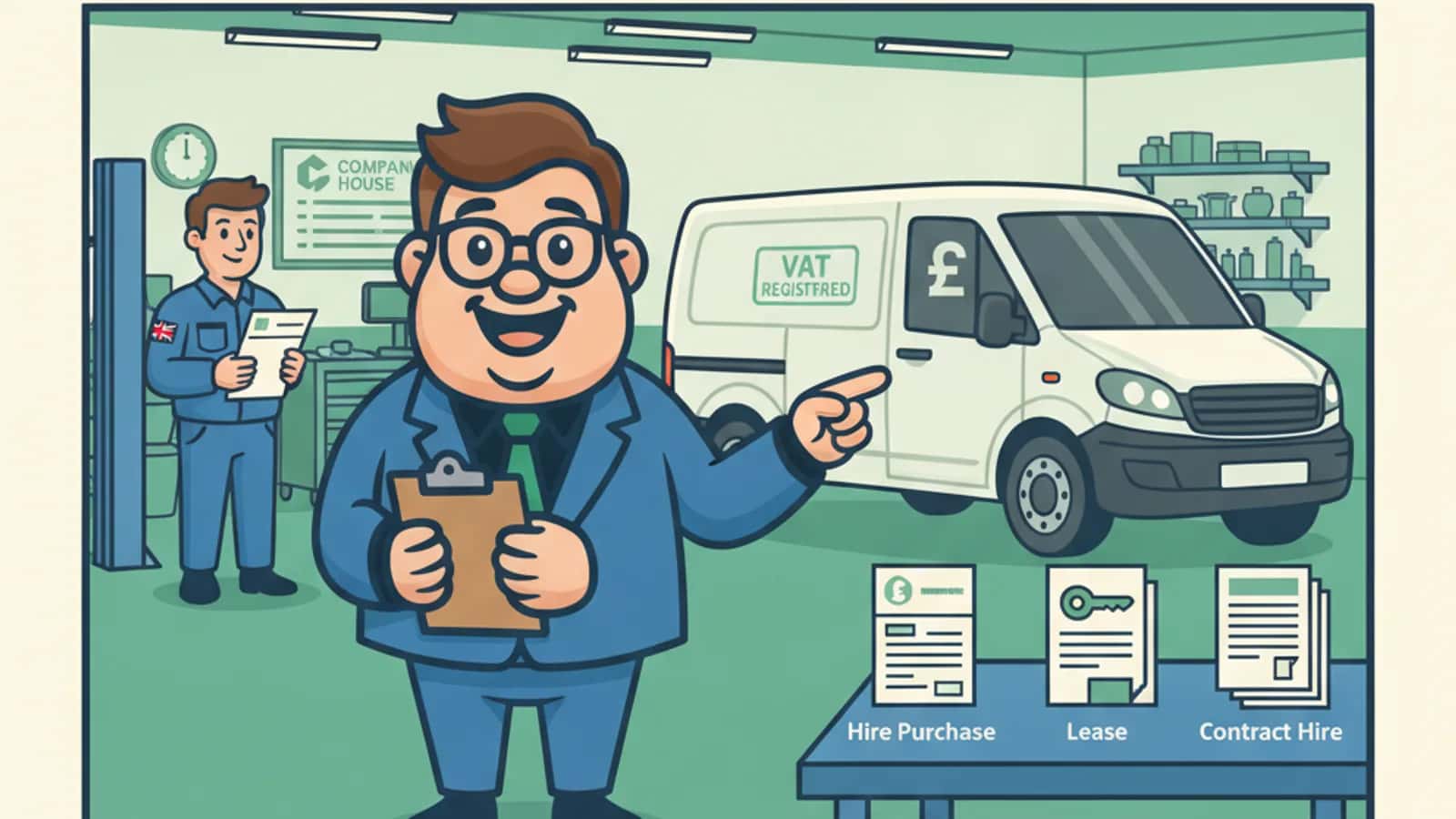
Yes. Both limited companies and sole traders can finance a van through the business rather than paying from personal funds, provided the van is used for trade purposes. Lenders assess the business (or the individual, for sole traders) rather than requiring the full purchase price in cash.
- Limited companies
- usually apply in the company name, with directors often asked to give a personal guarantee, especially for newer companies.
- Sole traders
- apply in their own name but can still class the van as a business asset for accounting and tax purposes.
- Partnerships
- typically need all partners named on the agreement.
A common mistake is assuming van finance is only for established fleets. In practice, a single van bought to cover a new contract is one of the most common asset finance requests lenders see. For a wider view of how van and fleet funding sits within the broader market, see this comparison of commercial vehicle finance vs asset finance.
What Is Hire Purchase vs Finance Lease for a Business Van?

Hire purchase (HP) and finance lease are both forms of credit used to acquire a van, but they differ in who legally owns the vehicle. With HP, ownership transfers to the business once all payments (including any final option fee) are made. With a finance lease, the finance company retains ownership throughout, and the business leases the right to use the van.
Hire Purchase
- Van sits on the business balance sheet as an asset once acquired.
- Fixed monthly payments cover the capital cost plus interest.
- Ownership passes to the business at the end of the term.
- Suits businesses planning to keep the van long-term, past the finance period.
Finance Lease
- The business pays to use the van over an agreed term.
- At the end, options typically include extending the lease, returning the van, or arranging a sale to a third party, with the business often sharing in any sale proceeds.
- No automatic ownership transfer, which can suit businesses that want flexibility rather than a long-term hold.
Choose HP if the van is a long-term tool you'll run for years after the agreement ends. Choose finance lease if you expect to refresh the vehicle or you'd rather not carry disposal risk. A fuller breakdown of how these two structures compare across asset types is covered in hire purchase vs finance lease.
What's the Difference Between Contract Hire and Lease for Vans?
Contract hire is a pure rental agreement with no ownership route at all, while a finance lease can still end in a sale or extended use arrangement. Contract hire (also called an operating lease) is usually bundled with fixed monthly costs and, in many agreements, maintenance.
- Contract hire:
- You never own the van. Monthly rental is fixed. Maintenance packages are common add-ons. The van goes back at the end, subject to condition and mileage checks.
- Finance lease:
- You don't own the van automatically either, but there's typically an end-of-term mechanism involving a sale, with the business potentially receiving a rebate of sale proceeds.
Decision rule: if you want the vehicle off your books entirely and predictable monthly costs with maintenance baked in, contract hire usually fits. If you want flexibility to keep using the van or benefit from its resale value, a finance lease is the closer match.
Business Van Finance Compared: HP, Finance Lease and Contract Hire
The table below summarises the practical differences business owners weigh up most when comparing business van finance options.
Ownership at end
- Hire Purchase
- Yes, after final payment
- Finance Lease
- No (sale/rebate route possible)
- Contract Hire
- No, van is returned
Balance sheet impact
- Hire Purchase
- Asset and liability recorded
- Finance Lease
- Asset and liability recorded
- Contract Hire
- Usually off balance sheet
Maintenance included
- Hire Purchase
- No, arranged separately
- Finance Lease
- No, arranged separately
- Contract Hire
- Often included or optional
Best for
- Hire Purchase
- Long-term keep, capital allowance planning
- Finance Lease
- Flexible mid-term use
- Contract Hire
- Fixed-cost, hassle-free use
Mileage limits
- Hire Purchase
- No
- Finance Lease
- No
- Contract Hire
- Yes, agreed annual mileage
VAT treatment
- Hire Purchase
- Depends on usage, check with HMRC
- Finance Lease
- Depends on usage, check with HMRC
- Contract Hire
- VAT usually charged on rentals, partly or fully reclaimable depending on use
Because pricing, deposit structure and lender appetite vary by applicant and vehicle, it's worth comparing options through a panel of specialist partners rather than assuming one structure suits every business. Funding Fred's asset finance for UK businesses service matches applicants with lenders covering HP, finance lease and contract hire across Commercial Vehicles, Construction Equipment and Plant & Machinery.
Is HP, Lease or Contract Hire Cheaper for a Van?
There's no single cheapest option, the right structure depends on how long you keep the van, your deposit, and whether maintenance is bundled in. A van kept for eight years is often better suited to HP, where ownership eventually removes ongoing finance costs. A van replaced every three years may cost less overall under contract hire once maintenance and disposal hassle are factored in.
Rates, fees and total cost depend on:
- The applicant's credit profile and trading history.
- The deposit put down (higher deposits generally reduce monthly cost).
- The van's age, mileage and residual value assumptions.
- Whether maintenance, servicing or breakdown cover is bundled in.
Because exact pricing varies lender to lender, treat any quoted rate as applicant-specific rather than a market standard. The safest way to compare true cost is a side-by-side quote across structures rather than assuming one route wins outright.
What Deposit and Term Are Typical for Business Van Finance?
Deposits and terms for business van finance vary by lender, applicant risk profile and van condition, there's no fixed industry figure, though many lenders offer flexible deposit structures to suit cash flow. Some agreements are available with a lower upfront deposit for applicants who meet lender criteria, while others require a higher deposit where credit history or trading time is limited.
- Term length:
- agreements commonly run across a multi-year term matched to how long the business plans to keep or use the van, with shorter and longer options available depending on the lender.
- Deposit:
- ranges from a lower-deposit structure for stronger applicants to a higher deposit where the lender needs more security.
- Balloon or final payment:
- some HP and lease structures include a final payment to reduce monthly cost, check this is affordable before signing.
Decision rule: if cash flow is tight because of a new contract or seasonal gap, ask lenders about flexible deposit options rather than assuming a large deposit is mandatory.
Is It Better to Buy or Lease a Van for Business?
Buying (via HP or cash) suits businesses that want a long-term asset on the books and plan to keep the van well beyond the finance term. Leasing (finance lease or contract hire) suits businesses that value predictable costs, regular vehicle upgrades, or want to avoid depreciation and resale risk.
Which is right for you?
Choose buying/HP if
- You run the van for many years past the agreement.
- You want the asset on the balance sheet for lending purposes later.
- You're comfortable managing resale or disposal.
Choose leasing if
- You prefer fixed monthly costs with fewer surprises.
- You replace vehicles every few years.
- You don't want van disposal to be your problem.
Many fleet operators mix both: HP for core vans kept long-term, contract hire for vans that need frequent refreshing. If the fleet is moving toward electric vans, review electric van and fleet finance before committing to a structure, since charging infrastructure and residual values differ from diesel vans.
Can I Get Van Finance If I'm Self-Employed or a New Business?
Sole traders and new businesses can access van finance for business, though lenders typically look for some trading history, proof of income and a credit check before approving an application. Van finance for self employed applicants is widely available, but underwriting focuses on affordability evidence rather than company age alone.
- Van finance for self employed:
- lenders often ask for recent bank statements, tax returns or accounts, and proof of the contract or work generating income.
- Van finance for new business:
- limited trading history makes this harder but not impossible, a strong personal credit history, a larger deposit, or a personal guarantee can help offset the lack of accounts.
- Ltd company van finance:
- directors are usually asked for a personal guarantee on newer companies, alongside company registration details from Companies House.
Best fit for a startup: a smaller deposit structure combined with a personal guarantee from the director, or starting with a shorter-term agreement to build a payment history before refinancing into better terms later. For a deeper look at qualifying without trading history, see this guide on asset finance for UK startups.
Can I Get a Business Van on Finance With Bad Credit?
Getting business van finance with a poor credit history is harder, but not automatically ruled out, some specialist lenders consider applications where mainstream banks decline, often alongside a larger deposit or additional security. No lender can promise guaranteed approval regardless of credit profile, and outcomes depend on the full application, not credit score alone.
Things that can help an application with credit issues:
- A larger deposit to reduce lender risk.
- Evidence of stable, recent trading income.
- A personal guarantee from a director with a stronger personal credit file.
- Choosing a shorter term to limit lender exposure.
A 2-min check through a broker panel that compares multiple specialist partners, rather than applying to one lender at a time, often surfaces options a single bank wouldn't offer. Comparing eligibility with no hard check to start means a declined quote from one lender doesn't show up as a hard search against the business.
How Long Does It Take to Get Approved for Van Finance?
Approval timescales for business van finance vary by lender, applicant type and how complete the application is, there is no fixed turnaround time across the market, though well-prepared applications with full documentation generally move faster. Missing paperwork, incomplete bank details or unclear trading history are the most common causes of delay.
Applicants can speed up the process by:
- Having the last several months of business bank statements ready.
- Confirming the exact van make, model and dealer or supplier quote in advance.
- Having identity and address documents for all directors or the sole trader on hand.
- Being upfront about credit issues rather than letting a lender discover them mid-application.
A fast decision is realistic when documentation is ready from the start, it's the gaps in paperwork, not the finance structure itself, that usually slow things down.
What Are the Hidden Costs in Van Leasing Deals?
Van leasing deals (finance lease and contract hire) can carry costs beyond the headline monthly rental, including excess mileage charges, end-of-agreement condition charges, early termination fees and arrangement fees. Reading the full agreement before signing avoids surprises at handover.
Costs to check for:
- Excess mileage charges:
- billed per mile over the agreed annual allowance.
- Condition and damage charges:
- assessed against a fair wear and tear standard at return.
- Arrangement or documentation fees:
- sometimes charged upfront or added to the first payment.
- Early termination fees:
- can be significant if the business exits the agreement before the end of term.
What happens if I exceed mileage on a lease van? Most contract hire and some finance lease agreements set an annual mileage cap at the start. Going over it typically triggers a per-mile excess charge at the end of the agreement or at review points during the term. If mileage needs are uncertain, for example, a new contract with unknown delivery volumes, agree a higher mileage allowance upfront rather than risk a large bill later.
What Maintenance Is Included in Contract Hire Agreements?
Maintenance inclusion in contract hire depends on the specific package chosen, some agreements bundle servicing, tyres and breakdown cover into the monthly rental, while others are rental-only with maintenance arranged separately. Always confirm exactly what's covered before comparing quotes across lenders.
Commonly available maintenance add-ons include:
- Routine servicing and MOT preparation.
- Tyre replacement.
- Breakdown and recovery cover.
- Replacement vehicle cover during repairs (on some packages).
A common mistake is comparing a maintained contract hire quote against a non-maintained finance lease quote and concluding the lease is cheaper, when servicing costs haven't been factored into the lease figure at all. Always compare total cost of ownership, not just the headline monthly payment.
Can I End a Van Lease Early Without Penalty?
Ending a van lease early without a penalty is uncommon, most finance lease and contract hire agreements include an early termination charge designed to cover the lender's remaining exposure. Some agreements allow early settlement with a calculated fee rather than a blanket penalty, but terms differ by provider.
Before signing, check:
- Whether early termination is permitted at all.
- How the termination charge is calculated (often linked to remaining payments and estimated resale value).
- Whether the agreement allows transfer to another business instead of termination.
If there's a reasonable chance the business need might change within the term, for example, a contract ending early, a shorter initial term or a flexible agreement may cost slightly more monthly but avoid a larger exit penalty later.
Can You Reclaim VAT on a Business Van?
VAT-registered businesses can often reclaim VAT charged on a van used for business purposes, because vans are generally treated by HMRC as commercial vehicles rather than cars for VAT purposes, but the exact treatment depends on the vehicle, its use, and the finance structure, so this should always be confirmed directly with HMRC or an accountant before relying on it.
Points worth checking with HMRC or an adviser:
- Whether the van qualifies as a commercial vehicle rather than a car under HMRC's definitions.
- Whether any private use of the van affects the VAT reclaim position.
- How capital allowances apply differently depending on whether the van is acquired via HP (where the business may claim allowances once it's treated as owning the asset) versus a lease (where lease rentals are typically treated as a deductible business expense instead).
- How van Benefit-in-Kind (BiK) rules apply if an employee or director has personal use of the van, since van BiK is calculated differently from company car BiK.
Because tax and VAT rules change and depend on individual circumstances, this section is general guidance only, not tax advice. Confirm the current position for a specific van and business structure with HMRC or a qualified accountant before finalising a finance decision. For how asset finance structures generally interact with balance sheets and allowances, see this overview of types of asset finance.
Business Van Finance Application Checklist
A complete, evidence-ready application is the single biggest factor in a faster decision. Use this checklist before applying for business van finance:
- Business details: Companies House registration (for limited companies) or sole trader registration details.
- Bank statements: recent months of business bank statements showing trading activity.
- Accounts or tax returns: latest filed accounts, or tax returns for sole traders and newer companies.
- Vehicle quote: make, model, price and supplier/dealer details for the specific van.
- Deposit confirmation: proof of funds available for the deposit, if required.
- Director/owner ID: identity and proof of address for all directors or the sole trader.
- Credit history awareness: know your business and personal credit position before applying, so any issues can be explained upfront.
- Intended use: be ready to confirm mileage expectations and whether the van is for sole business use or has any personal use element.
This checklist mirrors the kind of documentation most specialist lenders ask for across asset classes, see the full asset finance application checklist for a broader breakdown applicable beyond vans.
Next steps for business van finance
Choosing between hire purchase, finance lease and contract hire for business van finance comes down to three questions: Do you want to own the van eventually? How much deposit can you commit? And how long will you actually keep using it? HP suits long-term ownership and capital allowance planning. Finance lease suits businesses that want flexibility without full ownership. Contract hire suits those who want fixed costs and no disposal responsibility.
Whichever structure fits, the practical next step is the same: get documentation ready, bank statements, a vehicle quote, and proof of trading, and compare terms across more than one lender before committing. For a wider comparison of how van and fleet funding differs from other commercial vehicle finance routes, read commercial vehicle finance vs asset finance, or browse the full asset finance guides hub for related equipment and vehicle funding topics.
Funding Fred's eligibility check compares Hire Purchase, Finance Lease and contract hire quotes across a panel of specialist partners covering Commercial Vehicles, Construction Equipment and Plant & Machinery, with a 2 min check, no hard check to start, and no obligation to proceed. Check Eligibility Now to see what's available for your van purchase.
Frequently asked questions
Can I Finance a Van Through My Business?
Yes. Both limited companies and sole traders can finance a van through the business rather than paying from personal funds, provided the van is used for trade purposes. Lenders assess the business (or the individual, for sole traders) rather than requiring the full purchase price in cash.
What Is Hire Purchase vs Finance Lease for a Business Van?
Hire purchase (HP) and finance lease are both forms of credit used to acquire a van, but they differ in who legally owns the vehicle. With HP, ownership transfers to the business once all payments (including any final option fee) are made. With a finance lease, the finance company retains ownership throughout, and the business leases the right to use the van.
What's the Difference Between Contract Hire and Lease for Vans?
Contract hire is a pure rental agreement with no ownership route at all, while a finance lease can still end in a sale or extended use arrangement. Contract hire (also called an operating lease) is usually bundled with fixed monthly costs and, in many agreements, maintenance.
Is HP, Lease or Contract Hire Cheaper for a Van?
There's no single cheapest option, the right structure depends on how long you keep the van, your deposit, and whether maintenance is bundled in. A van kept for eight years is often better suited to HP, where ownership eventually removes ongoing finance costs. A van replaced every three years may cost less overall under contract hire once maintenance and disposal hassle are factored in.
What Deposit and Term Are Typical for Business Van Finance?
Deposits and terms for business van finance vary by lender, applicant risk profile and van condition, there's no fixed industry figure, though many lenders offer flexible deposit structures to suit cash flow. Some agreements are available with a lower upfront deposit for applicants who meet lender criteria, while others require a higher deposit where credit history or trading time is limited.
Is It Better to Buy or Lease a Van for Business?
Buying (via HP or cash) suits businesses that want a long-term asset on the books and plan to keep the van well beyond the finance term. Leasing (finance lease or contract hire) suits businesses that value predictable costs, regular vehicle upgrades, or want to avoid depreciation and resale risk.
Written by
The Funding Fred Editorial Team creates plain-English guides to help business owners understand funding options, eligibility, and application readiness before they compare finance options.
Reviewed by
UK business finance content reviewer
Robert reads our UK business finance guides before they go live, checking each one is accurate, easy to follow, and reflects how lending actually works today — not how a brochure says it should. He's listed on the FCA Register, approved as an SMF3 (AR) Executive Director at Switcha Limited, and connected to Lucky Growth Partners Ltd through its appointed representative relationship, so the regulated detail gets a properly qualified second read.