Business Loans With No Credit Check: What UK Borrowers Should Know
A genuine UK business loan with no credit assessment at any stage is unusual. Some lenders and brokers can begin with a soft-search eligibility check, while revenue-based finance, merchant cash advances and invoice finance may place more weight on trading data than on a credit score.

Quick answer
A genuine UK business loan with no credit assessment at any stage is unusual. Some lenders and brokers can begin with a soft-search eligibility check, while revenue-based finance, merchant cash advances and invoice finance may place more weight on trading data than on a credit score. A lender may still run business or personal credit checks before a final offer, so check the consent wording and terms before applying.
Key takeaways
- No credit check should not mean no affordability or identity assessment; reputable providers still verify the business and its ability to repay.
- A soft search is different from a hard search and is generally not visible to other lenders, but the provider should explain which search it will use.
- Open Banking, bank statements, card sales and invoice quality can all inform an eligibility decision.
- Merchant cash advances and invoice finance use different pricing from term loans, so compare the total amount repayable and every fee.
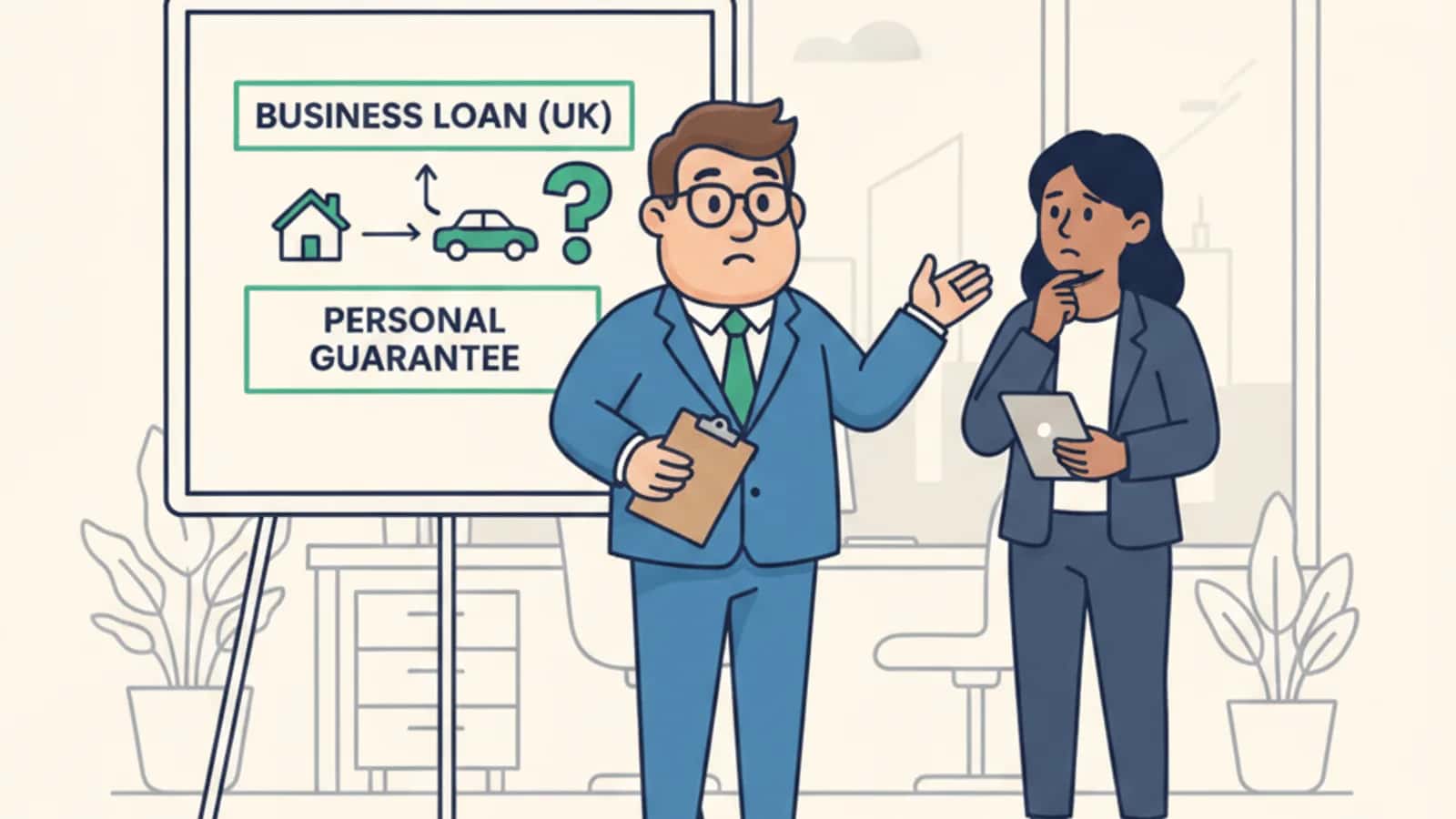
- An unsecured facility can still include a personal guarantee; read the security and default clauses carefully.
- Check the lender or broker and its relevant permissions on the FCA Register where regulation applies.
What Does ‘No Credit Check’ Mean for a UK Business Loan?

In UK business finance, "no credit check" often describes the first eligibility step, not the entire application. A provider may use a soft search initially, then complete business, director or identity checks before making a binding offer.
Truly zero-assessment lending is rare and should be treated cautiously. Some products place more weight on recent turnover, bank transactions, card sales or customer invoices, but the provider still needs enough information to assess risk and affordability.
How this differs from traditional lending:
| Factor | Conventional term loan | Soft-search or data-led route |
|---|---|---|
| Initial credit search | May be hard or soft | May begin with a soft search |
| Other information | Accounts, forecasts and bank statements | Revenue, cash flow, sales or invoices |
| Final checks | Depend on lender and product | Can still include business or personal credit checks |
| Pricing | Interest plus possible fees | Interest, fees or a fixed/factor-based charge |
What Do Lenders Check Instead of Relying Only on a Credit Score?

Depending on the product, providers may use Open Banking data, bank statements, card-sales history or outstanding invoices alongside credit and identity checks. Open Banking access requires your explicit consent and can give a current view of income and outgoings.
Common verification methods include:
- Open Banking or bank statements
- turnover, balances, existing commitments and cash-flow volatility
- Revenue records
- recent sales confirmed through accounts, banking data or payment platforms
- Card-sales data
- especially relevant to merchant cash advances
- Invoice quality
- invoice-finance providers may assess the customers that owe the money
- Trading history and sector
- used with the amount, purpose and proposed repayment structure
A strong recent trading record can help when the credit file is imperfect, but it does not guarantee approval. The lender will assess the application against its own criteria and the proposed repayments.
Which UK Funding Routes May Start Without a Hard Search?
Some online lenders and brokers offer an initial eligibility stage using a soft search or trading data. The route that fits depends on how the business earns money, what it is funding and whether the repayments remain affordable.
Routes worth comparing
- Merchant cash advances — an advance repaid from future card sales; relevant mainly to card-taking businesses
- Unsecured business loans — fixed repayments, often with director checks and potentially a personal guarantee
- Invoice finance — funding against eligible B2B invoices, with costs and customer-notification terms that vary
- Revenue-based finance — repayments or eligibility linked to business revenue, with provider-specific terms
Preparation tip: Keep recent bank statements, management figures and the funding purpose ready. If Open Banking is offered, read the permissions and confirm how long access lasts before consenting.
Explore the full range of business loan options and guides to compare products side by side.
How Much Do No-Credit-Check and Soft-Search Options Cost?
There is no reliable single price range for these products. The quote depends on the product, amount, term, turnover, credit profile and security. Faster or more flexible routes can cost more, so compare like for like using a written quotation.
| Product | How pricing may be shown | What to compare |
|---|---|---|
| Merchant cash advance | Fixed fee or factor applied to the advance | Total repayment and share of card sales |
| Unsecured business loan | Interest rate or APR plus fees | Total repayable, term and early-repayment rules |
| Invoice finance | Service and funding charges | All fees, concentration limits and notice terms |
| Revenue-based finance | Fixed fee or revenue-linked charge | Total cost and effect on monthly cash flow |
Ask for the total amount repayable in pounds, the payment schedule, every compulsory fee and the cost of settling early. Model the repayments against a weaker sales month as well as an average one.
- Monthly revenue and consistency
- Time in business
- Industry risk profile
- Loan amount and term length
Comparison tip: APR can help compare loans with a defined term, but products such as merchant cash advances may be quoted differently. Do not rely on a factor or monthly payment alone; ask for the full cash cost.
Are These Options More Expensive Than a Bank Loan?
They can be. A well-established business may receive a lower-cost offer from its bank, while a specialist provider may price for speed, shorter terms or greater perceived risk. The only dependable comparison is between current offers for the same amount and purpose.
That said, the comparison isn't always straightforward:
- Speed can matter
- , but only if the opportunity is worth more than the additional funding cost
- Different criteria can widen the options
- , without guaranteeing that an application will be accepted
- Unsecured does not mean risk-free
- a personal guarantee or other contractual security may still apply
Choose a no credit check loan if
- The bank has declined the application and you understand why
- Recent trading data is stronger than the historic credit profile
- The business has card sales or eligible invoices that suit a specialist product
- You have compared the total cost and can absorb repayments in a weaker month
Stick to traditional lending if
- The business is likely to qualify for lower-cost bank funding
- The funding is not urgent and you can compare several routes
- Minimising total cost is more important than speed
Can Startups with Zero Credit History Qualify?
Startups with little or no trading history usually have fewer debt options because there is limited evidence of repayment capacity. Criteria vary, and a lender may ask for forecasts, director information, security or a personal guarantee.
What startups can access
- Start Up Loans and community lenders — subject to their own eligibility, affordability and credit checks
- Equity or reward crowdfunding — no loan repayment, but equity funding gives investors a stake in the business
- Asset finance — may be relevant when the funding is for identifiable equipment
- Founder, friends or family funding — document the terms and consider professional advice before proceeding
A young card-taking business may be assessed on payment-platform sales, but minimum trading periods, turnover thresholds and director checks remain provider-specific.
What Documents Do I Need to Apply for a No Credit Check Business Loan?
The documents depend on the product and amount. Having accurate information ready can reduce delays, but a streamlined application is not the same as an assessment-free one.
Standard requirements
- 3–6 months of business bank statements (or Open Banking connection)
- Proof of business registration (Companies House number for UK Ltd companies)
- Photo ID for the business owner/director
- Basic revenue or turnover figures
- Business address confirmation
For invoice financing specifically
- Outstanding invoices (PDF copies)
- Customer contact details for verification
- Proof the invoices are genuine and unpaid
What you typically won't need
- Business plan
- Detailed financial projections
- Tax returns (though some lenders request these for larger amounts)
- Collateral documentation
If Open Banking is available, it can replace some manual statement uploads. Review the consent screen, the data being shared and the access period before connecting an account.
What Credit Score Alternatives Do Lenders Use?
Providers that use data-led underwriting may consider current business performance alongside credit history. They do not all use the same model, and poor recent cash flow can still lead to a decline.
Key alternative signals lenders assess
- Monthly revenue consistency — is turnover stable, growing, or declining over 3–12 months?
- Cash flow patterns — do regular outgoings suggest a well-managed business?
- Average daily balance — does the account regularly run near zero, or is there a buffer?
- Card processing volumes — for MCAs, daily card sales determine both eligibility and repayment capacity
- Invoice quality — for invoice financing, the credit rating of your customers matters more than yours
- Industry and business type — some sectors carry higher risk profiles regardless of revenue
- Time in business — longer trading history reduces lender risk even without a credit score
A broker can compare the application with more than one provider, but neither technology nor panel size guarantees approval or a lower price.
Which Industries Are Most Likely to Get Approved?
Businesses with regular, well-evidenced revenue or eligible invoices may have more specialist routes to consider. Approval still depends on the provider, amount, sector, affordability and wider credit profile.
High approval likelihood
- Restaurants, cafes, and hospitality venues (strong card sales data)
- E-commerce and retail stores (platform sales history)
- Dental practices and private healthcare (regular, predictable invoicing)
- Construction and trade businesses (invoice financing suits B2B billing cycles)
- Hair salons, beauty clinics, and wellness businesses (card-heavy revenue)
Lower approval likelihood (but not impossible)
- Pre-revenue startups
- Seasonal businesses with long off-periods
- Cash-heavy businesses with limited bank transaction evidence
- Businesses in highly regulated or high-risk sectors (e.g., gambling, crypto)
What Are the Risks of Getting a No Credit Check Business Loan?
The biggest risks are cost, repayment pressure, and predatory lending. No credit check products exist on a spectrum from genuinely useful to exploitative — knowing the difference matters.
Key risks to understand
- High total cost — short terms and fixed charges can make funding expensive
- Repayment pressure — daily or weekly deductions can reduce working capital
- Refinancing risk — replacing one short-term facility with another can compound the cost
- Personal guarantee exposure — a default can affect directors personally where a guarantee applies
- Different regulatory coverage — not every commercial finance product is regulated in the same way, so check the firm, permissions and agreement
How to protect yourself
- Ask for the total repayment amount and all compulsory fees in writing
- Check the firm and its relevant permissions on the FCA Register where regulation applies
- Compare more than one suitable offer rather than accepting the first quotation
- Read the personal guarantee, default, early-repayment and broker-fee clauses
For a broader look at financing options and what to watch for, the Funding Fred business finance guides are a good starting point.
What Happens If I Can't Repay a No Credit Check Business Loan?
Missing repayments can trigger fees, collection activity, enforcement of security or a personal guarantee, and legal action. A provider may also report account performance to credit reference agencies, depending on its reporting arrangements.
Typical consequences of non-repayment
- Late fees and penalty charges — these add up quickly on short-term products
- Credit file damage — defaults are reported to Experian, Equifax, or TransUnion even if no check was run at application
- Debt collection action — lenders may pass accounts to collection agencies after a short grace period
- Personal guarantee enforcement — if a personal guarantee was signed (common for unsecured loans), the lender can pursue personal assets
- Legal action — for larger amounts, county court judgements (CCJs) are possible
If repayment becomes difficult
- Contact the lender immediately — most have hardship provisions
- Ask about restructuring or extended terms before missing a payment
- Seek free advice from the Business Debtline or a regulated financial adviser
Are Online Lenders or Alternative Financing Better for No Credit Check Options?
Online lenders, banks, invoice-finance providers and brokers serve different needs. The useful comparison is not simply online versus bank, but total cost, checks, security, repayment structure and whether the product fits the funding purpose.
Direct online lender: One application, one offer. Faster if you already know the product you need and the lender is a strong fit.
Broker with a lender panel: One fact-find may be used to identify several potential providers. Ask how the broker is paid, whether it covers the whole market or a panel, and whether any credit search will be soft or hard.
How to Compare Your Options Safely
UK businesses can sometimes explore eligibility without an immediate hard search, but a final finance agreement still involves assessment and verification. Confirm the type and timing of every search before submitting personal information.
Match the route to the underlying cash flow: merchant cash advances depend on card sales, invoice finance depends on eligible receivables, and term loans require scheduled repayments. None is automatically the best option for poor credit.
Compare the total amount repayable, fees, repayment frequency, personal guarantee and default terms. If the business is already struggling to meet commitments, seek independent debt advice before taking additional finance.
Your next steps:
- Check business-loan eligibility and confirm whether the initial search is soft or hard
- Prepare recent accounts or management figures and bank statements
- Compare total repayment amounts and fees across suitable offers
- Check the firm and relevant permissions on the FCA Register
- Read any personal guarantee and default clauses before signing
An imperfect credit history does not define every application, but the right outcome is affordable funding with clear terms—not approval at any cost.
Further reading
Frequently asked questions
What Does ‘No Credit Check’ Mean for a UK Business Loan?
In UK business finance, "no credit check" often describes the first eligibility step, not the entire application. A provider may use a soft search initially, then complete business, director or identity checks before making a binding offer.
What Do Lenders Check Instead of Relying Only on a Credit Score?
Depending on the product, providers may use Open Banking data, bank statements, card-sales history or outstanding invoices alongside credit and identity checks. Open Banking access requires your explicit consent and can give a current view of income and outgoings.
Which UK Funding Routes May Start Without a Hard Search?
Some online lenders and brokers offer an initial eligibility stage using a soft search or trading data. The route that fits depends on how the business earns money, what it is funding and whether the repayments remain affordable.
How Much Do No-Credit-Check and Soft-Search Options Cost?
There is no reliable single price range for these products. The quote depends on the product, amount, term, turnover, credit profile and security. Faster or more flexible routes can cost more, so compare like for like using a written quotation.
Are These Options More Expensive Than a Bank Loan?
They can be. A well-established business may receive a lower-cost offer from its bank, while a specialist provider may price for speed, shorter terms or greater perceived risk. The only dependable comparison is between current offers for the same amount and purpose.
Can Startups with Zero Credit History Qualify?
Startups with little or no trading history usually have fewer debt options because there is limited evidence of repayment capacity. Criteria vary, and a lender may ask for forecasts, director information, security or a personal guarantee.
Written by
The Funding Fred Editorial Team creates plain-English guides to help business owners understand funding options, eligibility, and application readiness before they compare finance options.
Reviewed by
UK business finance content reviewer
Robert reads our UK business finance guides before they go live, checking each one is accurate, easy to follow, and reflects how lending actually works today — not how a brochure says it should. He's listed on the FCA Register, approved as an SMF3 (AR) Executive Director at Switcha Limited, and connected to Lucky Growth Partners Ltd through its appointed representative relationship, so the regulated detail gets a properly qualified second read.