What Is a Line of Credit? The Complete UK Business Guide for 2026
A line of credit is a flexible borrowing arrangement where a lender approves a maximum credit limit and you draw funds as needed, paying interest only on what you use. Unlike a fixed business loan, you can repay and re-borrow within the limit during the draw period.

Quick answer
A line of credit is a flexible borrowing arrangement where a lender approves a maximum credit limit and you draw funds as needed, paying interest only on what you use. Unlike a fixed business loan, you can repay and re-borrow within the limit during the draw period. For UK small business owners, it works like a financial safety net — available when cash flow dips, without forcing you to take a lump sum you don't need.
Key takeaways
- A line of credit lets you borrow up to a set limit and only pay interest on what you actually draw down
- It differs from a traditional loan because funds are revolving — repay and borrow again without reapplying
- Business lines of credit can be secured (backed by assets) or unsecured (no collateral required)
- Interest rates are often variable, meaning costs can shift with market conditions
- Approval typically depends on credit score, revenue, and debt-to-income ratio
- UK business owners with less-than-perfect credit still have options through flexible lenders using Open Banking and Smart Tech
- Missing payments can trigger fees, damage your credit profile, and reduce your available limit
- A Merchant Cash Advance or Unsecured Loan may suit some businesses better than a line of credit
What Is a Line of Credit and How Does It Work?
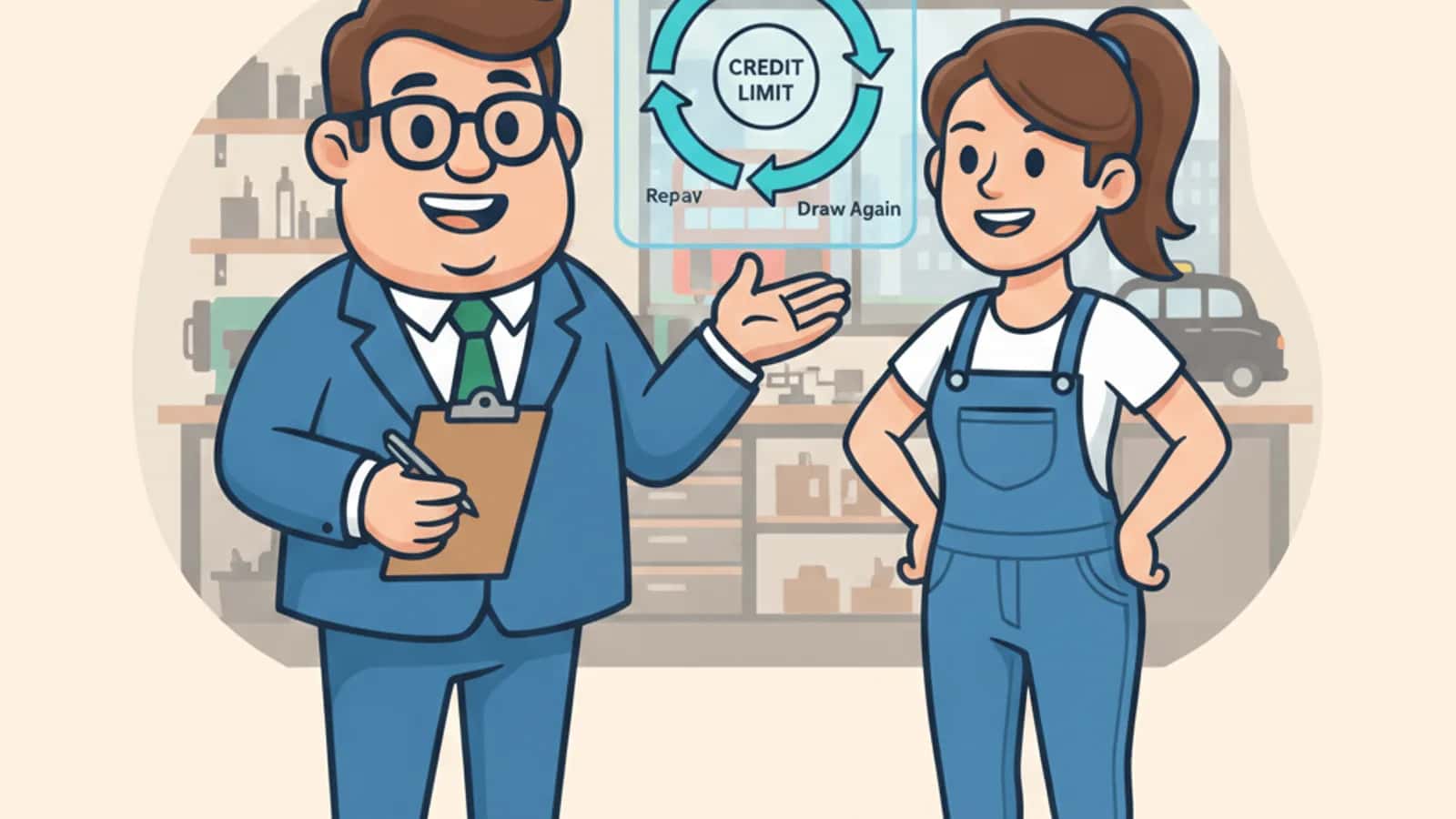
A line of credit (LOC) is a pre-approved borrowing limit set by a lender. You draw from it when you need funds, repay what you've used, and borrow again — all without going through a fresh application each time. You only pay interest on the outstanding balance, not the full limit.
Think of it like a business overdraft, but often with higher limits and more structured repayment terms. A restaurant owner covering a slow January, an e-commerce store buying seasonal stock, or a dental practice bridging a gap between invoices and supplier payments — a line of credit fits these real-world needs well.
How the mechanics work
- Credit limit: The lender sets a maximum amount (for example, £50,000)
- Draw period: The window during which you can access funds (commonly 12 to 36 months for business LOCs)
- Repayment period: After drawing, you repay principal plus interest — some LOCs require interest-only payments during the draw period
- Revolving access: Once you repay, that portion of the limit becomes available again
How Does a Line of Credit Work Differently from a Loan?
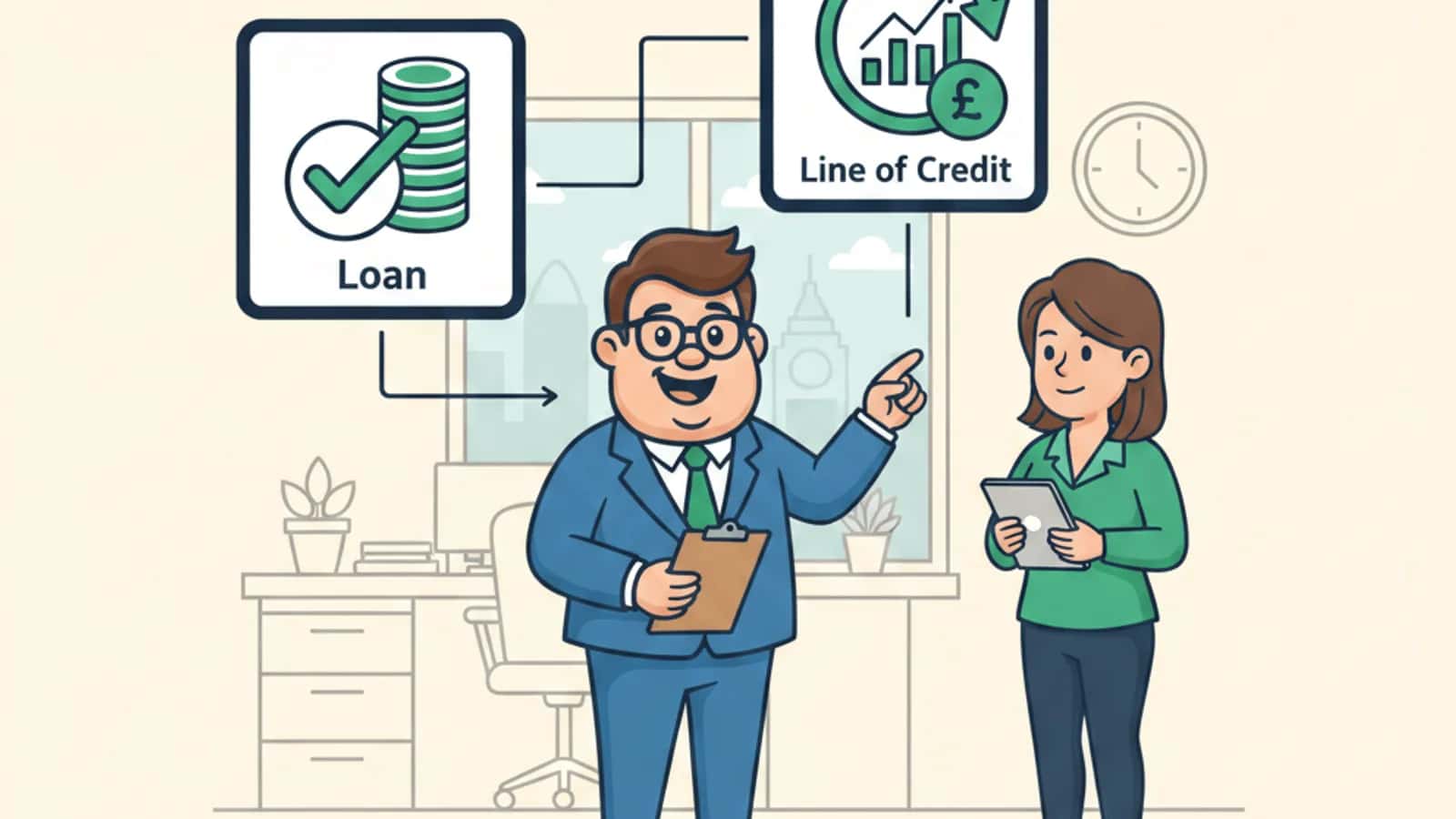
A line of credit is revolving and flexible; a business loan is a one-time lump sum with fixed repayments. With a loan, you receive the full amount upfront and repay it on a set schedule regardless of whether you used every penny. With a line of credit, you only borrow what you need, when you need it.
| Feature | Line of Credit | Business Loan |
|---|---|---|
| How funds are received | Draw as needed | Lump sum upfront |
| Interest charged on | Amount drawn | Full loan amount |
| Reusable | Yes (revolving) | No |
| Repayment structure | Flexible draw and repay | Fixed monthly instalments |
| Best for | Ongoing or unpredictable costs | One-off large purchases |
| Application frequency | Once (then draw freely) | Each time you need funds |
Which is right for you?
Choose a line of credit if
your cash flow is irregular and you need a buffer you can dip into repeatedly.
Choose a business loan if
you have a specific, one-off need — buying equipment, funding a fit-out, or consolidating debt — and you want predictable monthly repayments.
For a deeper look at how UK business loans are structured, the Business Loans guides on Funding Fred cover the main product types side by side.
Secured vs Unsecured Lines of Credit: What's the Difference?
A secured line of credit requires you to put up an asset as collateral (such as property or equipment). An unsecured line of credit requires no collateral — the lender relies on your creditworthiness and business performance instead.
Secured lines of credit
- Lower interest rates because the lender has less risk
- Higher credit limits available
- Your asset is at risk if you default
- Common example: a Home Equity Line of Credit (HELOC), where a homeowner borrows against property equity
Unsecured lines of credit
- No asset at risk
- Typically higher interest rates to offset lender risk
- Approval based on credit score, revenue, and trading history
- Faster to arrange — no asset valuation required
For most UK small business owners, an unsecured line of credit is the more practical option. You're not putting your home or equipment on the line. Flexible Criteria lenders using Open Banking can assess your real cash flow rather than relying purely on a credit score, which opens access for businesses that wouldn't qualify at a traditional bank.
If you're interested in how asset-backed finance compares, the Asset Finance guides on Funding Fred break down the secured borrowing landscape in detail.
What Credit Score Do You Need to Qualify for a Line of Credit?
For a personal line of credit, most mainstream lenders look for a credit score of around 700 or higher, along with a solid history of on-time debt repayments. For a business line of credit, the threshold varies significantly by lender.
Typical credit score requirements by lender type
- High street banks: Usually require strong personal and business credit scores, often 680+ personally, plus two or more years of trading history
- Alternative lenders / fintech platforms: More flexible — some will consider scores below 600 if your revenue and cash flow are healthy
- Specialist bad credit lenders: Focus more on recent bank statements and Open Banking data than on historical credit scores
Beyond the score itself, lenders also assess:
- Monthly or annual turnover
- Time in business (many require at least 6 months)
- Existing debt obligations
- Industry type and perceived risk
The key point for UK SME owners: Your credit score is one input, not the whole picture. A business turning over £30,000 a month with a patchy credit history may still qualify with the right lender. That's where Smart Tech and Open Banking assessments change the game compared to traditional bank processes.
Can You Get a Line of Credit with Bad Credit?
Yes, it's possible to get a line of credit with bad credit, but your options narrow and costs typically rise. Lenders that use Open Banking and real-time cash flow data are far more likely to approve businesses with imperfect credit than traditional banks.
What "bad credit" means in practice
- County Court Judgements (CCJs) on your business or personal record
- Missed payments or defaults in the past 12 to 36 months
- A thin credit file (not enough history for lenders to assess)
- Previous insolvency or IVA
Options for businesses with bad credit
- Alternative lenders with Flexible Criteria: Assess your bank statements and live revenue rather than just your score
- Merchant Cash Advance: Repayments are taken as a percentage of card sales — no fixed monthly payment, which suits businesses with variable income
- Unsecured Loans with Open Banking assessment: Lenders see your actual cash flow, not just a credit report snapshot
For a full breakdown of lenders that don't rely on hard credit checks to get started, see the Best Business Loans No Credit Check guide.
No hard check to start — many flexible lenders run a soft eligibility check first, so exploring your options won't damage your credit score.
How Much Can You Borrow with a Business Line of Credit?
The amount you can borrow depends on your business revenue, credit profile, and the lender's maximum limits. For UK SMEs, business lines of credit typically range from £5,000 to £250,000, though many alternative lenders focus on the £10,000 to £150,000 range.
Factors that determine your credit limit
- Annual turnover: Most lenders cap the limit at a percentage of your monthly or annual revenue
- Trading history: Longer-established businesses typically access higher limits
- Credit profile: Stronger credit means larger limits at lower rates
- Existing debt: High existing borrowing reduces the limit a lender will offer
For Funding Fred's target audience — UK businesses looking for capital between £40,000 and £120,000 — a business line of credit can sit comfortably within that range, provided turnover and trading history support it.
What Are the Interest Rates for Lines of Credit?
Interest rates on lines of credit are often variable, meaning they can change over time based on market conditions and lender terms. For UK business lines of credit in 2026, rates vary widely depending on whether the product is secured or unsecured, and the lender type.
Typical rate ranges (estimates based on market norms):
| Lender Type | Approximate Annual Rate |
|---|---|
| High street bank (secured) | 6% to 12% |
| High street bank (unsecured) | 10% to 18% |
| Alternative lender (unsecured) | 15% to 40%+ |
| Merchant Cash Advance (factor rate) | Equivalent to 20% to 50% APR |
For a current snapshot of what UK businesses are paying across different loan products, the Average Business Loan Interest Rates: June 2026 Update gives a detailed breakdown.
Additional fees to watch for:
- Arrangement or setup fees (often 1% to 3% of the credit limit)
- Annual maintenance fees
- Draw fees (charged each time you access funds)
- Early repayment charges on some products
The practical impact: On a £50,000 line of credit at 20% per annum, drawing £20,000 for three months costs roughly £1,000 in interest. Compare that to a fixed loan where you'd pay interest on the full £50,000 from day one.
Pros and Cons of Getting a Line of Credit
A line of credit suits businesses with variable cash flow needs, but it's not the right tool for every situation. Here's an honest assessment.
Pros
- Pay only for what you use — interest accrues on the drawn balance, not the full limit
- Revolving access — repay and borrow again without reapplying
- Cash flow buffer — covers gaps between invoices, stock purchases, or slow periods
- Faster than applying for multiple loans — one approval, ongoing access
- Unsecured options available — no need to risk business or personal assets
Cons
- Variable interest rates — costs can rise if base rates increase
- Temptation to over-borrow — easy access can lead to carrying unnecessary debt
- Fees can add up — setup, maintenance, and draw fees reduce the cost advantage
- Approval can be harder than a credit card — lenders assess income, trading history, and credit more rigorously
- Limits may be lower than expected — especially for newer businesses or those with weaker credit
Is a Line of Credit Good for Small Business Owners?
Yes — for the right type of business, a line of credit is one of the most practical funding tools available. It's particularly well-suited to businesses with seasonal revenue, irregular payment cycles, or unpredictable stock needs.
Best fit for
- Restaurants and hospitality businesses managing seasonal dips
- E-commerce stores buying stock ahead of peak periods
- Service businesses waiting on slow-paying clients
- Any SME that needs a recurring cash flow buffer rather than a one-off injection
Less suitable for
- Businesses needing a large, one-off capital investment (a fixed loan is cleaner)
- Startups with no trading history (harder to qualify — see the Business Loan for Startups: UK Guide 2026)
- Businesses already carrying high debt loads
Traditional Banks vs Funding Fred:
| Factor | Traditional Banks | Funding Fred |
|---|---|---|
| Application process | Heavy paperwork, weeks to decide | 2 min check, Fast Decision |
| Credit requirements | Strict — strong score required | All Credit Types considered |
| Collateral | Often required | Unsecured options available |
| Access to funds | Slow | Fast, once approved |
| Eligibility check | Hard credit check | No hard check to start |
Application process
- Traditional Banks
- Heavy paperwork, weeks to decide
- Funding Fred
- 2 min check, Fast Decision
Credit requirements
- Traditional Banks
- Strict — strong score required
- Funding Fred
- All Credit Types considered
Collateral
- Traditional Banks
- Often required
- Funding Fred
- Unsecured options available
Access to funds
- Traditional Banks
- Slow
- Funding Fred
- Fast, once approved
Eligibility check
- Traditional Banks
- Hard credit check
- Funding Fred
- No hard check to start
When Should You Use a Line of Credit Instead of a Credit Card?
Use a line of credit when you need higher borrowing limits, lower interest rates, or more structured repayment terms than a business credit card offers. A credit card is fine for small, frequent purchases. A line of credit is better for larger, planned draws where cost matters.
Which is right for you?
Choose a line of credit over a credit card when
- You need to borrow more than a typical credit card limit allows
- You want a lower interest rate on a larger balance
- You need funds transferred directly to your business account (not just card spending)
- You want a clear repayment structure rather than a revolving minimum payment
Choose a credit card when
- You need to make small, frequent purchases and pay off monthly
- You want purchase protection or rewards on spending
- The amount is under £5,000 and you'll clear it quickly
The cost difference matters: Carrying £20,000 on a business credit card at 25% APR costs significantly more than drawing the same amount from a line of credit at 15% to 18%, especially over several months.
How Quickly Can You Access Money from a Line of Credit?
Once a line of credit is approved and set up, funds can typically be accessed within one to two business days of making a draw request. The initial approval process is where timing varies most.
Typical timelines
- Traditional bank LOC: Application to approval can take two to six weeks
- Alternative lender LOC: Fast Decision processes can approve within 24 to 72 hours
- Ongoing draws (once approved): Usually same day or next business day
For businesses that need capital quickly — covering an unexpected supplier invoice or a sudden stock opportunity — the speed of initial approval matters as much as the rate. Alternative lenders using Open Banking can assess your application faster because they're reading live bank data rather than waiting for paper statements.
For a step-by-step guide to the full application process, the How to Get a Business Loan in 2026 guide covers what to prepare to speed things up.
What Happens If You Miss Payments on Your Line of Credit?
Missing payments on a line of credit triggers a chain of consequences that escalate quickly. At minimum, you'll face late payment fees. More seriously, your credit profile takes a hit and your lender may reduce or freeze your available limit.
What typically happens:
- 1
Late fee charged
usually within days of a missed payment
- 2
Interest continues to accrue
on the outstanding balance, including any fees added
- 3
Credit score impact
missed payments are reported to credit agencies, damaging your score
- 4
Limit reduction or freeze
the lender may reduce your available credit or suspend draw access
- 5
Default notice
if payments are missed repeatedly, the lender may issue a formal default
- 6
Debt collection
persistent non-payment can lead to the debt being passed to a collection agency or, for secured LOCs, asset recovery
If you're struggling to make payments
- Contact your lender before missing a payment — most will discuss a temporary arrangement
- Check whether your product has a payment holiday option
- Consider whether refinancing to a fixed loan with lower monthly payments is a better fit
Common Mistakes People Make with Lines of Credit
The most common mistake is treating a line of credit as extra income rather than a short-term cash flow tool. Here are the errors that cost business owners the most.
- 1
Maxing out the limit and staying there
A line of credit works best when you draw, repay, and keep the limit available. Sitting at maximum utilisation increases your credit utilisation ratio, which harms your credit score and signals financial stress to lenders.
- 2
Using it to fund ongoing losses
A LOC should bridge a temporary gap, not prop up a business that's consistently spending more than it earns. If you're drawing repeatedly and never fully repaying, that's a warning sign.
- 3
Ignoring variable rate risk
Rates can rise. A line of credit that costs 15% today could cost 20% in 18 months. Build that possibility into your cost calculations before drawing large amounts.
- 4
Not reading the fee structure
Setup fees, annual fees, and draw fees can significantly increase the true cost of borrowing. Always calculate the total cost of credit, not just the headline interest rate.
- 5
Missing the difference between draw period and repayment period
Some LOCs require interest-only payments during the draw period, then switch to full principal-plus-interest repayments. That jump in monthly cost catches some business owners off guard.
- 6
Applying to multiple lenders simultaneously
Each hard credit check leaves a mark on your file. Use a platform that offers a soft eligibility check first — No hard check to start — so you can explore options without damaging your score.
Next steps for what is a line of credit
Understanding what is a line of credit is the first step to using one well. For UK small business owners, it's one of the most flexible funding tools available — but only when it's matched to the right need. Use it to bridge cash flow gaps, fund seasonal stock, or cover short-term costs. Don't use it to paper over structural losses.
The key decisions are straightforward:
- Secured or unsecured?
- Unsecured protects your assets and moves faster.
- Bank or alternative lender?
- Alternative lenders with Flexible Criteria and Open Banking assessments serve All Credit Types — not just those with perfect scores.
- Line of credit or fixed loan?
- If you need a one-off lump sum, a fixed Unsecured Loan is cleaner. If you need ongoing, flexible access, a line of credit wins.
Next steps:
- Check your current monthly revenue and identify your realistic borrowing need
- Review your credit profile — both personal and business
- Use a soft eligibility check to explore options without damaging your score
- Compare total cost of credit (rate plus fees), not just the headline rate
- Check Eligibility Now with a Wide partner panel that covers All Credit Types
For a broader view of your business finance options, the Business Finance guides on Funding Fred cover everything from lines of credit to Merchant Cash Advances, asset finance, and startup loans — all in plain language, with Fast Decision tools built in.
Further reading
Frequently asked questions
What Is a Line of Credit and How Does It Work?
A line of credit (LOC) is a pre-approved borrowing limit set by a lender. You draw from it when you need funds, repay what you've used, and borrow again — all without going through a fresh application each time. You only pay interest on the outstanding balance, not the full limit.
How Does a Line of Credit Work Differently from a Loan?
A line of credit is revolving and flexible; a business loan is a one-time lump sum with fixed repayments. With a loan, you receive the full amount upfront and repay it on a set schedule regardless of whether you used every penny. With a line of credit, you only borrow what you need, when you need it.
Secured vs Unsecured Lines of Credit: What's the Difference?
A secured line of credit requires you to put up an asset as collateral (such as property or equipment). An unsecured line of credit requires no collateral — the lender relies on your creditworthiness and business performance instead.
What Credit Score Do You Need to Qualify for a Line of Credit?
For a personal line of credit, most mainstream lenders look for a credit score of around 700 or higher, along with a solid history of on-time debt repayments. For a business line of credit, the threshold varies significantly by lender.
Can You Get a Line of Credit with Bad Credit?
Yes, it's possible to get a line of credit with bad credit, but your options narrow and costs typically rise. Lenders that use Open Banking and real-time cash flow data are far more likely to approve businesses with imperfect credit than traditional banks.
How Much Can You Borrow with a Business Line of Credit?
The amount you can borrow depends on your business revenue, credit profile, and the lender's maximum limits. For UK SMEs, business lines of credit typically range from £5,000 to £250,000, though many alternative lenders focus on the £10,000 to £150,000 range.
Written by
The Funding Fred Editorial Team creates plain-English guides to help business owners understand funding options, eligibility, and application readiness before they compare finance options.
Reviewed by
UK business finance content reviewer
Robert reads our UK business finance guides before they go live, checking each one is accurate, easy to follow, and reflects how lending actually works today — not how a brochure says it should. He's listed on the FCA Register, approved as an SMF3 (AR) Executive Director at Switcha Limited, and connected to Lucky Growth Partners Ltd through its appointed representative relationship, so the regulated detail gets a properly qualified second read.