
Electric Van Loan Scheme for UK Businesses: What You Need to Know
The Energy Saving Trust runs an interest-free electric van loan scheme for UK businesses in England, helping companies buy electric vans for commercial use with no fixed application deadline. Separately, the government's Zero Emission Van Grant cuts up to £5,000 off the purchase price at the dealership.

Quick answer
The Energy Saving Trust runs an interest-free electric van loan scheme for UK businesses in England, helping companies buy electric vans for commercial use with no fixed application deadline. Separately, the government's Zero Emission Van Grant cuts up to £5,000 off the purchase price at the dealership. Both schemes can be used alongside other business finance to reduce the total cost of switching your fleet.
Key takeaways
- The Energy Saving Trust offers interest-free loans to UK businesses in England to purchase electric vans for commercial use, with rolling applications and no fixed end date
- The government's OZEV Plug-in Van Grant automatically discounts up to £2,500 (small vans) or £5,000 (large vans) off the purchase price at point of sale
- Under the ZEV mandate, 24% of all new vans sold in 2026 must be electric — meaning manufacturers are under pressure to offer competitive deals and incentives
- In March 2026, the UK government announced a £1 billion funding package to support the switch to electric vans and trucks through to 2030
- £170 million from that package is earmarked specifically for charging infrastructure for businesses and public authorities
- The Workplace Charging Scheme offers up to £350 per charge point for up to 40 points — stackable with van grants to cut total fleet costs further
- Electric vans must produce 0 gCO₂/km and travel at least 60 miles on electric power to qualify for the plug-in grant
- Businesses that have been declined by traditional lenders for fleet finance still have options — alternative lenders consider current trading performance, not just credit history
- Green loans from specialist lenders and banks increasingly cover zero-emission vehicles as eligible assets within wider sustainability finance
What Is the Electric Van Loan Scheme for UK Businesses?
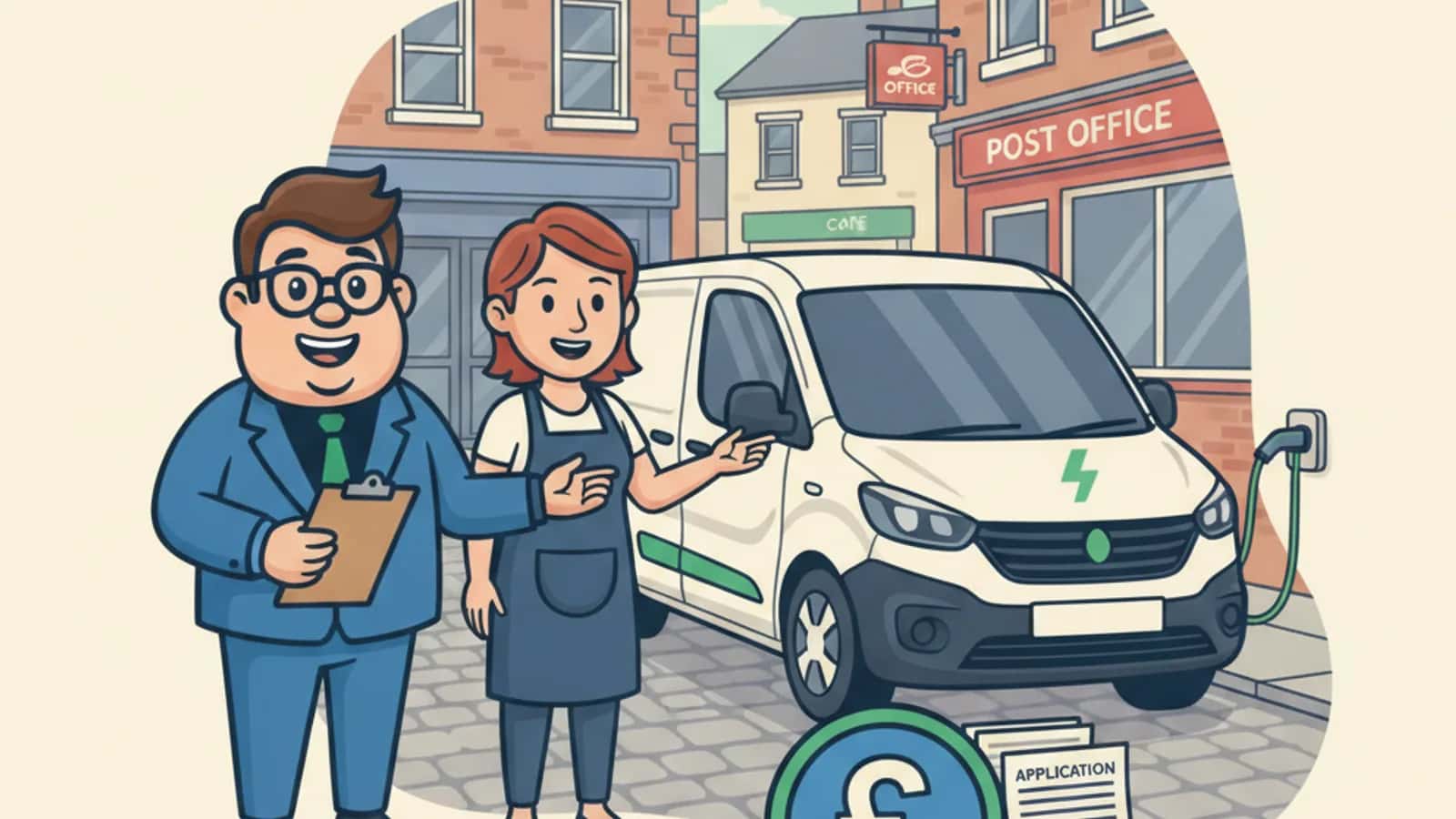
The Energy Saving Trust's electric van loan is an interest-free loan designed to help UK businesses in England purchase electric vans for commercial use. Applications are open on a rolling basis — there's no fixed deadline to worry about.
This isn't a grant. The money is repaid. But because there's no interest charged, the cost of borrowing is effectively zero, making it one of the most cost-effective ways to finance an electric van purchase available to UK businesses right now.
Key features of the scheme:
- Purpose:
- Purchase of electric vans for commercial use
- Interest rate:
- 0% (interest-free)
- Location:
- England (separate schemes may apply in Scotland, Wales, and Northern Ireland)
- Application:
- Rolling — no fixed deadline
- Primary source:
- Energy Saving Trust
Who Is Eligible for the Electric Van Loan?

The scheme is aimed at UK businesses in England that need electric vans for commercial operations. To qualify, your business generally needs to demonstrate that the van will be used for legitimate commercial purposes — not personal use.
Typical eligibility requirements include:
- Registered business operating in England
- Van used primarily for commercial purposes
- Vehicle must be a qualifying zero-emission electric van
- Business must be able to demonstrate ability to repay the loan
Choose this scheme if: Your business is based in England, needs one or more electric vans for deliveries, trades, or fleet operations, and wants to avoid interest costs entirely.
For businesses outside England, or those looking at broader green finance options, the green business loans and sustainable funding guide for 2026 covers alternative routes worth exploring.
What Government Grants Are Available Alongside the Loan?
The loan scheme doesn't exist in isolation. UK businesses can stack several forms of support to significantly reduce the cost of going electric.
1. OZEV Plug-in Van Grant
This is an automatic discount applied at the dealership — no separate application required by the business:
| Van Type | Weight | Maximum Grant |
|---|---|---|
| Small electric van | Under 2,500 kg | Up to £2,500 |
| Large electric van | 2,500–4,250 kg | Up to £5,000 |
The van must produce 0 gCO₂/km and have a minimum electric range of 60 miles. The grant covers up to 35% of the purchase price, capped at the figures above.
2. Workplace Charging Scheme
Covers up to £350 per charge point, for up to 40 charge points per business. This reduces the infrastructure cost of running an electric fleet significantly.
3. The £1 Billion Government Package (2026–2030)
In March 2026, the government confirmed a £1 billion funding commitment to support fleet electrification through to 2030, including £170 million specifically for charging infrastructure for businesses and public authorities.
These schemes are designed to work together. A business buying a large electric van could receive £5,000 off the purchase price automatically, then fund the remainder through an interest-free loan, and separately claim up to £350 per charge point for their depot.
How Does the ZEV Mandate Affect Electric Van Availability and Pricing in 2026?
The UK's Zero Emission Vehicle (ZEV) mandate requires that 24% of all new vans sold in 2026 must be electric. Given that electric vans represented around 12% market share in early 2026, manufacturers face significant pressure to close that gap fast.
What this means practically for businesses:
- More choice:
- A wave of new electric van models is expected throughout 2026 as manufacturers push to hit targets
- Better deals:
- Manufacturers risk fines for missing the 24% target, so expect aggressive leasing rates, discounted finance, and bundled service packages
- Stronger competition:
- More players in the market means better pricing across the board
The narrative has shifted. Electric vans in 2026 aren't just a "green" choice — they're increasingly competitive on everyday usability, range, and total cost of ownership compared to diesel equivalents.
For businesses considering asset finance as a route to fleet vehicles, the comparison between commercial vehicle finance and asset finance is worth reading before committing to a structure.
What Are the Financial Benefits of Electric Vans for UK Businesses?
Beyond the upfront grants and loans, the ongoing cost savings are where electric vans make a compelling case.
Running cost advantages
- Fuel savings: Electricity is significantly cheaper per mile than diesel, particularly with overnight off-peak charging at business premises
- Maintenance: Fewer moving parts means lower servicing costs over the vehicle's life
- Benefit-in-Kind (BIK): Fully electric vans available for private use attract zero-rated BIK tax
- London operations: Reduced Congestion Charge costs for zero-emission vehicles
- Clean Air Zones: Electric vans avoid charges in UK Clean Air Zones, which are expanding across more cities
Environmental and reputational benefits
- Reduced carbon footprint supports ESG reporting requirements
- Increasingly required by large clients and public sector contracts
- Aligns with UK net-zero commitments
Green loans from specialist lenders and banks are increasingly framing electric van finance as a strategic tool for managing risk and supporting innovation — not just a sustainability gesture.
How to Apply for the Electric Van Loan Scheme for UK Businesses
The application process for the Energy Saving Trust scheme is straightforward, but it helps to be prepared.
Step-by-step process:
- 1
Check eligibility
Confirm your business is based in England and the van will be used commercially
- 2
Identify your vehicle
Choose a qualifying zero-emission electric van
- 3
Visit the Energy Saving Trust website
Go to energysavingtrust.org.uk/grants-and-loans/electric-van-loan-for-businesses/ for the current application portal
- 4
Submit your application
Provide business details, intended vehicle, and commercial use evidence
- 5
Await assessment
The scheme operates on a rolling basis, so there's no single intake window
- 6
Receive funds
If approved, funds are directed toward the van purchase
What to have ready
- Business registration details
- Evidence of commercial use (delivery routes, trade use, fleet plans)
- Vehicle details (make, model, specifications confirming zero-emission status)
- Basic financial information
What If the Interest-Free Loan Isn't Enough — or You Don't Qualify?
The Energy Saving Trust loan is excellent — but it won't suit every business. Loan amounts may not cover the full cost of a fleet purchase, eligibility criteria may exclude some applicants, or a business may simply need faster access to capital.
Here's where alternative business finance fills the gap.
| Factor | Traditional Bank | Funding Fred Partner Panel |
|---|---|---|
| Speed | Weeks to months | Fast decision |
| Paperwork | Heavy | Minimal |
| Credit criteria | Strict, history-focused | Flexible, trading-focused |
| Loan range | Varies | £10k–£1m |
| Credit check to start | Hard search | No hard check to start |
| Green assets | Sometimes eligible | Considered |
Speed
- Traditional Bank
- Weeks to months
- Funding Fred Partner Panel
- Fast decision
Paperwork
- Traditional Bank
- Heavy
- Funding Fred Partner Panel
- Minimal
Credit criteria
- Traditional Bank
- Strict, history-focused
- Funding Fred Partner Panel
- Flexible, trading-focused
Loan range
- Traditional Bank
- Varies
- Funding Fred Partner Panel
- £10k–£1m
Credit check to start
- Traditional Bank
- Hard search
- Funding Fred Partner Panel
- No hard check to start
Green assets
- Traditional Bank
- Sometimes eligible
- Funding Fred Partner Panel
- Considered
Funding Fred connects UK businesses with a wide partner panel of lenders through a 2-minute eligibility check — no hard credit search to start, no obligation to proceed. It's built for business owners who've been declined by their bank or simply can't wait weeks for an answer.
Relevant options for electric van finance
- Unsecured business loans — No asset security required, based on trading performance
- Asset finance — Specifically structured for vehicle and equipment purchases, spreading cost over 3–7 years
- Business loans — Flexible funding from £10k to £1m across all credit types
If a bank has already said no, that's not the end of the road. See what to do after a business loan decline for practical next steps.
Business Funding. Without the Fuss.
Check Eligibility Now — no hard check to start, no obligation to proceed.
Common Mistakes Businesses Make When Financing Electric Vans
1. Waiting for a "better" grant The current support package is substantial. Waiting for a more generous scheme risks missing deals driven by the ZEV mandate pressure in 2026.
2. Not stacking available support The plug-in grant, the interest-free loan, and the Workplace Charging Scheme can all be used together. Many businesses use only one.
3. Assuming a bank decline means no options Traditional lenders apply rigid criteria. Alternative lenders assess current trading performance — particularly relevant for businesses with imperfect credit history. See the business loan eligibility criteria guide for a clear breakdown.
4. Choosing the wrong finance structure Asset finance and unsecured loans work differently. For large capital purchases like a fleet, asset finance versus a standard business loan is worth comparing carefully.
5. Ignoring total cost of ownership The upfront price is only part of the picture. Factor in fuel savings, maintenance reductions, BIK tax benefits, and Clean Air Zone avoidance when making the business case.
FAQ: Electric Van Loan Scheme for UK Businesses
Is the Energy Saving Trust electric van loan a grant or a loan?
It's a loan, not a grant. However, it's interest-free, meaning you repay only what you borrow with no interest charges added.
Is there a deadline to apply for the electric van loan?
No fixed deadline. The scheme operates on a rolling basis with ongoing applications accepted.
Can businesses outside England apply?
The Energy Saving Trust scheme specifically covers England. Separate support may be available in Scotland, Wales, and Northern Ireland through devolved programmes.
Does the OZEV Plug-in Van Grant require a separate application?
No. The discount is applied automatically at the dealership at point of sale — the business doesn't need to apply separately.
Can I combine the interest-free loan with the plug-in grant?
Yes. The plug-in grant reduces the purchase price at the dealership, and the loan can cover the remaining balance. These schemes are designed to complement each other.
What if my business has bad credit — can I still get electric van finance?
Yes. Alternative lenders through platforms like Funding Fred consider current trading performance rather than credit history alone. All credit types are considered. A 2-minute eligibility check starts with no hard credit search.
How much can I borrow through alternative business finance for electric vans?
Through Funding Fred's partner panel, businesses can access unsecured loans from £10,000 to £1,000,000 depending on trading performance and circumstances.
What's the difference between the small and large van grant amounts?
Small vans under 2,500 kg receive up to £2,500. Larger vans between 2,500 kg and 4,250 kg receive up to £5,000.
Are electric vans genuinely competitive with diesel in 2026?
Increasingly yes. The ZEV mandate is pushing manufacturers to improve range, reduce prices, and offer stronger deals. Range anxiety is less of a barrier for most commercial routes than it was two years ago.
Does the Workplace Charging Scheme cover home charging for employees?
No — the Workplace Charging Scheme covers charge points at business premises, not employee home installations. A separate OZEV scheme covers home charging.
Conclusion: Is Now the Right Time to Switch Your Fleet?
The short answer is yes — and the support available in 2026 makes it more financially viable than at any point before. For more comparisons and application guidance, browse our business loan guides.
The Energy Saving Trust's interest-free electric van loan removes the cost of borrowing entirely. The OZEV Plug-in Van Grant cuts up to £5,000 off the purchase price automatically. The government's £1 billion commitment through 2030 signals long-term policy stability. And the ZEV mandate is forcing manufacturers to compete hard on price and deals throughout 2026.
Actionable next steps:
- Check the Energy Saving Trust scheme at energysavingtrust.org.uk — confirm your eligibility and apply on a rolling basis
- Factor in the plug-in grant when getting dealer quotes — the discount is automatic, so make sure it's reflected in the price
- Explore the Workplace Charging Scheme if you need charging infrastructure at your premises
- If you need additional finance — or the loan alone doesn't cover your fleet needs — run a 2-minute eligibility check with Funding Fred. No hard credit search. No obligation. Wide partner panel. All credit types considered.
The cost of waiting is real: rising diesel prices, expanding Clean Air Zones, and growing client expectations around sustainability all point in the same direction. The tools to act are already in place.
Business Funding. Without the Fuss. Check Eligibility Now.
Further reading
Written by
The Funding Fred Editorial Team creates plain-English guides to help business owners understand funding options, eligibility, and application readiness before they compare finance options.
Reviewed by
UK business finance content reviewer
Robert reads our UK business finance guides before they go live, checking each one is accurate, easy to follow, and reflects how lending actually works today — not how a brochure says it should. He's listed on the FCA Register, approved as an SMF3 (AR) Executive Director at Switcha Limited, and connected to Lucky Growth Partners Ltd through its appointed representative relationship, so the regulated detail gets a properly qualified second read.
Sources
- 2026 Van Update Zev Targets Government Funding
- Plug In Van Grant
- Vans
- Electric Van Loan For Businesses
- Government Extends Electric Van And Truck Grants To 2027
- Electric Vehicle Plug In Van And Truck Grant Extended Until 2027
- How Going Electric Can Save You Money
- Green Loans For Smaller Businesses
- A Guide To Green Financing Options For Businesses
- Green Loans And Green Asset Finance Launched For Businesses