Green Business Loans & Grants for UK SMEs: July 2026 Guide
UK SMEs can access a range of green business loans and grants in July 2026, from local council energy-efficiency grants worth £1,000,£50,000 to national programmes like Innovate UK's £60 million Net Zero Living fund.
Quick answer
UK SMEs can access a range of green business loans and grants in July 2026, from local council energy-efficiency grants worth £1,000,£50,000 to national programmes like Innovate UK's £60 million Net Zero Living fund. Green loans differ from standard business loans because the money must be spent on eligible sustainable activities, and lenders will ask for evidence. If a grant isn't available in your area, a fast unsecured business loan can still fund your green project today.
Key takeaways
- Green grants are real but competitive, most are capped, regional, and first-come-first-served. Act fast.
- Green loans restrict use of funds to eligible sustainable activities such as solar, EVs, and energy efficiency.
- Local council schemes (Somerset, Coventry & Warwickshire, Three Rivers) are among the most accessible routes in mid-2026.
- Innovate UK's Net Zero Living programme offers competitive grant rounds for SME innovation projects.
- A business plan helps, most grant schemes require it; loan applications via smart lenders are faster and lighter on paperwork.
- Speed matters, some schemes close when funds run out. Don't wait for a bank to decide.
- Soft search first, checking eligibility with a lender like Funding Fred won't mark your credit file.
- British Business Bank guarantees have unlocked £12 billion for 160,000+ smaller businesses since 2014.
- ESG factors are rising, lenders and investors increasingly reward businesses that can show sustainability credentials.
- All credit types can access green funding, trading performance matters as much as credit history.
What Are Green Business Loans and Grants Available to UK SMEs in 2026?
Green business loans and grants are funding products specifically designed to help UK SMEs invest in sustainable or low-carbon activities. In July 2026, the landscape covers both public grant schemes (free money, no repayment) and commercial green loans (borrowed capital with conditions on how it's spent).
Here's a breakdown of the main categories active right now:
Green Grants (Free Funding)
Innovate UK Net Zero Living
- Amount
- Competitive rounds
- Who It's For
- UK SMEs innovating for net zero
- Status (July 2026)
- Open, multiple rounds
Coventry & Warwickshire Green Business Programme
- Amount
- £1,000,£50,000 (up to 40% of costs)
- Who It's For
- SMEs investing in energy efficiency
- Status (July 2026)
- Active
Somerset Green Business Grants
- Amount
- Varies
- Who It's For
- SMEs ≤250 employees in Somerset
- Status (July 2026)
- Active
Three Rivers Solar PV & Battery Grant
- Amount
- Up to £3,000
- Who It's For
- SMEs installing solar/battery systems
- Status (July 2026)
- Open until 31 Dec 2026 or funds exhausted
Bath & North East Somerset / South Gloucestershire
- Amount
- Varies
- Who It's For
- Local SMEs, decarbonisation focus
- Status (July 2026)
- Active
Workplace Charging Scheme (WCS)
- Amount
- Contribution to EV charge point costs
- Who It's For
- Any UK business installing EV chargers
- Status (July 2026)
- Extended to 31 March 2027
Green Loans (Repayable Finance)
- Energy efficiency loans
- , for insulation, LED lighting, heating upgrades
- Renewable energy finance
- , solar PV, wind, battery storage
- EV and fleet loans
- , electric vans, cars, charging infrastructure (see our Electric Van Loan Scheme guide)
- Green building loans
- , retrofitting commercial premises
- Sustainability-linked loans
- , interest rates tied to hitting ESG targets
The British Business Bank notes that green loans typically require evidence that funds are used for eligible sustainable activities, often defined by the lender's own green taxonomy.
What's the Difference Between a Green Loan and a Regular Business Loan?
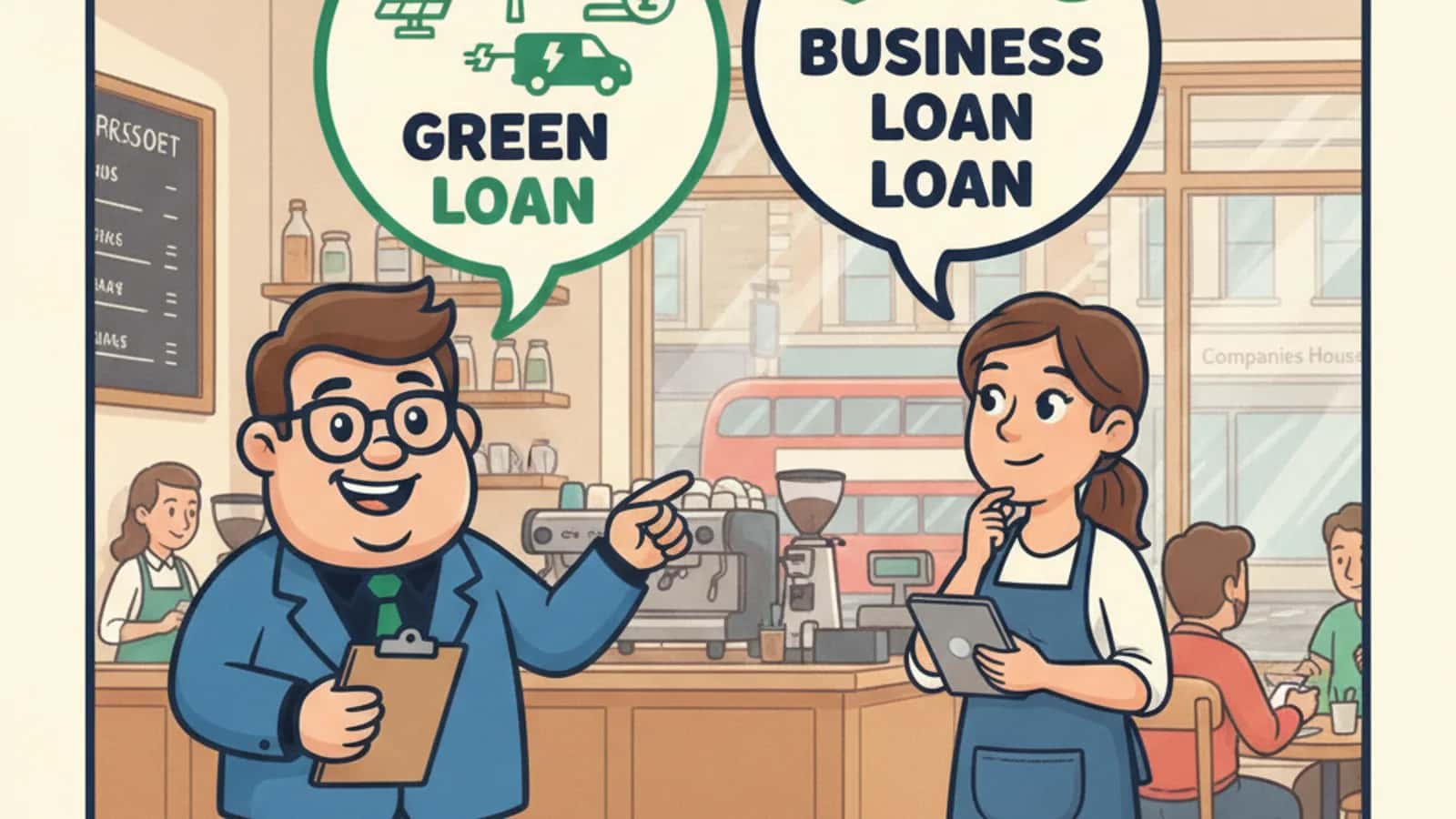
The core difference is a use-of-funds restriction. A standard unsecured business loan can fund anything, stock, wages, equipment, expansion. A green loan comes with conditions: the money must go toward eligible sustainable activities, and the lender may ask for invoices or reports to confirm this.
Key differences at a glance
- Purpose: Green loans are ring-fenced for sustainable investment; standard loans are flexible
- Rate: Some green loans offer preferential rates as an incentive, but not always
- Reporting: Green loans often require you to report on environmental outcomes
- Eligibility: Lenders apply a "green taxonomy" to decide what qualifies
- Speed: Standard unsecured loans through smart lenders can be faster, no green-use verification needed
Which is right for you?
Choose a green loan if
your project clearly qualifies (solar install, EV fleet, energy retrofit) and you want any rate advantage on offer.
Choose a standard unsecured loan if
your green project is mixed-use, you need funds fast, or the green loan application process is too slow for your timeline. For a full comparison of loan types, see Different Types of Business Loans Available in the UK.
How Much Can I Borrow With a Green Business Loan in the UK?
Green loan amounts vary widely depending on the lender and scheme. Local council grants top out at £3,000,£50,000. Commercial green loans from banks and specialist lenders typically range from £25,000 to several million for larger projects.
For SMEs using a platform like Funding Fred, unsecured loans between £10,000 and £1,000,000 are accessible, and can be directed toward green projects without the ring-fencing restrictions of a formal green loan product.
Factors that affect how much you can access:
- Turnover and trading history
- , lenders want to see the business can service the debt
- Project size and evidence
- , grant schemes often cap at a percentage of total project cost (e.g., 40% under Coventry & Warwickshire's scheme)
- Credit profile
- , imperfect credit doesn't automatically disqualify you; trading performance counts
- Scheme rules
- , some grants require you to fund the majority yourself (Three Rivers requires SMEs to cover at least 75% of installation costs)
Which UK SMEs Qualify for Green Business Grants?
Most green grant schemes target SMEs with fewer than 250 employees, the standard EU/UK definition of a small or medium-sized enterprise. Beyond that, eligibility varies by scheme.
Common eligibility criteria across active schemes
- Based in the relevant region or local authority area
- Trading for a minimum period (often 6-12 months)
- Project must deliver measurable carbon or energy savings
- Business must not already have received state aid above the de minimis threshold
- Some schemes exclude certain sectors (e.g., agriculture may have separate routes)
Somerset Green Business Grants, for example, are open to SMEs with 250 or fewer employees and cover energy efficiency, renewable energy, transport, waste, and biodiversity projects.
Innovate UK's Net Zero Living programme is more competitive, it runs timed rounds and looks for innovation-led projects rather than straightforward equipment purchases.
What Counts as a Green Business for UK Funding Purposes?
You don't need to be an environmental company to qualify. A restaurant fitting solar panels, a logistics firm switching to electric vans, or a construction business upgrading to low-energy site equipment can all qualify for green funding.
The British Business Bank defines eligible green activities as including: renewable energy, green buildings, pollution prevention, sustainable water management, and clean transport. Lenders apply their own taxonomies, but these categories are the most commonly accepted.
Activities that typically qualify
- Solar PV and battery storage installation
- LED lighting and energy-efficient heating/cooling
- EV charging infrastructure and electric fleet vehicles
- Insulation and building fabric improvements
- Waste reduction and recycling systems
- Low-carbon manufacturing processes
Activities that typically don't qualify for green-labelled products
- General working capital
- Marketing or staff costs
- Standard IT equipment (unless specifically energy-efficient)
- Projects with no measurable environmental benefit
If your project sits in a grey area, a standard unsecured business loan is often the simpler route, no taxonomy check required.
What Interest Rates Are Green Business Loans Charging Right Now?
Green loan rates in mid-2026 vary significantly. Some lenders offer a small rate discount (typically 0.25%,0.5% lower than equivalent standard loans) to incentivise green borrowing, but this isn't universal.
For context, average UK business loan rates in 2026 sit in a range influenced by the Bank of England base rate and lender risk appetite. For a current picture, see our Average Business Loan Interest Rates: June 2026 Update.
What drives your rate
- Business credit profile and trading history
- Loan size and term
- Whether the product is formally "green labelled" or a standard loan
- The lender's own cost of capital
The OECD's 2026 UK SME finance report notes that tighter credit conditions in 2024 have carried forward, making lender criteria an important factor for SMEs seeking any type of finance. A wide partner panel, rather than a single bank, gives you the best chance of a competitive rate.
Can I Get a Green Grant Without Taking Out a Loan?
Yes. Grants are entirely separate from loans. You don't need to borrow anything to apply for a grant, but you will usually need to fund a portion of the project yourself upfront.
How grant co-funding typically works
- The grant covers a percentage of eligible project costs (e.g., 40% under some regional schemes)
- You fund the remainder from cash reserves, or via a loan
- Some grants pay in arrears, meaning you spend first, then claim back
If cash flow is the barrier to accessing a grant, a short-term business loan can bridge the gap. You fund the project, claim the grant, and use the grant payment to reduce the loan balance. This is a practical combination many SMEs use.
For a broader look at funding options beyond loans, see our guide to Alternative Business Funding for UK SMEs.
How Do I Apply for Green Funding as a Small Business?
The application process depends on whether you're going for a grant or a loan, they're very different journeys.
Applying for a Green Grant
- Identify the right scheme, use resources like Swoop Funding's sustainability grants directory or your local council website
- Check eligibility, geography, business size, project type, and any deadlines
- Prepare your project proposal, most grants require a business plan or project description (see below)
- Gather supporting documents, accounts, energy bills, quotes from suppliers
- Submit before the deadline, many schemes are first-come-first-served or run competitive rounds
- Wait for assessment, grant decisions can take weeks to months
Applying for a Green Loan (or Standard Unsecured Loan)
This is faster. Through a platform like Funding Fred:
- 2-minute eligibility check, no hard credit search to start
- Open Banking connection, lenders see real trading data, not just a credit score
- Compare selected finance partners, see offers from a wide panel
- Choose your offer, no obligation to proceed
- Funds released, often within 24-48 hours for approved applications
For more on the loan application process, see How to Get a Business Loan in 2026.
Do I Need a Business Plan to Apply for Green Grants?
For most grant schemes, yes, some form of project plan is required. It doesn't need to be a 40-page document, but you'll typically need to show:
- What the project is and what it will achieve
- Estimated costs and how the grant will be used
- Projected energy savings or carbon reduction
- How you'll fund the non-grant portion
Innovate UK's Net Zero Living programme expects detailed innovation proposals. Local council grants like Three Rivers' solar scheme tend to be lighter, a short application form and supplier quotes may be enough.
For loans, the bar is lower. Smart lenders using Open Banking assess your trading performance directly. A formal business plan is rarely required for unsecured loans under £250,000. For more on what documents lenders actually want, see What Documents Do I Need to Apply for a Business Loan.
How Long Does It Take to Get Approved for Green Business Funding?
Green grants: Weeks to months. Competitive rounds (like Innovate UK) can take 8-12 weeks from submission to decision. Local council grants are faster but still typically 2-6 weeks.
Green loans from banks: 4-8 weeks is common, with significant paperwork.
Unsecured business loans via smart lenders: Same day to 48 hours for many applicants. The 2-minute eligibility check and Open Banking connection remove most of the delay.
If your green project has a time-sensitive element, a supplier quote expiring, a scheme deadline approaching, waiting for a bank isn't realistic. Fast-decision lending exists precisely for this situation.
Are There Green Loans for Businesses That Aren't Environmentally Focused?
Yes. You don't need to be a "green business" to access green finance, you just need a qualifying project. A takeaway restaurant installing solar panels, a hair salon upgrading to energy-efficient equipment, or a logistics firm buying electric vans can all access green funding.
The project qualifies, not the sector. As long as the investment meets the lender's or scheme's definition of a green activity, the nature of your core business doesn't disqualify you.
If your business has no green project in mind but needs capital for other growth, a standard unsecured loan is the right tool. See our guide to Unsecured Business Loans for how that works.
Which Green Funding Schemes Have the Easiest Application Process?
The simplest schemes in mid-2026 are local council grants with straightforward eligibility and short application forms.
Easiest to apply for
- Three Rivers Solar PV & Battery Grant, up to £3,000, first-come-first-served, application via the council website
- Somerset Green Business Grants, covers multiple green categories, accessible to most local SMEs ≤250 employees
- Workplace Charging Scheme, government-backed contribution to EV charger installation, running to March 2027
More involved
- Innovate UK Net Zero Living, competitive, requires detailed innovation proposals
- Coventry & Warwickshire Green Business Programme, larger grants (up to £50,000) but more documentation required
Fastest overall: An unsecured business loan through a smart lender. No grant application, no project assessment, no weeks of waiting. Business Funding. Without the Fuss.
What Happens If My Green Business Project Fails After Getting Funding?
For grants, the consequences depend on the grant conditions. Most grants require you to complete the project and evidence the outcomes. If the project fails or the money is misused, the grant body can demand repayment, and in serious cases, pursue legal action.
Practical steps if a project runs into trouble
- Contact the grant body early, most prefer to work with you rather than claw back funds
- Keep records of all spending and any reasons for delays
- Check whether the grant has a force majeure or variation clause
- For loans, contact your lender immediately, many have hardship provisions
For loans, the standard rules apply: missed repayments affect your credit file and may trigger recovery action. Understanding repayment terms before you borrow is essential. Our Business Loan Repayment Examples guide shows what payments look like at different loan sizes.
What Are Common Mistakes SMEs Make When Applying for Green Loans and Grants?
The OECD's Platform on Financing SMEs for Sustainability identifies informational barriers, limited collateral, and complex application processes as the main obstacles SMEs face. In practice, these translate into avoidable errors.
Most common mistakes:
- Applying for the wrong scheme, not checking geographic or sector eligibility before spending hours on an application
- Missing deadlines, first-come-first-served schemes close without warning
- Underestimating co-funding requirements, grants rarely cover 100% of costs; not having the balance ready stalls projects
- Weak project evidence, vague descriptions of carbon savings won't pass assessment
- Applying to a single lender, one bank rejection isn't the end; a wide partner panel dramatically improves approval odds
- Ignoring Open Banking, lenders who use real trading data can approve businesses that a credit-score-only check would decline
- Waiting too long, green funding windows close; by the time a bank has processed your application, the scheme may be exhausted
Funding Fred: Fast Green Business Finance Without the Fuss
Banks are slow. Green grant applications take weeks. But your solar quote expires in 14 days and the EV lease deal ends this month.
That's the gap Funding Fred fills.
<div style="background-color:#f0faf4; border-left:4px solid #2e7d32; padding:20px; margin:20px 0; border-radius:4px;"> <strong style="font-size:1.1em; color:#2e7d32;">Funding Fred vs Traditional Bank</strong> <table style="width:100%; border-collapse:collapse; margin-top:12px; font-size:0.95em;"> <tr style="background-color:#2e7d32; color:white;"> <th style="padding:10px; text-align:left;">Traditional Bank</th> <th style="padding:10px; text-align:left;">Funding Fred</th> </tr> <tr style="background-color:#ffffff;"> <td style="padding:10px; border-bottom:1px solid #ddd;">Weeks to decide</td> <td style="padding:10px; border-bottom:1px solid #ddd;"> Fast Decision, same day to 48 hrs</td> </tr> <tr style="background-color:#f9f9f9;"> <td style="padding:10px; border-bottom:1px solid #ddd;">Heavy paperwork</td> <td style="padding:10px; border-bottom:1px solid #ddd;"> 2-min check, Open Banking</td> </tr> <tr style="background-color:#ffffff;"> <td style="padding:10px; border-bottom:1px solid #ddd;">Clean credit required</td> <td style="padding:10px; border-bottom:1px solid #ddd;"> All Credit Types considered</td> </tr> <tr style="background-color:#f9f9f9;"> <td style="padding:10px; border-bottom:1px solid #ddd;">Single lender, take it or leave it</td> <td style="padding:10px; border-bottom:1px solid #ddd;"> Wide partner panel, compare offers</td> </tr> <tr style="background-color:#ffffff;"> <td style="padding:10px;">Hard credit search upfront</td> <td style="padding:10px;"> No hard check to start</td> </tr> </table> </div>
Unsecured Loans from £10k to £1m. Merchant Cash Advances. Flexible Criteria. Smart Tech.
No obligation to proceed. We do not charge you for using the service.
Check Eligibility Now, 2-min check, no hard search.
Next steps
Green business funding in the UK has never been more varied, or more time-sensitive. In July 2026, UK SMEs can tap local council grants worth up to £50,000, compete for Innovate UK's Net Zero Living rounds, claim contributions toward EV chargers through the Workplace Charging Scheme, and access commercial green loans for larger projects. For more comparisons and application guidance, browse our business loan guides.
Actionable next steps:
- Search your local council website for active green business grant schemes in your area, many are first-come-first-served and close without notice
- Check Innovate UK's Net Zero Living competition calendar if your project has an innovation angle
- Use the Workplace Charging Scheme if you're installing EV charge points, it runs until March 2027
- If a grant isn't available or is too slow, use a fast unsecured loan to fund your project now, you can still apply for a grant later
- Run a 2-minute eligibility check with Funding Fred to see what you qualify for, with no hard credit search and no obligation
Green investment pays back, in lower energy bills, stronger ESG credentials, and better access to future finance. Don't let a slow bank or a missed grant deadline stop you from making the move.
Business Funding. Without the Fuss. Check Eligibility Now
Further reading
Frequently asked questions
What Are Green Business Loans and Grants Available to UK SMEs in 2026?
Green business loans and grants are funding products specifically designed to help UK SMEs invest in sustainable or low-carbon activities. In July 2026, the landscape covers both public grant schemes (free money, no repayment) and commercial green loans (borrowed capital with conditions on how it's spent).
What's the Difference Between a Green Loan and a Regular Business Loan?
The core difference is a use-of-funds restriction. A standard unsecured business loan can fund anything, stock, wages, equipment, expansion. A green loan comes with conditions: the money must go toward eligible sustainable activities, and the lender may ask for invoices or reports to confirm this.
How Much Can I Borrow With a Green Business Loan in the UK?
Green loan amounts vary widely depending on the lender and scheme. Local council grants top out at £3,000,£50,000. Commercial green loans from banks and specialist lenders typically range from £25,000 to several million for larger projects.
Which UK SMEs Qualify for Green Business Grants?
Most green grant schemes target SMEs with fewer than 250 employees, the standard EU/UK definition of a small or medium-sized enterprise. Beyond that, eligibility varies by scheme.
What Counts as a Green Business for UK Funding Purposes?
You don't need to be an environmental company to qualify. A restaurant fitting solar panels, a logistics firm switching to electric vans, or a construction business upgrading to low-energy site equipment can all qualify for green funding.
What Interest Rates Are Green Business Loans Charging Right Now?
Green loan rates in mid-2026 vary significantly. Some lenders offer a small rate discount (typically 0.25%,0.5% lower than equivalent standard loans) to incentivise green borrowing, but this isn't universal.
Written by
The Funding Fred Editorial Team creates plain-English guides to help business owners understand funding options, eligibility, and application readiness before they compare finance options.
Reviewed by
UK business finance content reviewer
Robert reads our UK business finance guides before they go live, checking each one is accurate, easy to follow, and reflects how lending actually works today — not how a brochure says it should. He's listed on the FCA Register, approved as an SMF3 (AR) Executive Director at Switcha Limited, and connected to Lucky Growth Partners Ltd through its appointed representative relationship, so the regulated detail gets a properly qualified second read.
Sources
- Net Zero Living,
- Green Finance Or Financing Green: Bridging EU's Sustainable Finance And Capital Markets,
- Sustainability Grants,
- Business Industry And Supply Chain,
- Sustainable Business,
- United Kingdom SME Finance 2026,
- Small Business 2026 Grants,
- Green Loans For Smaller Businesses,
- Small Business Finance Markets 2026,
- OECD Platform On Financing SMEs For Sustainability,