
Business Credit Cards for Overseas Spending: FX Fees, Rates and Travel Costs
Most UK business credit cards charge a foreign exchange fee of 2.5% to 3% on every overseas transaction, a cost that compounds fast if your team travels regularly or your business buys from international suppliers. A small number of cards on the market charge no FX fee at all, and choosing the right one can save hundreds of pounds per year.

Quick answer
Most UK business credit cards charge a foreign exchange fee of 2.5% to 3% on every overseas transaction, a cost that compounds fast if your team travels regularly or your business buys from international suppliers. A small number of cards on the market charge no FX fee at all, and choosing the right one can save hundreds of pounds per year. The right card depends on how often you spend abroad, whether you need employee cards, and what your card limit needs to be.
Key takeaways
- Standard UK business credit cards charge 2.5%,3% FX fees on overseas purchases; some charge zero
- FX markup and exchange rate are two separate costs, both affect what you actually pay
- Cards marketed as "no FX fee" may still charge ATM withdrawal fees or apply a less favourable exchange rate
- Business credit cards are not covered by Section 75 of the Consumer Credit Act; chargeback rights apply instead
- Frequent international travellers should prioritise FX fee waivers, travel insurance, and lounge access over cashback rates
- Hidden fees, including dynamic currency conversion charges, can add cost even on a "fee-free" card
- A 2-minute eligibility check with no hard credit search can match your business to card providers with limits from £1k to £250k+
- Virtual cards and employee cards with spend controls help businesses track overseas spend in real time
What Are Foreign Exchange Fees on Business Credit Cards?

A foreign exchange fee, also called a non-sterling transaction fee or currency conversion fee, is a charge applied when you use a UK business credit card to make a purchase in a foreign currency. Most UK card issuers charge between 2.5% and 3% of the transaction value, automatically added to your statement.
This fee applies whether you're buying flights in euros, paying a software subscription in US dollars, or settling a supplier invoice in Japanese yen. The charge is separate from any exchange rate applied to the transaction itself.
For businesses that spend regularly in foreign currencies, whether through travel, international suppliers, or overseas ad platforms, this fee is not a one-off. It is a recurring cost baked into every transaction. A business spending £5,000 per month in foreign currency pays up to £1,800 per year in FX fees alone on a standard card.
What Is the Difference Between FX Markup and Exchange Rate?
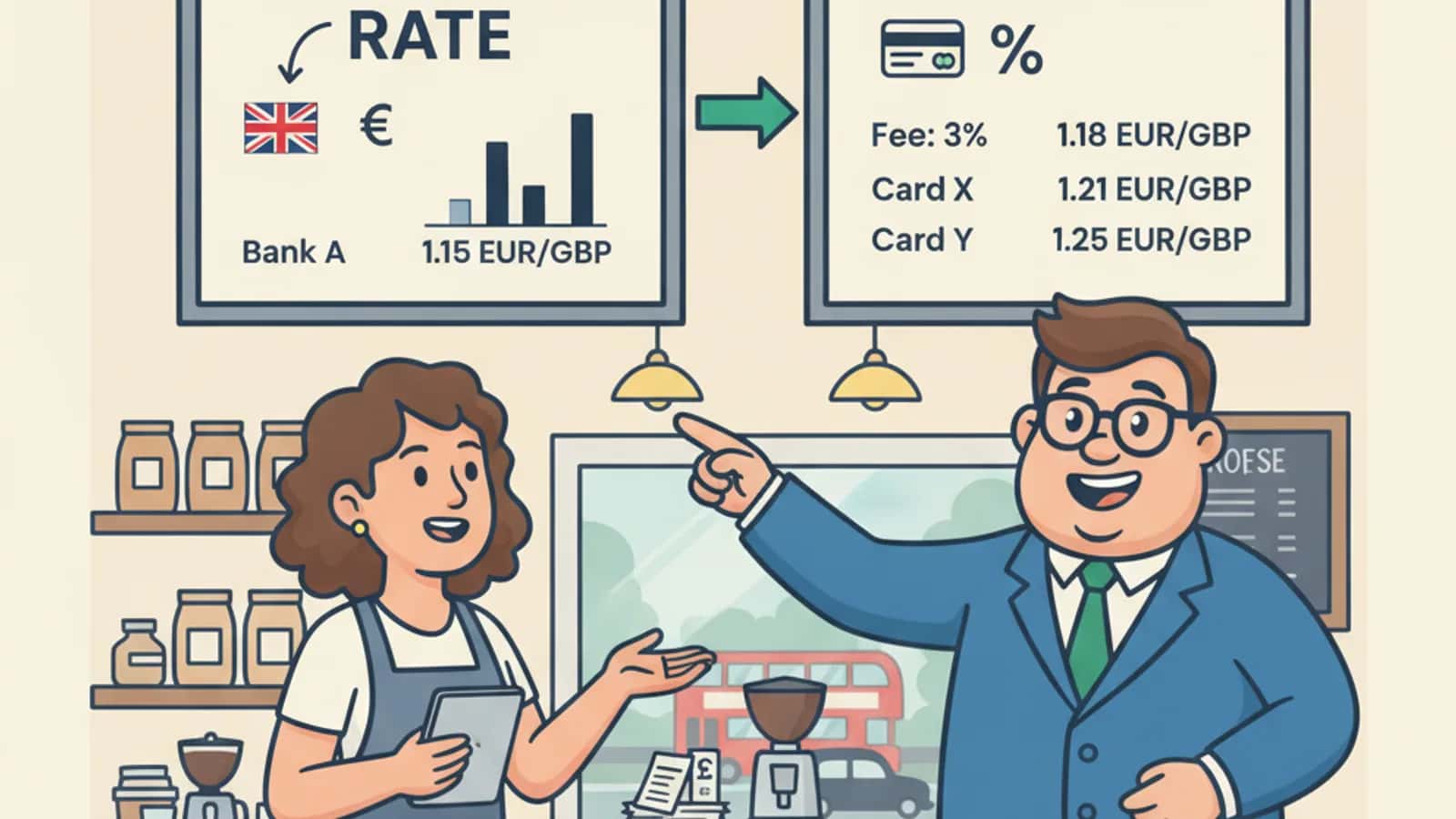
These are two distinct costs, and confusing them is one of the most common mistakes businesses make when choosing a card for overseas spending.
- Exchange rate:
- The rate at which your pounds are converted into the foreign currency. Card schemes (Visa, Mastercard) set a base rate daily, which is generally close to the interbank rate.
- FX markup (non-sterling fee):
- A percentage fee your card issuer adds on top of the exchange rate. This is where most of the cost sits.
A card may advertise "no FX fee" but still apply a less favourable exchange rate than a competitor. Equally, a card with a low FX markup may use a rate that diverges significantly from the mid-market rate on volatile currency days.
The practical check: Compare the total sterling amount charged for a known foreign currency transaction, not just the headline FX fee percentage. Visa and Mastercard both publish their daily exchange rates on their websites, giving you a benchmark.
How Much Do FX Fees Typically Cost on Business Purchases?
The standard non-sterling transaction fee on UK business credit cards sits at 2.5%,3%. On a £10,000 overseas purchase, that is £250,£300 added to your bill before interest.
Here is a rough cost comparison based on monthly overseas spend:
£500
- 2.5% FX Fee (annual)
- £150
- 3% FX Fee (annual)
- £180
- 0% FX Fee (annual)
- £0
£2,000
- 2.5% FX Fee (annual)
- £600
- 3% FX Fee (annual)
- £720
- 0% FX Fee (annual)
- £0
£5,000
- 2.5% FX Fee (annual)
- £1,500
- 3% FX Fee (annual)
- £1,800
- 0% FX Fee (annual)
- £0
£10,000
- 2.5% FX Fee (annual)
- £3,000
- 3% FX Fee (annual)
- £3,600
- 0% FX Fee (annual)
- £0
These figures assume no cashback or rewards offsetting the cost. For businesses with high overseas spend, the annual saving from switching to a no-FX-fee card can comfortably exceed the annual card fee. Read no-annual-fee business credit cards: the key points for the key considerations.
Do Business Credit Cards Charge Currency Conversion Fees?
Yes, most do. The non-sterling transaction fee is standard on UK high street business credit cards. It applies to:
- In-person purchases made abroad in a foreign currency
- Online purchases billed in a foreign currency, even if the merchant is UK-based
- Recurring subscriptions charged in USD, EUR, or any non-GBP currency
- Foreign ATM withdrawals (which may also carry a separate cash advance fee)
One exception: if a foreign merchant or ATM offers to charge you in sterling rather than the local currency, this is called dynamic currency conversion (DCC). Always decline DCC. The rate applied is set by the merchant, not your card scheme, and is almost always worse than what your card would apply in the local currency.
Can You Avoid Foreign Exchange Fees With a Business Credit Card?
Yes, but it depends on the card. A growing number of business card providers, particularly challenger and fintech-backed issuers, offer zero non-sterling transaction fees as a standard feature.
To avoid FX fees entirely:
- Choose a card that explicitly states 0% non-sterling transaction fee in its terms
- Check whether the fee-free offer applies to all currencies or only specific ones (some cards waive fees in euros but not globally)
- Confirm the card uses the Visa or Mastercard network rate rather than a proprietary rate
- Decline dynamic currency conversion at every terminal and ATM
Even with a fee-free card, ATM cash withdrawals abroad often carry a separate cash advance fee and may attract interest from the date of withdrawal. Keep overseas cash withdrawals on a business card to a minimum.
For businesses managing overseas supplier payments, it may also be worth reading about invoice financing for UK exporters turning overseas invoices into sterling cash as a complementary tool.
Best Business Credit Cards With No FX Fees
The best business credit cards for overseas spending with no FX fees are those that combine zero non-sterling transaction fees with strong card limits, employee card functionality, and spend controls. Specific products and rates change, always check current issuer terms before applying.
When comparing cards marketed as fee-free for overseas use, look for:
- Zero non-sterling transaction fee
- confirmed in the card's key financial information document
- Visa or Mastercard exchange rate
- applied (not a proprietary rate with a hidden margin)
- Employee cards included
- , so overseas spend across a team is consolidated on one account
- Virtual cards
- , useful for online purchases in foreign currencies without exposing a physical card number
- Spend controls per card
- , set limits by employee, category, or geography
- Card limit
- , a fee-free card with a £1,000 limit won't cover a team trip or a large supplier payment
Business Credit Cards from leading providers on the Funding Fred panel include options with no FX fees, limits up to £250k+, and a 2-minute eligibility check with no hard credit search to start. No obligation.
Business Credit Cards for Frequent International Travel
For businesses where directors or employees travel internationally several times a year, the right card does more than waive FX fees. It should reduce the admin burden of travel spend and provide cover when things go wrong.
Key features to prioritise for frequent international travel:
- No FX fee on all currencies
- , not just euros
- Travel insurance
- , check whether it covers medical, cancellation, and baggage, and whether it requires the trip to be booked on the card
- Airport lounge access
- , some premium business cards include Priority Pass or equivalent
- ATM fee waivers
- , or at least a low cash advance fee for overseas withdrawals
- Real-time spend notifications
- , so the finance team can see overseas spend as it happens
- Employee cards with individual limits
- , so each traveller has a card without sharing one account number
A business sending five employees to a trade show in Germany, each spending £800 over three days, is looking at £120 in FX fees on a standard 3% card. On a fee-free card, that's £120 saved per trip.
For businesses weighing up how to fund travel and operational costs without straining cashflow, the comparison of business overdraft vs line of credit vs loan is worth reading alongside card options.
Business Credit Cards vs Travel Cards for Overseas Spending
Business credit cards and dedicated travel cards serve different purposes, and the right choice depends on your business structure and spend volume.
| Feature | Business Credit Card | Dedicated Travel Card (prepaid/debit) |
|---|---|---|
| Credit limit | £1k,£250k+ | Loaded balance only |
| FX fees | 0%,3% depending on card | Often 0%, but check |
| Employee cards | Yes, with spend controls | Limited or not available |
| Expense reporting | Integrated with accounting tools | Manual in most cases |
| Purchase protection | Chargeback rights apply | Varies by provider |
| Up to 56 days interest-free | Yes | N/A (prepaid) |
| Cashback/rewards | Available on many cards | Rare |
| Credit building | Yes | No |
Which is right for you?
Choose a business credit card if
your team needs individual cards, you want up to 56 days interest-free on purchases, you need a meaningful credit limit, or you want cashback on overseas spend.
Choose a travel prepaid card if
you want to cap spend at a fixed loaded amount and have no need for credit.
Note: business credit cards are not covered by Section 75 of the Consumer Credit Act. That protection applies to personal credit cards only. Business cardholders can rely on chargeback rights through Visa or Mastercard for disputed transactions, but the process and outcome differ from Section 75.
Business Credit Cards With Travel Insurance and FX Benefits
Some business credit cards bundle travel insurance as a cardholder benefit, though the coverage level varies significantly between providers. Premium and corporate-tier cards are more likely to include it than entry-level business cards.
Before relying on card travel insurance for business trips, check:
- Whether the policy covers business travel specifically (some policies exclude business purposes)
- The medical coverage limit and whether it covers emergency repatriation
- Whether cover is automatic or requires trips to be booked on the card
- Whether employee cardholders are covered or only the primary cardholder
- The excess on claims and any exclusions for pre-existing conditions
Cards that combine zero FX fees with travel insurance represent the strongest value for businesses with regular overseas travel. The annual card fee on a premium card with both features can pay for itself quickly against the cost of separate business travel insurance and FX charges on a standard card.
Hidden Fees on Business Credit Cards When Travelling Internationally
The headline FX fee is not the only cost to watch. Several additional charges can appear on a statement after an overseas trip.
Common hidden fees:
- Dynamic currency conversion (DCC):
- Merchants and ATMs abroad may offer to charge in sterling. The rate they apply is almost always worse than your card's rate. Always pay in the local currency.
- ATM cash advance fee:
- Separate from the FX fee. Often 2%,3% of the withdrawal, with a minimum charge of £2,£3, plus interest from day one.
- Foreign ATM operator fee:
- The ATM owner may charge a local fee on top of your card's charges.
- Annual fee on employee cards:
- Some cards charge per additional cardholder, which adds up across a large team.
- Inactivity fees:
- Less common, but some cards charge if the card isn't used for a set period.
- Paper statement fee:
- Minor, but avoidable by switching to digital statements.
The total cost of overseas spending on a business card is the FX fee plus any ATM fees plus any DCC premium. On a standard card with 3% FX fee, a 3% cash advance fee, and DCC accepted at an ATM, a £500 cash withdrawal could cost £30 or more in fees alone.
Business Credit Cards for Expats Working Overseas
UK limited companies with directors or employees based abroad long-term face a specific challenge: standard business credit cards are issued to UK-registered businesses and billed in sterling, but the cardholder's day-to-day spend is in a foreign currency.
For expat employees on a UK business card:
- A no-FX-fee card is non-negotiable, the alternative is a 2.5%,3% surcharge on every transaction
- Virtual cards allow the business to issue a card instantly without waiting for international post
- Spend controls let the UK finance team set limits and categories for overseas cardholders
- Real-time notifications flag unusual spend without waiting for a monthly statement
UK businesses with overseas operations should also consider how they handle the currency risk on larger supplier payments. A business credit card handles day-to-day transactional spend; for larger cross-border invoices, separate FX tools or invoice financing may be more appropriate. See invoice financing costs in the UK for context on how financing costs compare.
How to Compare FX Rates Between Different Business Credit Cards
Comparing business credit cards for overseas spending on FX rates requires looking beyond the headline fee. Here is a practical process:
- Find the non-sterling transaction fee in the card's key financial information document, not the marketing page
- Identify the card network (Visa or Mastercard) and check that day's published exchange rate on the network's website
- Request a sample transaction, some providers will show you a worked example of a £1,000 purchase in USD
- Check for DCC opt-out settings, some cards allow you to block DCC at the account level
- Compare total cost of ownership, annual fee, employee card fees, and FX fees combined, against your estimated overseas spend. For a more detailed explanation, see business credit card APR in more detail.
- Check the limit, a card with 0% FX fee but a £2,000 limit won't work for a business with £20,000 in monthly overseas purchases
A 2-minute eligibility check through Funding Fred's panel of leading card providers gives you a view of which cards you're likely to qualify for, including limits, fees, and features, without a hard credit search. No obligation, no long forms. For the supporting detail, see the essentials of comparing business credit cards.
Cheapest Way to Spend Money Abroad With a Business Card
The cheapest way to spend money abroad on a business credit card is to use a card with zero non-sterling transaction fees, always pay in the local currency, and avoid ATM cash withdrawals where possible.
Ranked by cost impact:
- Get a no-FX-fee business card, this single change eliminates the largest recurring cost
- Always decline dynamic currency conversion, paying in the local currency means your card's rate applies, not the merchant's
- Avoid cash withdrawals on a credit card, cash advance fees and immediate interest make this the most expensive way to access foreign currency
- Use virtual cards for online foreign currency purchases, reduces fraud risk and keeps spend trackable
- Set employee card limits by geography or category, prevents accidental or unauthorised spend abroad
For businesses that also carry foreign currency balances or pay overseas suppliers on regular terms, a business credit card with a strong limit and no FX fee is one part of a broader approach. Comparing it against alternative business funding options can help identify where card credit fits alongside other facilities.
Next steps
The cost of using a standard UK business credit card abroad is not trivial. A 3% FX fee on £5,000 of monthly overseas spend costs £1,800 per year, before any ATM fees, DCC charges, or interest. For businesses that travel regularly, buy from overseas suppliers, or run international ad spend, that is a material drag on margin.
The fix is straightforward: choose a card built for overseas spending, with zero non-sterling transaction fees, employee cards with spend controls, and a limit that matches your actual needs. The card your bank issued five years ago probably isn't that card.
Funding Fred matches UK businesses to leading card providers in a 2-minute check, no hard credit search, no obligation, no long forms. Compare limits from £1k to £250k+, see which cards include no FX fees, virtual cards, and up to 56 days interest-free, and find out what you're eligible for today.
Check your eligibility for Business Credit Cards, Fast Decision, No hard check to start.
If you're also weighing up how card credit fits alongside other funding, the business overdraft vs line of credit vs loan guide covers the trade-offs clearly.
Frequently asked questions
What Are Foreign Exchange Fees on Business Credit Cards?
A foreign exchange fee, also called a non-sterling transaction fee or currency conversion fee, is a charge applied when you use a UK business credit card to make a purchase in a foreign currency. Most UK card issuers charge between 2.5% and 3% of the transaction value, automatically added to your statement.
What Is the Difference Between FX Markup and Exchange Rate?
These are two distinct costs, and confusing them is one of the most common mistakes businesses make when choosing a card for overseas spending.
How Much Do FX Fees Typically Cost on Business Purchases?
The standard non-sterling transaction fee on UK business credit cards sits at 2.5%,3%. On a £10,000 overseas purchase, that is £250,£300 added to your bill before interest.
Do Business Credit Cards Charge Currency Conversion Fees?
Yes, most do. The non-sterling transaction fee is standard on UK high street business credit cards. It applies to:
Can You Avoid Foreign Exchange Fees With a Business Credit Card?
Yes, but it depends on the card. A growing number of business card providers, particularly challenger and fintech-backed issuers, offer zero non-sterling transaction fees as a standard feature.
How to Compare FX Rates Between Different Business Credit Cards?
Comparing business credit cards for overseas spending on FX rates requires looking beyond the headline fee. Here is a practical process:
Written by
The Funding Fred Editorial Team creates plain-English guides to help business owners understand funding options, eligibility, and application readiness before they compare finance options.
Reviewed by
UK business finance content reviewer
Robert reads our UK business finance guides before they go live, checking each one is accurate, easy to follow, and reflects how lending actually works today — not how a brochure says it should. He's listed on the FCA Register, approved as an SMF3 (AR) Executive Director at Switcha Limited, and connected to Lucky Growth Partners Ltd through its appointed representative relationship, so the regulated detail gets a properly qualified second read.