
UK Bank Lending to Businesses Hits 28-Year Low in Q2 2026
Bank lending to UK non-financial businesses has fallen to approximately 59% of GDP — a level not seen since 1998, making Q2 2026 a 28-year low point for business bank lending.
Quick answer
Bank lending to UK non-financial businesses has fallen to approximately 59% of GDP — a level not seen since 1998, making Q2 2026 a 28-year low point for business bank lending. This is a structural, long-running decline rather than a sudden credit crisis, driven by subdued corporate borrowing demand, higher interest rates, and businesses turning to bond markets and alternative finance instead of traditional bank loans. For UK SMEs, the practical reality is simple: the banks are less accessible than ever, and alternative funding routes are filling the gap.
Key takeaways
- UK bank lending to businesses has dropped to roughly 59% of GDP — the lowest since 1998, making Q2 2026 a 28-year low
- In the mid-2010s, this ratio sat above 70% of GDP, so the decline is significant and long-running
- The Bank of England's Q1 2026 Credit Conditions Survey shows credit availability has modestly improved, but businesses are borrowing less anyway
- Bank Rate held at 3.75% as of February 2026, keeping borrowing costs high relative to the previous decade
- Larger companies are bypassing banks entirely, using bond markets and private credit instead
- SMEs — especially in hospitality, retail, construction, and logistics — face the sharpest squeeze
- Alternative lenders, challenger banks, and platforms like Funding Fred are stepping into the gap
- Startups and businesses with imperfect credit histories are disproportionately affected
- Government schemes exist but have limited reach; private alternative finance is faster and more accessible
- A 2-minute eligibility check with no hard credit search is now available for SMEs seeking £10k–£1m
Why Are UK Banks Lending Less to Businesses Right Now?

UK bank lending to businesses is falling because demand has dropped, borrowing costs remain high, and banks are prioritising capital efficiency over volume growth. It is not a crisis-style credit freeze — it is a slow structural withdrawal.
Several factors are driving this:
- High interest rates.
- The Bank of England held Bank Rate at 3.75% as recently as February 2026. That's expensive compared to the near-zero rates businesses got used to in the 2010s. Higher rates reduce the incentive to borrow, especially for businesses uncertain about growth prospects.
- Subdued corporate confidence.
- Lingering uncertainty around UK productivity, trade conditions, and broader economic headwinds has made many business owners reluctant to take on new debt.
- Balance-sheet adjustment.
- After the era of ultra-low interest rates, banks are focusing more on risk-weighted returns and capital efficiency rather than growing their loan books.
- Larger firms going elsewhere.
- Big corporates have increasingly turned to bond markets and private credit rather than bank loans, reducing overall lending volumes even when banks say they're open for business.
The result is a lending stock that has drifted down for years — not collapsed overnight.
How Does This 28-Year Low Compare to Previous Economic Downturns?
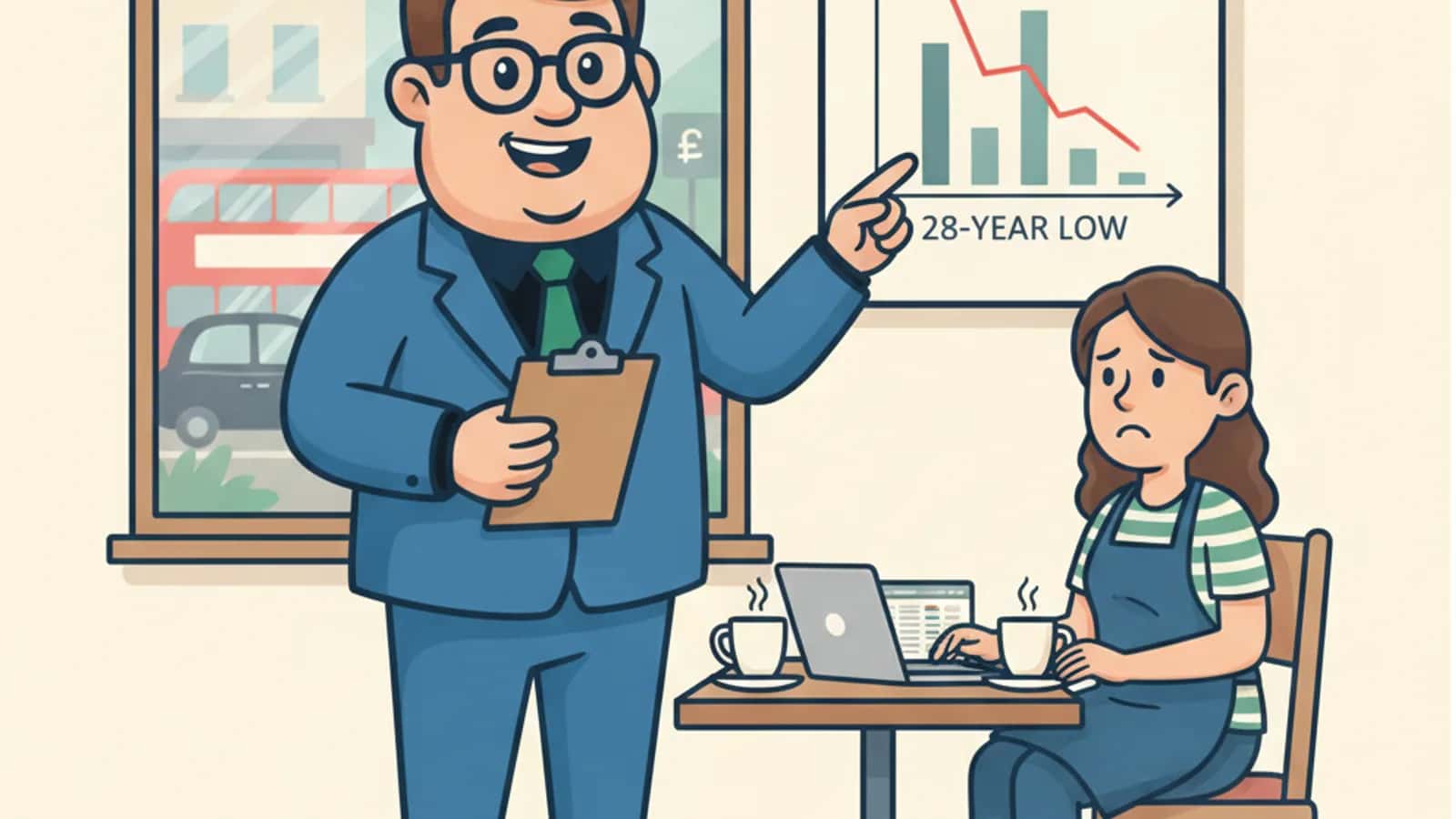
The current situation is structurally different from past lending crises like 2008-09. This is a gradual, demand-led decline rather than a supply-side freeze caused by bank failures or emergency regulatory intervention.
During the 2008 financial crisis, lending fell sharply because banks were capital-constrained and genuinely unable or unwilling to lend. Credit availability collapsed almost overnight. Businesses that needed money couldn't get it regardless of their creditworthiness.
What's happening in Q2 2026 is different:
| Feature | 2008-09 Financial Crisis | Q2 2026 Lending Low |
|---|---|---|
| Cause | Bank capital failure, systemic shock | Structural shift, subdued demand |
| Speed of decline | Rapid, crisis-driven | Gradual, multi-year |
| Credit availability | Severely restricted | Broadly stable (BoE Q1 2026 survey) |
| Who's most affected | All businesses | SMEs and new borrowers |
| Bank health | Fragile | Generally sound |
| Alternative finance | Limited | Growing rapidly |
The 28-year low in UK bank lending to businesses in Q2 2026 is concerning precisely because it doesn't have an obvious single trigger — which makes it harder to reverse quickly.
What Impact Will Reduced Bank Lending Have on Small Business Growth?
Reduced bank lending hits SMEs harder than large corporates, because small businesses have fewer alternative funding routes and less negotiating power with lenders. When banks pull back, SMEs feel it first and longest.
The practical consequences include:
- Delayed investment.
- Equipment upgrades, premises expansion, and hiring plans get pushed back when funding isn't available or is too expensive.
- Cash flow pressure.
- Businesses that rely on overdrafts or revolving credit facilities to manage seasonal gaps face tighter terms or outright refusals.
- Missed growth opportunities.
- A restaurant that can't fund a second location, or an e-commerce store that can't buy stock ahead of peak season, loses ground to better-funded competitors.
For context on why cash flow matters so much, see our guide to cash flow business loans — it explains how the right funding structure can prevent a short-term squeeze from becoming a long-term problem.
The broader economic risk is real too. SMEs account for a significant share of UK employment and GDP. If small business growth stalls because of a funding gap, the knock-on effects spread quickly.
Which Industries Are Most Affected by Lower Business Lending?
Capital-intensive and cash-flow-sensitive sectors feel the tightest squeeze when bank lending drops. Hospitality, construction, retail, logistics, and professional services are all exposed.
Here's a sector-by-sector view:
- Hospitality and food service
- (restaurants, cafes, pubs): High upfront costs, thin margins, seasonal revenue swings. Banks have always been cautious here, and tighter lending makes it worse.
- Construction and trades
- Project-based income means lumpy cash flow. Banks struggle to assess risk; businesses struggle to meet documentation requirements.
- Retail and e-commerce
- Stock financing and working capital needs are constant. A bank that takes 6-8 weeks to make a decision is simply too slow for a retailer ahead of peak season.
- Hair salons and personal services
- Small ticket, high frequency — banks rarely prioritise these businesses, and the current environment makes them even less likely to.
- Logistics and transport
- Asset-heavy businesses need finance for vehicles and equipment. Traditional lending criteria can be rigid when valuations fluctuate.
- Dental practices and healthcare
- Often need significant capital for equipment and premises but may not fit standard bank lending templates.
If your sector is on this list, the different types of business loans available in the UK are worth reviewing — some products are specifically designed for businesses that banks overlook.
Is This Lending Drop Happening Across All Bank Sizes, or Just Major Banks?
The decline in business lending is most pronounced among major high-street banks, but the trend is broad. Challenger banks and specialist lenders are bucking it.
Large banks are the primary drivers of the aggregate GDP ratio falling to a 28-year low, because they hold the majority of the stock of business loans. Their strategic shift toward capital efficiency and away from volume lending has the biggest statistical impact.
Smaller banks and challengers tell a different story. Many are actively growing their SME lending books, competing on speed and flexibility rather than price. Non-bank lenders — including fintech platforms, peer-to-business lenders, and merchant cash advance providers — are expanding into the space that traditional banks are vacating.
This divergence matters for business owners: the headline "28-year low" is real, but it doesn't mean all lenders have stopped lending. It means the *type* of lender you approach has never mattered more.
What Economic Factors Are Causing Banks to Restrict Business Loans?
Three forces are combining to keep business lending subdued: high interest rates, economic uncertainty, and a structural shift in how banks manage risk and capital.
Interest rates
are the most direct factor. With Bank Rate at 3.75% as of early 2026, the cost of borrowing is meaningfully higher than it was in the 2010s. Businesses that would have borrowed at 2-3% are less willing to borrow at 6-8% or more, especially with slower growth prospects.
Economic uncertainty
reduces appetite on both sides. Businesses are less confident about future revenue, so they borrow less. Banks are less confident about repayment, so they lend more cautiously.
Capital efficiency focus.
Post-pandemic and post-low-rate era, banks are under pressure to improve returns on equity. That means prioritising high-margin products and well-secured loans over unsecured SME lending, which is capital-intensive relative to its return.
For a current view on what rates look like in practice, the average business loan interest rates for June 2026 gives a useful benchmark.
Will Interest Rates Affect Business Lending in the Near Future?
Yes — if the Bank of England cuts rates further in 2026 or 2027, borrowing costs will fall and demand for business loans should recover. But the structural shift away from bank lending is unlikely to reverse fully, even with lower rates.
The Bank of England's Monetary Policy Committee voted 5-4 to hold Bank Rate at 3.75% in February 2026, signalling caution rather than urgency to cut. Any meaningful rate reduction will take time to feed through into lower loan pricing and renewed business confidence.
Even if rates fall, the broader structural trend — larger firms using bond markets, banks focusing on capital returns — will persist. The lending landscape in 2027 will probably look more like 2026 than 2015.
How Long Might This Low Lending Trend Continue?
The low lending trend could persist for several more years. Because the decline is structural rather than crisis-driven, there is no single policy lever that reverses it quickly.
Key factors that could accelerate recovery:
- Sustained Bank Rate cuts bringing borrowing costs back toward 2-3%
- Improved UK growth outlook boosting corporate confidence
- Government-backed lending schemes increasing SME access
- Continued growth of alternative finance reducing the visible impact of bank withdrawal
Key factors that could prolong it:
- Persistent inflation keeping rates elevated
- Ongoing economic uncertainty suppressing demand
- Banks continuing to prioritise capital efficiency over volume
The Bank of England's Q2 2026 Credit Conditions Survey is due on 2 July 2026 and will provide the next official read on whether conditions are improving. Until then, the data points to a trend that has years of momentum behind it.
How Can Small Businesses Get Funding If Banks Aren't Lending?
Small businesses have more funding options than ever outside traditional banks. The growth of alternative finance means that a bank rejection is not the end of the road — it's often just the wrong starting point.
The main routes available right now:
1. Unsecured business loans from alternative lenders No property security required. Decisions based on trading performance, not just credit history. Amounts from £10k to £1m. See how unsecured business loans work for a full breakdown.
2. Merchant Cash Advances (MCAs)
Repayments tied to card sales, so they flex with your revenue. Ideal for retail, hospitality, and any business with consistent card turnover. Learn more about how merchant cash advances work.
3. Asset finance
Fund equipment, vehicles, or machinery without a large upfront cost. The asset itself acts as security. Explore asset finance for UK businesses for eligibility and cost details.
4. Fintech platforms and broker networks
Platforms like Funding Fred use Open Banking and smart tech to match businesses with a wide partner panel of lenders — including specialist lenders that banks don't compete with. A 2-minute eligibility check. No hard credit search to start. No obligation to proceed.
5. Government-backed schemes
The British Business Bank operates several programmes supporting SME lending, including the Recovery Loan Scheme successor products. These can improve terms but often still route through accredited lenders, so access isn't always instant.
What Alternative Financing Options Exist for UK Companies?
UK businesses in 2026 have access to a broader range of non-bank funding than at any point in the past 28 years. The gap left by traditional banks has created a competitive alternative lending market.
Here's a comparison of the main options:
Unsecured business loan
- Best For
- Working capital, growth
- Speed
- 24-72 hours
- Credit Flexibility
- All credit types
Merchant cash advance
- Best For
- Card-taking businesses
- Speed
- 24-48 hours
- Credit Flexibility
- All credit types
Asset finance
- Best For
- Equipment, vehicles
- Speed
- 2-5 days
- Credit Flexibility
- Moderate flexibility
Invoice finance
- Best For
- B2B businesses with invoices
- Speed
- 24-48 hours
- Credit Flexibility
- Good flexibility
Traditional bank loan
- Best For
- Established, low-risk firms
- Speed
- 4-12 weeks
- Credit Flexibility
- Strict criteria
Government-backed loan
- Best For
- Various
- Speed
- Varies
- Credit Flexibility
- Moderate
For businesses that have been declined before or have imperfect credit, business loans with no credit check covers what's genuinely available and what to watch out for.
Are Startups or Established Companies More at Risk With Reduced Lending?
Startups face the higher risk. Banks already apply stricter criteria to new businesses, and a low-lending environment makes those criteria even harder to meet. Established companies with trading history have more options.
For a bank, a startup is an unknown quantity — no track record, no historical accounts, no proven ability to service debt. In a market where banks are already pulling back, startups are the first to be declined.
Established businesses with 2+ years of trading history and consistent revenue can still access bank lending, though it's slower and more conditional than it was five years ago. They also have stronger cases for alternative lenders, who can use Open Banking data to assess real trading performance rather than relying solely on credit scores.
If you're a newer business, the guide to business loans for startups is worth reading before you approach any lender.
What Government Policies Might Help Increase Business Lending?
Government intervention can help, but it rarely moves fast enough for businesses that need capital now. The most effective policies focus on risk-sharing with lenders and direct support for SME access.
Current and potential policy levers include:
- British Business Bank programmes
- Accredited lenders can offer government-backed products with improved terms. Reach is growing but still limited.
- Loan guarantee schemes
- By sharing default risk with lenders, these reduce the cost of lending to higher-risk SMEs. Effectiveness depends on uptake by accredited lenders.
- Interest rate policy
- The most powerful lever remains with the Bank of England. Rate cuts would do more for business lending volumes than most fiscal policies.
- Open Banking mandates
- Expanding Open Banking data access helps alternative lenders make better credit decisions for SMEs that don't fit traditional bank templates — this is already happening.
No single policy reverses a 28-year low quickly. The most practical response for a business owner today is to stop waiting for the macro environment to improve and find a lender whose criteria match current trading reality.
What Do Business Owners Need to Know About Getting Loans Now?
The rules have changed. Getting a business loan in 2026 means understanding that banks are not the only — or even the best — option for most SMEs. Speed, flexibility, and realistic criteria matter more than brand recognition.
What works in your favour with alternative lenders
- Consistent card or bank turnover (even if credit history is imperfect)
- 6+ months of trading history
- Open Banking access to verify income quickly
- Clear purpose for the funds
What slows things down
- Applying to a bank first and waiting weeks for a decision
- Not having basic documents ready (bank statements, business details)
- Applying for more than you can realistically service
What to do right now:
- Check your eligibility with a platform that uses a soft search — no hard credit check, no impact on your score
- Compare selected finance partners rather than going direct to one lender
- Know your numbers: monthly turnover, average card sales, outstanding liabilities
The Funding Fred 2-minute eligibility check uses Open Banking and smart tech to match you with the right lenders from a wide partner panel. No obligation to proceed. No hard check to start.
Next steps
UK bank lending to businesses hitting a 28-year low in Q2 2026 is a real and significant trend. It reflects years of structural change — not a sudden crisis — and it's unlikely to reverse quickly. For SMEs, that means the bank on the high street is less useful than it's been at any point since the late 1990s.
But the funding gap is real only if you limit yourself to traditional banks.
Alternative lenders, fintech platforms, and specialist finance providers have built products specifically for businesses that banks overlook: businesses with imperfect credit, seasonal revenue, or a need for speed that a bank simply can't match. Unsecured loans, merchant cash advances, and asset finance are all available now, with decisions measured in hours rather than weeks.
The practical next step is straightforward:
Check your eligibility in 2 minutes — no hard credit check, no obligation Compare selected finance partners across a wide panel Get a fast decision based on how your business actually trades today
Business Funding. Without the Fuss. Start your 2-minute check at Funding Fred and find out what's available for your business right now.
*Meta Title:* UK Bank Lending Hits 28-Year Low in Q2 2026 | What SMEs Must Know
*Meta Description:* UK bank lending to businesses has hit a 28-year low in Q2 2026. Find out why it's happening, which sectors are hit hardest, and how SMEs can access funding fast.
Further reading
Frequently asked questions
Why Are UK Banks Lending Less to Businesses Right Now?
UK bank lending to businesses is falling because demand has dropped, borrowing costs remain high, and banks are prioritising capital efficiency over volume growth. It is not a crisis-style credit freeze — it is a slow structural withdrawal.
How Does This 28-Year Low Compare to Previous Economic Downturns?
The current situation is structurally different from past lending crises like 2008-09. This is a gradual, demand-led decline rather than a supply-side freeze caused by bank failures or emergency regulatory intervention.
What Impact Will Reduced Bank Lending Have on Small Business Growth?
Reduced bank lending hits SMEs harder than large corporates, because small businesses have fewer alternative funding routes and less negotiating power with lenders. When banks pull back, SMEs feel it first and longest.
Which Industries Are Most Affected by Lower Business Lending?
Capital-intensive and cash-flow-sensitive sectors feel the tightest squeeze when bank lending drops. Hospitality, construction, retail, logistics, and professional services are all exposed.
Is This Lending Drop Happening Across All Bank Sizes, or Just Major Banks?
The decline in business lending is most pronounced among major high-street banks, but the trend is broad. Challenger banks and specialist lenders are bucking it.
What Economic Factors Are Causing Banks to Restrict Business Loans?
Three forces are combining to keep business lending subdued: high interest rates, economic uncertainty, and a structural shift in how banks manage risk and capital.
Written by
The Funding Fred Editorial Team creates plain-English guides to help business owners understand funding options, eligibility, and application readiness before they compare finance options.
Reviewed by
UK business finance content reviewer
Robert reads our UK business finance guides before they go live, checking each one is accurate, easy to follow, and reflects how lending actually works today — not how a brochure says it should. He's listed on the FCA Register, approved as an SMF3 (AR) Executive Director at Switcha Limited, and connected to Lucky Growth Partners Ltd through its appointed representative relationship, so the regulated detail gets a properly qualified second read.