SBA Loan Rates Explained: 7(a), 504 and Microloan Interest Rate Caps for 2026
SBA loan rates are not one number. Each program sets its own ceiling: 7(a) loans cap the spread a lender can add to a base rate (usually Prime), 504 loans price off a government-guaranteed debenture sold monthly, and microloans let nonprofit intermediaries charge within an SBA-set range.

Quick answer
SBA loan rates are not one number. Each program sets its own ceiling: 7(a) loans cap the spread a lender can add to a base rate (usually Prime), 504 loans price off a government-guaranteed debenture sold monthly, and microloans let nonprofit intermediaries charge within an SBA-set range. The actual rate you get depends on loan size, term, your lender, and current market rates, so current SBA loan rates move whenever the base rate moves, even though the caps themselves stay fixed for longer stretches.
Key takeaways
- SBA loan rates are built from a base rate plus a capped spread, not a single published number.
- 7(a) loan rates can be fixed or variable, with the maximum variable-rate spread set by loan size, from base rate + 6.5% for $50,000 or less down to base rate + 3.0% above $350,000.
- SBA 504 loan rates are fixed for the life of the loan once your debenture funds, but the rate resets monthly for new borrowers based on that month's debenture sale.
- Microloans are priced by nonprofit intermediary lenders within a range the SBA allows, and often run higher than 7(a) rates despite smaller loan sizes.
- Guarantee fees, CDC fees, and packaging costs sit on top of the quoted rate and affect your real cost of borrowing.
- Rates have stayed elevated but relatively stable moving into late 2026, tracking a higher-for-longer rate environment.
- A $10,000 ask and a $2 million ask will not see the same spread, loan size changes the cap.
- Below is a practical breakdown of how each SBA program sets its ceiling, what fees stack on top, and how to tell whether an SBA loan still beats the alternatives.
What are current SBA loan rates in 2026?
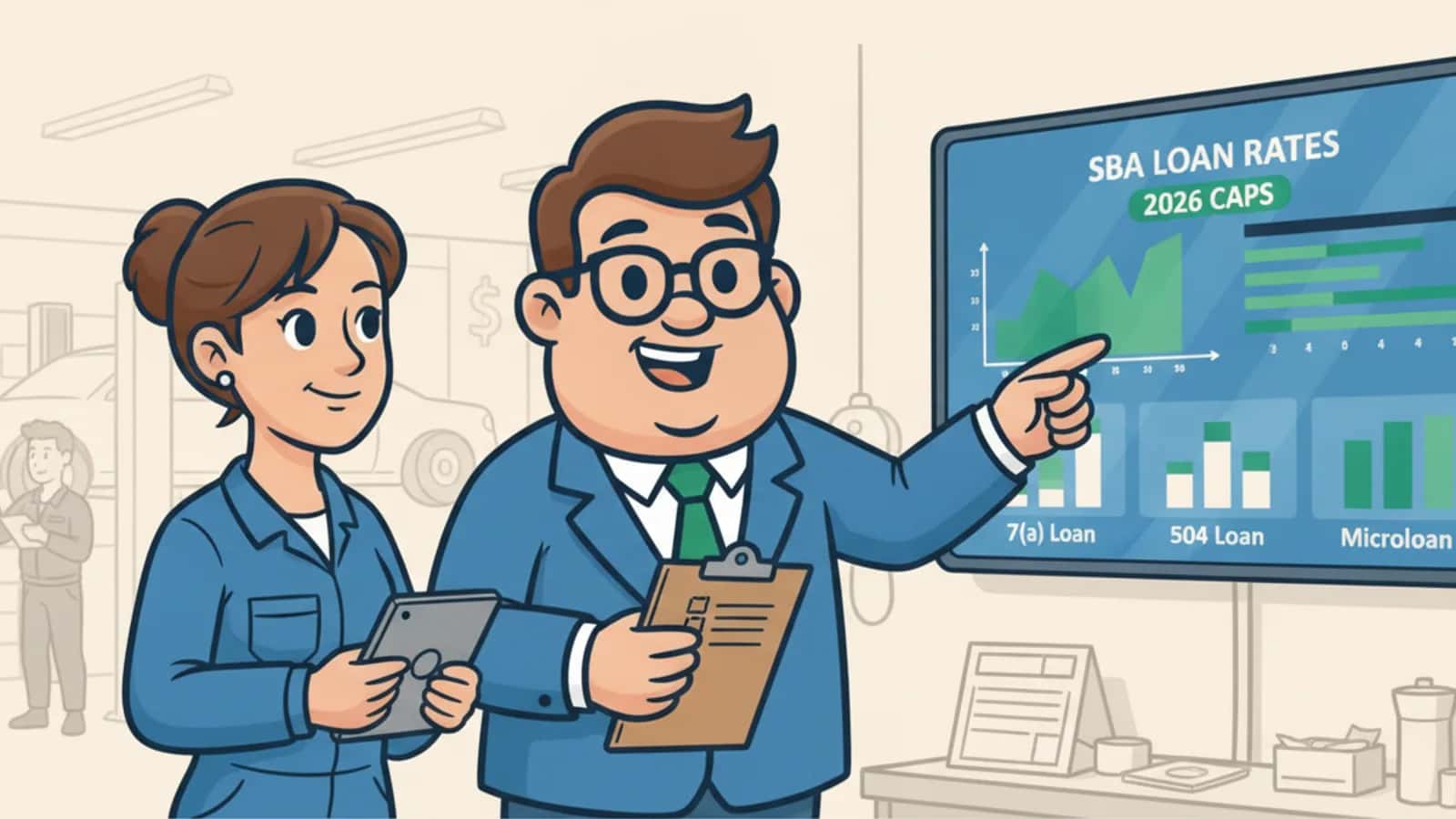
Current SBA loan rates sit above where they were a few years ago, because every SBA program ties its pricing to a base rate that has stayed elevated through 2026. There is no single "SBA rate", each program publishes its own structure, and the number you're quoted depends on your lender, loan size, and term.
Here's how the three main programs stack up at a glance:
7(a)
- Rate type
- Fixed or variable
- How the rate is set
- Base rate (commonly Prime) plus a lender spread, capped by loan size
- Who sets the spread
- Lender, within SBA maximums
504
- Rate type
- Fixed for the life of the loan
- How the rate is set
- Priced off a monthly debenture sale, plus CDC and SBA fees
- Who sets the spread
- SBA/CDC market pricing, not lender-negotiated
Microloan
- Rate type
- Fixed or variable, set by intermediary
- How the rate is set
- SBA allows a range; the nonprofit intermediary sets the final number within it
- Who sets the spread
- Nonprofit intermediary lender
If you're weighing programs for a specific purchase, say, a building versus working capital, the deeper mechanics are covered in the SBA 7(a) loans guide and the SBA 504 vs 7(a) comparison.
What is the maximum SBA 7(a) loan rate, and how is it calculated?

The maximum SBA 7(a) rate is calculated as a base rate (usually the Prime rate) plus a spread the SBA caps by loan size, lenders can price below the cap but not above it. This is why two borrowers with the same Prime rate can see different 7(a) quotes: the spread allowed shrinks as the loan size grows.
Key mechanics to know about sba 7a loan rates:
- Variable-rate loans reset periodically (commonly monthly or quarterly) as the base rate moves, so your payment can change over the life of the loan.
- Fixed-rate loans lock in a note rate at closing, which tends to run a bit higher than an equivalent variable-rate quote to compensate the lender for taking on rate risk.
- Spreads shrink as loans get bigger. SBA's maximum variable-rate spreads are base rate + 6.5% for loans of $50,000 or less, + 6.0% for $50,001 to $250,000, + 4.5% for $250,001 to $350,000, and + 3.0% over $350,000. SBA publishes maximum fixed rates separately.
- Lenders can always price under the cap, especially for well-qualified borrowers with strong cash flow and collateral, the published maximum is a ceiling, not a quote.
Common mistake: assuming the "maximum rate" published by the SBA is what you'll be charged. In practice, most approved 7(a) borrowers land somewhere below the ceiling, and the exact number depends on the lender's underwriting of your file.
How are SBA 504 loan rates set?
SBA 504 loan rates are set by a monthly debenture sale, not by individual lender negotiation, the rate is effectively fixed once your debenture funds, but it resets for every new monthly pool of 504 loans. That means two businesses closing 504 loans a month apart can land on noticeably different fixed rates, even with identical credit profiles.
A few things borrowers get wrong about sba 504 loan rates:
- The rate is fixed for the life of the loan once it's set, typically for 10-, 20-, or 25-year terms, but it is not fixed across time for new applicants; it moves with each debenture sale.
- The published "effective rate" bundles the debenture coupon with CDC servicing and SBA fees, so it's higher than the raw Treasury-linked debenture rate alone.
- Certified Development Companies (CDCs), the nonprofits that administer 504 loans, publish updated effective rates after each sale, for example, a September 2026 sale produces rates that apply to loans funding that cycle, not to loans that fund later.
- 504 loans are built for major fixed assets, real estate, heavy equipment, not working capital, which limits their flexibility compared to 7(a).
Edge case: if your financing timeline straddles two debenture sales, your final fixed rate depends on which sale your loan actually settles into, not the rate quoted when you applied. For a side-by-side on when 504 beats 7(a) for property purchases, see SBA 504 vs 7(a).
What rates apply to SBA microloans, and are they cheaper than a 7(a) loan?
SBA microloans are usually not cheaper than 7(a) loans. The SBA lends funds to nonprofit intermediaries, who then set the final borrower rate within a range the SBA allows, and because microloans are small and often serve thinner-file borrowers, intermediaries frequently price near the top of that range.
What drives microloan pricing:
- Rates are set by the intermediary lender, not a bank or SBA directly, the SBA's role is to cap the range, not dictate the exact number. The cap is the intermediary's own SBA loan rate plus 7.75% for microloans over $10,000, or plus 8.5% for microloans of $10,000 or less.
- Microloans top out at a relatively small loan size compared to 7(a) and 504, so the higher effective rate applies to a smaller balance, which can limit the total interest cost even if the rate itself looks higher.
- Intermediaries may also charge packaging or application fees on top of interest, set independently by each intermediary.
Decision rule: choose a microloan if you need a smaller amount, have limited time in business, or don't qualify for a 7(a) loan's underwriting standards, not because the rate will necessarily beat a 7(a) loan. For a deeper look at when a smaller loan outperforms a bank relationship, read SBA microloans.
What fees get added on top of SBA loan rates?
Every SBA program adds fees beyond the quoted interest rate, and those fees change your real cost of borrowing more than most borrowers expect. On 7(a) loans, the SBA charges lenders an upfront guarantee fee and an annual servicing fee on the guaranteed portion. Lenders may pass the upfront fee on to the borrower, but SBA rules say the annual servicing fee cannot be charged to the borrower. On 504 loans, CDC processing fees, an SBA funding fee, and closing costs are built into the "effective rate" CDCs publish. On microloans, the intermediary may charge its own packaging or application fee separate from interest.
Practical guidance:
- Ask your lender for the all-in annual percentage rate (APR), not just the note rate, so fees are reflected in one comparable number.
- For 504 loans, confirm whether the quoted rate already includes CDC and SBA fees, most published "effective rates" do.
- For 7(a) loans, ask whether packaging or loan-closing fees are charged separately by the lender on top of the SBA's own guarantee fee.
- Fee schedules change periodically, so confirm the current structure directly with your lender or SBA's published SOP guidance before signing.
Why are SBA loan rates so high right now?
SBA loan rates are elevated mainly because every program's pricing is anchored to a base rate, commonly Prime for 7(a), and Treasury-linked debenture pricing for 504, and that base rate has stayed high through 2026. SBA caps limit how much a lender can add on top, but they don't control the base rate itself.
Three forces explain the current level:
- Base rate environment.
- Prime and related benchmark rates have stayed elevated compared to the low-rate years earlier in the decade, which flows directly into both 7(a) and 504 pricing.
- Debenture market pricing.
- 504 rates reflect what investors demand for government-guaranteed debentures at each monthly sale, when broader credit markets price risk higher, 504 effective rates follow.
- Relative stability, not relief.
- Industry trackers describe SBA rates as elevated but holding fairly steady heading into late 2026, rather than spiking further. That stability can be useful for planning even if the absolute level isn't low.
How do SBA loan rates compare to bank loans and other financing?
SBA loan rates are usually lower than unsecured online or alternative financing, but the application takes longer and requires more documentation than a conventional bank term loan in many cases. The SBA guarantee reduces the lender's risk, which is why the spread caps exist in the first place, lenders can offer a government-backed loan at a more moderate rate because the SBA shares the default risk.
Can you negotiate SBA loan rates with a lender?
You can negotiate the spread on a 7(a) loan within the SBA's maximum, but 504 rates are not negotiable because they're set by the debenture market, not the lender. Strong financials, collateral, and a longer banking relationship give you more room to push a 7(a) spread down toward the lower end of what's allowed.
Do SBA loan rates vary by state?
SBA loan rates don't vary by state in the way some state-backed programs do, the caps and base rates are federal, but the lender or CDC you work with can affect your quoted spread, and some state programs stack on top of SBA financing. For state-level co-lending options, see how the SSBCI program can complement SBA financing in certain states.
SBA loan rates for bad credit and for startups vs. established businesses
Weaker credit or a short operating history doesn't change the SBA's published rate caps, but it narrows which lenders will approve you and often pushes your quote toward the top of the allowed spread. Startups typically face tighter underwriting and may be steered toward microloans or smaller 7(a) loans, while established businesses with stronger cash flow tend to land closer to the lower end of the cap. If credit history is a concern, compare realistic options in bad credit business loans and in SBA and non-SBA startup financing.
How long do SBA loan rates stay fixed?
Fixed-rate 7(a) loans and 504 loans lock the rate for the full term once funded, but variable-rate 7(a) loans reset on a schedule, often monthly or quarterly, tied to movements in the base rate. Read your loan agreement closely: "fixed" only describes the note rate from the date it's set, not a guarantee against future refinancing needs if your business outgrows the loan.
Worked example: estimating a monthly payment on an SBA loan
Here's an illustration only, not a quote. Suppose a lender prices a $350,000 SBA 7(a) loan with a 10-year maturity at a spread within the SBA's published range for that loan size. If the base rate used were around 7.00%, a loan priced near a 3-point spread would carry a note rate close to 10.00%.
At that rate, over 120 monthly payments, the loan amortizes to roughly $4,625 per month in principal and interest, before any guarantee fee or closing costs are factored in. Change the base rate by even half a point, and the monthly payment shifts by meaningful dollars over a 10-year term. That sensitivity is exactly why "current SBA loan rates" is a moving target, not a fixed figure you can bank on months in advance.
This is for illustration only. Your actual rate depends on your lender, your loan's size and maturity, and the base rate on the day your loan is priced.
Are SBA loans worth it compared to regular business loans?
SBA loans are usually worth it when you need a longer term, a lower rate ceiling than unsecured alternatives, and can tolerate a slower, document-heavy process. They're less of a fit when you need cash in days, not weeks, or when your business doesn't fit SBA eligibility rules around size, ownership, or use of funds.
A quick decision guide:
- Choose an SBA 7(a) loan if you need working capital, equipment, or a business acquisition and can wait several weeks for underwriting.
- Choose an SBA 504 loan if you're buying real estate or major fixed equipment and want a long-term fixed rate.
- Choose a microloan if your ask is small and your credit file is thin.
- Choose a non-SBA alternative if speed matters more than the lowest possible rate. Compare mechanics in term loan vs. line of credit vs. merchant cash advance.
Traditional banks and SBA lenders aren't the only route to capital, and they aren't always the fastest. A fast eligibility check can show what you might qualify for across a wider panel before committing to a lengthy SBA application.
| Factor | Traditional bank / SBA lender | Funding Fred |
|---|---|---|
| Speed to initial answer | Often weeks, heavy underwriting | Fast eligibility check, no hard credit pull to start |
| Paperwork upfront | Extensive financials often required early | No upfront financials required to check eligibility |
| Matching approach | Fixed criteria per lender | Smart Matching across US funding partners based on revenue and sector fit |
| Flexibility | Rigid program rules | Flexible criteria across a panel of partners |
| Verification | Manual, lender-by-lender | Business Verification via Secretary of State, EIN, and business bank account |
| Commitment | Formal application required | No obligation to proceed, no charge to use the service |
Speed to initial answer
- Traditional bank / SBA lender
- Often weeks, heavy underwriting
- Funding Fred
- Fast eligibility check, no hard credit pull to start
Paperwork upfront
- Traditional bank / SBA lender
- Extensive financials often required early
- Funding Fred
- No upfront financials required to check eligibility
Matching approach
- Traditional bank / SBA lender
- Fixed criteria per lender
- Funding Fred
- Smart Matching across US funding partners based on revenue and sector fit
Flexibility
- Traditional bank / SBA lender
- Rigid program rules
- Funding Fred
- Flexible criteria across a panel of partners
Verification
- Traditional bank / SBA lender
- Manual, lender-by-lender
- Funding Fred
- Business Verification via Secretary of State, EIN, and business bank account
Commitment
- Traditional bank / SBA lender
- Formal application required
- Funding Fred
- No obligation to proceed, no charge to use the service
Check Eligibility Now to see what you might qualify for, a fast check with no hard credit pull to start, matched across US funding partners by revenue, trading history, and sector.
For the full range of structures beyond SBA programs, the US business loans overview covers working capital, equipment, and growth financing side by side, and the business loans blog hub rounds up related guides by topic.
Application-readiness checklist
Before you apply for any SBA program, gather the following. Lenders consistently ask for these items, and missing documents are the most common reason applications stall:
- Two to three years of business and personal tax returns
- Year-to-date profit and loss statement and balance sheet
- Personal financial statement for each owner with 20%+ ownership
- Business debt schedule listing all current loans and balances
- Entity documents (articles of incorporation, operating agreement)
- A clear statement of use of funds
- Collateral details, if applicable (real estate, equipment)
- Personal credit score check and resolution of any outstanding liens
For a step-by-step walkthrough of what lenders check and why, see how to qualify for a business loan and the business loan approval checklist.
Next steps for SBA loan rates
SBA loan rates aren't a single headline number, they're a set of caps, base rates, and fees that combine differently for 7(a), 504, and microloan borrowers. The practical next step is to confirm your base rate environment, gather the documents lenders will ask for, and get specific quotes from more than one source before assuming an SBA program is your cheapest path. If speed or flexibility matters as much as rate, it's worth comparing a fast eligibility check against a traditional SBA timeline before you commit paperwork to either route.
Frequently asked questions
What are current SBA loan rates in 2026?
Current SBA loan rates sit above where they were a few years ago, because every SBA program ties its pricing to a base rate that has stayed elevated through 2026. There is no single "SBA rate", each program publishes its own structure, and the number you're quoted depends on your lender, loan size, and term.
What is the maximum SBA 7(a) loan rate, and how is it calculated?
The maximum SBA 7(a) rate is calculated as a base rate (usually the Prime rate) plus a spread the SBA caps by loan size, lenders can price below the cap but not above it. This is why two borrowers with the same Prime rate can see different 7(a) quotes: the spread allowed shrinks as the loan size grows.
How are SBA 504 loan rates set?
SBA 504 loan rates are set by a monthly debenture sale, not by individual lender negotiation, the rate is effectively fixed once your debenture funds, but it resets for every new monthly pool of 504 loans. That means two businesses closing 504 loans a month apart can land on noticeably different fixed rates, even with identical credit profiles.
What rates apply to SBA microloans, and are they cheaper than a 7(a) loan?
SBA microloans are usually not cheaper than 7(a) loans. The SBA lends funds to nonprofit intermediaries, who then set the final borrower rate within a range the SBA allows, and because microloans are small and often serve thinner-file borrowers, intermediaries frequently price near the top of that range.
What fees get added on top of SBA loan rates?
Every SBA program adds fees beyond the quoted interest rate, and those fees change your real cost of borrowing more than most borrowers expect. On 7(a) loans, the SBA charges lenders an upfront guarantee fee and an annual servicing fee on the guaranteed portion. Lenders may pass the upfront fee on to the borrower, but SBA rules say the annual servicing fee cannot be charged to the borrower. On 504 loans, CDC processing fees, an SBA funding fee, and closing costs are built into the "effective rate" CDCs publish. On microloans, the intermediary may charge its own packaging or application fee separate from interest.
Why are SBA loan rates so high right now?
SBA loan rates are elevated mainly because every program's pricing is anchored to a base rate, commonly Prime for 7(a), and Treasury-linked debenture pricing for 504, and that base rate has stayed high through 2026. SBA caps limit how much a lender can add on top, but they don't control the base rate itself.
Written by
The Funding Fred Editorial Team creates plain-English guides to help business owners understand funding options, eligibility, and application readiness before they compare finance options.
Reviewed by
Business finance content reviewer
Robert reads our business finance guides before they go live, checking each one is accurate, easy to follow, and reflects how lending actually works today — not how a brochure says it should. He's listed on the UK's FCA Register, approved as an SMF3 (AR) Executive Director at Switcha Limited, and connected to Lucky Growth Partners Ltd through its appointed representative relationship, so each guide gets a properly qualified second read.