Business Loans for Startups: SBA and Non-SBA Options for New Companies
US startups may consider SBA microloans, CDFI loans, equipment finance, online lenders, grants or equity. Availability depends on revenue history, owner credit, collateral, experience and use of funds; pre-revenue businesses usually have fewer debt options.

Quick answer
US startups may consider SBA microloans, CDFI loans, equipment finance, online lenders, grants or equity. Availability depends on revenue history, owner credit, collateral, experience and use of funds; pre-revenue businesses usually have fewer debt options.
Key takeaways
- SBA 7(a) loans can support eligible startups, but approval depends on lender underwriting and ability to repay
- The SBA Microloan Program provides loans of up to $50,000 through nonprofit intermediary lenders
- CDFIs and local nonprofit lenders may offer smaller loans and technical assistance
- Pre-revenue founders may need owner investment, collateral, grants or equity instead of conventional debt
- Rates and timelines vary by lender and product, so compare total repayment and required guarantees
- An initial eligibility check may use a soft inquiry; a lender can still require a hard inquiry later
What Exactly Is an SBA Loan and How Do I Qualify?
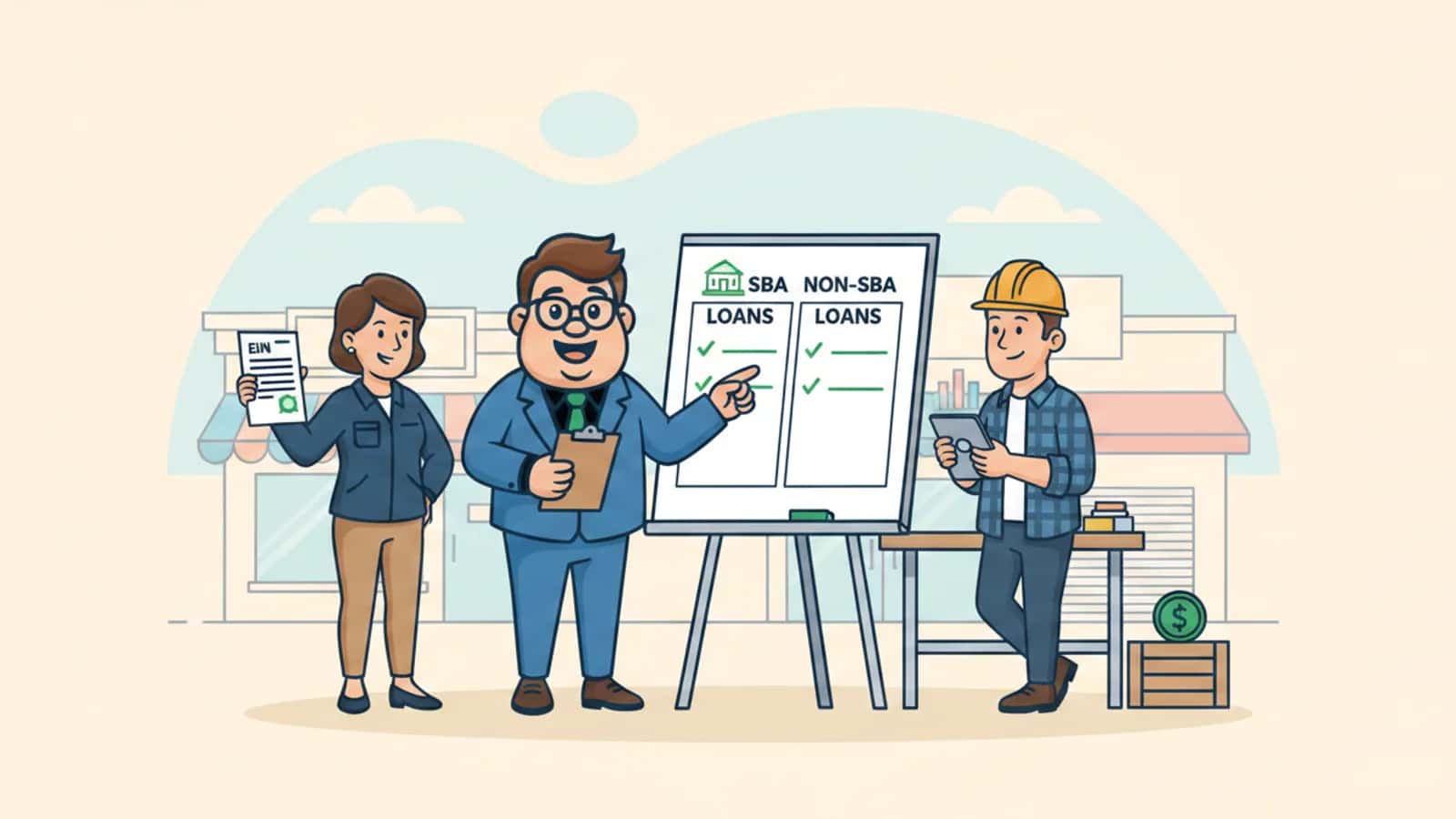
An SBA loan is a small business loan partially guaranteed by the U.S. Small Business Administration, which reduces the risk for lenders and allows them to offer better terms to borrowers. The SBA doesn't lend money directly — it backs loans made by approved banks, credit unions, and non-bank lenders.
Main SBA loan types for startups
- SBA 7(a) loans — up to $5 million for eligible purposes such as working capital, equipment, real estate and acquisitions. Rates are negotiated subject to SBA maximums. See our SBA 7(a) guide.
- SBA Microloans — up to $50,000 through nonprofit intermediaries for working capital, inventory, supplies, furniture, fixtures, machinery or equipment. Read our SBA microloans guide.
- CDFI and local nonprofit loans — smaller facilities and technical assistance for businesses that may not fit conventional bank criteria.
- SBA 504 loans — long-term finance for eligible fixed assets such as owner-occupied real estate or major equipment; not working-capital funding.
Basic SBA qualification criteria
- Operate as a for-profit business in the U.S.
- Meet SBA size standards for your industry
- Have a reasonable personal credit score (typically 640+ for most programs, though some intermediaries are flexible)
- Demonstrate ability to repay — through projections if revenue history is thin
- Be unable to obtain credit on reasonable terms elsewhere
How Much Startup Funding Can I Get Without Revenue History?

Startups with no revenue history have fewer debt options because repayment cannot yet be demonstrated. SBA microloans are capped at $50,000, and the amount offered by any intermediary can be lower. Founders should also compare grants, equity, crowdfunding and owner funding. Founders can compare these routes within the broader landscape of small business funding options.
What lenders look at when revenue is zero
- Personal credit score — the primary underwriting factor for pre-revenue businesses
- Business plan — projected cash flow, market analysis, and use of funds
- Collateral — personal assets, equipment, or inventory
- Owner's industry experience — relevant background reduces perceived risk
- EIN and business entity registration — verified through Secretary of State lookup, this signals legitimacy
Once a business reaches 3–6 months of trading with bank statements to show, more options open up. Revenue-led matching becomes possible, and lenders can assess actual cash flow rather than projections alone.
Choose this path if
- Pre-revenue: SBA Microloan, personal loan used for business, or crowdfunding
- 3–12 months revenue: CDFI loans, some online lenders, equipment finance or carefully assessed revenue-based products
- 12+ months revenue: SBA 7(a), bank term loans, or lines of credit
Differences Between SBA 7(a) and Traditional Bank Business Loans
SBA 7(a) loans and traditional bank loans are both bank-originated products, but the SBA guarantee changes the risk profile significantly — and that changes what startups can access.
| Feature | SBA 7(a) Loan | Traditional Bank Loan |
|---|---|---|
| Government guarantee | Yes (up to 85%) | No |
| Interest rate (2026) | 6.5%–8.5% | Varies; often 7%–12%+ |
| Approval time | 2–8 weeks | 2–6 weeks |
| Startup-friendly | More so | Less so |
| Revenue requirement | Flexible | Usually 2+ years |
| Paperwork | Moderate to high | High |
| Collateral required | Often, but flexible | Usually required |
| Max loan amount | $5 million | Varies by lender |
The SBA guarantee means lenders take on less risk, so they're more willing to work with newer businesses. Traditional bank loans, by contrast, typically require two or more years of operating history and strong financials before they'll engage seriously.
For a deeper comparison of loan structures, see our term loan vs. line of credit vs. merchant cash advance breakdown.
Are There Startup Loan Options If I Have Bad Personal Credit?
Bad personal credit makes SBA loans harder but doesn't close every door. Several non-SBA lenders — particularly online and fintech lenders — use revenue-led matching and flexible criteria that weigh business performance more heavily than credit scores.
Options for lower credit scores (below 620)
- Online lenders — some approve with scores as low as 550, focusing on monthly revenue and time in business
- Merchant cash advances (MCAs) — based on future card sales, not credit score; higher cost
- Microloans through CDFIs — Community Development Financial Institutions often serve underserved borrowers with flexible criteria
- Invoice financing — uses outstanding invoices as collateral; credit score is secondary
- Equipment financing — the equipment itself serves as collateral, reducing credit risk
For more on how credit scoring affects funding access, see our business credit scores guide.
What Interest Rates Should I Expect for New Business Financing?
Startup-loan pricing varies widely by product, lender, term, security and borrower profile. SBA 7(a) rates are negotiated subject to SBA caps tied to a base rate. Compare APR or equivalent total repayment, fees, payment frequency and personal-guarantee exposure before applying.
Rate ranges by product type (2026 estimates)
- SBA 7(a): 6.5%–8.5%
- SBA Microloan: 8%–13% (set by intermediary lenders)
- Bank term loan: 7%–12%
- Online lender term loan: 10%–35%
- Merchant cash advance: 20%–80% effective APR
- Invoice financing: 1%–5% per month on invoice value
What moves your rate
- Personal credit score (higher = lower rate)
- Time in business (longer = lower rate)
- Monthly revenue (more consistent = lower rate)
- Loan term (shorter terms often carry lower rates)
- Collateral offered
The default rate for startup loans held steady at 4.5% in Q1 2026 (National Small Business Association, June 2026), which suggests lenders are pricing risk carefully — not recklessly.
Which Loan Types Work Best for Tech Startups Versus Retail Businesses?
The best loan type depends on what the business actually needs the money for — and how its revenue flows. Tech startups and retail businesses have very different cash flow patterns, which affects which products fit.
Tech startups
- Often pre-revenue or subscription-based with delayed cash flow
- Best fits: SBA Microloans, CDFI loans, venture debt after institutional funding, and relevant federal or state grant programs
- Revenue-based financing works well once monthly recurring revenue is established
Retail businesses
- Inventory-heavy with more predictable daily or weekly revenue
- Best fits: SBA 7(a) working capital loans, merchant cash advances (tied to card sales), inventory financing, lines of credit
- See our restaurant business loans guide for a food service-specific breakdown
Construction and transport
- Equipment-heavy, project-based cash flow
- Best fits: Equipment financing, SBA 7(a), invoice/contract financing
- Explore equipment and cash flow options for sector-specific guidance
Choose X if
- You need inventory fast → inventory financing or MCA
- You're pre-revenue tech → SBA Microloan or grant programs
- You're buying equipment → equipment financing (asset is collateral)
- You need flexible working capital → SBA 7(a) line of credit
Common Reasons Startups Get Rejected for Business Loans
Most startup loan rejections come down to a small set of predictable issues. Knowing them in advance lets founders address gaps before applying.
Top rejection reasons:
- 1
Too new
less than 6 months in business eliminates most bank products
- 2
Low personal credit score
below 640 closes most SBA options
- 3
No collateral
many lenders require assets to secure the loan
- 4
Insufficient cash flow
projected revenue without supporting data doesn't satisfy underwriters
- 5
Incomplete documentation
missing EIN, bank statements, or business registration
- 6
High existing debt
personal debt-to-income ratio above 40%–50% raises flags
- 7
Industry risk
some sectors (cannabis, gambling, adult entertainment) are ineligible for SBA loans
For a full pre-application checklist, see our US business loan approval checklist.
Can I Get a Business Loan With Just a Business Plan?
A business plan supports an application but rarely replaces evidence of repayment ability. Microloan and CDFI intermediaries may also review owner experience, personal credit, projected cash flow, entity documents and a business bank account.
What a strong business plan adds
- Demonstrates market understanding and realistic revenue projections
- Shows the lender how funds will be used and repaid
- Signals owner competence and preparation
What it can't replace
- Personal credit history
- Business bank account activity
- Legal entity registration (Secretary of State verification)
Pre-revenue applicants should present a realistic business plan, documented owner investment, relevant experience and a clear repayment case. Even then, a lender may decide that grants, equity or a smaller microloan is more appropriate than conventional debt.
Startup Loan Requirements for Businesses Less Than One Year Old
Businesses under one year old face the tightest lending criteria. SBA Microloans, CDFI lenders, equipment finance, grants and equity are possible routes, but availability and underwriting vary by provider.
Typical requirements for sub-12-month businesses
- Valid EIN and registered business entity
- Business bank account (separate from personal)
- Personal credit score of 600+ (higher for SBA products)
- Business plan with financial projections
- 3–6 months of bank statements (if any revenue exists)
- Personal guarantee from the owner
What personal collateral looks like in practice: Lenders may ask for a lien on personal assets — home equity, vehicles, savings — to secure the loan. The SBA generally requires collateral for loans above $25,000, though it won't decline a loan solely because collateral is insufficient. For more on this, see our guide on UCC liens and personal guarantees.
Alternative Funding Sources If Banks Won't Approve Me
If bank or SBA-backed debt is not available, alternatives include CDFI lending, equipment finance, invoice finance for eligible B2B receivables, crowdfunding, grants and equity. Each changes cost, control and repayment risk in a different way.
Practical alternatives
- Online lenders — potentially quicker decisions and broader criteria, usually with higher or more complex costs than bank finance
- Merchant cash advances — advance against future card sales; no fixed repayment schedule
- Invoice financing — borrow against unpaid invoices; useful for B2B startups
- Crowdfunding — reward-based (Kickstarter) or equity-based (Regulation CF) platforms
- Angel investors — equity in exchange for capital; no repayment required
- Government grants — non-repayable; competitive but worth pursuing (e.g., SBIR/STTR for tech)
- Friends and family — informal but common; document the terms clearly
Pros and cons of online lenders vs. traditional banks: > - Online: faster (hours to days), flexible criteria, higher cost, shorter terms > - Banks: slower (weeks), stricter criteria, lower cost, longer terms
What Documentation Do I Need to Apply for a Startup Business Loan?
The documentation required varies by lender and loan type, but most applications share a core set of requirements. Having these ready before starting any application speeds up the process significantly.
Standard documents for most startup loan applications
- Government-issued ID (driver's license or passport)
- EIN (Employer Identification Number)
- Business formation documents (LLC operating agreement, articles of incorporation)
- Secretary of State business registration confirmation
- Business bank account statements (3–6 months, if available)
- Personal tax returns (2 years)
- Business tax returns (if filed)
- Business plan with financial projections
- Personal financial statement
- Any existing debt schedules
SBA-specific additions
- SBA borrower information form (Form 1919)
- Business debt schedule
- Collateral documentation
A platform that verifies your business entity via Secretary of State lookup and matches you to US funding partners based on your revenue, trading history, and sector can significantly reduce the paperwork burden before you ever reach a formal application.
FAQ: Business Loans for Startups
Can a brand-new business with no revenue get a loan?
Sometimes, but options are limited. A microloan or CDFI may consider the owner's credit, experience, investment and business plan. Grants, equity or owner funding may be more realistic where repayment cannot yet be demonstrated.
What credit score do I need for an SBA startup loan?
Most SBA lenders look for a personal credit score of 640 or higher. The SBA Microloan Program through nonprofit intermediaries can be more flexible, sometimes approving scores in the 580–620 range.
How long does SBA loan approval take?
There is no single SBA timeline. It depends on the lender, loan type, documentation, underwriting and whether SBA review is required. Ask the lender for an application-to-funding estimate for your case.
Do I need collateral for a startup business loan?
Not always. SBA policy says collateral shortfalls shouldn't automatically disqualify an applicant. However, most lenders will ask for a personal guarantee, and loans above $25,000 typically require some form of collateral.
What's the difference between a microloan and a standard SBA loan?
SBA Microloans are capped at $50,000 and made by nonprofit intermediaries. SBA 7(a) loans are made by approved lenders, can be larger and cover a broader set of eligible business purposes.
Can minority-owned startups access special funding programs?
Yes. Minority-owned startups received 12% of total small business loans in Q1 2026 (Minority Business Development Agency, June 2026), up from 10% the prior quarter. The SBA also runs the 8(a) Business Development Program for socially and economically disadvantaged business owners.
Is a merchant cash advance a good option for a new business?
It can be, if the business processes card payments and needs fast capital. The cost is high — effective APRs can reach 80% — so it works best as a short-term bridge, not a long-term funding strategy.
What happens if I default on a startup loan?
Default rates for startup loans held at 4.5% in Q1 2026. If you default, lenders may pursue personal guarantees, seize collateral, or report to credit bureaus. SBA lenders follow a formal default and liquidation process. Understanding UCC liens and personal guarantees before signing is essential.
Can I use a startup loan for payroll?
Yes. Working capital loans, SBA 7(a) loans, and lines of credit can all be used for payroll. Some lenders restrict use of funds — confirm this before applying.
Is it worth checking eligibility before applying?
Yes, but confirm whether the check uses a soft or hard credit inquiry. A soft inquiry can help narrow options; a lender may still require a hard inquiry and full underwriting later.
Conclusion: Choosing the Right Path Forward
Getting a business loan as a startup isn't simple, but it's more achievable than most founders expect — if they match the right product to their actual situation. For more comparisons and application guidance, browse our business loan guides.
Actionable next steps:
- Know your profile. Check your personal credit score, confirm your EIN is active, and verify your business entity registration. These are the first things any lender will look at.
- Match the product to your stage. Pre-revenue: grants, equity, owner funding, microloans or CDFIs. Early revenue: some online or equipment lenders. Established revenue: bank, SBA 7(a) or line-of-credit options.
- Check the credit-search type. Initial matching may use a soft inquiry, but a full application can involve a hard inquiry. Read the consent before proceeding.
- Prepare your documents. EIN, business bank account, registration documents, and personal tax returns cover most applications. See the US business loan approval checklist for a complete list.
- Compare costs honestly. An SBA loan at 7% and an MCA at 50% effective APR are very different commitments. Know the total cost before signing.
The right funding option exists for most startups in 2026 — the key is finding it without wasting time on applications you won't qualify for. A credible first step with flexible criteria and smart matching can save weeks of frustration and protect your credit in the process.
Further reading
- guide to using retirement accounts to fund your business loans rollovers and tax
- terms and how to apply options
- compare business loans for real estate investors fix and flip rental
- how to qualify for a business loan step by step guide to lender
- costs and eligibility for sBA disaster loans for small businesses
Written by
The Funding Fred Editorial Team creates plain-English guides to help business owners understand funding options, eligibility, and application readiness before they compare finance options.