Government Backed Business Loans UK: Growth Guarantee Scheme and Other Options
Government backed business loans are not loans from the government. They are ordinary loans from banks and alternative lenders where the government guarantees part of the lender's loss if the business defaults.
Quick answer
Government backed business loans are not loans from the government. They are ordinary loans from banks and alternative lenders where the government guarantees part of the lender's loss if the business defaults. The main scheme open to UK small businesses right now is the Growth Guarantee Scheme (GGS), run by the British Business Bank, which gives lenders a 70% guarantee on the outstanding balance while the borrower stays 100% liable for the full debt. Older schemes like Bounce Back Loans and the Recovery Loan Scheme have closed.
Key takeaways
- Government backed business loans are funded by commercial lenders, not the Treasury. The guarantee protects the lender, not you.
- The Growth Guarantee Scheme (GGS) is the UK's current flagship guarantee scheme, administered by the British Business Bank and scheduled to run until 31 March 2030.
- GGS supports facilities generally from £25,001 up to £2m per business group (£1m where Northern Ireland Protocol rules apply), through term loans, overdrafts, asset finance, invoice finance and asset-based lending.
- Businesses need turnover up to £45m, UK trading activity, and more than 50% of income from trading to typically qualify.
- Bounce Back Loans and the Recovery Loan Scheme are closed. GGS is described by multiple lenders and the British Business Bank as the direct successor to the Recovery Loan Scheme.
- You remain fully responsible for repaying the debt, including interest. A guarantee does not cancel or reduce what you owe.
- You cannot apply to the government directly. You apply through an accredited lender's own underwriting process.
-
What Is a Government Backed Business Loan in the UK?

A government backed business loan is a standard commercial loan where part of the lender's potential loss is guaranteed by government, usually through the British Business Bank. The money still comes from a bank or alternative lender. The government never hands cash to the borrower directly.
The guarantee exists to make lenders more comfortable approving finance they might otherwise decline or price higher. British Business Bank describes this structure as a "risk-sharing partnership" between government and accredited lenders. It's a credit-enhancement tool for the lender's balance sheet, not a subsidy or grant for your business. If your business can't repay, you still owe the money. The guarantee only changes how much of that loss the lender can recover from government after exhausting normal recovery steps.
This matters because a lot of business owners assume "government backed" means easier approval or a cheaper rate. Neither is guaranteed. Pricing, eligibility and timing still vary by lender and applicant.
Can You Get a Business Loan Directly From the Government?
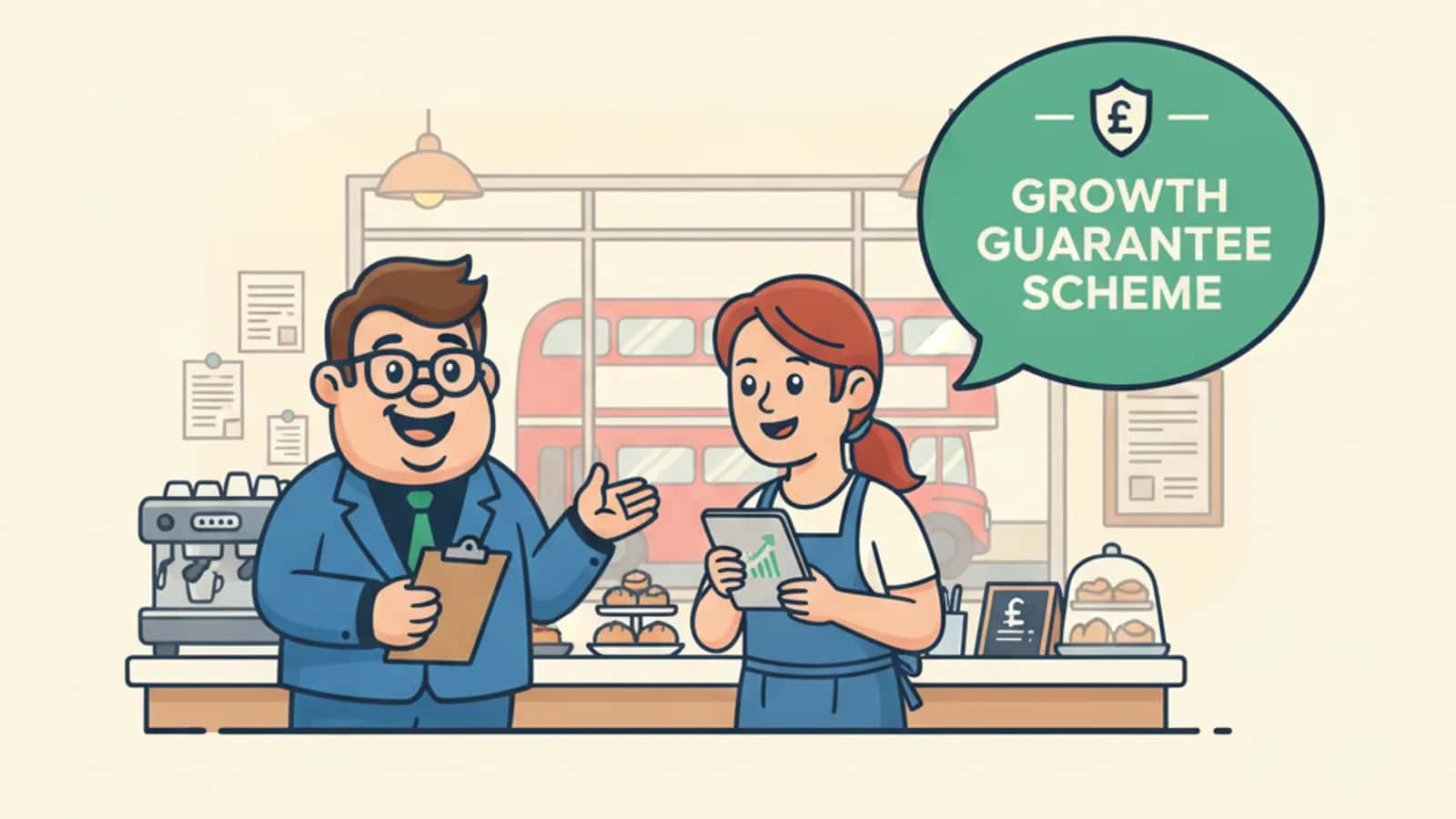
No. UK government does not operate a direct small business lending desk. Every government backed business loan is issued and funded by a commercial lender that has been accredited to offer a specific scheme.
GOV.UK's business finance support page, last updated 29 September 2026, confirms this clearly: support comes through a network of accredited lenders offering term loans, overdrafts, asset finance, invoice finance and asset-based lending, with the government's role limited to guaranteeing part of the lender's exposure. You will never submit an application form to a government department for a GGS facility. You apply to a bank or alternative lender, and that lender decides whether to approve you based on its own credit criteria.
Grants are a different category entirely. Some UK grant schemes do pay money that doesn't need repaying, unlike any loan, guaranteed or not. If non-repayable funding is more relevant to your situation, it's worth reading about grants that do not need repaying before committing to a loan application.
How Does the Growth Guarantee Scheme Work?
GGS works by giving an accredited lender a 70% government guarantee on the outstanding balance of your facility, triggered only after the lender has exhausted its normal recovery process. You, the borrower, remain 100% liable for the whole debt throughout[11-style structure confirmed at 1].
The scheme is administered by the British Business Bank on behalf of the Secretary of State for Business and Trade. It replaced the Recovery Loan Scheme as the main ongoing guarantee scheme for business growth from July 2024, and several accredited lenders including RBS reference GGS using that succession language.
Key mechanics to understand:
- The guarantee sits between lender and government.
- It does not sit between you and the lender. Your contract terms, repayment schedule and liability are unaffected by the guarantee itself.
- A personal guarantee from you may still be required.
- GGS rules allow lenders to ask company directors for a personal guarantee on facilities, subject to the lender's own policy and the loan size. The government guarantee reduces the lender's risk; it does not remove the lender's right to ask you to secure the debt personally.
- The facility type varies.
- GGS can back term loans, overdrafts, asset finance, invoice finance and asset-based lending, not just a single loan product.
For a deeper breakdown of rates, accredited lender lists, and recent updates to the scheme, see how the Growth Guarantee Scheme works. And because personal liability is the part most business owners underestimate, it's worth reading about personal guarantees on business loans before you sign anything.
Eligibility Requirements for Government Backed Loans
Eligibility for GGS centres on turnover, trading location and business health, not a flawless credit file. British Business Bank and the Scottish government's Find Business Support service both confirm a turnover cap of £45m, UK-based trading activity, and generally more than 50% of income coming from trading.
Published conditions also specify:
- Your business must be UK-based and carrying out trading activity in the UK.
- Public-sector bodies and state-funded primary and secondary schools are excluded.
- The business must not be "in difficulty" or in collective insolvency proceedings at the time of application.
- A wide range of legal structures can apply, including sole traders, limited companies, partnerships, co-operatives and community benefit societies.
Can startups get government backed loans, or only established businesses?
Startups are not automatically excluded from GGS, but most accredited lenders still want to see some trading history before approving a facility of this size. If you're pre-revenue or only a few months old, Start Up Loans (a separate, smaller government-backed personal loan programme for new businesses) or specialist funding for startups may fit your stage better than GGS. Always check current scheme rules directly on british-business-bank.co.uk before assuming either route applies to your business, since criteria and availability can change.
How Much Can You Borrow With a Government Backed Business Loan?
GGS facilities generally range from a minimum of £25,001 up to £2m per business group, with a £1m cap for borrowers within the scope of the Northern Ireland Protocol. The exact amount you're offered depends on the lender's own assessment of affordability, not a fixed government allocation.
Businesses that previously borrowed under CBILS, CLBILS, BBLS or the Recovery Loan Scheme are not automatically blocked from GGS, but earlier facilities can reduce the maximum amount a lender will now offer. That's a detail worth raising directly with any lender you approach if you used an earlier crisis-era scheme.
Which Schemes Are Open Now, and Which Have Closed?
GGS is the main general-purpose government backed loan guarantee scheme currently open to UK smaller businesses, running until 31 March 2030. Start Up Loans and some regional funds also remain active for specific business stages or locations, but several earlier national schemes have closed permanently.
| Scheme | Status | Typical use |
|---|---|---|
| Growth Guarantee Scheme (GGS) | Open, runs to 31 March 2030 | General growth, cashflow, asset purchase, working capital via accredited lenders |
| Start Up Loans | Separate government-backed programme for new businesses | Early-stage trading businesses |
| Regional/devolved nation funds | Vary by location and availability | Local economic development, sector-specific support |
| Bounce Back Loan Scheme (BBLS) | Closed | Was pandemic-era emergency support |
| Coronavirus Business Interruption Loan Scheme (CBILS/CLBILS) | Closed | Was pandemic-era emergency support |
| Recovery Loan Scheme (RLS) | Closed, succeeded by GGS | Was post-pandemic recovery finance |
Because scheme status, caps and dates can be updated, always confirm current details on the British Business Bank's own GGS pages before applying.
Growth Guarantee Scheme vs Other Business Loan Options
GGS is best suited to established UK businesses that want a larger facility and can satisfy a lender's full underwriting process. It is not the fastest or most flexible route if you need a smaller amount quickly, have thin trading history, or want to avoid a lengthy application.
| Feature | Growth Guarantee Scheme | Standard Unsecured Business Loan (via a wide partner panel) |
|---|---|---|
| Who funds it | Accredited banks and lenders, government-guaranteed in part | Commercial lenders across a wide partner panel |
| Typical facility size | £25,001 to £2m (£1m NI Protocol) | Roughly £10k to £1m, depending on lender |
| Decision speed | Full lender underwriting; varies by lender | Can move faster using Open Banking and current trading data |
| Credit history | Lender's own criteria apply; not guaranteed easier | Flexible criteria; current trading performance matters, not just a clean credit file |
| Personal guarantee | May still be required by the lender | Depends on the lender and loan structure |
| Best for | Larger, established businesses needing growth capital | Businesses that have been declined elsewhere or need capital quickly |
If your business doesn't fit the GGS mould right now, or a bank has already said no, unsecured business loans sourced through a wide partner panel can be a faster-moving alternative worth comparing alongside any guarantee scheme application.
How to Find an Accredited GGS Lender
You find a GGS lender by checking the British Business Bank's published list of accredited lenders, not by applying to a government body. Major high-street banks and a number of specialist lenders hold GGS accreditation, and that list is maintained directly by British Business Bank.
Practical steps:
- Check the current accredited lender list on british-business-bank.co.uk before contacting anyone.
- Approach the lender directly, as you would for any other business loan.
- Expect the lender's own standard affordability and credit checks, in addition to the scheme's eligibility rules.
- Ask specifically whether a personal guarantee will be required on your facility.
Do not assume every bank offers GGS, and do not assume accreditation means automatic approval. The guarantee affects the lender's risk, not your underwriting outcome.
How Long Does It Take to Get Approved for a Government Backed Business Loan?
Approval timing for GGS depends entirely on the individual lender's underwriting process, and no fixed turnaround time is published by British Business Bank. Larger, guaranteed facilities typically involve more documentation than a standard small business loan, which can extend the timeline.
Have these ready before you start, regardless of which lender you approach:
- Last two to three years of filed accounts, or management accounts if newer
- Recent business bank statements
- Current debt schedule, including any prior CBILS, CLBILS, BBLS or RLS borrowing
- Management information on turnover split between UK and overseas trading
- A clear explanation of what the facility will fund
If speed matters more than facility size, a faster-moving unsecured route assessed through Open Banking may suit your timeline better than a full GGS application cycle.
Do Government Backed Business Loans Cost Less? Do You Need Collateral?
Government backed business loans are not automatically cheaper than ordinary business loans. The guarantee can help a lender offer finance at a lower price than it otherwise would, or approve lending it might otherwise decline, but published scheme material does not promise a specific discounted rate. Pricing is set by each individual lender based on its own risk assessment.
Collateral and personal guarantee requirements also sit with the lender, not the scheme itself. The government guarantee covers part of the lender's loss after recovery action; it does not remove the lender's ability to ask for security or a personal guarantee from directors. This is one of the most misunderstood parts of "government backed" lending; read personal guarantees on business loans for a full breakdown before signing terms.
What Happens If You Can't Repay a Government Backed Business Loan?
You remain fully liable for the outstanding debt even after a government guarantee is involved. The guarantee only changes what the lender can recover from government after it has completed its own normal recovery process against your business.
In practice this means the lender will first pursue standard recovery steps: contact, repayment plans, and, if applicable, action against any security or personal guarantee you provided. Only after that process is exhausted does the government guarantee reduce the lender's residual loss. From your side, missing payments still damages your credit file and can trigger the same consequences as defaulting on any other commercial loan.
What Can You Use a Government Backed Business Loan For?
Government backed business loans through GGS can generally fund a wide range of legitimate business purposes, including cashflow management, growth investment, asset purchases and working capital, not just crisis recovery. Unlike the emergency-era schemes that preceded it, GGS is explicitly positioned as a forward-looking growth finance tool.
Common uses lenders report include:
- Buying equipment, vehicles or stock
- Managing seasonal cashflow gaps
- Funding expansion into new premises or locations
- Covering invoice-to-payment timing gaps through invoice finance products backed by the scheme
Alternatives to Government Backed Loans for Small Businesses
Alternatives exist for businesses that don't fit GGS criteria, don't want to wait for a full underwriting cycle, or simply need a smaller, faster facility. Unsecured business loans and merchant cash advances from a wide panel of finance partners are two of the most common routes.
If a bank has already turned you down, or you're running against a deadline, consider:
- Unsecured business loans assessed on current trading performance rather than only a clean credit file
- Merchant cash advances for businesses with steady card revenue
- Invoice finance if your main constraint is unpaid customer invoices
- Non-repayable grants that do not need repaying, where your business and purpose qualify
Funding Fred exists for exactly this gap: a sub-two-minute eligibility check, using Open Banking rather than a pile of paperwork, with no hard check to start and no obligation to proceed. It's Business Funding. Without the Fuss. Compare selected finance partners through the business loans comparison service to see what's realistically available for your trading history, separate from any guarantee scheme timeline.
Common Mistakes When Applying for Government Backed Business Loans
The most common mistake is assuming "government backed" means government money, guaranteed approval, or a discounted rate. None of those assumptions hold. The guarantee protects the lender's loss position; it does not change your liability, and it does not promise a lower price than you'd get elsewhere.
Other frequent errors:
- Applying without checking current eligibility criteria directly on british-business-bank.co.uk, since caps and rules can be updated
- Not disclosing prior CBILS, CLBILS, BBLS or RLS borrowing, which can reduce your new facility limit
- Assuming a personal guarantee won't be asked for, then being surprised at offer stage
- Treating GGS as the only option and ruling out faster unsecured routes while waiting on a slow underwriting decision
- Not having management accounts or a debt schedule ready, which stalls the process further
For a wider view of why applications stall generally, see what to do if your bank loan is declined and the broader UK business loan eligibility guide in our business loans hub.
Application-Readiness Checklist
Before approaching any lender, accredited or otherwise, confirm you have:
- Filed accounts or management accounts covering the last two to three years
- Recent business bank statements
- A clear statement of what the loan will fund
- Details of any existing government-backed borrowing (CBILS, CLBILS, BBLS, RLS or GGS)
- Confirmation your turnover and trading location fit the scheme you're targeting
- An honest view on whether you can accept a personal guarantee if asked
Next steps for government backed business loans
Government backed business loans in the UK work through a guarantee to the lender, not a cheque from the Treasury. GGS is the scheme doing the heavy lifting right now, running to 31 March 2030, covering facilities from £25,001 to £2m through accredited lenders. You still owe every penny you borrow, and a personal guarantee is still possible.
If GGS fits your business size and you can wait for full underwriting, start by checking current criteria directly on british-business-bank.co.uk and approaching an accredited lender. If you need a decision faster, or your trading history doesn't match the scheme's profile, a faster-moving unsecured route might serve you better right now. Check eligibility now through Funding Fred's two-minute, Open Banking-based check: no hard check to start, no obligation to proceed, and a wide partner panel built for businesses the high street has already said no to.
Frequently asked questions
What Is a Government Backed Business Loan in the UK?
A government backed business loan is a standard commercial loan where part of the lender's potential loss is guaranteed by government, usually through the British Business Bank. The money still comes from a bank or alternative lender. The government never hands cash to the borrower directly.
Can You Get a Business Loan Directly From the Government?
No. UK government does not operate a direct small business lending desk. Every government backed business loan is issued and funded by a commercial lender that has been accredited to offer a specific scheme.
How Does the Growth Guarantee Scheme Work?
GGS works by giving an accredited lender a 70% government guarantee on the outstanding balance of your facility, triggered only after the lender has exhausted its normal recovery process. You, the borrower, remain 100% liable for the whole debt throughout[11-style structure confirmed at 1].
How Much Can You Borrow With a Government Backed Business Loan?
GGS facilities generally range from a minimum of £25,001 up to £2m per business group, with a £1m cap for borrowers within the scope of the Northern Ireland Protocol. The exact amount you're offered depends on the lender's own assessment of affordability, not a fixed government allocation.
Which Schemes Are Open Now, and Which Have Closed?
GGS is the main general-purpose government backed loan guarantee scheme currently open to UK smaller businesses, running until 31 March 2030. Start Up Loans and some regional funds also remain active for specific business stages or locations, but several earlier national schemes have closed permanently.
How to Find an Accredited GGS Lender?
You find a GGS lender by checking the British Business Bank's published list of accredited lenders, not by applying to a government body. Major high-street banks and a number of specialist lenders hold GGS accreditation, and that list is maintained directly by British Business Bank.
Written by
The Funding Fred Editorial Team creates plain-English guides to help business owners understand funding options, eligibility, and application readiness before they compare finance options.
Reviewed by
UK business finance content reviewer
Robert reads our UK business finance guides before they go live, checking each one is accurate, easy to follow, and reflects how lending actually works today — not how a brochure says it should. He's listed on the FCA Register, approved as an SMF3 (AR) Executive Director at Switcha Limited, and connected to Lucky Growth Partners Ltd through its appointed representative relationship, so the regulated detail gets a properly qualified second read.
Sources
- Growth Guarantee Scheme
- Growth Guarantee Scheme
- Growth Guarantee Scheme Businesses
- Frequently Asked Questions
- British Business Bank Growth Guarantee Scheme
- Request Proposals
- Growth Guarantee Scheme
- Growth Guarantee Scheme
- Growth Guarantee Scheme
- British Business Bank Launches Growth Guarantee Scheme Help Smaller Businesses