
Supply Chain Finance in the UK: How Manufacturers and Distributors Can Use Invoices to Fund Growth
Supply chain finance in the UK lets manufacturers, wholesalers, and distributors turn unpaid invoices into working capital — typically within 24 to 48 hours — without waiting 30, 60, or 90 days for customers to pay.

Quick answer
Supply chain finance in the UK lets manufacturers, wholesalers, and distributors turn unpaid invoices into working capital — typically within 24 to 48 hours — without waiting 30, 60, or 90 days for customers to pay. Instead of chasing payment, businesses access a percentage of the invoice value upfront through a specialist finance partner, then receive the remainder once the customer settles. It's not a loan. It's your money, sooner.
Key takeaways
- Supply chain finance uses your existing invoices as the funding mechanism — no new debt, no asset security required in most cases.
- UK manufacturers and distributors are among the most frequent users of invoice-backed finance, because long payment terms from large buyers are standard in these sectors.
- Two core products cover most needs: invoice factoring (the finance partner manages collections) and invoice discounting (you stay in control of credit control).
- Facilities typically range from £10,000 to £5 million+, scaling as your turnover grows.
- The UK government has actively used supply chain finance schemes — including for community pharmacies — demonstrating its credibility as a mainstream funding tool.
- UK Finance's 2026 Plan for Growth identifies receivables and working capital finance as central to SME growth and export strategy.
- A 2-minute eligibility check with no hard credit search is enough to find out if you qualify — no long forms, no obligation.
- The Bank of England's June 2026 agents' summary confirms continued pressure on working capital, keeping demand for invoice finance elevated.
What Is Supply Chain Finance and Why Does It Matter for UK Manufacturers?
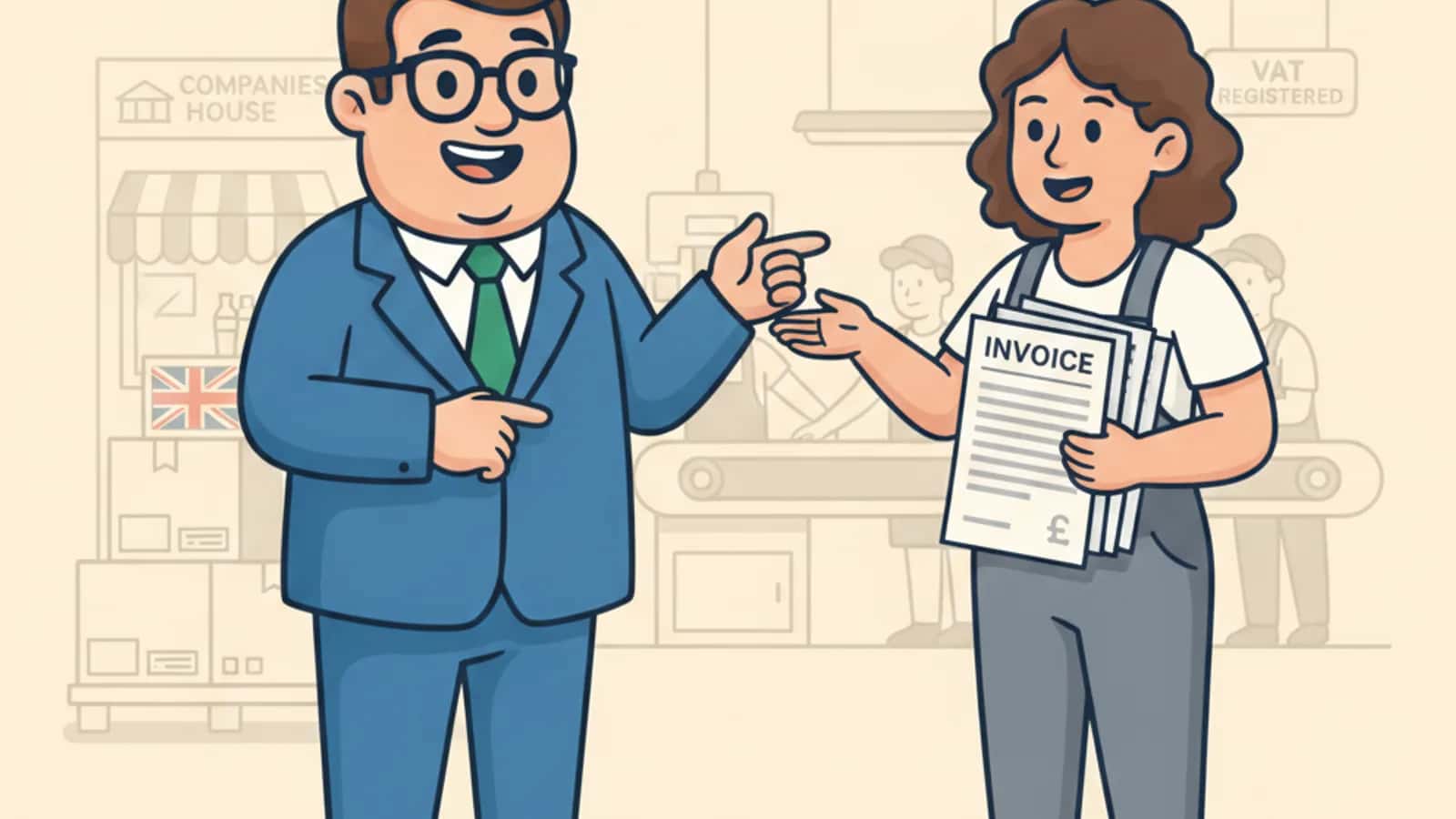
Supply chain finance in the UK is a funding arrangement where a business uses its outstanding invoices to access cash before the payment due date. For manufacturers and distributors, this solves a specific and persistent problem: goods leave the warehouse, the invoice goes out, but the cash doesn't arrive for weeks or months.
This isn't a niche workaround. UK Finance's May 2026 Plan for Growth explicitly positions trade and receivables finance as a core pillar of SME growth and export strategy. The City of London's analysis of technologies shaping UK financial services in 2026 also identifies data-driven receivables finance as one of the sector's key growth areas.
Why manufacturers and distributors feel this most acutely
- Large retail and wholesale buyers routinely impose 60- to 90-day payment terms as standard.
- Production costs — materials, labour, energy — are paid upfront, long before the customer settles.
- Seasonal demand spikes mean cash is needed precisely when it's least available.
- Taking on a new contract often requires buying more stock or hiring before any revenue arrives.
The result is a timing problem, not a business problem. Supply chain finance in the UK: how manufacturers and distributors can use invoices to fund growth is fundamentally about closing that gap.
How Does Invoice-Backed Supply Chain Finance Actually Work?

The mechanics are straightforward. A business issues an invoice to a customer. Instead of waiting for payment, it submits that invoice to a specialist finance partner. The partner advances a percentage of the invoice value — typically 80% to 90% — usually within 24 to 48 hours. When the customer pays, the remaining balance is released, minus a small service fee.
The standard process, step by step:
- Deliver goods or services and issue the invoice as normal.
- Submit the invoice to your invoice finance provider (this can be done digitally, often through integrated accounting software).
- Receive an advance — typically 80–90% of the invoice face value — within one to two business days.
- Customer pays on their usual terms (30, 60, or 90 days).
- Receive the remaining balance, minus the provider's fee.
The fee structure usually includes a service charge (a percentage of invoice value) and a discount charge (similar to interest, applied to the days the advance is outstanding). Costs vary by provider, sector, and invoice volume — which is why comparing specialist partners matters.
For a broader view of how invoice finance compares to traditional borrowing, see this comparison of invoice finance vs business loans.
Invoice Factoring vs Invoice Discounting: Which Suits Manufacturers and Distributors?
Both products release cash from unpaid invoices. The difference is who manages the credit control process.
| Feature | Invoice Factoring | Invoice Discounting |
|---|---|---|
| Who chases payment | Finance partner | Your business |
| Customer awareness | Yes — customers know | Typically confidential |
| Admin burden | Lower (outsourced) | Higher (you manage) |
| Best for | Smaller teams, rapid growth | Established credit control |
| Typical advance rate | 80–90% | 80–90% |
| Flexibility | High | High |
Which is right for you?
Choose invoice factoring if
your team is lean, you're scaling fast, or you'd rather hand off credit control entirely. Many smaller manufacturers and distributors find factoring removes a significant administrative burden.
Choose invoice discounting if
you have a strong internal credit control function and want to keep the funding arrangement confidential from customers. This is common among larger distributors with long-standing buyer relationships.
Both options are available through Funding Fred's invoice finance platform, which matches businesses with specialist partners across both products.
Who Qualifies for Supply Chain Finance in the UK?
Most UK manufacturers, wholesalers, and distributors that invoice other businesses (B2B) are eligible. The key criteria are simpler than most business owners expect.
You're likely to qualify if
- Your business invoices other UK businesses (not consumers).
- You have outstanding invoices that are not yet overdue.
- Your annual turnover is broadly in line with the facility size you need (£10k to £5m+ facilities are available).
- Your customers are creditworthy — the finance partner assesses buyer quality, not just your own credit.
Common sectors that use supply chain finance in the UK
- Manufacturing (engineering, food production, textiles)
- Wholesale and distribution
- Logistics and haulage
- Construction and building supplies
- Recruitment and staffing
- Business services
The UK government's own supply chain finance scheme — used to support community pharmacies — demonstrates that even public-sector supply chains can benefit from invoice-backed funding.
A 2-minute eligibility check with no hard credit search is the fastest way to find out where you stand. No obligation, no long forms.
What Are the Real-World Benefits for Manufacturers and Distributors?
Supply chain finance in the UK: how manufacturers and distributors can use invoices to fund growth delivers four concrete outcomes that matter to business owners running healthy but cash-constrained operations.
1. Cover payroll without stress A manufacturer with a strong order book but 60-day payment terms shouldn't be worrying about wages. Invoice finance means payroll is covered from money already earned.
2. Take on larger contracts Distributors regularly turn down growth opportunities because they can't fund the stock purchase upfront. With an invoice finance facility in place, taking on a new contract becomes a cash flow decision, not a gamble.
3. Pay suppliers on time (and negotiate better terms) Paying suppliers promptly often unlocks early payment discounts or preferential pricing. That's a direct margin improvement funded by your own receivables.
4. Bridge seasonal gaps Food manufacturers, garden product distributors, and construction suppliers all face seasonal demand spikes. Invoice finance scales with turnover — so the facility grows when you need it most.
"The business was profitable on paper. But every month, we were waiting on three or four large invoices before we could pay anyone. Invoice finance changed that entirely." — Typical scenario for a mid-sized UK distributor.
For businesses exploring broader working capital options, the working capital ratio guide explains how lenders assess financial health before approving facilities.
How Does Supply Chain Finance Differ from a Business Loan?
This is one of the most common questions — and the answer matters because the two products solve different problems.
A business loan gives you a fixed sum, repaid over time with interest. It's appropriate for capital investment — buying equipment, funding an acquisition, or expanding premises. For that, asset finance or a business loan may be the right tool.
Invoice finance, by contrast, is not a loan. It's an advance against money you're already owed. There's no fixed repayment schedule because the customer's payment clears the advance. The facility grows as your invoicing grows.
| Factor | Invoice Finance | Business Loan |
|---|---|---|
| Security | Your invoices | Assets or personal guarantee |
| Repayment | Customer pays the invoice | Fixed monthly repayments |
| Scales with turnover | Yes | No |
| Speed of access | 24–48 hours | Days to weeks |
| Credit search | Soft check to start | Hard credit search |
| Best for | Cash flow timing gaps | Capital investment |
For businesses that have been declined for a loan, invoice finance is often a viable alternative. See what to do if your business loan is declined for more options.
What's Changing in UK Supply Chain Finance in 2026?
Three developments are reshaping how manufacturers and distributors access invoice-backed funding in 2026.
1. Interoperability between banks and platforms SWIFT's updated standards for supply chain finance are enabling more scalable, bank-to-bank processing of invoice-based transactions. This means faster settlements and broader access for mid-market businesses.
2. Sustainability-linked facilities Sustainability-linked supply chain finance is gaining traction in UK retail-manufacturing chains, with invoice funding costs increasingly tied to ESG performance metrics. Businesses that can demonstrate environmental credentials may access preferential rates. For context on sustainable funding trends, see green business loans and sustainable funding in 2026.
3. Elevated demand driven by economic conditions The Bank of England's June 2026 agents' summary confirms continued pressure on working capital and trade-related finance. Global supply chain disruption — including tariff uncertainty and logistics volatility — is keeping demand for receivables finance high. Businesses that have a facility in place are better positioned than those scrambling to arrange funding mid-crisis.
How to Get Started with Invoice Finance: A Practical Checklist
Getting set up is faster than most business owners expect. Here's what the process looks like.
Before you apply
- [ ] Confirm your business invoices other businesses (B2B)
- [ ] Check your outstanding invoices are not overdue
- [ ] Have recent accounts or management information ready (not always required at the eligibility stage)
- [ ] Know your approximate monthly invoicing volume
At the eligibility stage
- [ ] Complete a 2-minute eligibility check — no hard credit search, no obligation
- [ ] Review matched specialist partners and their terms
- [ ] Ask about advance rates, service fees, and contract length
Once approved
- [ ] Integrate your invoicing software if available (many platforms connect directly to Xero, Sage, or QuickBooks)
- [ ] Submit your first batch of invoices
- [ ] Receive your advance — typically within 24 to 48 hours
For a broader look at alternative funding routes, alternative business funding strategies covers the full landscape of options available to UK SMEs.
Next steps
Supply chain finance in the UK: how manufacturers and distributors can use invoices to fund growth isn't a complicated concept. It's a practical answer to a timing problem that affects thousands of healthy UK businesses every month. Goods shipped, work done, invoice issued — but the cash is sitting in a customer's accounts payable queue for 60 or 90 days.
Invoice factoring and invoice discounting both solve that problem. The right choice depends on your team size, your customer relationships, and how much control you want to retain over credit management. Either way, the outcome is the same: faster access to money you've already earned, without taking on traditional debt.
In 2026, with working capital pressure elevated and trade finance increasingly mainstream, having an invoice finance facility isn't just a cash flow fix — it's a competitive advantage. Businesses that can pay suppliers promptly, take on new contracts without hesitation, and cover payroll without stress are better positioned to grow.
Actionable next steps:
- Check your eligibility — a 2-minute check with no hard credit search tells you where you stand. Start here with Funding Fred.
- Compare specialist partners — don't accept the first offer. Rates, advance percentages, and contract terms vary.
- Integrate with your accounting software — the fastest facilities connect directly to your invoicing system.
- Review your invoice finance options regularly — as your turnover grows, your facility should too.
Invoice Finance. Without the Fuss. That's what a good facility looks like — and it starts with a 2-minute check.
Further reading
Frequently asked questions
What Is Supply Chain Finance and Why Does It Matter for UK Manufacturers?
Supply chain finance in the UK is a funding arrangement where a business uses its outstanding invoices to access cash before the payment due date. For manufacturers and distributors, this solves a specific and persistent problem: goods leave the warehouse, the invoice goes out, but the cash doesn't arrive for weeks or months.
How Does Invoice-Backed Supply Chain Finance Actually Work?
The mechanics are straightforward. A business issues an invoice to a customer. Instead of waiting for payment, it submits that invoice to a specialist finance partner. The partner advances a percentage of the invoice value — typically 80% to 90% — usually within 24 to 48 hours. When the customer pays, the remaining balance is released, minus a small service fee.
Invoice Factoring vs Invoice Discounting: Which Suits Manufacturers and Distributors?
Both products release cash from unpaid invoices. The difference is who manages the credit control process.
Who Qualifies for Supply Chain Finance in the UK?
Most UK manufacturers, wholesalers, and distributors that invoice other businesses (B2B) are eligible. The key criteria are simpler than most business owners expect.
What Are the Real-World Benefits for Manufacturers and Distributors?
Supply chain finance in the UK: how manufacturers and distributors can use invoices to fund growth delivers four concrete outcomes that matter to business owners running healthy but cash-constrained operations.
How Does Supply Chain Finance Differ from a Business Loan?
This is one of the most common questions — and the answer matters because the two products solve different problems.
Written by
The Funding Fred Editorial Team creates plain-English guides to help business owners understand funding options, eligibility, and application readiness before they compare finance options.
Reviewed by
UK business finance content reviewer
Robert reads our UK business finance guides before they go live, checking each one is accurate, easy to follow, and reflects how lending actually works today — not how a brochure says it should. He's listed on the FCA Register, approved as an SMF3 (AR) Executive Director at Switcha Limited, and connected to Lucky Growth Partners Ltd through its appointed representative relationship, so the regulated detail gets a properly qualified second read.