
Private Credit vs. Traditional Business Loans: What Main Street Borrowers Need to Know
Private-credit and traditional bank loans differ in underwriting flexibility, documentation, covenants, pricing and repayment structure. Private credit may fit a complex or time-sensitive case, while bank debt may be cheaper for a strong conventional borrower; compare the full term sheet.

Quick answer
Private-credit and traditional bank loans differ in underwriting flexibility, documentation, covenants, pricing and repayment structure. Private credit may fit a complex or time-sensitive case, while bank debt may be cheaper for a strong conventional borrower; compare the full term sheet.
Key takeaways
- Compare total repayment, fees, covenants and default terms rather than headline rate alone
- Private lenders may assess complex situations that fall outside bank policy
- Banks usually require stronger documentation and a more conventional risk profile
- Faster underwriting does not guarantee faster funding or approval
- Review security and personal-guarantee exposure before signing
What Exactly Is Private Credit, and How Is It Different From a Bank Loan?
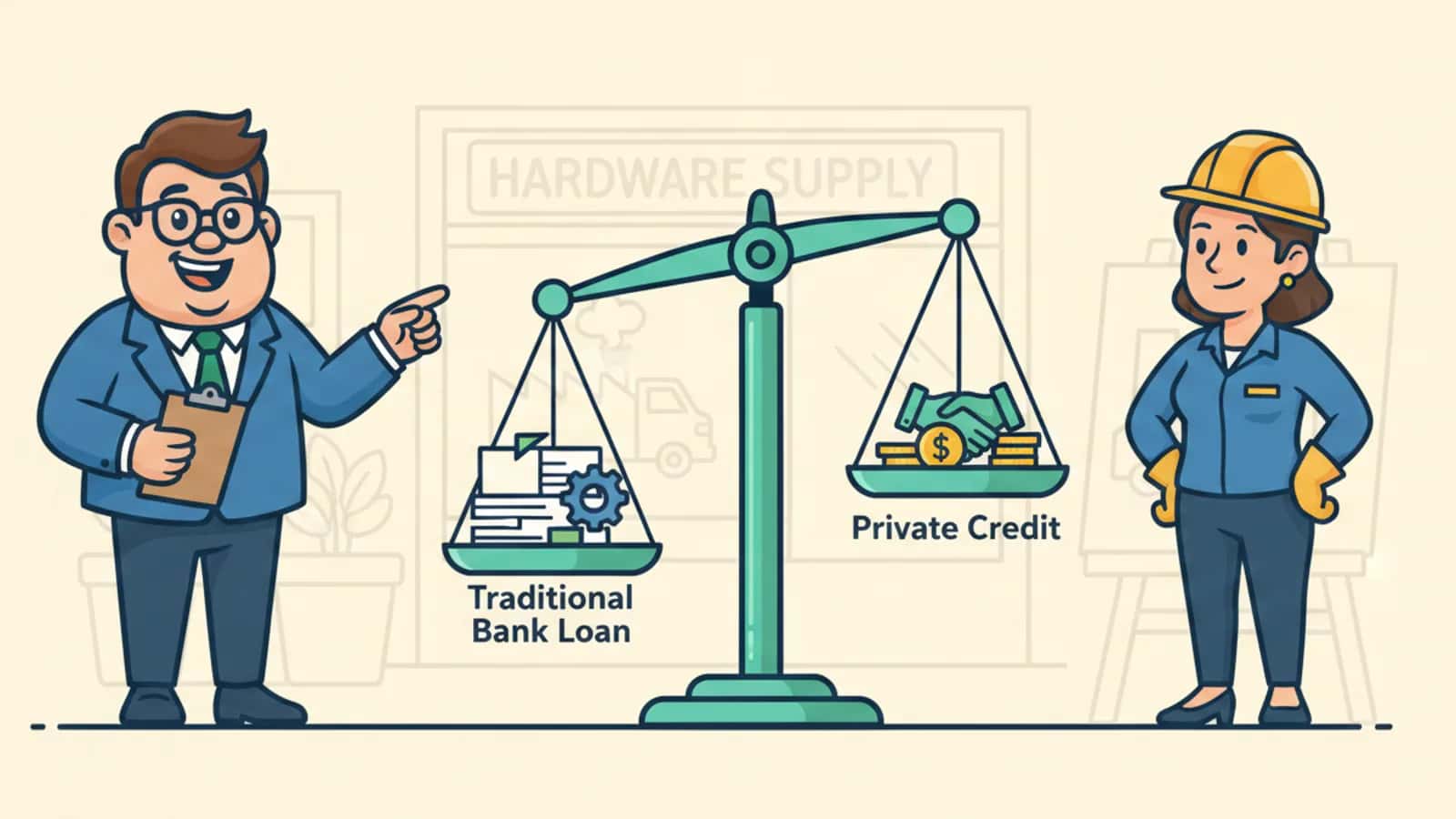
Private credit is lending that happens outside the regulated banking system. Instead of a federally chartered bank using depositor funds, a private credit fund, BDC, or specialty lender uses capital raised from institutional or accredited investors to make loans directly to businesses.
The structural difference matters for borrowers:
- Banks
- are regulated, use short-term deposits to fund long-term loans, and must meet strict capital adequacy rules under Basel III
- Private credit funds
- typically hold equity equivalent to 65–80% of total assets — far more than the roughly 10% equity cushion at U.S. banks — which gives them more flexibility to absorb losses and take on deals banks won't touch
- Loan terms
- from private lenders often run five to seven years, while the funds themselves have lifespans of 10–12 years, meaning there's minimal pressure to call loans early
For a business owner, the practical difference is this: a bank loan is cheaper and more regulated, but harder to qualify for and slower to close. A private credit loan is faster and more flexible, but the pricing reflects the additional risk the lender is taking on.
Are Private Credit Rates Cheaper or More Expensive Than Traditional Business Loans?

Private credit almost always costs more than a traditional bank loan. That's the honest answer.
Traditional bank business loans — including SBA-backed products — typically price off benchmark rates (like the prime rate or SOFR) with spreads that keep effective APRs in a range that reflects the borrower's creditworthiness and the bank's regulatory cost of capital. Private credit lenders price for flexibility and speed, and that premium is real.
Key cost differences to understand:
| Cost Factor | Traditional Bank Loan | Private Credit |
|---|---|---|
| Interest Rate | Generally lower; tied to prime or SOFR + spread | Higher; often floating with wider spreads |
| Origination Fee | 0.5%–2% typical | 1%–4% or higher |
| Prepayment Penalty | Sometimes; often negotiable | Common; can be significant |
| PIK Interest | Rare | Used in some structures — interest accrues and compounds |
| Speed Premium | None | Built into pricing |
Business Development Companies (BDCs), which are one common vehicle for private credit, have posted average dividend yields of 12.1% to investors — a figure that reflects what those investors expect to earn from the underlying loans. That yield has to come from somewhere: the borrowers.
Decision rule: If a bank will approve you at a reasonable rate, take it. Private credit makes sense when bank approval is unlikely, the timeline is critical, or the deal structure requires flexibility a bank won't offer.
For a broader look at how different loan types compare, see this guide to term loans, lines of credit, and merchant cash advances.
What Size Business Qualifies for Private Credit Financing?
Private credit was originally built for mid-market companies — businesses with $10 million or more in annual revenue that were too small for public bond markets but too complex or risky for traditional banks.
That has changed. The market has expanded downward, and some private credit lenders now work with businesses generating $500,000 to $2 million in annual revenue. However, the sweet spot for most private credit funds remains businesses with:
- At least $1 million in annual revenue
- 12–24 months of operating history
- Demonstrable cash flow to service debt
Very small businesses — sole proprietors, micro-businesses under $250,000 in revenue — are typically better served by SBA microloans, community development financial institutions (CDFIs), or revenue-based financing platforms. See our SBA microloan guide for a comparison of when smaller-scale options make more sense.
What Credit Score Do I Need to Get Approved for Private Credit?
There is no universal minimum credit score for private credit. Unlike banks, which often apply hard FICO cutoffs (commonly 680+ for conventional business loans), private credit lenders tend to underwrite based on a broader picture.
What private lenders actually look at:
- Revenue consistency
- monthly and annual revenue trends matter more than a single score
- Cash flow coverage
- can the business service the proposed debt from operating cash flow?
- Industry and sector risk
- some sectors get tighter terms regardless of credit score
- Collateral or personal guarantee
- many deals require one or both
- Business age
- two or more years of trading history is a common threshold
A business owner with a 620 personal credit score but strong, consistent revenue may qualify for private credit where a bank would decline. Conversely, a high credit score won't override weak cash flow in most private credit underwriting.
Understanding your business credit score separately from your personal FICO is worth doing before approaching any lender.
How Fast Can I Get Funding Through Private Credit Compared to a Traditional Bank?
Speed is one of the clearest advantages private credit holds over traditional banks. Traditional bank business loan processes — especially for SBA products — can take 30 to 90 days from application to funding. Some community banks move faster, but underwriting committees, document requirements, and regulatory review add time.
Private credit lenders, by contrast, often aim for decisions in 5 to 15 business days, with funding possible within two to four weeks for straightforward deals.
Why the difference:
- Private credit funds don't rely on deposit-based funding that requires regulatory sign-off
- Underwriting is done by fund managers with direct decision authority, not credit committees with multiple approval layers
- Documentation requirements, while still real, are often narrower in scope
Can Startups and Small Businesses Actually Get Private Credit?
Startups — businesses under 12 months old — face real barriers in private credit, just as they do with banks. Most private credit funds require at least one to two years of operating history and verifiable revenue. Without that track record, underwriting becomes speculative, and most institutional private credit lenders won't take that risk.
Small businesses with 12–24 months of history and consistent revenue have more options, particularly through:
- Revenue-based financing
- repayments tied to a percentage of monthly revenue
- Merchant cash advances
- advances against future card receivables (expensive; use with caution)
- BDC-backed small business lending programs
- some BDCs have expanded into the lower middle market
- Alternative lending platforms
- which use Revenue-Led Matching to connect businesses with appropriate funding partners
For businesses that are genuinely early-stage, the SBA 7(a) loan program may be a more realistic and cost-effective path.
What Types of Businesses Work Best With Private Credit Lending?
Private credit portfolios are broadly diversified. Research on private credit fund holdings shows financials at 20.6% of assets, industrials at 15.4%, and healthcare at 12.4%. That spread reflects where private credit lenders have found the best risk-adjusted returns.
Businesses that tend to work well with private credit:
- Professional services firms
- with recurring revenue and low capital intensity
- Healthcare businesses
- dental practices, specialty clinics, home health agencies
- Industrial and manufacturing companies
- with equipment as collateral
- Established retail and food service businesses
- with proven cash flow (see our restaurant business loans guide for sector-specific context)
- Construction and contracting firms
- with contract-backed revenue
- E-commerce businesses
- with consistent order volume and inventory
Businesses that struggle: those with highly seasonal revenue, thin margins, no collateral, or operating in sectors flagged as high-risk by institutional lenders.
What Hidden Fees Should I Watch Out For in Private Credit Agreements?
Private credit agreements can carry costs that aren't obvious from the headline interest rate. This is one of the most important areas of Private Credit vs. Traditional Business Loans: What Main Street Borrowers Need to Know.
Fees to scrutinize before signing
- Origination fee: Charged upfront, often 1–4% of the loan amount. On a $500,000 loan, that's $5,000–$20,000 off the top.
- Prepayment penalty: Many private credit deals include "make-whole" provisions or step-down penalties that make early repayment expensive. If you plan to refinance or pay off early, this matters a lot.
- PIK (payment-in-kind) interest: Instead of paying interest in cash, PIK interest accrues and compounds. It reduces monthly cash burden but inflates the total amount owed significantly over time.
- Unused commitment fees: On revolving facilities, lenders sometimes charge a fee on undrawn capacity.
- Amendment and waiver fees: If your business needs to modify loan terms later, expect to pay.
- Monitoring fees: Some private credit lenders charge ongoing fees for portfolio oversight.
Understanding UCC liens and personal guarantees — which private credit lenders commonly require — is also essential before signing. Our guide to UCC liens and personal guarantees explains what you're actually agreeing to.
When Does Private Credit Make More Sense Than a Traditional Small Business Loan?
Private credit vs. traditional business loans is not a question of which is universally better — it's a question of fit. Private credit makes more sense in specific situations.
Choose private credit if
- A bank has declined your application and you have strong revenue but a complicated credit profile
- You need funding faster than a bank can deliver — for an acquisition, inventory purchase, or time-sensitive contract
- Your deal structure is complex (acquisition financing, management buyout, bridge loan) and banks won't accommodate it
- You're in a sector banks are currently pulling back from
- Flexible repayment terms matter more to you than the lowest possible rate
Stick with traditional bank financing if
- You qualify — the rate savings over the life of the loan are substantial
- You have time to go through a thorough underwriting process
- You want the stability of a regulated lender relationship
- You're pursuing an SBA-backed product with government guarantees
For businesses that fall in the middle — unsure of what they qualify for — a Fast eligibility check with no hard credit pull is a practical first step. Check Eligibility Now at Funding Fred to see what US funding partners might offer based on your revenue and trading history, with no obligation to proceed.
What Happens If I Can't Repay a Private Credit Loan?
Default consequences in private credit can be severe, and they move faster than most borrowers expect. Unlike banks, which operate under regulatory frameworks that often require workout periods and loss mitigation steps, private credit lenders have more contractual flexibility.
What typically happens:
- 1
Default notice
the lender issues formal notice, triggering a cure period (often 10–30 days)
- 2
Acceleration
the full outstanding balance may become immediately due
- 3
Collateral enforcement
if a UCC lien is in place, the lender can move against business assets; personal guarantees bring personal assets into scope
- 4
Negotiated workout
many lenders prefer restructuring over liquidation, but this is at their discretion, not a regulatory requirement
Private credit funds also face less public scrutiny than banks, which means less external pressure to be lenient. Before taking any private credit deal, understand the default provisions in detail. The business loan approval checklist can help you assess whether your financial position is solid enough to take on the obligation responsibly.
Are There Industries That Private Credit Won't Fund?
Yes. Private credit funds — especially institutional ones — maintain exclusion lists that are often stricter than bank policies in some areas and more lenient in others.
Commonly excluded or heavily restricted sectors
- Cannabis and marijuana-related businesses (federal illegality is the primary barrier)
- Firearms manufacturing and certain firearms retail (depends on the fund's LP mandates)
- Gambling and gaming operations (some funds exclude; others specialize here)
- Adult entertainment
- Highly speculative ventures with no revenue history
- Businesses under active litigation or with unresolved regulatory violations
How private credit lenders decide how much to lend: Beyond sector fit, deal sizing typically comes down to a multiple of EBITDA (earnings before interest, taxes, depreciation, and amortization), a percentage of collateral value, or a multiple of monthly revenue. Most private credit lenders won't exceed 3–5x EBITDA for a small business deal, and loan-to-value ratios on collateral typically cap at 70–80%.
Risks of Choosing Private Credit Over a Bank Loan: What Main Street Borrowers Need to Know
The biggest risks in private credit vs. traditional business loans come down to cost, transparency, and flexibility — or the lack of it.
Key risks
- Higher total cost of capital: Even a 4–6 percentage point rate difference compounds significantly over a three- to five-year term
- Less regulatory protection: Private credit lenders aren't subject to the same consumer and business lending protections as FDIC-insured banks
- Opacity in valuation: Private credit assets are not publicly traded, so pricing and terms are negotiated privately — borrowers may not know if they're getting a fair deal without independent advice
- Interconnectedness risk: Banks increasingly provide credit lines to private credit funds, meaning a stress event in private credit could ripple through the broader financial system — a macro risk that individual borrowers can't control but should be aware of
- Covenant complexity: Private credit deals often include maintenance covenants (financial ratios you must maintain throughout the loan) that can trigger technical default even if you're making payments
The rapid growth of private credit has also drawn regulatory attention. The Federal Reserve and Boston Fed have both flagged concerns about financial stability risks as the sector expands. That doesn't mean private credit is unsafe for borrowers — but it does mean the market is evolving, and terms may tighten.
Conclusion: Choosing the Right Path for Your Business
Private credit has genuinely expanded the capital options available to American small businesses. The shift is real — non-bank lenders now originate more than 60% of corporate loans under $100 million, and that share continues to grow. For business owners who don't fit the traditional bank mold, that's a meaningful development. For more comparisons and application guidance, browse our business loan guides.
But private credit is not a substitute for doing the math. The higher cost, less regulated environment, and complex fee structures mean that going in without preparation is a real risk. The right move is to understand what you actually qualify for before committing to anything.
Practical next steps:
- Check your business credit profile before approaching any lender — know your starting position
- Run a Fast eligibility check with no hard credit pull to see realistic options across US funding partners — no obligation to proceed
- Compare the full cost of any private credit offer against what a bank or SBA product would cost, including all fees
- Read default and covenant provisions carefully — or have an advisor do it
- Match the loan structure to the use of funds — working capital needs are different from acquisition financing
US Business Funding. Checked Fast. Smart Matching connects your revenue profile and trading history to the right funding partners — without locking you in. Check Eligibility Now and get clarity on realistic options across $10k to $5m, with Flexible Criteria and no hard check to start.
Further reading
Frequently asked questions
What Exactly Is Private Credit, and How Is It Different From a Bank Loan?
Private credit is lending that happens outside the regulated banking system. Instead of a federally chartered bank using depositor funds, a private credit fund, BDC, or specialty lender uses capital raised from institutional or accredited investors to make loans directly to businesses.
Are Private Credit Rates Cheaper or More Expensive Than Traditional Business Loans?
Private credit almost always costs more than a traditional bank loan. That's the honest answer.
What Size Business Qualifies for Private Credit Financing?
Private credit was originally built for mid-market companies — businesses with $10 million or more in annual revenue that were too small for public bond markets but too complex or risky for traditional banks.
What Credit Score Do I Need to Get Approved for Private Credit?
There is no universal minimum credit score for private credit. Unlike banks, which often apply hard FICO cutoffs (commonly 680+ for conventional business loans), private credit lenders tend to underwrite based on a broader picture.
How Fast Can I Get Funding Through Private Credit Compared to a Traditional Bank?
Speed is one of the clearest advantages private credit holds over traditional banks. Traditional bank business loan processes — especially for SBA products — can take 30 to 90 days from application to funding. Some community banks move faster, but underwriting committees, document requirements, and regulatory review add time.
Can Startups and Small Businesses Actually Get Private Credit?
Startups — businesses under 12 months old — face real barriers in private credit, just as they do with banks. Most private credit funds require at least one to two years of operating history and verifiable revenue. Without that track record, underwriting becomes speculative, and most institutional private credit lenders won't take that risk.
Written by
The Funding Fred Editorial Team creates plain-English guides to help business owners understand funding options, eligibility, and application readiness before they compare finance options.
Sources
- Banks Vs Private Credit Funds Balance Sheet Comparison
- W34991
- What You Need To Know About Private Credit
- Could The Growth Of Private Credit Pose A Risk To Financial System Stability
- Banks Are Structurally Disadvantaged In The Lending Business
- Bank Lending To Private Credit Size Characteristics And Financial Stability Implications 20250523 - &