Refinancing Business Loans: When, How, and Whether It Makes Financial Sense
Refinancing a business loan means replacing your existing debt with a new loan that has better terms, a lower rate, or a longer repayment period. It can reduce monthly payments and total interest costs, but only when the savings outweigh the fees.

Quick answer
Refinancing a business loan means replacing your existing debt with a new loan that has better terms, a lower rate, or a longer repayment period. It can reduce monthly payments and total interest costs, but only when the savings outweigh the fees. For many small business owners carrying high-rate debt, refinancing is worth a serious look — but the math has to work first.
Key takeaways
- Refinancing replaces an existing business loan with a new one, ideally at a lower interest rate or on more manageable terms
- The best candidates are businesses with high-interest loans, improved credit profiles, or rising revenue since the original loan was issued
- Closing costs typically run 1% to 5% of the loan amount, so calculating your break-even point is essential before committing
- A credit score drop of 5 to 15 points is common after refinancing, but usually recovers within six months with consistent payments
- The refinancing process generally takes 60 to 120 days from application to closing
- Prepayment penalties on your existing loan can significantly reduce or eliminate the financial benefit of refinancing
- SBA loans can be used to refinance existing business debt, though qualifying standards are strict
- If you're already struggling to make payments, refinancing may not solve the problem — it may just extend it
What Exactly Is Business Loan Refinancing and How Does It Work
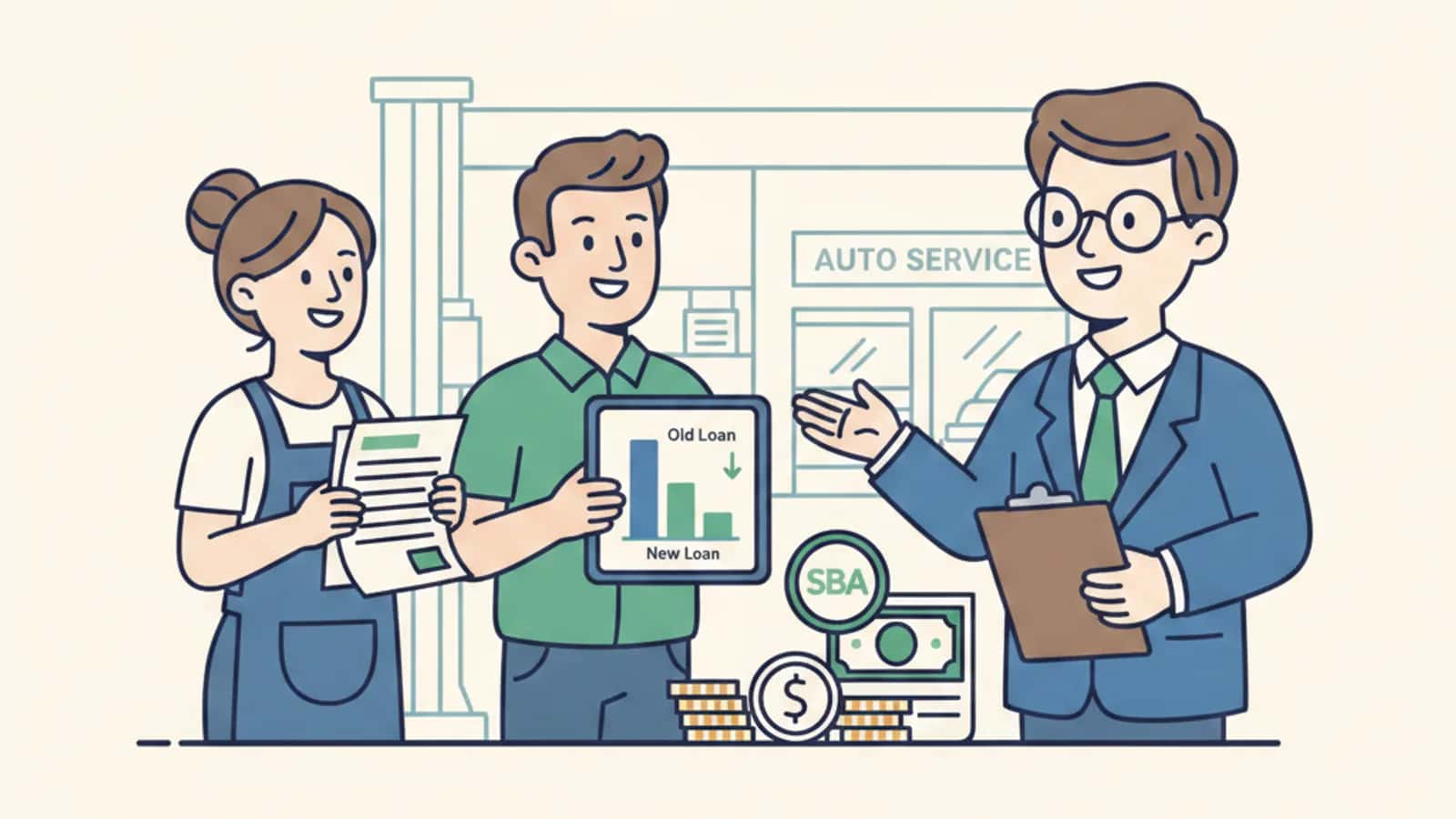
Business loan refinancing means taking out a new loan to pay off an existing one, with the goal of getting better terms. The new loan replaces the old debt entirely, and you then repay the new lender under the revised agreement.
Here's the basic sequence:
- 1
Review your current loan
note the interest rate, remaining balance, monthly payment, and any prepayment penalties
- 2
Check your business financials
lenders will assess revenue, time in business, and credit profile
- 3
Shop for new lenders
compare rates, terms, and fees from banks, credit unions, and alternative lenders
- 4
Apply for the new loan
submit documentation and go through underwriting
- 5
Pay off the old loan
the new lender typically sends funds directly to your existing lender
- 6
Begin repayment
you now make payments to the new lender under the new terms
Refinancing is not the same as debt consolidation. Consolidation combines multiple loans into one. Refinancing replaces a single loan with a better version of itself. Both can be useful, but they solve different problems.
When Is the Right Time to Refinance a Business Loan

The right time to refinance is when the financial benefit clearly exceeds the cost of switching. Three situations make the strongest case.
Your business has improved significantly since the original loan. If your credit score has risen, your revenue has grown, or you've been in business longer, you likely qualify for better rates now than you did before. Lenders price risk based on your profile at the time of application — a stronger profile means lower rates.
Market interest rates have dropped. If rates have fallen since you locked in your original loan, refinancing to a lower rate can reduce both monthly payments and total interest paid over the life of the loan.
Your current loan terms are creating cash flow strain. A shorter repayment term or a high rate may be squeezing monthly cash flow in ways that limit your ability to operate or grow. Refinancing to a longer term or lower rate can free up working capital.
When refinancing is probably not the right move
- You're already behind on payments or struggling to qualify for new credit
- Your existing loan has a large prepayment penalty that eats into savings
- You're near the end of your loan term (most interest is paid early in amortizing loans)
- Your business financials have declined since the original loan
"If you're having difficulty making current loan payments, refinancing might not be the best solution." — NerdWallet
How Much Money Can You Actually Save by Refinancing
Savings depend on three variables: the rate difference, the remaining loan balance, and the fees involved. There's no universal answer, but the math is straightforward.
For businesses carrying merchant cash advances (MCAs), the savings potential is even larger. MCAs can carry effective APRs between 60% and 150%. Refinancing into an SBA 7(a) loan, which typically runs 9% to 15%, can cut financing costs dramatically.
The break-even formula
- Total refinancing costs ÷ Monthly savings = Break-even in months
- If you plan to keep the loan longer than the break-even period, refinancing likely makes sense
Always run this calculation before applying. Fees that look small as a percentage can still erase months of savings.
What Credit Score Do You Need to Qualify for Business Loan Refinancing
Most traditional lenders want a personal credit score of at least 680 to 700 for business loan refinancing. SBA lenders generally require a score of 650 or above, though individual lender standards vary. Alternative lenders may work with scores as low as 550, but at higher rates.
For a full picture of how lenders evaluate your profile, see this guide on business credit scores — it covers both personal and business credit and what actually moves the needle.
Beyond credit score, lenders also look at:
- Debt service coverage ratio (DSCR):
- Most want at least 1.25, meaning your business generates $1.25 in income for every $1.00 of debt payment
- Loan-to-value ratio:
- Typically no higher than 75% for secured loans
- Time in business:
- Generally 2+ years preferred
- Annual revenue:
- Varies by lender and loan size
What Are the Typical Closing Costs and Fees for Refinancing
Refinancing costs typically range from 1% to 5% of the loan amount, depending on the loan size, lender type, and deal complexity. On a $300,000 loan, that's $3,000 to $15,000 in upfront costs.
Common fees to expect:
| Fee Type | Typical Range |
|---|---|
| Origination fee | 0.5% – 3% of loan amount |
| Prepayment penalty (existing loan) | 1% – 5% of remaining balance |
| Appraisal fee (secured loans) | $300 – $1,500+ |
| Legal/closing costs | $500 – $2,500 |
| Application fee | $0 – $500 |
Before signing anything, ask your existing lender for the exact prepayment penalty amount. This is often the biggest hidden cost and the one most owners overlook.
For a full breakdown of what lenders ask for before approving any loan, the US business loan approval checklist covers the documentation side in detail.
How Long Does the Business Loan Refinancing Process Usually Take
The refinancing process typically takes 60 to 120 days from application to closing. SBA loans tend to sit at the longer end of that range. Alternative lenders can sometimes move faster, in as little as two to four weeks for simpler deals.
Rough timeline breakdown
- Week 1–2: Application submitted, initial review
- Week 2–4: Underwriting, document requests, appraisals (if applicable)
- Week 4–8: Conditional approval, final terms negotiated
- Week 8–16: Closing, funds disbursed, old loan paid off
Speed up the process by having your documents ready before applying: tax returns (2–3 years), bank statements (3–6 months), profit and loss statements, existing loan documents, and business licenses.
What Are the Biggest Mistakes Business Owners Make When Refinancing
The most common mistake is focusing only on the monthly payment without calculating total cost over the life of the loan. A lower payment achieved by extending the term can mean paying significantly more interest overall.
Other frequent errors
- Ignoring prepayment penalties on the existing loan until after applying elsewhere
- Not shopping multiple lenders — rates and fees vary more than most owners expect
- Refinancing too early in the loan term, when most interest has already been paid and the remaining balance is mostly principal
- Underestimating the credit impact — a hard inquiry and new account will temporarily lower scores
- Refinancing to solve a cash flow problem that's actually a revenue problem — refinancing buys time, it doesn't fix declining sales
The fee math matters as much as the rate. A 2% lower rate on a loan with 6 months left barely moves the needle.
Is Refinancing Worth It for Small Businesses vs. Larger Companies
Refinancing can benefit businesses of any size, but the calculus is different for small businesses. Smaller loan amounts mean fees represent a larger percentage of potential savings, so the break-even period is often longer.
For small businesses specifically, the strongest cases for refinancing are:
- High-rate short-term debt
- (MCAs, short-term loans) being replaced by term loans or SBA products
- Businesses that have grown significantly
- and now qualify for rates they couldn't access at launch
- Owners who took emergency financing
- at unfavorable rates and now have time to refinance into something more sustainable
For larger businesses with established banking relationships and lower starting rates, the savings from refinancing may be more modest. The fee-to-savings ratio is more favorable at larger loan sizes, but the opportunity gap between current and available rates is often smaller.
For industry-specific context, restaurant owners facing high-cost debt can find relevant guidance in this piece on restaurant business loans and working capital.
What Happens If My Business Revenue Drops After Refinancing
If revenue drops after refinancing, you're in a similar position to any other borrower facing cash flow pressure — but potentially with a larger or longer obligation than before. Refinancing doesn't eliminate risk; it restructures it.
Practical steps if revenue declines post-refinancing
- Contact your lender early — many offer hardship programs or payment deferrals for borrowers who communicate proactively
- Review whether your loan has a variable rate that could rise and compound the pressure
- Explore whether a disaster loan or emergency financing option applies to your situation
- Avoid stacking additional high-cost debt on top of the refinanced loan
This is also why refinancing while revenue is strong is preferable to refinancing under pressure. Lenders offer better terms to businesses that don't need the money urgently.
Are There Different Refinancing Strategies for Different Industries
Yes. Industry context affects both what products are available and what makes financial sense.
Construction and equipment-heavy businesses often refinance equipment loans separately from working capital debt. Equipment financing tied to specific assets may have different prepayment terms and collateral requirements. See the equipment and cash flow options guide for more on this.
Retail and e-commerce businesses
carrying MCA debt are strong candidates for refinancing into term loans, given the rate gap between MCAs and conventional lending.
Food service and hospitality
businesses often benefit from SBA 7(a) refinancing, which can consolidate multiple debts and extend terms. The SBA 7(a) loan guide covers eligibility in detail.
Professional services firms
with strong receivables may qualify for lines of credit as a refinancing alternative — more flexible than a term loan and potentially cheaper. Comparing term loans vs. lines of credit vs. merchant cash advances can help clarify which structure fits.
What Alternative Financing Options Should You Consider Instead of Refinancing
Refinancing isn't always the best path. Depending on the situation, these alternatives may serve the business better.
- SBA 7(a) working capital line of credit
- flexible draw-and-repay structure, lower rates than most alternatives. See the SBA 7(a) working capital pilot for current details
- SBA microloans
- for businesses needing under $50,000, often with more flexible qualification standards. The SBA microloan guide explains when this beats a bank loan
- Invoice financing
- converts outstanding receivables into immediate cash without taking on new debt
- Revenue-based financing
- repayments scale with monthly revenue, which can help during slower periods
- Debt negotiation
- some lenders will modify existing loan terms without a full refinance, especially if you've been a reliable borrower
The right choice depends on why you're considering refinancing in the first place. Lower rate? Refinancing. More flexibility? A line of credit may be better. Short-term cash gap? Working capital options may solve it without restructuring existing debt.
How Does Refinancing Impact Business Credit and Future Loan Applications
Refinancing has a temporary, manageable impact on credit. A hard inquiry from the new lender typically reduces your personal credit score by 5 to 15 points, and opening a new account lowers the average age of your credit history. Most businesses see scores recover within six months, provided payments are made on time.
Longer-term credit effects
- Closing the old loan removes it from active accounts, which can slightly reduce available credit history
- Consistent on-time payments on the new loan build positive payment history over time
- A lower debt-to-income ratio (if the new loan has a lower balance or payment) can improve future borrowing capacity
For future loan applications, lenders will see the refinanced loan as a standard business obligation. The fact that you refinanced is not itself a negative signal — in fact, it may indicate sound financial management if the new terms are clearly better.
Next steps
Refinancing a business loan is a practical tool, not a magic fix. It works best when a business has genuinely improved since the original loan was issued, when the rate difference is meaningful, and when the fees don't erase the savings before the break-even point arrives. For more comparisons and application guidance, browse our business loan guides.
Actionable next steps:
- Pull your current loan documents and note the rate, remaining balance, and any prepayment penalty
- Run the break-even calculation: total refinancing costs ÷ monthly savings = months to break even
- Check your business credit profile before approaching lenders
- Compare at least three lenders — banks, SBA-approved lenders, and alternative options
- If you're not sure where to start, a fast eligibility check with no hard credit pull can show what you might realistically qualify for before you commit to anything
For US small business owners who want to understand realistic options across $10,000 to $5 million without locking in, checking eligibility through a platform like Funding Fred is a no-obligation first step. No hard check to start. No upfront financials required. Just a clear picture of where you stand.
US Business Funding. Checked Fast.
Further reading
Frequently asked questions
What Exactly Is Business Loan Refinancing and How Does It Work?
Business loan refinancing means taking out a new loan to pay off an existing one, with the goal of getting better terms. The new loan replaces the old debt entirely, and you then repay the new lender under the revised agreement.
When Is the Right Time to Refinance a Business Loan?
The right time to refinance is when the financial benefit clearly exceeds the cost of switching. Three situations make the strongest case.
How Much Money Can You Actually Save by Refinancing?
Savings depend on three variables: the rate difference, the remaining loan balance, and the fees involved. There's no universal answer, but the math is straightforward.
What Credit Score Do You Need to Qualify for Business Loan Refinancing?
Most traditional lenders want a personal credit score of at least 680 to 700 for business loan refinancing. SBA lenders generally require a score of 650 or above, though individual lender standards vary. Alternative lenders may work with scores as low as 550, but at higher rates.
What Are the Typical Closing Costs and Fees for Refinancing?
Refinancing costs typically range from 1% to 5% of the loan amount, depending on the loan size, lender type, and deal complexity. On a $300,000 loan, that's $3,000 to $15,000 in upfront costs.
How Long Does the Business Loan Refinancing Process Usually Take?
The refinancing process typically takes 60 to 120 days from application to closing. SBA loans tend to sit at the longer end of that range. Alternative lenders can sometimes move faster, in as little as two to four weeks for simpler deals.
Written by
The Funding Fred Editorial Team creates plain-English guides to help business owners understand funding options, eligibility, and application readiness before they compare finance options.