Business Loan Interest Rates: Typical APRs by Loan Type
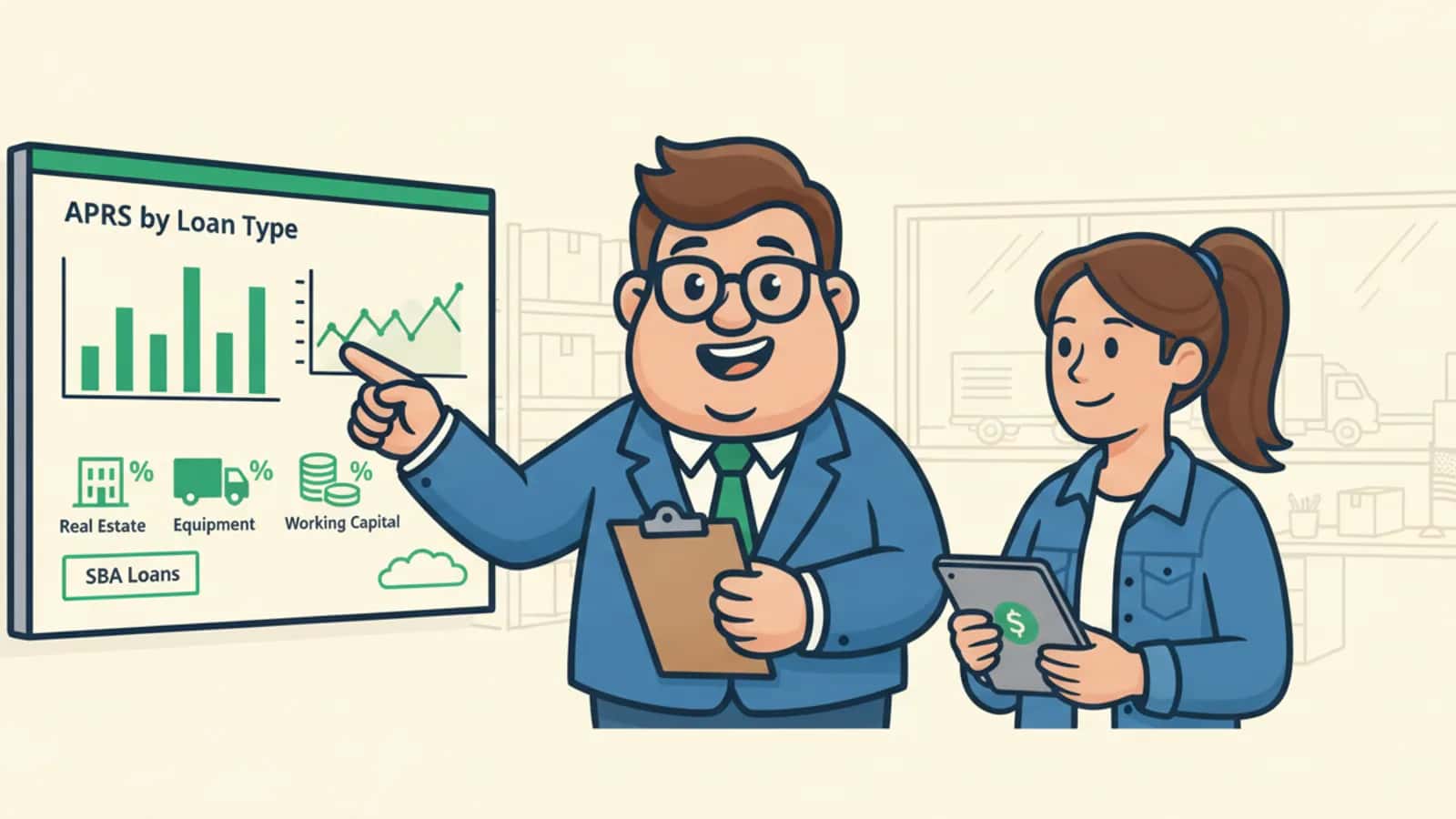
Business loan interest rates in 2026 vary dramatically by product: SBA 7(a) loans typically run about 10-13.5% variable APR, bank term loans and lines of credit cluster around 6.4-11%, and online term loans or merchant cash advances can range from roughly 14% up past 100% APR once fees and factor rates are converted. There is no single "average business loan interest rate", the loan type, your credit profile, and how a lender structures fees matter more than any headline number.
Quick answer
Business loan interest rates in 2026 vary dramatically by product: SBA 7(a) loans typically run about 10-13.5% variable APR, bank term loans and lines of credit cluster around 6.4-11%, and online term loans or merchant cash advances can range from roughly 14% up past 100% APR once fees and factor rates are converted. There is no single "average business loan interest rate", the loan type, your credit profile, and how a lender structures fees matter more than any headline number.
Key takeaways
- SBA 7(a) variable rates are generally 10-13.5% as of late 2026, tied to a base rate plus a capped lender markup.
- Bank term loans for strong borrowers often land between 6.4% and 11% APR, with fixed-rate loans averaging around 7.1-7.8%.
- Online term loans and lines of credit trade speed for cost, APRs commonly span 10% to 99% depending on risk.
- Equipment financing is usually one of the cheapest options, often 4-7.5% APR at banks for qualified buyers.
- Merchant cash advances and invoice factoring carry the highest effective APRs, sometimes 40% to over 300% once factor rates are converted.
- Your credit score, time in business, revenue, and collateral all move your rate up or down, more than the lender's brand name does.
- Startups and newer businesses almost always pay more, but SBA and some bank programs can narrow that gap for well-documented applicants.
Business Loan Interest Rates by Loan Type
Average business loan interest rates differ by thousands of basis points depending on the product you choose, not just the lender you pick. The table below summarizes typical 2026 APR ranges reported across SBA, bank, and online lending data.
| Loan Type | Typical APR Range (2026) | Best Fit For |
|---|---|---|
| SBA 7(a) (variable) | About 10%,13.5% | Established businesses wanting the lowest government-backed rate |
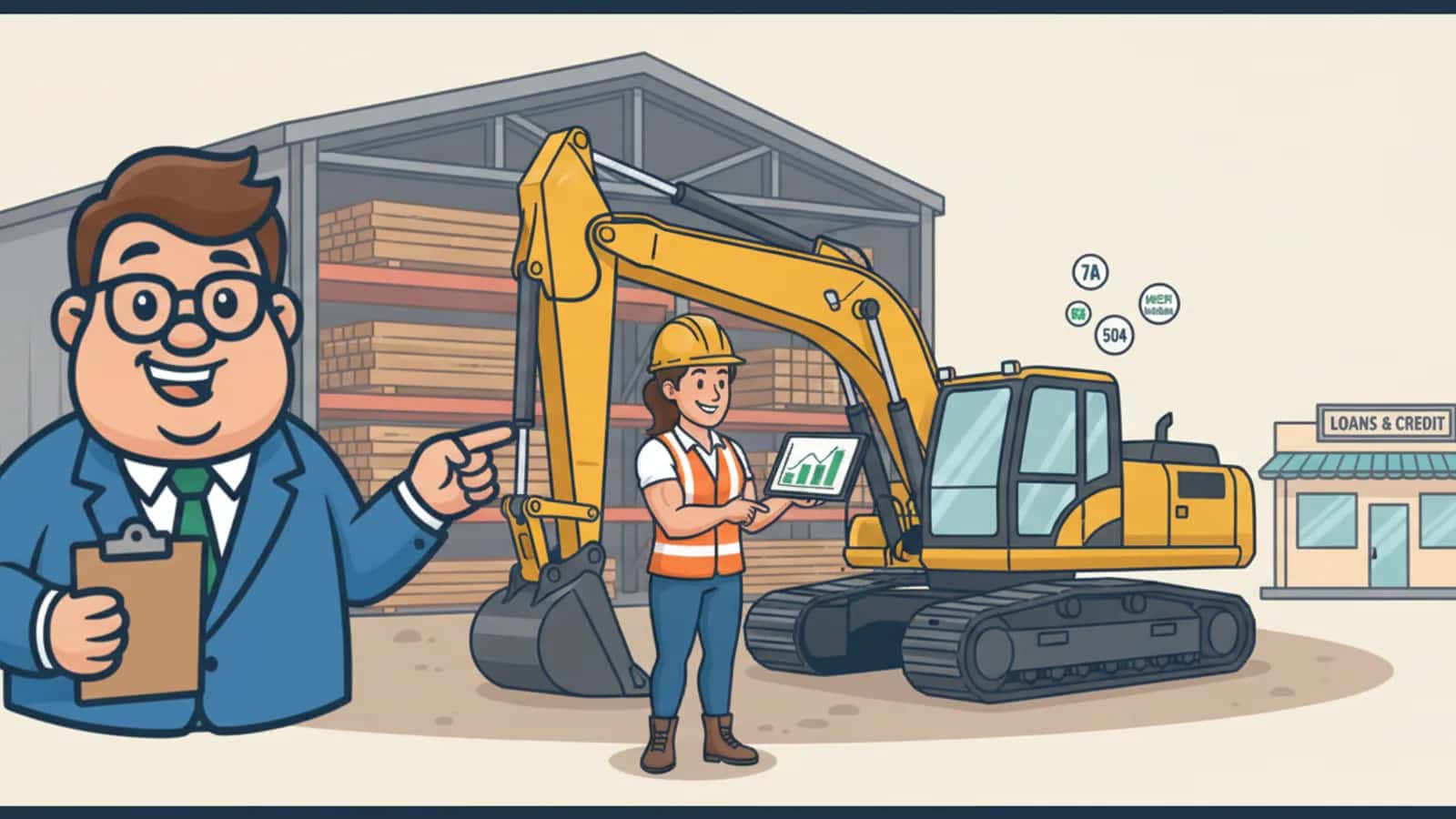
| SBA 504 (CDC debenture) | Roughly 6.5%,6.6% | Real estate or major equipment purchases |
| Bank term loan | About 6.4%,11% | Strong-credit, established businesses |
| Bank line of credit | About 7%,7.9% | Cash flow gaps, seasonal needs |
| Equipment financing | About 4%,45%, wide spread by lender type | Purchasing vehicles, machinery, tools |
| Online term loan | About 10%,99% | Faster funding, thinner credit files |
| Online line of credit | About 3%,57% | Flexible, repeat draw needs |
| Invoice factoring | About 10%,79% | B2B businesses with slow-paying clients |
| Merchant cash advance | About 40%,350% (converted APR) | Short-term, high-urgency gaps only |
These are ranges, not quotes. Actual pricing depends on your credit profile, revenue, and the specific lender's underwriting. For a side-by-side structural comparison beyond rate alone, see term loan vs. line of credit vs. merchant cash advance guidance.
What Is a Good APR for a Small Business Loan?
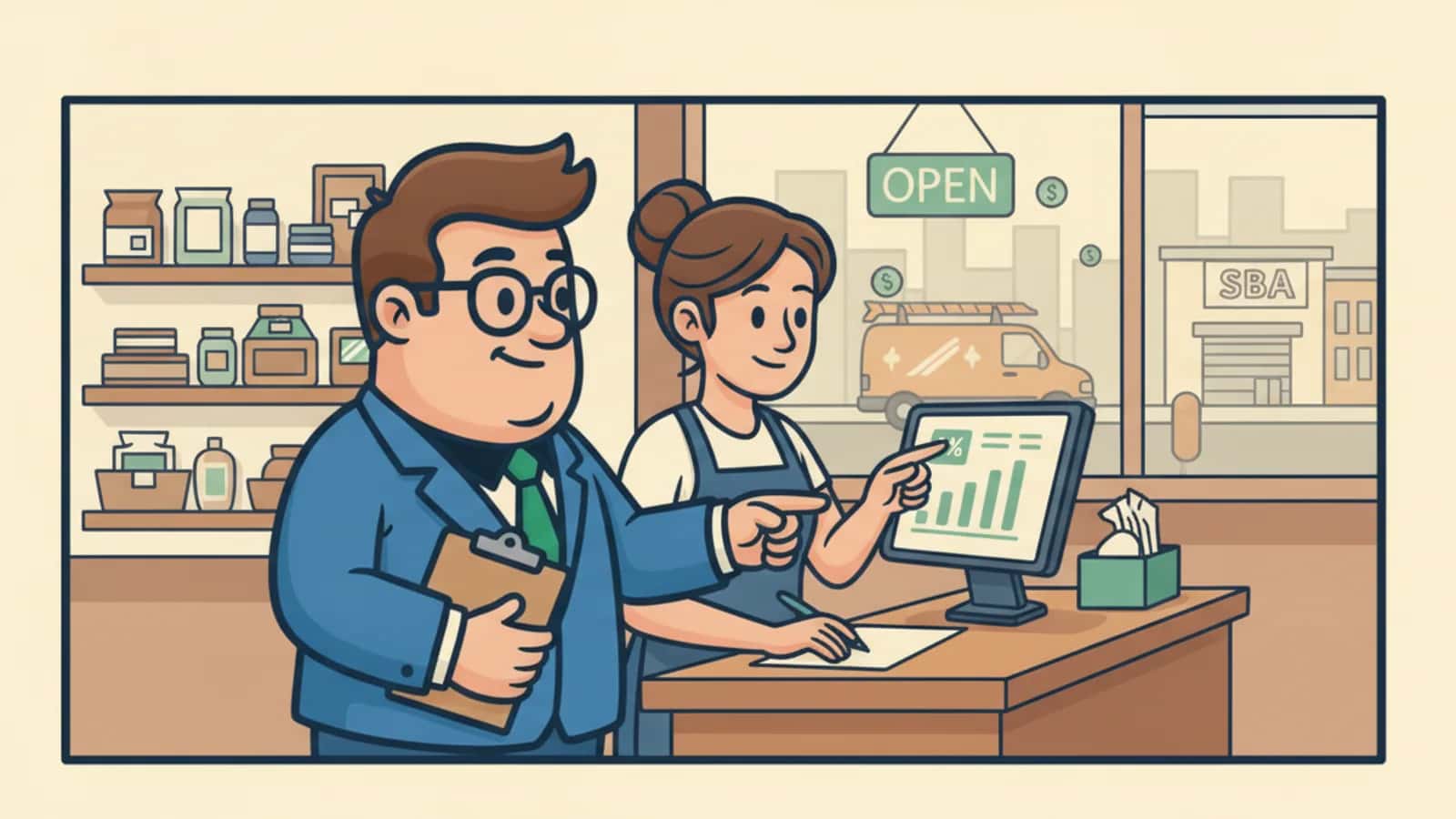
A good APR for a small business loan generally sits in the single digits to low double digits, think bank term loans around 6.4-11% or SBA 7(a) loans around 10-13.5%, because these reflect pricing for established, creditworthy borrowers. Anything much higher isn't automatically bad, but it usually signals higher risk pricing, a shorter term, or a faster funding timeline.
What counts as "good" depends on context:
- For a bank or SBA loan:
- Single digits to low teens is competitive.
- For an online term loan:
- Rates in the 10-20% range are on the better end of that category; 30%+ is common for thinner files.
- For short-term working capital (MCA, factoring):
- Even a "good" deal can land in the 40-80% converted APR range, because the category itself is priced for speed and risk.
Common mistake: comparing a factor rate or a monthly fee from an MCA directly against a bank loan's APR. They are not the same measurement, and the comparison makes alternative financing look artificially cheap. Always convert to APR before comparing.
What Is the Interest Rate on a $50,000 Business Loan?
There is no fixed interest rate for a $50,000 business loan, the rate depends entirely on the loan type and lender, not the loan amount by itself. A $50,000 SBA 7(a) loan, for example, falls into the SBA's lowest tier and carries the highest allowable markup over the base rate (base plus up to 6.5% for loans of $50,000 or less), which is why smaller SBA loans often price a bit higher than larger ones.
At a bank, a $50,000 term loan to a qualified borrower might land in the same 6.4-11% band as larger bank loans. Online lenders may quote a $50,000 term loan anywhere from roughly 10% up through the high double digits, depending on time in business, revenue, and credit. The amount alone tells a lender little, what moves the quote is the full applicant profile. For a sense of what lenders ask for before quoting a rate, see this business loan approval checklist.
What Factors Affect Your Business Loan Interest Rate?
Your business loan interest rate is driven by five main inputs: credit profile, time in business, revenue and cash flow, collateral, and loan structure (term length, amount, and whether the rate is fixed or variable). Lenders combine these into a risk score that sets your final offer.
- Personal and business credit scores.
- Higher scores generally unlock lower APR tiers across every loan type.
- Time in business.
- Two or more years of operating history typically opens access to bank and SBA pricing; less than that pushes many applicants toward online lenders.
- Revenue stability.
- Consistent monthly revenue reduces perceived risk, which can lower the rate or increase the amount offered.
- Collateral and personal guarantee.
- Secured loans (equipment, real estate, blanket liens) often price lower than unsecured products.
- Loan term and amount.
- Shorter terms and smaller SBA loans can carry higher rate caps; longer, asset-backed SBA 504 debentures price lower.
How Do You Qualify for the Lowest Business Loan Rates?
To qualify for the lowest business loan rates, pair strong personal and business credit with at least two years in business, steady revenue, and if possible, collateral to secure the loan. Decision rule: choose a bank or SBA route if you meet those four criteria and can wait through a longer underwriting process; choose an online lender if speed matters more than getting the absolute lowest rate.
How Do Business Loan Interest Rates Compare to Personal Loans?
Business loan interest rates and personal loan rates overlap at the low end but diverge sharply at the high end, because business lending includes products, like merchant cash advances and factoring, that have no direct personal-loan equivalent. A strong-credit borrower might see similar APRs on a personal loan and a bank business term loan, both in the single digits to low teens.
Where they differ:
- Personal loans are usually capped by state usury limits and typically top out well below the highest business APR tiers.
- Business financing includes revenue-based and factor-rate products (MCA, factoring) that convert to very high effective APRs, a category personal lending rarely touches.
- Business loans can be underwritten on business revenue alone in some cases, which changes the risk calculation compared with a personal loan tied only to personal income.
Why Are Small Business Loan Rates Higher Than Mortgage Rates?
Small business loan rates are higher than mortgage rates mainly because most business loans are unsecured or only partially secured, shorter in term, and tied to a business with more variable cash flow than a home with a stable, appraised value. Mortgages are secured by real estate with an established resale market, which lowers the lender's risk and the rate.
Business lending also carries higher failure risk over the loan's life, and many products (working capital loans, MCAs) are priced for speed and flexibility rather than long-term collateral security, both push APRs up relative to a 30-year, asset-backed mortgage.
How Much Does a Small Business Loan Cost Per Month?
Monthly cost on a small business loan depends on three inputs: principal, APR, and term length, not the interest rate alone. A lower rate over a shorter term can cost more per month than a higher rate stretched over a longer one, even though the shorter loan is cheaper overall.
Illustrative example (for explanation only, not a quote): a $50,000 loan at a 10% APR over five years produces a materially lower monthly payment than the same amount at 10% over two years, because the principal is spread across more installments. Conversely, daily or weekly repayment structures common with online term loans and MCAs can make the "monthly" cost feel higher even at a similar headline rate, because repayment happens more frequently and often pulls directly from revenue.
Before signing, ask for:
- The total repayment amount, not just the rate
- Whether repayment is daily, weekly, or monthly
- Any origination, draw, or prepayment fees layered on top
Can You Get a Business Loan With Bad Credit?
Yes, bad credit business loans exist, but they typically come with higher APRs, shorter terms, and sometimes a personal guarantee or collateral requirement to offset the risk. Bank and SBA options become harder to access below certain credit thresholds, which shifts many applicants toward online or alternative lenders.
Decision rule: if your credit score is weak but your revenue is strong and consistent, revenue-based online lenders may offer workable terms. If both credit and revenue are weak, treat any offer with extreme caution and compare the full APR, not just the advertised rate. For a deeper look at what's realistic versus predatory in this space, see this guide to bad credit business loans.
Fixed vs. Variable Rate Business Loans
Fixed-rate business loans keep the same interest rate for the entire term, while variable-rate loans move with a benchmark (commonly the prime rate), so payments can rise or fall over time. SBA 7(a) loans are a common example of variable-rate products, pegged to a base rate plus a capped lender markup.
- Choose fixed if:
- you want predictable payments and plan to hold the loan through multiple rate cycles. Bank fixed-rate term loans have recently averaged around 7.1-7.8%.
- Choose variable if:
- the starting rate is meaningfully lower and you can absorb payment changes, or the loan term is short enough that rate movement is less likely to matter. Bank variable loans have recently averaged around 7.7-7.9%.
Common mistake: assuming "variable" always means riskier. Over a short enough term, a variable rate can end up cheaper than locking in a fixed rate with a built-in premium.
What's the Average SBA Loan Interest Rate Right Now?
As of late September 2026, SBA 7(a) variable rates are commonly reported in the 10-13.5% range, reflecting a roughly 7.0% base rate plus allowable lender markups capped by SBA rules. SBA 504 debentures sold in September 2026 priced closer to 6.5-6.6%, making that program notably cheaper for real estate and major equipment purchases.
SBA maximum variable-rate spreads are tiered by loan size: base rate plus 6.5% for loans of $50,000 or less, plus 6.0% for $50,001,$250,000, plus 4.5% for $250,001,$350,000, and plus 3.0% above $350,000. Smaller SBA loans therefore often carry higher rate caps than larger ones, even within the same program. For a full breakdown of SBA 7(a) structure, fees, and eligibility, see SBA 7(a) loan requirements and terms.
How Do Online Lenders Compare to Banks for Business Loan Rates?
Online lenders generally charge higher business loan interest rates than banks, but they trade that cost for faster decisions, lighter paperwork, and more flexible eligibility criteria. Bank term loans for qualified borrowers often land around 6.4-11% APR, while online term loans can range from about 10% at the low end to 99% for higher-risk files.
| Factor | Traditional Banks | Funding Fred |
|---|---|---|
| Speed to a decision | Often weeks | Fast eligibility check, no hard check to start |
| Paperwork upfront | Extensive financials required early | No upfront financials needed for the fast check |
| Eligibility criteria | Rigid, often credit-score-first | Flexible criteria, revenue-led matching across US funding partners |
Speed to a decision
- Traditional Banks
- Often weeks
- Funding Fred
- Fast eligibility check, no hard check to start
Paperwork upfront
- Traditional Banks
- Extensive financials required early
- Funding Fred
- No upfront financials needed for the fast check
Eligibility criteria
- Traditional Banks
- Rigid, often credit-score-first
- Funding Fred
- Flexible criteria, revenue-led matching across US funding partners
Lender comparison data through fall 2026 shows wide dispersion even within categories like same-day funding, where APRs can exceed 30-40% once fees and short repayment windows are factored in, while bank-backed offers in the same tables often stay under 10%. The decision rule is simple: pick the bank/SBA route if you qualify and can wait; pick an online or alternative route if timing matters more than minimizing the headline rate.
How Do MCA Factor Rates Convert to APR?
Merchant cash advance factor rates (typically shown as a decimal like 1.2 or 1.4) are not APRs, they represent the total repayment multiple, and converting them to an annualized rate almost always reveals a much higher effective cost. A factor rate of 1.3 on a $20,000 advance means repaying $26,000 total, but the APR equivalent depends heavily on how quickly that amount is repaid.
The shorter the repayment period, the higher the converted APR, because the same dollar cost is compressed into fewer months. This is why reported MCA APRs in 2026 data span a wide 40% to over 300% range, a factor rate that looks modest on paper can translate into an extremely high annualized cost once daily or weekly holdbacks are factored in. For a full walkthrough of factor-rate math, holdbacks, and lower-cost alternatives, see this guide to MCA factor rates.
Common mistake: comparing a 1.3 factor rate against a 13% bank loan rate and assuming they're close. They are not. Always ask the provider for the estimated APR, not just the factor rate.
Do New Businesses Get Higher Interest Rates?
Yes, new businesses typically pay higher interest rates than established ones, because lenders have less operating history to assess and treat the loan as higher risk. Startups are often steered toward online lenders, equipment financing tied to the asset itself, or SBA microloan-style programs rather than conventional bank term loans.
Can a startup get a low rate? It's possible but uncommon without strong compensating factors, solid personal credit, collateral, a cosigner, or a well-documented business plan can narrow the gap. Startups focused on a smaller funding need may also find SBA microloan programs more accessible than a full bank underwriting process. For unsecured options specifically, see unsecured business loans coverage of costs and guarantee requirements.
How Long Does It Take to Get Approved for a Business Loan?
Approval timing varies by lender and product: bank and SBA loans generally take longer due to fuller underwriting, while online lenders and fast-check platforms can return a preliminary answer in a much shorter window. Exact timelines depend on the lender, the loan size, and how complete your documentation is, pricing, eligibility, and timing vary by lender and applicant, so treat any "same-day" claim as product-specific rather than universal.
A fast eligibility check is useful precisely because it gives a realistic read on options before committing to a longer, paperwork-heavy bank process. Funding Fred's US business loans platform offers a no-hard-check starting point that matches on revenue, trading history, and sector, useful context before deciding whether to pursue a bank, SBA, or online route.
Application Readiness Checklist
Before requesting rate quotes from any lender, gather the following. Lenders use this information to price your loan, and having it ready speeds up every stage of comparison.
- Last 3-6 months of business bank statements
- Most recent business tax return (and personal, if applicable)
- Time in business documentation (formation date, licenses)
- Estimated monthly revenue and average daily balance
- Personal and business credit score estimates
- A clear statement of loan purpose and desired amount
- Any collateral you're willing to offer, if applicable
Decision rule: if most of this is ready and your revenue is consistent, you're positioned for bank or SBA-tier pricing. If documentation is thin or revenue is irregular, expect online-lender pricing and plan your cash flow around a higher APR.
Next steps for business loan interest rates
Business loan interest rates are not one number, they are a spread across products, from SBA and bank financing at the low end to online term loans, factoring, and merchant cash advances at the high end. The rate a specific business qualifies for depends on credit, time in business, revenue, and collateral far more than on any single lender's brand.
Before applying anywhere, pull your documentation together, decide whether speed or cost matters more for this specific need, and compare full APRs rather than headline rates or factor rates alone. Reviewing the broader category of small business loan guides can help narrow which product fits before you start requesting quotes.
If the next step is understanding what's realistic for your business specifically, a fast eligibility check is a low-commitment way to see where you stand. Funding Fred's smart matching connects revenue, trading history, and sector fit against a panel of US funding partners, with business verification run through Secretary of State lookup to keep the process credible on both sides. There's no obligation to proceed and no charge to use the service. Check eligibility now to see realistic options before committing to anything.
Frequently asked questions
What Is a Good APR for a Small Business Loan?
A good APR for a small business loan generally sits in the single digits to low double digits, think bank term loans around 6.4-11% or SBA 7(a) loans around 10-13.5%, because these reflect pricing for established, creditworthy borrowers. Anything much higher isn't automatically bad, but it usually signals higher risk pricing, a shorter term, or a faster funding timeline.
What Is the Interest Rate on a $50,000 Business Loan?
There is no fixed interest rate for a $50,000 business loan, the rate depends entirely on the loan type and lender, not the loan amount by itself. A $50,000 SBA 7(a) loan, for example, falls into the SBA's lowest tier and carries the highest allowable markup over the base rate (base plus up to 6.5% for loans of $50,000 or less), which is why smaller SBA loans often price a bit higher than larger ones.
What Factors Affect Your Business Loan Interest Rate?
Your business loan interest rate is driven by five main inputs: credit profile, time in business, revenue and cash flow, collateral, and loan structure (term length, amount, and whether the rate is fixed or variable). Lenders combine these into a risk score that sets your final offer.
How Do Business Loan Interest Rates Compare to Personal Loans?
Business loan interest rates and personal loan rates overlap at the low end but diverge sharply at the high end, because business lending includes products, like merchant cash advances and factoring, that have no direct personal-loan equivalent. A strong-credit borrower might see similar APRs on a personal loan and a bank business term loan, both in the single digits to low teens.
Why Are Small Business Loan Rates Higher Than Mortgage Rates?
Small business loan rates are higher than mortgage rates mainly because most business loans are unsecured or only partially secured, shorter in term, and tied to a business with more variable cash flow than a home with a stable, appraised value. Mortgages are secured by real estate with an established resale market, which lowers the lender's risk and the rate.
How Much Does a Small Business Loan Cost Per Month?
Monthly cost on a small business loan depends on three inputs: principal, APR, and term length, not the interest rate alone. A lower rate over a shorter term can cost more per month than a higher rate stretched over a longer one, even though the shorter loan is cheaper overall.
Written by
The Funding Fred Editorial Team creates plain-English guides to help business owners understand funding options, eligibility, and application readiness before they compare finance options.
Reviewed by
Business finance content reviewer
Robert reads our business finance guides before they go live, checking each one is accurate, easy to follow, and reflects how lending actually works today — not how a brochure says it should. He's listed on the UK's FCA Register, approved as an SMF3 (AR) Executive Director at Switcha Limited, and connected to Lucky Growth Partners Ltd through its appointed representative relationship, so each guide gets a properly qualified second read.