Bad Credit Business Loans UK: What Lenders Check and Realistic Options
Yes, you can get a business loan with bad credit in the UK, but your options narrow and the terms usually cost more. Lenders look at the company's credit file, the director's personal credit history, current trading performance, and cash flow, not credit score alone.
Quick answer
Yes, you can get a business loan with bad credit in the UK, but your options narrow and the terms usually cost more. Lenders look at the company's credit file, the director's personal credit history, current trading performance, and cash flow, not credit score alone. Bad credit business loans typically come through unsecured lenders with flexible criteria, secured loans, asset finance, invoice finance, or merchant cash advances rather than high-street banks.
Key takeaways
- Bad credit covers defaults, County Court Judgments (CCJs), missed payments, arrears, and in some cases a director's personal insolvency history, not just a low credit score.
- UK lenders check both the company's credit file and, for most small businesses, the director's personal credit, especially where a personal guarantee is involved.
- Secured loans, asset finance, invoice finance, and merchant cash advances are generally more accessible than unsecured bank loans when credit is poor.
- Bad credit borrowing costs more than prime-rate lending, though exact pricing, eligibility and timing vary by lender and applicant.
- Government-backed schemes run through the British Business Bank exist to support lending to smaller businesses that don't fit standard commercial criteria, though the specific scheme and its terms can change.
- Strong recent trading numbers, a clear reason for past credit problems, and tidy paperwork all improve approval odds, no lender can guarantee approval.
- No legitimate UK lender skips credit checks entirely. If a product claims "no credit check," read the small print carefully.
- Table of Contents
- What counts as bad credit for a business loan?
- Can you get a business loan with bad credit in the UK?
- Do lenders check the director's personal credit or only the company's?
- How bad does your credit have to be before you're rejected?
- What do lenders look at besides your credit score?
- Which types of finance are easiest to get with bad credit?
- How much more do bad credit business loans cost?
- What's the difference between bad credit business loans and regular business loans?
- How can you improve your chances before applying?
- What documents do you need for a bad credit business loan application?
- Checklist: Getting application-ready
- FAQ
- Conclusion
What counts as bad credit for a business loan?
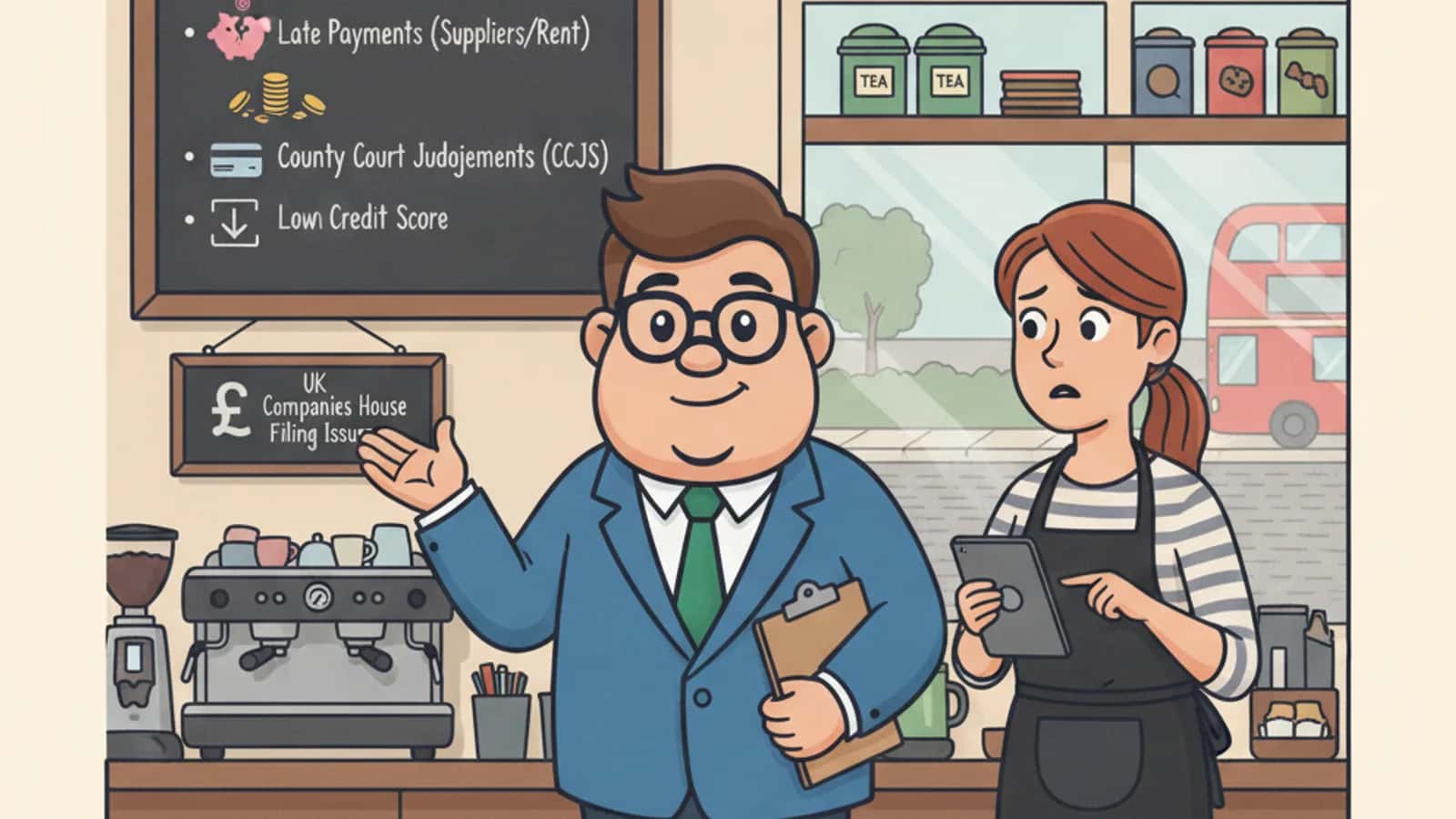
Bad credit, for a business lender, means a credit file that shows a history of missed or late payments, defaults, CCJs, or insolvency events rather than a single low number. Lenders read the pattern behind the score, not just the score itself.
Common markers lenders flag include:
- Defaults
- , accounts marked as unpaid after missed payments.
- CCJs
- , County Court Judgments registered against the company or director.
- Arrears
- , late payments on existing loans, credit cards, or supplier accounts.
- Insolvency history
- , a previous liquidation, administration, or Individual Voluntary Arrangement (IVA) linked to a director.
- Thin file
- , not enough credit history for a lender to judge risk either way, which some lenders treat similarly to bad credit.
Decision rule: if your business has a default or CCJ from more than two or three years ago and trading has been stable since, many specialist lenders will still consider you. If the issue is current or unresolved, expect a smaller pool of lenders and tighter terms.
Can you get a business loan with bad credit in the UK?
Yes. A bad credit business loan is possible in the UK through specialist and alternative lenders, even where high-street banks have declined the application. The trade-off is fewer lenders to choose from, smaller loan amounts in some cases, and higher costs.
Who this works for: businesses with a default, CCJs, or director credit issues that are trading now and can show bank statements or invoices proving income. Who it doesn't work for: businesses with no trading history at all, or those mid-way through insolvency proceedings, these cases usually need a different route entirely.
A practical example: a logistics operator with a two-year-old default from a supplier dispute, but twelve months of consistent turnover, is a realistic candidate for business loans for bad credit through an alternative lender. A business that opened three months ago with the same default has a much harder case to make, regardless of credit history.
You can compare business loan options across a wide panel of finance partners rather than relying on one bank's decision.
Do lenders check the director's personal credit or only the company's?
Most UK lenders check both the limited company's credit file and the director's personal credit file, particularly for smaller businesses or where a personal guarantee is required. Sole traders and partnerships are assessed almost entirely on personal credit, since there's no separate legal entity.
How this plays out in practice:
- Limited companies
- lenders usually pull a company credit check through agencies like Experian or Equifax, and separately check the director's personal file if a personal guarantee is part of the deal.
- Sole traders and partnerships
- personal credit history carries most of the weight because the business and the individual are legally the same.
- Multiple directors
- some lenders check all directors with significant shareholding, not just the one who applied.
Common mistake: assuming a clean company file is enough when the director's personal credit is poor. If a personal guarantee is on the table, that personal file will almost always be checked.
No FCA-regulated or unregulated UK lender skips credit checks. Treat any offer claiming otherwise with caution.
How bad does your credit have to be before you're rejected for a business loan?
There's no single credit score threshold that guarantees rejection, lenders set their own criteria and weigh credit history alongside trading performance, affordability, and the loan purpose. A low score combined with weak or inconsistent cash flow is far more likely to lead to decline than a low score alone.
What tends to push an application from "harder to place" into "likely declined":
- Multiple unresolved CCJs with no repayment plan.
- A default on a previous business loan, specifically, rather than a consumer account.
- Current insolvency proceedings against the company or director.
- Negative or wildly inconsistent cash flow over recent months.
If your business has been declined once, that doesn't close every door. Read what to do after a declined business loan for the next steps before reapplying elsewhere.
What do lenders look at besides your credit score for business loans?
Lenders assess current trading performance, cash flow, time trading, sector risk, and existing debt alongside the credit file, a strong trading picture can offset a weaker credit history. This is why businesses with bad credit still get approved: lenders are pricing risk across several factors, not just one.
Key factors beyond the score:
- Bank statements and turnover
- , recent, consistent income matters more than a perfect file.
- Time trading
- , established businesses generally have more options than very new ones.
- Existing debt load
- , how much the business already owes relative to income.
- Sector
- , some industries (hospitality, construction) carry different risk weightings.
- Open Banking data
- , many modern lenders use Open Banking to assess real-time cash flow rather than relying only on historical credit data, which can work in favour of businesses that have improved recently but whose credit file hasn't caught up.
A dental practice with a CCJ from a dispute three years ago, but £40,000 a month moving through its business account, is a very different proposition to an underwriter than the credit score alone would suggest.
Which types of finance are easiest to get with bad credit?
Secured loans, asset finance, invoice finance, and merchant cash advances are generally more accessible than standard unsecured bank loans for businesses with poor credit, because the lender has an asset, invoice, or revenue stream reducing their risk. Unsecured loans are still available through specialist lenders, but typically at smaller amounts or higher pricing than secured products.
Secured business loan
- How forgiving of bad credit
- More forgiving
- What it's secured against
- Property, equipment, other assets
- Good fit if
- You own assets and need a larger sum
Asset finance
- How forgiving of bad credit
- More forgiving
- What it's secured against
- The equipment or vehicle itself
- Good fit if
- You're buying machinery, vehicles, or tools
Invoice finance
- How forgiving of bad credit
- More forgiving
- What it's secured against
- Unpaid customer invoices
- Good fit if
- You invoice other businesses and wait on payment
Merchant Cash Advance
- How forgiving of bad credit
- Moderately forgiving
- What it's secured against
- Future card sales
- Good fit if
- You take regular card payments (retail, hospitality)
Unsecured business loan
- How forgiving of bad credit
- Least forgiving for bad credit
- What it's secured against
- None (often a personal guarantee instead)
- Good fit if
- You have no assets but strong recent trading
If you're buying equipment specifically, bad credit asset finance often works because the equipment itself backs the loan, lowering the lender's risk. For businesses that invoice other companies, invoice finance vs business loans is worth comparing before settling on an unsecured route. And for larger funding needs where you own property or equipment, secured business loans tend to open up better terms than unsecured options when credit history is a concern.
How much more do bad credit business loans cost?
Bad credit borrowing costs more than prime lending because the lender is pricing in higher risk, but exact APRs, fees and loan limits vary by lender, loan size, security offered, and the applicant's specific file, there's no fixed industry-wide rate band. Be wary of any source quoting a single "bad credit rate."
What tends to drive the price up or down:
- Security offered
- , secured loans and asset finance are often priced lower than unsecured lending because the lender has recourse to an asset.
- Severity and age of the credit issue
- , a recent CCJ affects pricing more than a three-year-old default that's been settled.
- Loan term
- , shorter terms can mean higher monthly costs but lower total interest paid overall.
- Trading strength
- , strong, recent turnover can offset some of the credit-risk pricing.
Decision rule: if cost is the main concern, ask every lender for the total repayable amount and any arrangement or early repayment fees up front, not just the headline rate, comparing total cost across offers is more useful than comparing rates alone.
What's the difference between bad credit business loans and regular business loans?
The core products are often the same, term loans, asset finance, invoice finance, but bad credit business loans usually come with tighter underwriting, more emphasis on security or guarantees, and pricing that reflects the higher risk. Regular business loans from mainstream banks tend to lean heavily on the credit score as a first filter; specialist lenders dig into current performance instead.
Practical differences to expect:
- Fewer lenders will quote, since high-street banks mostly sit out of this segment.
- More lenders will ask for security or a personal guarantee.
- Approval may hinge more on recent bank statements than on the credit file.
- Decisions can come faster, because specialist lenders are often built for speed rather than legacy processing.
This is where the gap between a traditional bank and a tech-led panel matters most.
| Factor | Traditional Banks | Funding Fred |
|---|---|---|
| Credit view | Score-led, often a hard cut-off | Flexible criteria, all credit types considered |
| Application | Paperwork-heavy, slow | 2 min check, smart tech |
| Decision speed | Weeks | Fast decision through Open Banking |
| Starting point | Hard search upfront | No hard check to start |
Credit view
- Traditional Banks
- Score-led, often a hard cut-off
- Funding Fred
- Flexible criteria, all credit types considered
Application
- Traditional Banks
- Paperwork-heavy, slow
- Funding Fred
- 2 min check, smart tech
Decision speed
- Traditional Banks
- Weeks
- Funding Fred
- Fast decision through Open Banking
Starting point
- Traditional Banks
- Hard search upfront
- Funding Fred
- No hard check to start
How can you improve your chances before applying?
Strengthening recent cash flow evidence, settling or arranging repayment for outstanding defaults, and choosing the right product type before applying all improve approval odds, no step guarantees approval, but each one removes a reason to decline.
Practical steps that make a measurable difference:
- Check your business credit score first. Knowing what a lender will see lets you explain issues proactively rather than being caught off guard. Review your business credit score before applying anywhere.
- Deal with what you can fix. Settle small outstanding debts where possible, and get formal repayment plans in place for anything you can't clear immediately.
- Get three to six months of clean bank statements ready. Lenders using Open Banking want to see current performance, not just history.
- Match the product to your situation. If you own equipment or property, lean toward secured options. If you invoice B2B clients, consider invoice finance.
- Apply through a panel, not one lender at a time. A single decline from one bank says nothing about your odds elsewhere. Comparing selected finance partners through one check avoids repeated hard searches.
- Be upfront about the credit issue. Underwriters respond better to a clear explanation ("supplier dispute, resolved, two years ago") than silence.
What documents do you need for a bad credit business loan application?
Most lenders ask for proof of trading, bank statements, basic financials, and identification for all directors, bad credit applications often need slightly more context, such as an explanation letter for defaults or CCJs. Having these ready before applying speeds up the decision.
Typical document list:
- Recent business bank statements (usually three to twelve months).
- Proof of identity and address for each director.
- Companies House registration details (for limited companies).
- Basic management accounts or latest filed accounts.
- A short written explanation of any default, CCJ, or arrears on file.
- Evidence of security, if offering an asset against a secured loan.
For a full breakdown by lender type, see what documents do I need to apply for a business loan.
Checklist: Getting application-ready
- Pulled your business and personal credit reports and know what's on file
- Gathered three to six months of bank statements
- Written a short, factual explanation for any default or CCJ
- Identified whether you have an asset to offer as security
- Worked out exactly how much you need and what it's for
- Confirmed you can afford realistic monthly repayments against current cash flow
- Checked eligibility across a panel rather than applying to one lender at a time
Next steps for bad credit business loans
Bad credit narrows the field. It doesn't close it. UK lenders look well beyond the credit score, current trading, cash flow, security, and how long ago the credit issue happened all carry weight. Secured loans, asset finance, and invoice finance tend to open doors that unsecured bank lending won't, and preparation (clean statements, a clear explanation, the right product) moves applications from "likely declined" to "worth underwriting."
The next move is practical, not theoretical: check your credit position, gather your statements, and compare options across a panel rather than betting everything on one lender's decision. Explore the full range of business loan options built around all credit types, or browse the wider business loans guides for more detail on specific products before you apply. Funding Fred's 2-minute eligibility check uses a soft search, so reviewing your options costs nothing and carries no obligation to proceed.
Frequently asked questions
What counts as bad credit for a business loan?
Bad credit, for a business lender, means a credit file that shows a history of missed or late payments, defaults, CCJs, or insolvency events rather than a single low number. Lenders read the pattern behind the score, not just the score itself.
Can you get a business loan with bad credit in the UK?
Yes. A bad credit business loan is possible in the UK through specialist and alternative lenders, even where high-street banks have declined the application. The trade-off is fewer lenders to choose from, smaller loan amounts in some cases, and higher costs.
Do lenders check the director's personal credit or only the company's?
Most UK lenders check both the limited company's credit file and the director's personal credit file, particularly for smaller businesses or where a personal guarantee is required. Sole traders and partnerships are assessed almost entirely on personal credit, since there's no separate legal entity.
How bad does your credit have to be before you're rejected for a business loan?
There's no single credit score threshold that guarantees rejection, lenders set their own criteria and weigh credit history alongside trading performance, affordability, and the loan purpose. A low score combined with weak or inconsistent cash flow is far more likely to lead to decline than a low score alone.
What do lenders look at besides your credit score for business loans?
Lenders assess current trading performance, cash flow, time trading, sector risk, and existing debt alongside the credit file, a strong trading picture can offset a weaker credit history. This is why businesses with bad credit still get approved: lenders are pricing risk across several factors, not just one.
Which types of finance are easiest to get with bad credit?
Secured loans, asset finance, invoice finance, and merchant cash advances are generally more accessible than standard unsecured bank loans for businesses with poor credit, because the lender has an asset, invoice, or revenue stream reducing their risk. Unsecured loans are still available through specialist lenders, but typically at smaller amounts or higher pricing than secured products.
Written by
The Funding Fred Editorial Team creates plain-English guides to help business owners understand funding options, eligibility, and application readiness before they compare finance options.
Reviewed by
UK business finance content reviewer
Robert reads our UK business finance guides before they go live, checking each one is accurate, easy to follow, and reflects how lending actually works today — not how a brochure says it should. He's listed on the FCA Register, approved as an SMF3 (AR) Executive Director at Switcha Limited, and connected to Lucky Growth Partners Ltd through its appointed representative relationship, so the regulated detail gets a properly qualified second read.