Business Loan for Self-Employed UK: 2026 Complete Guide
Self-employed people in the UK can access business loans in 2026, but the process differs from standard applications. Lenders assess income using SA302 forms, bank statements, or Open Banking data rather than payslips.

Quick answer
Self-employed people in the UK can access business loans in 2026, but the process differs from standard applications. Lenders assess income using SA302 forms, bank statements, or Open Banking data rather than payslips. Options range from government-backed Start Up Loans at 6% fixed to unsecured loans from alternative lenders, with amounts typically running from £1,000 to £500,000 depending on trading history and revenue.
Key takeaways
- A business loan for self-employed UK applicants is absolutely achievable in 2026, even without two full years of accounts
- Alternative lenders often accept six months of trading history, versus the two-year minimum most high-street banks demand
- Unsecured loans protect personal assets; secured loans typically offer lower rates but require collateral
- SA302 tax calculations, bank statements, and Open Banking connections are the standard proof-of-income tools for self-employed borrowers
- Bad credit does not automatically disqualify you; flexible criteria lenders assess real business performance instead
- The average UK business loan amount was £176,000 with an average interest rate of 6.5% as of late 2025
- A Merchant Cash Advance can suit businesses with card-based revenue, repaying as a percentage of daily sales
- Separating personal and business finances significantly improves approval chances
- Government Start Up Loans offer £500 to £25,000 at a fixed 6% rate for businesses under three years old
- Fast Decision lenders using Smart Tech can return offers in hours, not weeks
What Business Loan Options Actually Exist for Freelancers and the Self-Employed in the UK
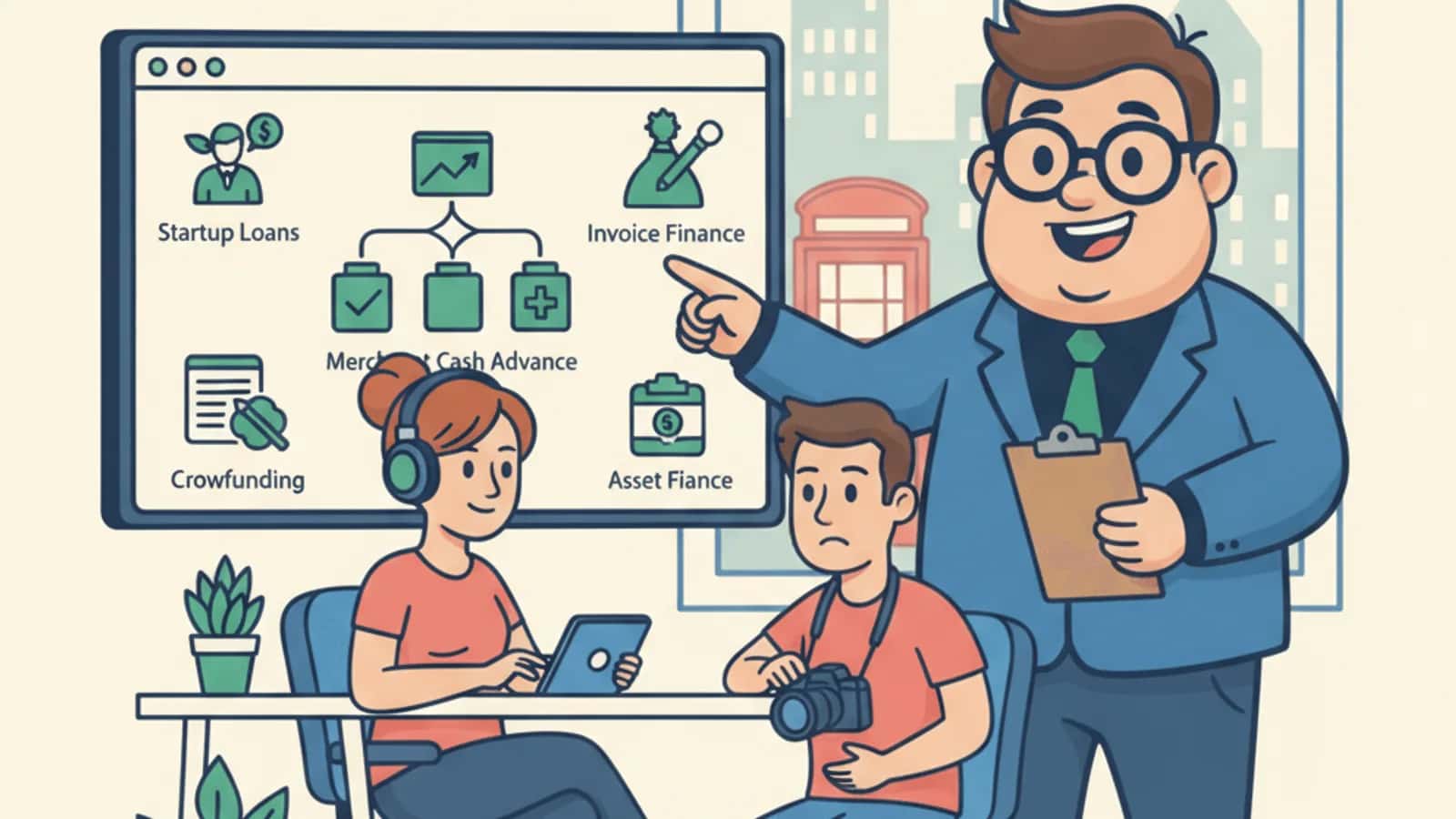
Self-employed borrowers in the UK have more funding routes in 2026 than most people realise. The key is matching the right product to your trading structure and revenue profile.
Here are the main options available:
Unsecured Business Loans
No collateral required. Amounts typically range from £5,000 to £250,000. Lenders assess income and trading history rather than assets. Ideal for sole traders who do not want to risk personal property. See the full breakdown in our guide to unsecured business loans.
Secured Business Loans
Backed by an asset, usually property. Somo, for example, offers secured loans from £27,500 to £3 million with rates starting at 7.1%, available to self-employed individuals provided they are homeowners. Lower rates are the trade-off for pledging collateral.
Merchant Cash Advance (MCA)
Suited to businesses that take card payments, such as restaurants, retail, or e-commerce. Repayments flex with daily card turnover, so quiet periods cost less. Liberis provides revenue-based financing between £2,500 and £300,000 with minimal documentation, focusing on card statement evidence.
Government-Backed Start Up Loans
The British Business Bank offers £500 to £25,000 at a fixed 6% interest rate for businesses under three years old. A business plan and financial forecasts are required. Forbes Advisor UK rates this as a strong option for early-stage freelancers due to the low fixed rate and free mentoring support.
Peer-to-Peer and Online Lenders
Platforms like Funding Circle accept sole traders with at least two years of trading and minimum annual revenue of £50,000, with loans from £10,000 to £500,000. iwoca accepts sole traders from six months of trading, using Open Banking to analyse bank statements rather than relying solely on tax returns.
Line of Credit
A revolving facility that lets you draw funds as needed and only pay interest on what you use. Useful for managing uneven cash flow. Learn more in our guide to what a line of credit is.
For a broader overview of all available products, the different types of business loans available in the UK covers each in detail.
How Much Can a Self-Employed Person Typically Borrow

Borrowing limits for self-employed applicants depend on three factors: trading history, annual revenue, and the lender's risk appetite. Most lenders will offer between 1x and 3x monthly revenue as a starting point.
Typical ranges by lender type:
| Lender Type | Typical Loan Range | Min. Trading History |
|---|---|---|
| High-street bank | £5,000 - £250,000 | 2-3 years |
| Alternative lender (e.g. iwoca) | £1,000 - £500,000 | 6 months |
| Government Start Up Loan | £500 - £25,000 | Under 3 years |
| Secured lender (e.g. Somo) | £27,500 - £3 million | Varies |
| Revenue-based (e.g. Liberis) | £2,500 - £300,000 | Card revenue dependent |
The average UK business loan as of November 2025 was £176,000, with an average interest rate of 6.5%. That figure skews upward because of larger limited company loans. For sole traders and freelancers, practical borrowing amounts more commonly fall between £10,000 and £150,000.
For a detailed look at borrowing limits relative to your stage of business, see how much money you can borrow to start a business in the UK.
Choose this approach if: You want a realistic target before applying. Work backwards from your monthly revenue, then use 1.5x to 2x as a conservative estimate of what lenders will consider.
Do You Need Two Years of Accounts to Qualify for a Business Loan
No, two years of accounts is not a universal requirement in 2026. It is the standard threshold for high-street banks, but alternative lenders have different criteria.
- High-street banks
- (Barclays, HSBC, NatWest, Lloyds): Typically require two to three years of trading history, full SA302 forms, and audited or filed accounts
- iwoca
- Accepts sole traders with as little as six months of trading history, using Open Banking bank statement analysis
- Funding Circle
- Requires two years of trading and SA302 forms for sole traders, plus minimum £50,000 annual revenue
- Swishfund
- Requires at least one full set of filed annual accounts and minimum £50,000 annual turnover for single-person limited companies
- Start Up Loans
- No trading history required; the scheme is designed for businesses under three years old
If your business is under 12 months old, the business loan for startups guide covers the specific routes available to you.
Which UK Lenders Are Most Accessible for Self-Employed Entrepreneurs
Traditional banks are the hardest route for self-employed borrowers. Alternative lenders and specialist platforms are generally more accessible.
More accessible lenders for self-employed applicants
- iwoca: Open Banking-based assessment, six months minimum trading, loans up to £500,000
- Novuna: Assesses real business performance rather than credit scores alone, unsecured loans from £5,000 to £250,000 with flexible repayment terms
- Liberis: Revenue-based financing, minimal paperwork, focuses on card payment history
- Swishfund: Targets single-person limited companies and professional services, up to £400,000
- British Business Bank (Start Up Loans): Government-backed, low rate, mentoring included, no trading history needed
Traditional banks vs. alternative lenders at a glance:
| Factor | Traditional Banks | Alternative / Online Lenders |
|---|---|---|
| Decision speed | Weeks to months | Hours to days |
| Min. trading history | 2-3 years | 6-12 months |
| Credit score weighting | High | Flexible Criteria |
| Documentation required | Extensive | Streamlined |
| Hard credit check upfront | Yes | Often no (No hard check to start) |
| Use of Open Banking | Rare | Standard |
Kandoo notes that self-employed individuals can access loans through banks, government schemes, and alternative lenders, with the emphasis on demonstrating stable earnings and a realistic plan for the loan's use.
What Is the Difference Between Secured and Unsecured Business Loans
A secured loan requires an asset as collateral. An unsecured loan does not. For self-employed borrowers, this distinction matters because it directly affects personal risk.
Secured business loans
- Backed by property, equipment, or other assets
- Generally lower interest rates
- Higher borrowing limits
- Risk: the lender can claim the asset if you default
- Somo offers secured loans from 7.1% for self-employed homeowners
Unsecured business loans
- No collateral required
- Faster approval process
- Slightly higher rates to reflect lender risk
- Personal assets are not directly at risk (though a personal guarantee may still be requested)
- Novuna offers unsecured loans from £5,000 to £250,000
Which is right for you?
Choose secured if
You own property, want the lowest possible rate, and are borrowing a larger amount over a longer term.
Choose unsecured if
You do not want to risk personal assets, need funds quickly, or are borrowing a smaller amount for working capital or stock.
For self-employed sole traders who are also homeowners, the choice between the two is worth careful consideration. Experian advises that separating personal and business finances strengthens loan applications regardless of which route you take.
Can You Get a Business Loan for Self-Employed UK Applicants With Bad Credit
Bad credit does not automatically block a self-employed business loan application in 2026. Flexible Criteria lenders assess overall business health, not just a credit score.
Several lenders specifically accommodate all credit types:
- Open Banking lenders
- (like iwoca) look at real cash flow data rather than relying on a credit file alone
- Revenue-based lenders
- (like Liberis) focus on card payment history and monthly turnover
- Novuna
- assesses real business performance, making credit score less of a deciding factor
What lenders look at instead of (or alongside) credit score
- Monthly bank statement patterns
- Consistency of income over 6-12 months
- Outstanding invoices or contracts
- Card payment volume
- Business age and sector
Practical steps to improve approval chances with bad credit:
- Connect via Open Banking to show real-time cash flow
- Separate personal and business bank accounts before applying
- Clear any small outstanding debts that appear on your file
- Apply for an amount proportionate to your monthly revenue
- Use a Wide partner panel broker to match with lenders suited to your profile
For a full breakdown of no-credit-check and flexible-criteria options, see best business loans with no credit check.
What Documents Do You Need to Apply for a Self-Employed Business Loan
The documents required depend on the lender type and loan amount. Alternative lenders generally ask for less than high-street banks.
Core documents most lenders request
- SA302 tax calculation forms: Usually the last two years, obtained from HMRC or your accountant. Funding Circle specifically requires two years of SA302 forms.
- Bank statements: Typically three to six months of business bank statements
- Proof of identity: Passport or driving licence
- Proof of address: Utility bill or bank statement dated within three months
- UTR number: Your Unique Taxpayer Reference, used to verify self-employment status with HMRC. If you are unsure what this is, the UTR number guide explains everything.
For larger or secured loans, you may also need
- Filed company accounts (one to two years)
- Business plan and financial forecasts (required for Start Up Loans)
- Asset valuations (for secured applications)
- Details of existing debts or credit facilities
Open Banking alternative: Some lenders, including iwoca, skip SA302 forms entirely and instead use Open Banking to read bank statement data directly. This speeds up the process significantly.
For a full document checklist, the complete guide to what documents you need to apply for a business loan covers every scenario in detail.
Are Start Up Loans Better Than Traditional Business Loans for New Freelancers
For freelancers with no trading history or under two years of accounts, Start Up Loans are often the most practical first option. Traditional business loans are largely inaccessible at this stage.
Start Up Loan advantages
- No trading history required
- Fixed 6% interest rate, one of the lowest available
- Free mentoring and business support included
- Government-backed, so criteria focus on the plan, not the credit file
- Amounts up to £25,000 per director (up to £100,000 per business with multiple directors)
Start Up Loan limitations
- Maximum £25,000 per individual is low for capital-intensive businesses
- Requires a full business plan and financial forecasts
- Application process takes longer than fast-decision alternative lenders
- Only available to businesses under three years old
Traditional business loan advantages
- Higher borrowing limits
- Faster decisions from alternative lenders
- No business plan required for most products
- Revolving credit and MCA options available
Which is right for you?
Choose a Start Up Loan if
You are a new freelancer, have limited credit history, need under £25,000, and value the mentoring support alongside the funding.
Choose an alternative lender if
You have been trading six months or more, need funds quickly, or require more than £25,000.
Forbes Advisor UK recommends the Start Up Loan specifically for its low fixed rate and mentoring support for early-stage businesses. For a side-by-side comparison of startup funding routes, see the business loan for startups UK guide.
What Are the Typical Interest Rates for Self-Employed Business Loans in 2026
Interest rates for self-employed business loans in 2026 vary significantly by lender type, loan size, and borrower risk profile. The average UK business loan rate was 6.5% as of November 2025.
Rate ranges by product type:
| Product | Typical Rate Range | Notes |
|---|---|---|
| Government Start Up Loan | 6% fixed | Best available for new businesses |
| Secured business loan | From 7.1% | Somo example; asset required |
| Unsecured bank loan | 7% - 15% | Depends on credit profile |
| Alternative unsecured lender | 10% - 30%+ | Faster access, higher risk priced in |
| Merchant Cash Advance | Factor rate, not APR | Typically 1.1 to 1.5 factor rate |
| Revenue-based financing | Varies by turnover | Liberis: based on card volume |
What drives your rate up
- Short trading history
- Lower credit score
- Unsecured product (no collateral)
- Smaller loan amount (less economical for lenders)
- Inconsistent revenue
What drives your rate down
- Two or more years of stable accounts
- Strong monthly cash flow
- Secured collateral
- Larger loan amount
- Good business credit score
For current rate benchmarks and how to compare offers, the average business loan interest rates guide is updated regularly.
What Mistakes Do Self-Employed People Make When Applying for Business Loans
The most common mistakes are avoidable with preparation. Lenders see the same errors repeatedly from self-employed applicants.
- 1
Mixing personal and business finances
Using a personal bank account for business income makes it harder to demonstrate revenue clearly. Experian specifically flags this as a factor that reduces approval chances. Open a dedicated business account before applying.
- 2
Applying to the wrong lender first
Going straight to a high-street bank when you have under two years of accounts wastes time and generates hard credit checks. Match the lender to your trading stage first.
- 3
Underestimating the documentation needed
SA302 forms, bank statements, and UTR numbers should be gathered before starting an application, not during. PocketWise advises maintaining accurate financial records specifically to strengthen loan applications.
- 4
Borrowing more than the business can service
A loan that looks affordable at the point of application can strain cash flow if revenue dips. Calculate your working capital position before committing. The working capital ratio guide helps with this.
- 5
Ignoring the business credit score
Self-employed applicants often focus on personal credit but neglect their business credit profile. These are assessed separately. See the business credit score guide for how to build and check yours.
- 6
Not using Open Banking
Refusing to connect via Open Banking slows down applications and removes one of the strongest tools for demonstrating real cash flow, especially for those with limited accounts history.
- 7
Applying for multiple loans simultaneously
Multiple hard credit checks in a short window damage your credit file. Use a broker with a Wide partner panel to find the right match before triggering formal applications.
Can You Use a Business Loan for Working Capital or Just Equipment
A business loan can be used for working capital, equipment, stock, marketing, hiring, premises, or almost any legitimate business purpose. There is no restriction to equipment alone.
Common uses for self-employed business loans
- Working capital: Covering payroll, supplier invoices, or operational costs during slow periods
- Stock and inventory: Buying ahead of peak seasons (common for e-commerce and retail)
- Equipment and tools: Machinery, technology, vehicles
- Marketing and growth: Paid advertising, website development, trade shows
- Hiring: Bringing on contractors or employees
- Premises: Deposits, fit-outs, or lease commitments
Kandoo notes that lenders want to see a realistic plan for the loan's use, so being specific about purpose strengthens applications. Saying "working capital" is fine, but quantifying it (for example, "covering three months of supplier payments during a seasonal dip") is better.
One restriction to note: Start Up Loans cannot be used to repay existing debts or fund personal expenses. All other standard business purposes are permitted.
A Merchant Cash Advance is particularly well-suited to working capital needs because repayments flex with revenue, reducing pressure during quiet periods.
Are Online Lenders Safer Than Traditional Banks for Self-Employed Borrowers
Reputable online lenders are safe to use and are regulated by the Financial Conduct Authority (FCA) in the UK. The question is not safety but fit.
What makes an online lender legitimate
- FCA authorisation (check the FCA register at fca.org.uk)
- Clear terms, including total repayment cost and APR or factor rate
- No upfront fees before loan approval
- Transparent complaints process
Where online lenders have an advantage for self-employed borrowers
- Smart Tech-driven decisions that assess real cash flow, not just credit files
- Fast Decision turnaround, often same-day
- Open Banking integration for streamlined income verification
- Flexible Criteria that accommodate irregular income patterns
- No hard check to start with many platforms
Where traditional banks have an advantage
- Lower rates for well-established, profitable businesses
- Established relationship banking
- Access to overdrafts and broader financial products
The honest answer: For most self-employed borrowers in 2026 who need funds quickly and do not have a pristine two-year trading record, a reputable online lender will be both faster and more likely to approve than a traditional bank. Safety is not the differentiator. Speed, flexibility, and eligibility criteria are.
PocketWise advises exploring alternative lenders specifically when mainstream options are unavailable.
What Alternative Funding Might Work If You Cannot Get a Traditional Business Loan
If a traditional business loan is not accessible right now, several alternatives can bridge the gap.
Merchant Cash Advance (MCA)
If your business takes card payments, an MCA advances cash against future card sales. Repayment is a percentage of daily takings, so it scales with revenue. No fixed monthly repayment. Liberis operates in this space for UK businesses.
Invoice Finance
If you invoice clients, you can release up to 90% of the invoice value immediately rather than waiting 30 to 90 days. Useful for freelancers with B2B clients.
Asset Finance
Spread the cost of equipment over time rather than buying outright. The asset itself serves as security. Explore the asset finance options available to UK businesses.
Revenue-Based Financing
Similar to an MCA but tied to total monthly revenue rather than card payments alone. Repayments flex with business performance.
Government Grants
Non-repayable funding from Innovate UK, local enterprise partnerships, or sector-specific schemes. Competitive but worth pursuing for eligible businesses.
Friends and Family / Angel Investment
Informal funding for early-stage freelancers. Requires clear written agreements to protect relationships.
Business Credit Card
For smaller, short-term needs. High interest if not cleared monthly, but useful as a bridge.
Start Up Loan
If your business is under three years old and you have not yet applied, this remains one of the most accessible routes at 6% fixed.
The how to get a business loan guide covers the full application process if you want to revisit the traditional route with a stronger application.
Next steps
Getting a business loan for self-employed UK applicants in 2026 is not the uphill struggle it was five years ago. The landscape has shifted. Alternative lenders using Open Banking, Flexible Criteria, and Smart Tech have made fast, accessible funding a genuine reality for sole traders, freelancers, and single-person limited companies across the UK. For more comparisons and application guidance, browse our business loan guides.
The path forward is straightforward:
- Know your numbers. Pull together your SA302 forms, last six months of bank statements, and your UTR number before you start.
- Match lender to stage. Under two years trading? Look at iwoca, Novuna, or the Start Up Loan scheme rather than high-street banks.
- Protect your credit file. Use a platform that offers No hard check to start so you can check eligibility without risk.
- Consider all products. An Unsecured Loan, Merchant Cash Advance, or revenue-based facility may suit your cash flow better than a traditional term loan.
- Separate your finances. A dedicated business account strengthens every application.
The self-employed community is one of the most dynamic parts of the UK economy. Lenders who understand that are offering better, faster, and fairer products than ever before. The right funding is out there. Check Eligibility Now and take the next step.
Further reading
Frequently asked questions
What Business Loan Options Actually Exist for Freelancers and the Self-Employed in the UK?
Self-employed borrowers in the UK have more funding routes in 2026 than most people realise. The key is matching the right product to your trading structure and revenue profile.
How Much Can a Self-Employed Person Typically Borrow?
Borrowing limits for self-employed applicants depend on three factors: trading history, annual revenue, and the lender's risk appetite. Most lenders will offer between 1x and 3x monthly revenue as a starting point.
Do You Need Two Years of Accounts to Qualify for a Business Loan?
No, two years of accounts is not a universal requirement in 2026. It is the standard threshold for high-street banks, but alternative lenders have different criteria.
Which UK Lenders Are Most Accessible for Self-Employed Entrepreneurs?
Traditional banks are the hardest route for self-employed borrowers. Alternative lenders and specialist platforms are generally more accessible.
What Is the Difference Between Secured and Unsecured Business Loans?
A secured loan requires an asset as collateral. An unsecured loan does not. For self-employed borrowers, this distinction matters because it directly affects personal risk.
Can You Get a Business Loan for Self-Employed UK Applicants With Bad Credit?
Bad credit does not automatically block a self-employed business loan application in 2026. Flexible Criteria lenders assess overall business health, not just a credit score.
Written by
The Funding Fred Editorial Team creates plain-English guides to help business owners understand funding options, eligibility, and application readiness before they compare finance options.
Reviewed by
UK business finance content reviewer
Robert reads our UK business finance guides before they go live, checking each one is accurate, easy to follow, and reflects how lending actually works today — not how a brochure says it should. He's listed on the FCA Register, approved as an SMF3 (AR) Executive Director at Switcha Limited, and connected to Lucky Growth Partners Ltd through its appointed representative relationship, so the regulated detail gets a properly qualified second read.