Should You Use a Business Credit Card for Unexpected Expenses?
Yes, a business credit card can be a practical first line of response for unexpected business expenses, particularly when you need to act fast and keep cash in the account. Cards with up to 56 days interest-free give you breathing room without immediately hitting your overdraft or reserves.

Quick answer
Yes, a business credit card can be a practical first line of response for unexpected business expenses, particularly when you need to act fast and keep cash in the account. Cards with up to 56 days interest-free give you breathing room without immediately hitting your overdraft or reserves. But the card works best as a timing tool, not a permanent fix for a funding gap.
Key takeaways
- A business credit card is well-suited to one-off, short-term unexpected costs, equipment repairs, emergency supplier payments, urgent travel, where you can clear the balance within the interest-free window
- Cards keep cash in your account longer, which protects day-to-day operations while you deal with the unexpected cost
- Using a business card (not a personal card) keeps expenses separate, simplifies accounting, and protects your personal credit file
- Unexpected expenses that are large, recurring, or structural, like replacing a major asset or covering a persistent cash shortfall, are better handled with a loan, overdraft, or invoice finance
- Responsible use of a business credit card can build your business credit profile over time; missed payments can damage it
- HMRC allows you to claim the business portion of expenses charged to a card, but the tax treatment follows the nature of the expense, not the payment method
- If you can't clear the balance quickly, interest charges can turn a manageable cost into a more expensive problem, know your card's APR before you rely on it
- Spend controls, virtual cards, and employee cards mean you can issue access to a team member in a crisis without losing oversight of what's spent
What Counts as an Unexpected Business Expense?

An unexpected business expense is any cost that wasn't budgeted for and requires payment outside your normal cash cycle. These aren't rare, most UK SMEs face several each year.
Common examples include:
- Equipment breakdown or emergency repair (boiler, server, vehicle)
- A supplier increasing prices mid-contract or demanding early payment
- Emergency professional fees, legal, accountancy, or compliance costs
- Urgent stock purchases when a supplier offers a short-window deal
- Staff costs from unplanned absence or a sudden project requirement
- HMRC penalties or VAT demands that land outside your planning cycle
- Emergency travel or accommodation for a client crisis
The key distinction is between a genuine one-off and a recurring shortfall. A burst pipe in your office is unexpected. Consistently running out of cash before invoices are paid is a structural cash flow problem, and that needs a different solution. Understanding why small businesses struggle with cash often comes down to this exact confusion.
Should You Use a Business Credit Card for Unexpected Expenses?
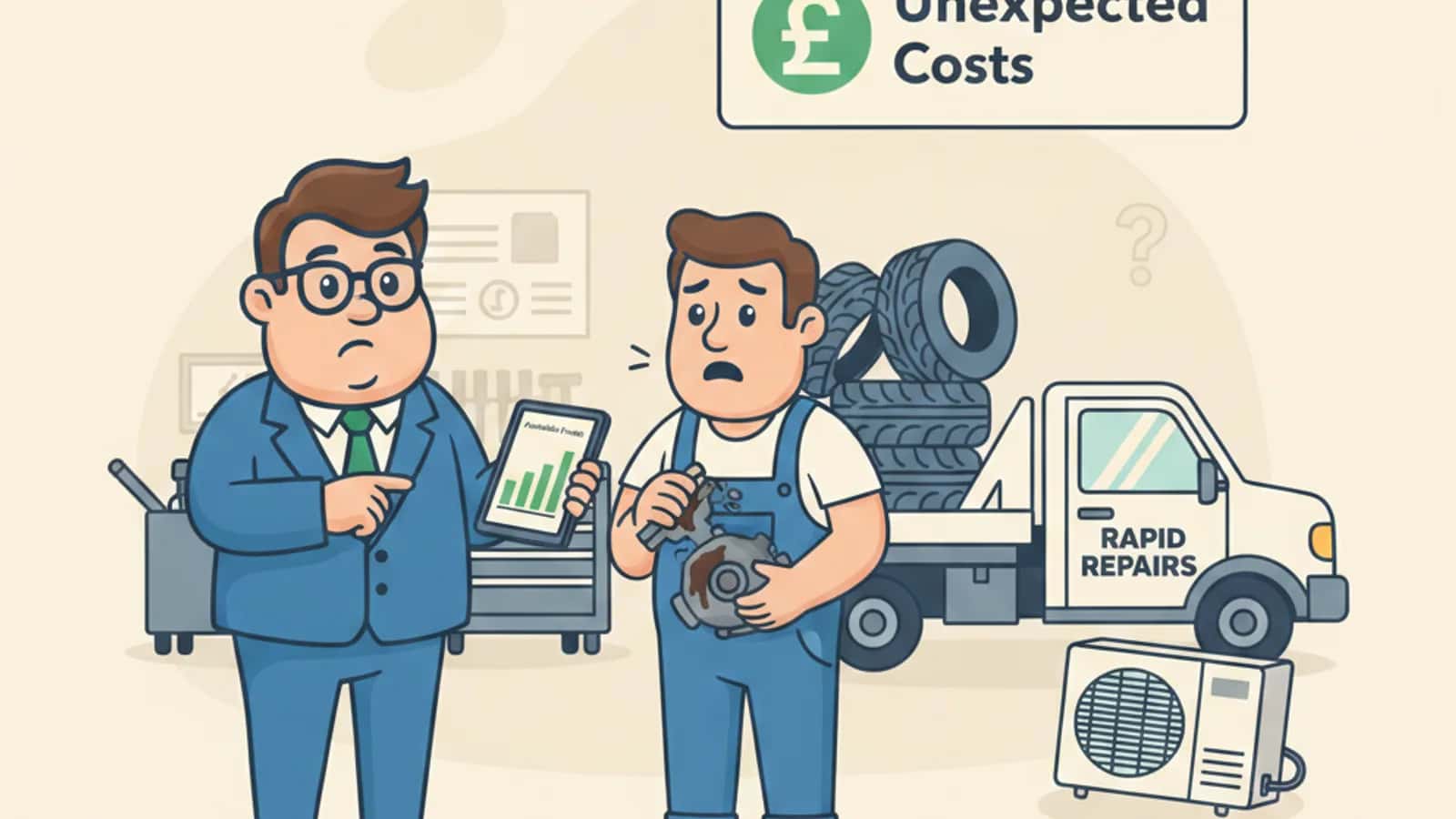
A business credit card is one of the most practical tools for handling unexpected expenses quickly, provided the cost is manageable within your credit limit and you can clear it within the interest-free period. U.S. Bank's guidance confirms that paying unforeseen costs such as equipment repairs or rising supply prices with a business credit card can be an efficient option, but only as part of a broader plan that includes cash reserves. Read paying suppliers by business credit card: the key points for the key considerations.
Use a business credit card for unexpected expenses when
- The cost is a genuine one-off, not a sign of a deeper cash flow problem
- You can realistically clear the balance before interest kicks in
- Speed matters, you need to act within hours or days, not weeks
- You want to protect your working capital and keep cash in the account
- The expense qualifies as a legitimate business cost for accounting purposes
Don't rely on it when
- The cost is so large it will sit on the card for months
- You're already carrying a balance and adding to it
- The expense is personal in nature, even partly
- You're using the card because your bank account is already empty
Cards with up to 56 days interest-free effectively give you a short-term, zero-cost bridge. That's genuinely useful for a business that invoices on 30-day terms and needs to cover a cost today.
Business Credit Card vs Personal Card for Surprise Costs
Always use a business card rather than a personal card for business expenses. This isn't just tidiness, it has real financial and legal consequences.
| Factor | Business Credit Card | Personal Credit Card |
|---|---|---|
| Expense separation | Clean split from day one | Manual reconciliation required |
| Accounting | Feeds directly into bookkeeping | Extra admin every month |
| Credit file impact | Builds business credit profile | Affects personal credit score |
| Limits available | Up to £250k+ with right provider | Typically capped much lower |
| Employee access | Employee cards with spend controls | No equivalent |
| Rewards on business spend | Cashback on ad spend, travel, stock | Consumer rewards only |
| FCA consumer protections | Do not apply to business cards | Apply to personal cards |
Mixing personal and business spend is one of the most common mistakes UK limited company directors make. It creates problems at year-end, complicates HMRC enquiries, and can blur the line between company and personal liability. If staff are currently putting company costs on their own cards and claiming expenses, that's a sign the business needs proper business credit cards with employee access built in.
Note: Section 75 of the Consumer Credit Act does not apply to business credit cards. Some providers offer their own purchase protection, and chargeback rights via the card scheme may still apply, check your card's specific terms.
Does Using Business Credit for Emergencies Hurt Cash Flow?
Used correctly, a business credit card protects cash flow rather than hurting it. The interest-free window means you keep cash in your account for longer, which is the entire point.
The risk comes when:
- You carry a balance beyond the interest-free period and start paying APR
- The credit limit is too low to cover the cost, forcing you to split payments or use personal funds anyway
- Monthly minimum payments start competing with other outgoings. Compare this with the practical guide to business credit card minimum payments.
Advisory guidance for 2026 describes cards as a way to bridge the "procure-to-pay" gap, extending payment by roughly 20 to 45 days without cost, if managed well. That's a real cash flow benefit. But if the card becomes a revolving balance that never clears, the interest cost becomes a drag on the business. For a more detailed explanation, see using business credit cards for cash flow in more detail.
The fix is a higher limit with a provider that actually moves when your business grows, not a limit that hasn't changed in five years. See how a business overdraft compares to a line of credit if you need a more permanent cash flow buffer.
How Do Unexpected Expenses Affect Your Business Credit Score?
Unexpected expenses don't directly damage your business credit score, but how you handle them does. Putting a large cost on a card and clearing it on time can actually strengthen your profile by demonstrating responsible credit use.
What damages your score:
- Missing a payment or paying late after an unexpected expense stretches your cash
- Using a very high proportion of your available credit limit (high utilisation)
- Applying for multiple new credit products in quick succession after a crisis
What helps:
- Paying at least the minimum on time, every time
- Keeping utilisation below 30% of your limit where possible
- Using a card consistently for legitimate business spend and clearing it regularly
If an unexpected expense forces you into a position where you might miss a payment, contact your card provider before the due date. Most providers have hardship processes that won't automatically trigger a default.
Can You Write Off Unexpected Business Expenses on Taxes?
Yes, if the expense is wholly and exclusively for business purposes, it's deductible against profits regardless of whether you paid by card, bank transfer, or cash. HMRC's position is that the tax treatment follows the nature of the expense, not the payment method.
Practical points for UK businesses
- Card interest and annual fees are deductible as business finance costs if the card is used exclusively for business
- If a card is used for mixed personal and business spend, only the business proportion is deductible, and HMRC may scrutinise mixed-use cards
- Keep receipts and transaction records; a card statement alone is not always sufficient for a tax enquiry
- For VAT-registered businesses, input VAT can be reclaimed on qualifying business purchases made by card in the usual way
- Sole traders using a personal card for business costs can still claim the expense, but it makes record-keeping harder
This is general guidance. For advice specific to your business structure and circumstances, speak to a qualified accountant.
What Happens If You Can't Pay Unexpected Business Expenses Right Away?
If you can't clear the balance immediately, the cost doesn't disappear, it starts accruing interest at your card's APR. Business credit card rates vary significantly between providers, so the actual cost depends on your specific card terms.
Options if you're carrying a balance
- Pay as much as you can each month to reduce the interest-bearing balance
- Check whether your card has a balance transfer option or a lower-rate facility
- Consider a short-term business loan to clear the card balance at a lower rate, see emergency business loans UK for options
- If the expense relates to unpaid invoices, invoice financing may release cash faster than waiting for customers to pay
The worst outcome is paying minimum payments indefinitely. On a high-APR business card, a £10,000 balance on minimum payments can cost significantly more over time. Act quickly to either clear it or refinance it.
Unexpected Business Expenses That Shouldn't Go on a Credit Card
Not every surprise cost is a good fit for a credit card. Some expenses are better handled through other financing routes from the start.
Costs that typically shouldn't go on a card
- Large asset purchases, a new vehicle, machinery, or equipment above your card limit is better handled through asset finance or hire purchase
- Property-related costs, deposits, fit-outs, or structural repairs at scale
- Payroll shortfalls, if you can't cover wages, a card is a short-term sticking plaster on a serious problem; a cash flow loan or overdraft is more appropriate
- Tax bills, HMRC will accept card payment, but the APR on a card is almost always higher than a business loan for VAT or tax bills
- Costs that will recur, if the same "unexpected" expense keeps appearing, it's not unexpected; budget for it or find a structural solution
The common thread: if the cost is large enough that you won't clear it within the interest-free window, a purpose-built finance product will almost always be cheaper.
Should Small Business Owners Keep an Emergency Fund Instead of Using Credit?
Both. An emergency fund and a business credit card serve different purposes and work best together.
A cash reserve covers costs immediately without any credit dependency. Most financial guidance suggests holding three to six months of fixed costs in a separate business account, though many UK SMEs operate with far less than this.
A business credit card fills the gap when:
- The reserve is depleted or the cost exceeds it
- Speed matters more than cost (the card is instant; building a reserve takes time)
- You want to earn cashback or rewards on the spend while you rebuild the reserve
The mistake is treating the card as the reserve. Credit has a cost if you don't clear it, and a limit that can be reduced or withdrawn. Cash in the bank cannot be taken away. Build the reserve, use the card as the bridge, and don't confuse the two.
How to Track Unexpected Expenses for Accounting Purposes
Every unexpected expense charged to a business card needs to be captured in your accounting records with the same rigour as a planned purchase.
Practical steps:
- Categorise the expense correctly at the point of entry, don't leave it as "miscellaneous"
- Attach the receipt or invoice to the transaction in your accounting software
- Note the business purpose if it's not obvious from the supplier name
- For VAT-registered businesses, confirm whether VAT was charged and at what rate
- Flag the expense to your accountant if it's above a certain threshold or unusual in nature
- Reconcile card statements monthly, don't let several months build up
Most modern accounting platforms (Xero, QuickBooks, FreeAgent) connect directly to business card feeds, which removes the manual entry step. Cards with virtual card functionality also make it easier to assign spend to specific projects or team members from day one.
Alternatives to a Business Credit Card for Covering Surprise Costs
A business credit card isn't always the right tool. Here are the main alternatives and when each makes more sense:
Business overdraft
- Best for
- Recurring short-term gaps
- Speed
- Instant (if pre-arranged)
- Cost indicator
- Interest on amount used
Emergency business loan
- Best for
- Larger costs, longer repayment
- Speed
- Days to a week
- Cost indicator
- Fixed rate, structured repayment
Invoice finance
- Best for
- Costs tied to outstanding invoices
- Speed
- 24-48 hours
- Cost indicator
- Fee on invoice value
Asset finance
- Best for
- Equipment and machinery
- Speed
- Days
- Cost indicator
- Spread over asset life
Business line of credit
- Best for
- Flexible, repeat draw-down needs
- Speed
- Instant once set up
- Cost indicator
- Interest on drawn amount only
For a broader view of funding options, alternative business funding routes covers eight approaches side by side. If a loan was declined, what to do after a business loan rejection is worth reading before you apply again.
What to Look for in a Business Credit Card for Emergency Situations
Not all business cards perform equally in a crisis. The features that matter most for unexpected expenses are different from what matters for everyday spend.
Prioritise
- Higher limits, a £1,000 limit won't cover most genuine emergencies; look for providers offering £10k,£250k+
- Fast approval, some providers can issue a decision in minutes and a virtual card within hours
- Up to 56 days interest-free, maximises the window to clear the balance without cost
- Employee cards with spend controls, so you can give a team member access immediately without losing oversight
- Virtual cards, usable for online supplier payments before a physical card arrives
- No hard credit check to start, a 2-minute eligibility check that doesn't mark your credit file lets you explore options without risk
The contrast with a standard high street business card is significant. Many high street providers take weeks to decide, start with low limits, and require extensive documentation. Leading card providers on platforms like Funding Fred are built for speed and headroom, not for businesses that can wait a month.
Next steps
A business credit card is one of the fastest and most practical tools for handling unexpected expenses, but it works best when the cost is manageable, the balance clears within the interest-free window, and the card is part of a broader financial plan rather than a substitute for one.
For UK businesses, the practical checklist is straightforward: use a business card (not a personal one), categorise and record the expense properly, pay it off as quickly as possible, and treat any cost that won't clear within 56 days as a signal to look at a more structured finance option.
If your current card limit isn't high enough to cover a real emergency, or your bank hasn't moved it in years, that's the problem worth fixing now, before the next unexpected cost arrives.
Check Eligibility Now with Funding Fred's 2-minute check. No hard credit search, no obligation, and access to leading card providers offering limits from £1k to £250k+. Business Credit Cards. Without the Fuss.
Frequently asked questions
What Counts as an Unexpected Business Expense?
An unexpected business expense is any cost that wasn't budgeted for and requires payment outside your normal cash cycle. These aren't rare, most UK SMEs face several each year.
Should You Use a Business Credit Card for Unexpected Expenses?
A business credit card is one of the most practical tools for handling unexpected expenses quickly, provided the cost is manageable within your credit limit and you can clear it within the interest-free period. U.S. Bank's guidance confirms that paying unforeseen costs such as equipment repairs or rising supply prices with a business credit card can be an efficient option, but only as part of a broader plan that includes cash reserves. Read paying suppliers by business credit card: the key points for the key considerations.
Does Using Business Credit for Emergencies Hurt Cash Flow?
Used correctly, a business credit card protects cash flow rather than hurting it. The interest-free window means you keep cash in your account for longer, which is the entire point.
How Do Unexpected Expenses Affect Your Business Credit Score?
Unexpected expenses don't directly damage your business credit score, but how you handle them does. Putting a large cost on a card and clearing it on time can actually strengthen your profile by demonstrating responsible credit use.
Can You Write Off Unexpected Business Expenses on Taxes?
Yes, if the expense is wholly and exclusively for business purposes, it's deductible against profits regardless of whether you paid by card, bank transfer, or cash. HMRC's position is that the tax treatment follows the nature of the expense, not the payment method.
What Happens If You Can't Pay Unexpected Business Expenses Right Away?
If you can't clear the balance immediately, the cost doesn't disappear, it starts accruing interest at your card's APR. Business credit card rates vary significantly between providers, so the actual cost depends on your specific card terms.
Written by
The Funding Fred Editorial Team creates plain-English guides to help business owners understand funding options, eligibility, and application readiness before they compare finance options.
Reviewed by
UK business finance content reviewer
Robert reads our UK business finance guides before they go live, checking each one is accurate, easy to follow, and reflects how lending actually works today — not how a brochure says it should. He's listed on the FCA Register, approved as an SMF3 (AR) Executive Director at Switcha Limited, and connected to Lucky Growth Partners Ltd through its appointed representative relationship, so the regulated detail gets a properly qualified second read.