Asset Based Lending UK: Combining Invoices, Stock and Plant in One Facility
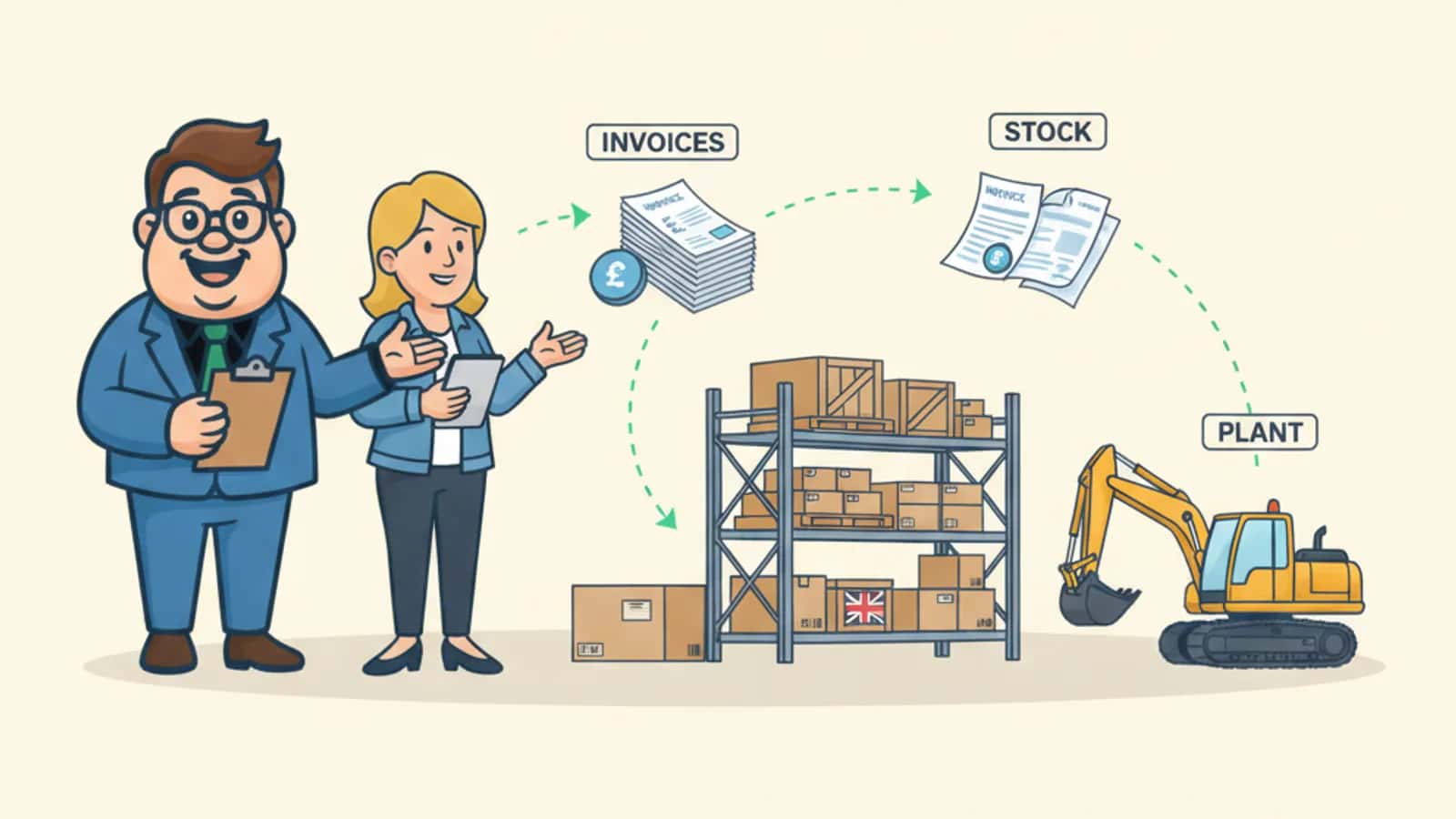
Asset based lending (ABL) lets a UK business borrow against several assets at once, unpaid invoices, stock, plant and machinery, and sometimes property, inside a single facility with one borrowing base instead of separate loans.

Quick answer
Asset based lending (ABL) lets a UK business borrow against several assets at once, unpaid invoices, stock, plant and machinery, and sometimes property, inside a single facility with one borrowing base instead of separate loans. It suits established businesses with turnover typically in the millions, strong asset registers, and a need for more working capital than invoice finance alone can deliver. Costs and advance rates vary by lender and by asset type, so always confirm exact terms with the provider before signing.
Key takeaways
- Asset based lending combines multiple asset classes, receivables, stock, plant, and sometimes property, into one revolving facility with a blended borrowing base.
- Invoices usually generate the highest advance rate, followed by stock and then plant and machinery, though exact percentages differ by lender and asset quality.
- ABL tends to suit businesses with meaningful turnover, multiple asset types, and more complex funding needs than a standalone invoice finance line can meet.
- Lenders including Novuna Business Cash Flow and Metro Bank have expanded UK asset based lending propositions, reflecting growing demand from mid-market firms.
- ABL is not free of covenants or monitoring. Expect asset audits, reporting requirements, and valuation reviews throughout the facility's life.
- If your main problem is customer payment delays rather than funding growth or acquisitions, invoice finance alone may be simpler and faster to set up than full ABL.
- Pricing, approval speed, and eligibility criteria vary by lender and applicant, there is no single published rate or turnaround time across the UK market.
What is asset based lending and how does it work?
Asset based lending is a funding structure where a lender advances cash against the value of a business's assets, rather than relying mainly on turnover, profit, or a fixed loan amount. The lender builds a "borrowing base" from eligible assets and lends a percentage of that base, which moves up and down as the assets change.
In practice, this means:
- A lender assesses receivables, stock, and plant and machinery (and sometimes property) to work out their lendable value.
- Each asset class gets its own advance rate, reflecting how easily it could be sold or collected if things went wrong.
- The facility is usually revolving, so available funds rise as the asset base grows (more invoices raised, more stock held) and fall as it shrinks.
- Lenders monitor the borrowing base regularly through reporting, stock checks, and asset valuations.
The Chartered Financial Analyst Society's UK directory lists asset based lending as a recognised structured finance discipline distinct from simple overdraft or term lending, and UK providers such as Metro Bank describe their ABL product as funding built around a business's balance sheet rather than a single credit score.
Asset based lending vs traditional bank loans: what's the difference?

The core difference is what secures the money. A traditional bank loan is usually sized against profit history, credit score, and sometimes a fixed charge over property. Asset based lending is sized against the current, fluctuating value of specific assets, so the facility can grow alongside the business.
Key contrasts:
- Flexibility
- A bank term loan pays out a fixed sum once. An ABL facility revolves, funding available today reflects today's invoices and stock, not a number fixed months ago.
- Growth fit
- Businesses expanding turnover quickly often outgrow a static bank loan limit faster than they outgrow an ABL borrowing base, because the base recalculates as sales grow.
- Security
- Bank loans often lean heavily on property or personal guarantees. ABL spreads security across several asset types, which can reduce reliance on a single piece of collateral.
- Reporting
- ABL usually demands more frequent reporting, stock reports, aged debtor analysis, than a standard bank loan.
Choose a bank loan if you need one simple, fixed sum for a defined purchase. Choose asset based lending if your funding need scales with trading activity and you hold a mix of receivables, stock, and equipment worth leveraging together.
Can you combine invoices, stock and plant in one facility?
Yes. Combining invoices, stock, and plant and machinery into a single asset based lending facility is the defining feature of ABL in the UK market, and it is the main reason businesses move from a standalone invoice finance line to a full ABL structure.
Rather than running a separate invoice discounting facility, a separate stock loan, and separate equipment finance, an ABL facility blends them into one borrowing base with one lender relationship, one set of covenants, and one reporting cycle. Novuna Business Cash Flow's recently launched asset based lending proposition was built specifically around this integrated approach, replacing the need for multiple disconnected funding lines with a single facility that layers receivables, stock, and plant together.
This matters most for businesses where invoices alone don't unlock enough working capital, for example, a manufacturer holding significant raw material and finished goods stock, or a construction firm with expensive plant sitting on the balance sheet. If your funding need is purely about getting paid faster on invoices you've already issued, a standalone facility explored through invoice finance may be simpler to arrange than a full multi-asset ABL structure.
What assets can you use for asset based lending, and at what advance rates?
Lenders typically include trade receivables, stock or inventory, and plant and machinery in a UK ABL borrowing base, with property sometimes added for larger facilities. Each asset class carries its own advance rate, and receivables generally attract the highest rate because they convert to cash fastest.
A typical (illustrative) funding mix might look like this, actual percentages vary by lender, sector, and asset condition, and should always be confirmed directly with a provider:
| Asset class | Typical role in the borrowing base | Relative advance rate (illustrative only) |
|---|---|---|
| Trade receivables / invoices | Core, most liquid asset; funded against eligible, in-term debtors | Highest of the asset classes |
| Stock and raw materials | Funded against saleable, valued inventory, often capped | Moderate, below receivables |
| Plant and machinery | Funded against appraised or book value of owned equipment | Lower, reflecting resale risk |
| Commercial property | Sometimes added for larger or mid-market facilities | Varies by valuation and charge position |
Metro Bank's asset based lending product illustrates how a UK lender structures funding across these asset types within one facility, with advance levels set asset-by-asset rather than as a single blanket percentage. For a deeper look at how plant and machinery specifically gets valued and funded, see this guide to plant and machinery finance for UK construction businesses, and for stock-specific funding mechanics, see this overview of business loans for stock and inventory.
Asset based lending rates and costs in the UK
Asset based lending costs are usually made up of a discount or interest charge on funds drawn, plus service and monitoring fees, and these vary significantly by lender, facility size, and asset mix. There is no single published UK-wide rate, so any number quoted elsewhere should be treated as an estimate rather than a guarantee.
Typical cost components include:
- A discount margin charged on the amount drawn against receivables.
- Interest on stock and plant drawings, which can carry a different rate than the invoice element.
- Facility or arrangement fees, often charged as a one-off percentage at setup.
- Audit and monitoring fees for periodic stock checks and asset valuations.
Because ABL layers several asset classes with different risk profiles, pricing is rarely a single flat rate, it's a blend across the facility. Ask any lender for a full breakdown by asset class before comparing offers, and always confirm whether fees are fixed or scale with facility usage.
Who qualifies for asset based lending?
Lenders generally look for an established UK business with a meaningful asset base across at least two of the eligible categories, receivables, stock, and plant, plus management information good enough to support regular reporting. There is no single published eligibility threshold across the market, and criteria differ by lender.
Common qualifying factors include:
- A trading history long enough to show consistent receivables and stock patterns.
- Owned or leased plant and machinery with a clear, verifiable value.
- Management accounts and aged debtor reports produced reliably and often.
- A business model where assets genuinely secure the facility (service businesses with few physical assets may fit invoice finance better than full ABL).
Decision rule: if your business holds receivables plus either stock or plant worth funding, and you can produce regular management reporting, ABL eligibility is worth exploring with a lender. If your only significant asset is your sales ledger, a standalone facility may be the more direct route, see how invoice finance works as a funding pool tied purely to receivables.
How much can you borrow with asset based lending?
Borrowing capacity under asset based lending is driven by the combined value of eligible assets in the borrowing base, not by a fixed loan limit, so it scales as the business grows or shrinks. There is no universal UK maximum or minimum figure that applies to every lender.
In practice, availability depends on:
- The current value of eligible receivables, stock, and plant after advance rates are applied.
- Concentration limits (a lender may cap how much of the facility can come from one large customer's invoices).
- Ineligible amounts, such as overdue debtors or obsolete stock, which are excluded from the base.
- Headroom set aside for seasonal stock builds or project-based plant purchases.
Novuna Business Cash Flow's recently launched ABL proposition was reported with a facility figure in the tens of millions, reflecting the scale some providers now offer mid-market UK businesses. Smaller businesses with a simpler asset mix will typically see proportionally smaller facilities, calculated the same way, as a percentage of eligible assets, not a flat industry number.
Is asset based lending for small businesses, or mid-market only?
Asset based lending in the UK tends to suit established small and mid-sized businesses with multiple asset classes worth funding, rather than very early-stage or asset-light companies. Smaller businesses with receivables as their only significant asset are often better served by a standalone invoice finance facility.
Sector fit tends to favour:
- Manufacturing and wholesale, where stock and plant sit alongside receivables.
- Construction, where plant and machinery values are significant.
- Distribution and logistics, where stock turnover and fleet assets both matter.
- Businesses going through acquisitions, restructurings, or other event-driven financing where a single flexible facility beats arranging several separate loans at once.
If your business is a recruitment agency, consultancy, or other services firm with receivables as your only real asset, full ABL may add complexity without adding meaningful extra funding. In that case, a facility built around invoice finance alone is usually the more proportionate choice.
How long does asset based lending take to get approved?
Approval timelines for asset based lending vary by lender, facility size, and how complex the asset verification process is, and no fixed UK-wide turnaround time applies. Multi-asset facilities generally take longer to set up than a single-asset invoice finance line because the lender must value and verify each asset class separately.
Expect the process to involve:
- Initial eligibility and financial review.
- Asset valuation and/or stock audit, which can involve third-party surveyors for plant and property.
- Legal documentation covering security across each asset class.
- Final facility agreement and drawdown setup.
Because of this extra verification layer, businesses wanting the fastest possible access to cash tied up in unpaid invoices often start with a standalone invoice finance facility and consider a broader ABL structure later, once the business has grown into needing it. Read how invoice finance approval speed typically compares when receivables are the only asset involved.
Asset based lending vs invoice financing: which is better?
Neither is universally "better", the right choice depends on whether your funding need is purely about unpaid invoices or spans multiple asset types. Invoice financing is faster to set up and simpler to manage; asset based lending unlocks more total funding by adding stock, plant, and sometimes property into the mix.
| Factor | Invoice Financing Alone | Full Asset Based Lending (ABL) |
|---|---|---|
| Assets funded | Unpaid invoices only | Invoices, stock, plant, sometimes property |
| Speed of setup | Generally faster, single asset to verify | Slower, multiple asset valuations needed |
| Total funding potential | Limited to sales ledger value | Higher, blended across asset classes |
| Reporting burden | Aged debtor reports | Debtor, stock, and asset reporting combined |
| Best fit | Slow-paying customers, cash flow timing problem | Growth, acquisition, or restructuring with multiple assets |
If the real problem is simply that customers take 30, 60, or 90 days to pay, invoice finance solves that directly without the added complexity of a multi-asset structure. Compare the two paths further in this breakdown of invoice finance vs business loans, or explore the broader invoice financing category hub for related funding structures.
Asset based lending risks and drawbacks
The main drawback of asset based lending is the ongoing monitoring and covenant burden that comes with pledging multiple asset classes, along with the risk that available funding can shrink quickly if asset values fall. These are structural trade-offs, not failures of any particular lender.
Specific risks include:
- Borrowing base can contract fast
- If stock becomes obsolete or a major customer invoice turns bad, available funding drops immediately.
- Multiple covenants
- Each asset class may carry its own reporting and compliance requirements, increasing administrative load.
- Audit and valuation costs
- Regular stock checks and plant valuations add ongoing cost beyond the headline rate.
- Cross-default risk
- Problems in one asset class (say, a stock write-down) can affect the whole facility, not just that portion.
- Less suited to asset-light businesses
- Service firms with little stock or equipment may find the structure disproportionate to their actual funding need.
Edge case: a business with seasonal stock swings may find its ABL facility shrinks sharply in quiet months, even if receivables remain strong, worth stress-testing before committing.
Common mistakes with asset based lending
The most common mistake is entering an ABL facility sized for the business's peak asset base rather than its average, which creates covenant pressure when stock or receivables dip. Several other avoidable errors come up repeatedly.
- Underestimating reporting demands
- Businesses without strong management information systems can struggle with the weekly or monthly reporting ABL lenders expect.
- Ignoring concentration limits
- Relying heavily on one large customer's invoices can cap how much of the facility that debtor actually unlocks.
- Skipping a cost comparison against simpler alternatives
- Some businesses commit to full ABL when a standalone invoice finance facility would have met the actual need at lower complexity.
- Not planning for asset volatility
- Failing to model how a stock write-down or slow-paying customer affects available funding before it happens.
- Treating property-backed ABL casually
- Facilities involving commercial property, similar in spirit to the funding released through sale and leaseback arrangements, carry longer-term security implications that deserve legal review.
Asset based lending when you have bad credit
Asset based lending can sometimes be more accessible than unsecured bank lending for businesses with credit history issues, because the facility is secured primarily against asset value rather than credit score alone. That said, no lender guarantees approval, and credit history still factors into the overall assessment.
What tends to matter most:
- The quality and verifiability of the underlying assets, more than a clean credit file alone.
- Director conduct and any history of insolvency, which lenders will still review.
- Current trading performance and the strength of the asset base today, not just historic credit events.
If credit history is the main obstacle, it's worth discussing openly with a potential lender early, rather than assuming either an automatic decline or an automatic approval. A standalone receivables-based facility may also be worth exploring in parallel, since some providers specialise in funding businesses with a less-than-perfect credit history.
Is asset based lending right for your business?
Asset based lending fits businesses that hold a genuine mix of receivables, stock, and plant, need funding that scales with trading activity, and can support the reporting demands of a multi-asset facility. It is less suited to businesses whose only real asset is their sales ledger.
Use this checklist before approaching a lender:
- [ ] You hold receivables plus stock and/or plant worth including in a borrowing base.
- [ ] Management accounts and aged debtor reports are produced regularly and accurately.
- [ ] You understand that available funding will move with asset values, not stay fixed.
- [ ] You've compared the cost and complexity of ABL against a standalone invoice finance facility.
- [ ] You're prepared for ongoing audits, valuations, and covenant reporting.
- [ ] Your funding need is for growth, acquisition, restructuring, or working capital that spans more than just unpaid invoices.
If most boxes are ticked, a conversation with an asset based lender is worthwhile. If only the first and last boxes relate to invoices, a simpler route through invoice finance is likely to get cash moving faster with less setup.
Next steps for asset based lending
Asset based lending gives UK businesses a way to fund growth, acquisitions, or working capital gaps by layering invoices, stock, and plant into one facility instead of juggling several separate loans. It suits established businesses with a genuine mix of assets and the reporting capability to support ongoing monitoring. For businesses whose main challenge is simply waiting too long to get paid, a standalone invoice finance facility is often the faster, simpler route to cash, without the added covenants of a multi-asset structure.
If late-paying customers are the real issue behind your cash flow pressure, start with a straightforward check rather than a complex facility. Check Eligibility Now, it takes around 2 min check, there's no hard check to start, and it comes with no obligation. Funding Fred connects you with specialist partners offering Invoice Factoring and Invoice Discounting, matched to your sales ledger, so you can improve cash flow and get paid faster: Invoice Finance. Without the Fuss.
Frequently asked questions
What is asset based lending and how does it work?
Asset based lending is a funding structure where a lender advances cash against the value of a business's assets, rather than relying mainly on turnover, profit, or a fixed loan amount. The lender builds a "borrowing base" from eligible assets and lends a percentage of that base, which moves up and down as the assets change.
Asset based lending vs traditional bank loans: what's the difference?
The core difference is what secures the money. A traditional bank loan is usually sized against profit history, credit score, and sometimes a fixed charge over property. Asset based lending is sized against the current, fluctuating value of specific assets, so the facility can grow alongside the business.
Can you combine invoices, stock and plant in one facility?
Yes. Combining invoices, stock, and plant and machinery into a single asset based lending facility is the defining feature of ABL in the UK market, and it is the main reason businesses move from a standalone invoice finance line to a full ABL structure.
What assets can you use for asset based lending, and at what advance rates?
Lenders typically include trade receivables, stock or inventory, and plant and machinery in a UK ABL borrowing base, with property sometimes added for larger facilities. Each asset class carries its own advance rate, and receivables generally attract the highest rate because they convert to cash fastest.
Who qualifies for asset based lending?
Lenders generally look for an established UK business with a meaningful asset base across at least two of the eligible categories, receivables, stock, and plant, plus management information good enough to support regular reporting. There is no single published eligibility threshold across the market, and criteria differ by lender.
How much can you borrow with asset based lending?
Borrowing capacity under asset based lending is driven by the combined value of eligible assets in the borrowing base, not by a fixed loan limit, so it scales as the business grows or shrinks. There is no universal UK maximum or minimum figure that applies to every lender.
Written by
The Funding Fred Editorial Team creates plain-English guides to help business owners understand funding options, eligibility, and application readiness before they compare finance options.
Reviewed by
UK business finance content reviewer
Robert reads our UK business finance guides before they go live, checking each one is accurate, easy to follow, and reflects how lending actually works today — not how a brochure says it should. He's listed on the FCA Register, approved as an SMF3 (AR) Executive Director at Switcha Limited, and connected to Lucky Growth Partners Ltd through its appointed representative relationship, so the regulated detail gets a properly qualified second read.
Sources
- Novuna Business Cash Flow Launches Asset Based Lending Proposition
- Novuna Launches £25m Asset Based Lending Offer
- Novuna Business Cash Flow Launches Asset Based Lending For UK Firms
- 799522-2
- Sixth Street Supports UK Commercial Real Estate Lending Through A Co-Operative Agreement With Lloyds
- Sixth Street Targets UK RE Lending With Lloyds Tie-Up
- Asset Based Lending Market
- Asset Based Lending
- Asset Based Lending
- Asset Based Lending Market Report